
Published vendor guides quote a wide range of employee wellness program costs, so a single fixed figure rarely holds up. We recommend presenting finance with a range tied to modular scope choices and starting with a pilot. RAND stresses program depth over feature count, and CDC guidance gives you a menu of elements to price.
TL;DR:
- Clinical services, coaching, screenings, and larger incentives push costs upward; virtual delivery can lower per employee spending but requires stronger communications.
- Build low, middle, and high budgets around platform only, incentives, or full service; use payroll share before quotes and per employee pricing to compare vendors.
- A randomized trial found no significant clinical or spending differences after 18 months; a multiyear cohort reported $35 monthly savings and $2.53 returned per dollar.
- Track enrollment and first participation in month one, repeat participation by months two and three, and judge medical savings only over multiple years.
- For movement based sponsorship, set a per mile rate and spending cap upfront; donations and reporting are included, while clinical care remains separate.
Table of Contents
- How much does a wellness program cost per employee?
- What drives program costs and how vendors price them
- How to present a defensible wellness budget to finance
- What the evidence says about wellness program ROI
- How to cut wellness spending without killing engagement
- What does a wellness app with charitable giving actually cost?
- Budgeting examples with charitable sponsorship caps
- How long until a wellness program shows results?
- Why a movement and sponsorship model stretches budgets
- How Charity Miles fits different budgets and how to get started
- FAQ
- Sources
How much does a wellness program cost per employee?
The range you will see quoted by vendors and planning guides varies widely by scope. We treat those as vendor-referenced planning figures, not audited market data, so use them to sanity-check quotes rather than to set a final number. The spread is wide because “wellness program” can mean a shared spreadsheet or a clinic-backed service with coaching.
Here is how the bands typically break down:
- Free or basic: An in-house or toolkit approach. You assemble walking challenges, newsletters and existing benefits yourself, and the cost is mostly staff time.
- Low-cost platform plus light incentives: A software platform with team challenges, a health risk assessment and modest rewards. The platform fee scales with headcount, and incentive spend is the main variable.
- Full-service vendor: Coaching, biometric screenings, disease management and larger incentives bundled under one contract. This is where costs climb toward the high end.
What moves you from one band to the next? Biometric screenings, one-on-one coaching, clinical services and incentive size are the big jumps. Reporting integrations with your HRIS or benefits carrier add more.
Company size matters too. Larger employers spread fixed fees across more people, so per-employee math improves with scale. Distributed and remote workforces shift spending toward virtual delivery, which often costs less per head than on-site screenings but needs stronger communications to hold attention.
What drives program costs and how vendors price them
A quote is only as useful as your ability to read its line items. Most proposals combine some mix of these:
- Platform or subscription fees for the software employees use
- Vendor administration and account management
- Clinical services and coaching, usually the costliest line
- Biometric screenings and lab work
- Incentive spend, paid to employees for participating
- Integration and reporting, such as HRIS connections and dashboards
- Communications and internal staff time, which vendors rarely list but you will pay
Pricing models determine how those lines show up on an invoice. Per-employee-per-year (PEPY) is the most common. Per-user seat pricing charges only for enrolled users, flat program fees cover a defined scope, and per-event pricing suits one-off challenges or screening days. Sponsorship-style models work differently: the license is light, and you set aside variable spend, such as a per-activity donation with a cap, that rises only as employees take part.
Incentive size deserves its own scrutiny. RAND’s analysis of employer wellness spending suggests that where incentives sit and how big they are changes completion rates, so ask any vendor to show the threshold behind its recommendation. For design guidance, see our practical guide to wellness incentives.
How to present a defensible wellness budget to finance
Finance teams respond to ranges with logic behind them. Presenting leadership with a budget range tied to modular strategy choices, such as virtual versus in-person and tiered options, is a best practice noted in this engagement budgeting guide. It also protects always-on engagement from arbitrary cuts.
Build your low, mid and high scenarios around scope: platform only, platform plus incentives, or full service with coaching and screenings. For a planning baseline, use either a per-employee figure from a vendor quote or a share of payroll. Per-employee works when you are comparing vendors. A payroll percentage works when you are setting a ceiling before you have quotes.
Here is a pilot checklist you can adapt:
- Pick a pilot group large enough to show a pattern, such as one or two departments or a single office.
- Set a window long enough to capture repeat behavior, not just launch excitement.
- Define scope and a hard spending cap before you launch.
- Track participation, repeat participation and the change in your engagement survey.
- Report results to finance in the same format as your budget ranges.
Pro Tip: Ask finance which metric they trust most before the pilot starts, then make that the headline number in your results.
Our guide on measuring corporate wellness impact covers the metrics and reporting approach in more detail.
What the evidence says about wellness program ROI
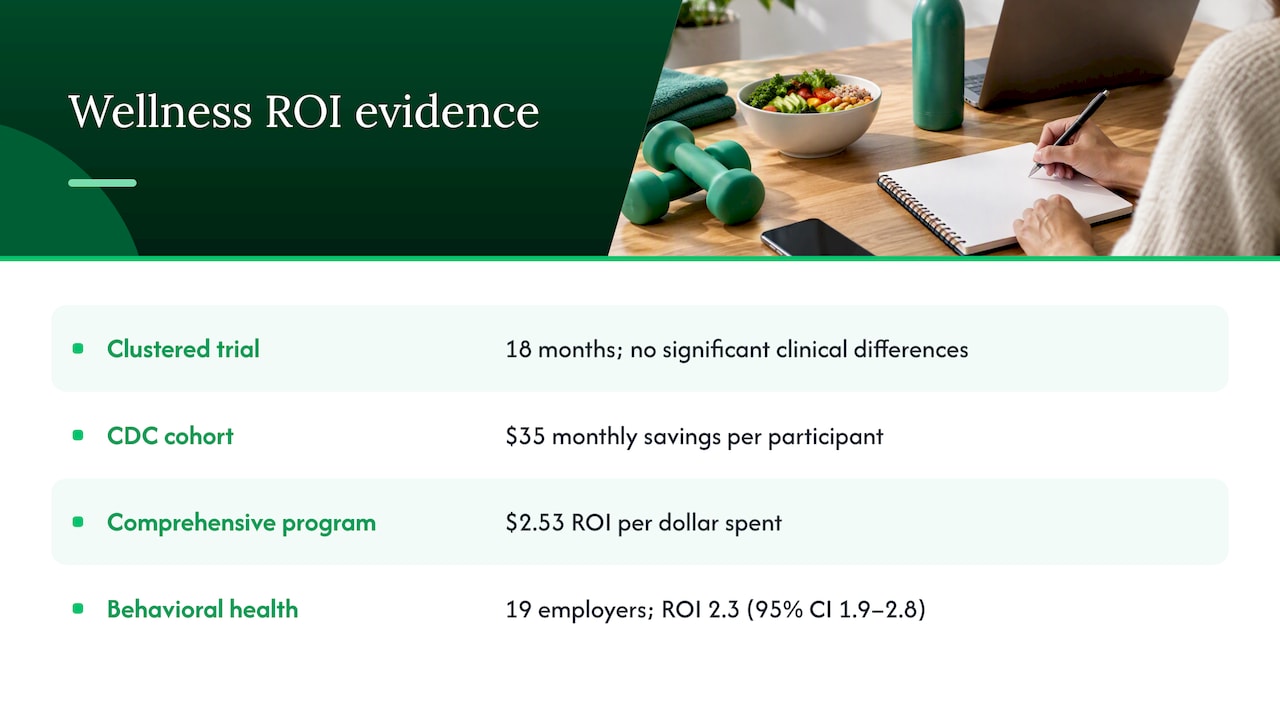
The research is more mixed than vendor brochures suggest. A clustered randomized trial found improved self-reported exercise and weight management behavior, but no significant differences in clinical measures, health care spending or employment outcomes after 18 months. Lifestyle programs change habits first. Medical cost savings, if they come, take longer.
Component mix matters. RAND analysis indicates that disease management can yield higher short-term ROI than lifestyle management, so component mix affects likely financial payoff. A long-term observational cohort analysis from the CDC reported mean monthly health care cost savings of about $35 per participant and an ROI of $2.53 for every dollar spent for a well-established, comprehensive program over multiple years.
A pooled analysis of 19 employers found an ROI multiple of 2.3 for enhanced behavioral health services (95% CI, 1.9–2.8). Targeted clinical support can pay back more reliably than general lifestyle offerings.
The practical takeaway: plan on a multi-year horizon for financial returns, and judge early success by engagement metrics. Our wellness program ROI guide shows how to build that business case.
How to cut wellness spending without killing engagement
Cutting well means protecting what drives participation and trimming what does not. We suggest these moves:
- Prioritize low-cost, evidence-backed elements: a health risk assessment with targeted incentives, focused disease management and virtual challenges.
- Tier your offerings so always-on engagement stays funded while premium services flex with budget.
- Use sponsorship or matching models, where you fund a per-activity or per-mile amount up to a cap, so variable spend stays predictable.
- Automate communications, centralize vendor administration and favor virtual-first delivery.
Pro Tip: Before renewing any feature, check how many employees actually used it last year and cut or replace the ones nobody touched.
RAND’s guidance frames this as balancing essential preventive care against unused flashy features. For structuring capped sponsorships, see our notes on wellness challenge cost.
What does a wellness app with charitable giving actually cost?
An app that converts movement into donations has a different cost structure than a traditional vendor package, and it helps to separate its parts. In our own model, the app is free for individual employees and free for charities, so the employer-side costs sit in a few places.
- Program license or fees: Companies run a private team through our Employee Empowerment program. Pricing is not published; current prices are on our site.
- Sponsorship spend: You choose the rate per mile and the total cap, and you decide whether donations go to each employee’s chosen charity or a company-selected cause. This is the one variable line, and the cap makes it a fixed ceiling in practice.
- Reporting: Team and donation reporting is part of the program, so you are not buying a separate analytics tool.
- Internal time: Launch communications, a team kickoff and periodic updates. This is a real cost even when no invoice shows it.
- Incentives beyond donations: Optional prizes or recognition, which you can skip entirely if the charitable element is motivating enough.
The program is built around movement, not medical delivery. That makes it a complement to a benefits stack, not a replacement for clinical care. Because any movement counts, a lunchtime walk or a bike commute logs miles, which keeps the program inclusive without a separate accessibility budget.
Budgeting examples with charitable sponsorship caps
A worked example shows how a cap controls cost. Say, for illustration only, that you sponsor a set amount per mile with a company-wide cap. You cannot spend past $20,000 on donations, no matter how enthusiastic participation gets, so finance has a firm ceiling from day one. These are illustrative inputs, not pricing from our program.
Real results show why the cap matters. HARMAN’s Charity Miles team saw an increase in employee participation, with employees generating donations for charity. A cap lets an employer enjoy that kind of surge without a surprise invoice.
Here is how the same logic scales across three common setups:
| Setup | Sponsorship design | Spending control |
|---|---|---|
| Small pilot | One private team, short window | Low cap set before launch |
| Department rollout | Several teams, rate per mile | Cap per team |
| Enterprise program | Company-wide challenges | Annual cap with a strategic charity partner |
For more structure on pilot budgets, our guidance on how HR can budget sponsor-funded challenges walks through the approach step by step.
How long until a wellness program shows results?
Expect results in layers. Engagement shows up first, behavior change follows, and financial effects arrive last, if at all within a typical budget cycle.
In the first month, track enrollment and first-time participation. By months two and three, repeat participation tells you whether the program is a habit or a one-time event. Over time, your engagement survey delta and team-level activity trends can give finance something concrete. Medical cost effects belong on a multi-year horizon: the randomized trial found no significant spending differences at 18 months, and survey and screening participation at intervention sites averaged about 36%–45%.
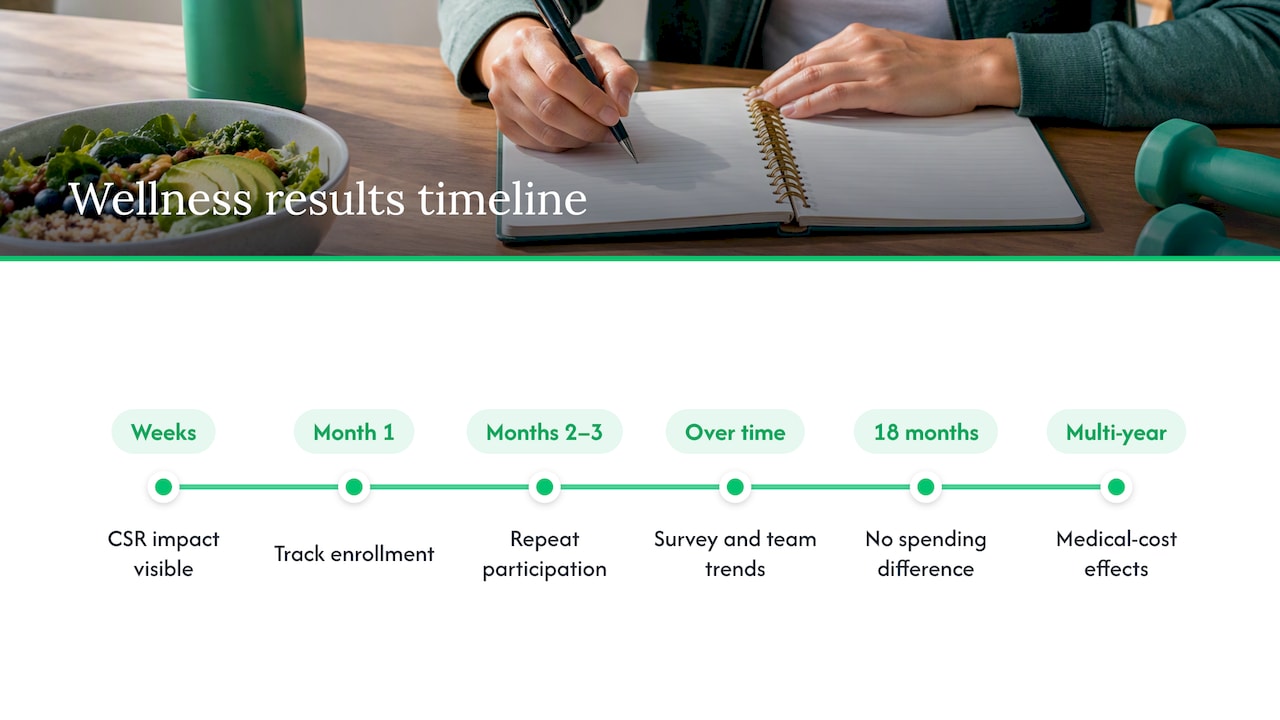
CSR engagement can move faster than clinical outcomes. When employees personally generate donations, the impact is visible in weeks, which gives leadership an early win to point to. We suggest an early checkpoint for participation and a later review for engagement and culture measures. For program formats that tend to sustain participation, see our corporate wellness ideas that boost engagement.
Why a movement and sponsorship model stretches budgets
Most wellness spending fails quietly: you buy features nobody uses. A movement-plus-sponsorship model flips that, because cost follows participation and you set the ceiling. We built our Employee Empowerment program around that idea. You pick the rate per mile and the cap, and spend only grows when employees show up.
A rise in participation and donations can show what engagement-driven value can look like. If finance is your hurdle, we would pilot with a capped sponsorship, a short window and engagement outcomes defined in advance.
— Gene
How Charity Miles fits different budgets and how to get started
Our Employee Empowerment program works at small and large scale: start with a private team and a capped sponsorship, or expand to enterprise sponsorships once you see results. You can read how the mechanics work on our how it works page, then download the app. Before a pricing conversation, have three things ready: your number of employees, your pilot length and the sponsorship cap you are comfortable with. With those, we can scope a program to your budget.
FAQ
How much should employers budget per employee for wellness?
Published vendor ranges vary by scope. Present finance with a low, mid and high range tied to what each tier includes, and start with a pilot.
Do wellness programs actually save money?
It depends on the components. A randomized trial found no significant short-term spending differences, while RAND analysis suggests disease management often returns more than lifestyle programs.
What is the cheapest way to start a wellness program?
Run a short, capped pilot with a private team and virtual challenges. This keeps variable spend predictable and gives you participation data before you commit more budget.
How long before I see results from a wellness program?
Engagement metrics may appear before financial returns, which can take longer to emerge. Track participation and repeat participation first, then add survey and cost measures over time.
Sources
- Effect of a Workplace Wellness Program on Employee Health and Economic Outcomes
- Impacts of Workplace Health Promotion and Wellness
- Rand
- The Impact of Enhanced Behavioral Health Services on Total Healthcare Costs Among US Employers: A Site-Level Analysis of 19 Cohort Studies – PMC
- Cdc