
Entry-level digital wellness platforms typically run about $3 to $5 per employee per month, while full-service programs with coaching and biometric screenings can climb well past $58 to $100 per employee per month. Employers usually cover the full cost, and the return on that spend varies more than most vendors admit. For budget-conscious HR teams, sponsor-funded models offer a no-cost alternative that still drives engagement.
TL;DR:
- Small companies can run effective wellness challenges with minimal costs, often under $5 per employee per month, focusing on participation rather than clinical outcomes.
- Per-participant billing protects budgets during uneven turnout, especially when engagement is unpredictable or expected to fluctuate month to month.
- External sponsorships, like charity mileage challenges, provide a no-cost alternative by setting fixed caps and avoiding traditional platform fees.
- Incentives like gift cards and charitable donations tend to be low-cost and effective, with raffle systems maintaining budget predictability.
- Pilot programs measuring participation, satisfaction, and engagement offer a more realistic return on investment than expecting immediate medical cost savings.
Table of Contents
- Pricing Models and What They Actually Include
- How Company Size and Participation Change the Math
- Cost Drivers and Hidden Line Items to Budget For
- Three Sample Budgets by Company Size
- What the Evidence Says About ROI
- Low-Cost and No-Cost Wellness Challenge Formats
- A Real-World Low-Cost Model in Practice
- Where This Leaves HR Budgeting Decisions
- Charity Miles: How to Launch a Low-Cost, High-Engagement Challenge
- Sources
- FAQ
Pricing Models and What They Actually Include
Wellness vendors price their programs in a handful of ways, and knowing the difference helps you compare quotes that otherwise look nothing alike.
Per-employee-per-month (PEPM) pricing charges you for every eligible employee, whether or not they participate. Per-participant-per-year pricing only bills for people who actually enroll, which rewards low turnout with a smaller invoice but can make budgeting less predictable if participation spikes. Flat fees bundle a challenge, platform access, and reporting into one price regardless of headcount, which tends to suit smaller companies running a single seasonal push.
Basic digital platforms, the kind offering step tracking, leaderboards, and simple challenges generally fall in the $3 to $5 PEPM range. Mid-tier programs that add coaching modules, health assessments, or app integrations push that number higher, and full-service vendors with dedicated account managers, biometric screenings, and clinical support can exceed $58 to $100 PEPM depending on scope.
When you’re comparing vendor quotes, translate everything to the same unit before deciding:
- PEPM to annual cost: multiply by 12 months and by total eligible headcount, not just expected participants.
- Per-participant to PEPM: divide the per-participant annual fee by 12 and multiply by your expected participation rate.
- Flat fee to PEPM: divide the flat fee by headcount and by the number of months the program runs.
Once quotes are in the same unit, ask what’s actually included. A cheap PEPM quote that excludes reporting or incentive funding may end up costing more once you add those pieces back in.
How Company Size and Participation Change the Math
Total spend depends less on your industry and more on two numbers: how many people are eligible and what share of them actually show up. Here’s how that plays out across common organization sizes.
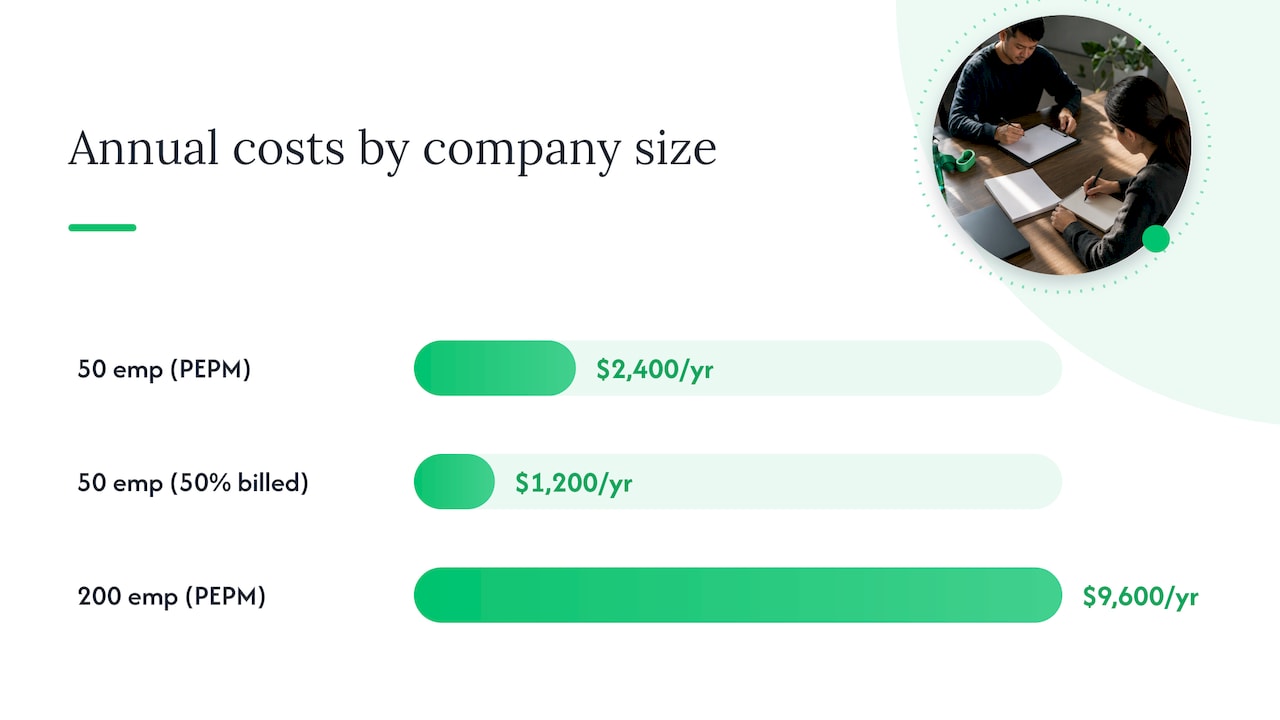
- A 50-employee company running a basic digital challenge at $4 PEPM spends roughly $200 a month, or $2,400 a year, before incentives. If only half the staff participates and the vendor bills per participant instead, the annual cost could drop closer to $1,200.
- A 200-employee company at the same $4 PEPM rate spends about $800 monthly, or $9,600 annually, for platform access alone. Adding a mid-tier coaching module can roughly double that figure depending on how many employees opt in.
- A 1,000-employee company hits PEPM pricing that vendors often discount for volume, so the per-head rate may drop even as the total invoice grows into tens of thousands of dollars annually once coaching, screenings, and account management are included.
Per-participant billing matters most for companies expecting uneven turnout, since it protects you from paying full PEPM rates for employees who never log in. Volume discounts tend to kick in above a few hundred enrolled employees, so it’s worth asking vendors directly rather than assuming the sticker price applies at scale.
Expect real variability month to month. A one-time spring challenge costs less than a program that runs continuously, and a pilot quarter almost always looks cheaper than the ongoing version once it becomes a fixture of your benefits calendar.
Cost Drivers and Hidden Line Items to Budget For
The base platform fee is rarely the whole story. These are the add-ons that most often push a wellness budget past what HR originally planned.
- Coaching and biometric screenings add per-session or per-employee charges on top of platform access.
- Dedicated account management is common in full-service tiers and usually carries its own line item.
- Integrations with wearables, HR systems, or insurance portals can involve setup fees.
- Custom content and branding built specifically for your company costs more than reusing a vendor’s existing challenge templates.
- Hardware, like pedometers or fitness trackers, adds a one-time or recurring cost if you’re not relying on employees’ own phones.
- Live events or kickoff sessions often carry venue, catering, or facilitator fees separate from the software.
Incentive design is its own variable. Industry write-ups commonly describe incentive totals in the low hundreds of dollars per participant across longer, multi-module programs, and the structure you choose (cash, gift cards, or charitable donations) changes the marginal cost per person as participation grows.
Pro Tip: Ask vendors to quote a capped, all-in annual price before you sign, rather than a base rate that leaves incentives, screenings, and support fees as open-ended extras.
Three Sample Budgets by Company Size
These templates translate the pricing models above into numbers you can adapt to your own headcount.
A 50-employee company running a low-cost entry model might budget around $2,400 a year for platform access at $4 PEPM, plus a modest incentive pool.
A 250-employee company stepping up to a mid-tier platform with screening and light coaching might see:
- Platform access at a mid-tier PEPM rate, running several thousand dollars annually.
- A biometric screening add-on billed per participating employee.
- A modest coaching allocation for employees who opt into one-on-one sessions.
- An incentive budget that scales with participation rather than headcount.
High participation (60% or more) meaningfully increases the screening and incentive lines, since those costs scale with actual enrollment rather than total headcount.
A 1,000-employee enterprise budget typically blends a discounted volume PEPM rate with dedicated account management, more generous incentive spending, and reporting built for board-level visibility. Even with a lower per-head rate, the absolute dollar total is the largest of the three, and the swing between low and high participation scenarios is where most budget surprises happen, since incentive and screening costs are the pieces most tied to actual turnout rather than fixed contract terms.
What the Evidence Says About ROI
The honest answer is that wellness programs tend to move behavior before they move medical spending, and HR should plan pilots around the outcomes actually likely to show up in 18 months.
A randomized clinical trial of a multicomponent workplace wellness program found increases in some self-reported healthy behaviors but no detectable differences in clinical health measures or health care spending after 18 months.
A large randomized trial found improved self-reported health behaviors among participants, but no measurable reduction in clinical outcomes or medical costs over that period. That’s a meaningful signal for anyone building a business case on projected health care savings: the evidence supports engagement and behavior gains far more confidently than it supports near-term cost reduction.
Meanwhile, employer investment in preventive benefits keeps rising. SHRM’s 2026 Employee Benefits Survey reports growing employer investment in preventive benefits, giving HR useful context for how peer companies are allocating wellness budgets.
The practical takeaway: treat participation rate, satisfaction, and behavior change as the metrics your pilot should hit. Treat any promised reduction in medical spending as a longer-term hope, not a number to put in this year’s budget justification.
Low-Cost and No-Cost Wellness Challenge Formats
Not every effective challenge needs a paid platform. Several formats keep direct spend near zero while still building real engagement.
- Sponsor-funded charity challenges let the company fund donations tied to employee mileage instead of paying platform licensing fees, shifting cost from software to cause.
- Team step challenges using free or low-cost tracking apps need minimal setup, usually just a spreadsheet or leaderboard someone on the HR team maintains.
- Activity logging with public recognition costs nothing beyond a Slack channel or newsletter shoutout, and works well for smaller teams.
- Low-cost prize structures, like a modest gift card raffle instead of per-person incentives, keep variable costs predictable regardless of turnout.
Admin time for these formats runs light, often a few hours a week to manage a leaderboard and send updates. They tend to outperform paid platforms specifically for companies that want visible participation without procurement cycles, and they make the most sense when the goal is culture and morale rather than clinical outcomes a full-service vendor is built to track.
A Real-World Low-Cost Model in Practice
One sponsor-funded approach available through an employee empowerment program lets companies create private teams, run internal challenges, and choose whether to sponsor employee miles. Since launching its Charity Miles team in 2021, HARMAN saw an 11x increase in employee participation, with more than 1,200 employees generating over $120,000 for charity.
Sponsorship pricing works differently from PEPM licensing. Instead of paying a flat platform fee, the company sets:
- A per-mile sponsor rate it’s willing to fund.
- A total sponsorship cap to keep spend predictable regardless of participation surges.
- A choice between directing donations to employees’ chosen charities or a company-selected cause, with reporting on miles logged and funds generated.
That structure lets HR budget a sponsorship pool the same way it might budget an incentive fund, with a hard ceiling instead of an open-ended per-employee bill. Charity Miles also publishes walking challenge themes and launch resources HR teams can reuse instead of building challenge content from scratch.
Where This Leaves HR Budgeting Decisions
We’d push back on treating wellness challenge cost as the main variable worth optimizing. The evidence points toward participation and behavior change as the realistic near-term win, not medical cost savings, so a smaller, well-run pilot beats an expensive program built to chase a return it may not deliver in year one.
Run a 3 to 6 month pilot with capped incentives and three KPIs: participation rate, employee satisfaction (a simple net promoter score works), and program cost per engaged employee, not per eligible one. Before signing anything, get a written, all-in quote covering setup, incentives, and support so nothing shows up as a surprise line item later.
— Gene
Charity Miles: How to Launch a Low-Cost, High-Engagement Challenge
This structure lets a company set employee teams, sponsorship terms, and reporting to achieve engagement without a PEPM invoice. The company can choose the sponsorship rate, set a spending cap, and decide how donations flow, with tracking suitable for HR reporting.
- Explore the Employee Empowerment program to see how sponsorship budgets replace platform fees.
- Review corporate sponsorship opportunities if you want to direct funding toward a specific cause.
- Check out how the app works before rolling it out to your teams.
If your company needs clinical screenings, dedicated coaching staff, or deep integration with an existing benefits platform, a full-service vendor is still the right call. But for HR teams that want visible participation, a CSR story employees actually talk about, and a budget with a hard ceiling, this is a route worth comparing before you sign a platform contract.
Sources
- Effect of a Workplace Wellness Program on Employee Health and Economic Outcomes
- SHRM Employee Benefits 2026 executive summary
FAQ
How much does a wellness program cost?
Basic digital platforms typically run $3 to $5 per employee per month, while full-service programs with coaching and screenings can exceed $58 to $100 per employee per month. Total annual cost depends heavily on participation rate and which add-ons, like biometric screenings or account management, you include.
What are some good prizes for a wellness challenge?
Gift cards, extra paid time off, and charitable donations made in an employee’s name all work well as low-cost incentives. A raffle-style prize structure often costs less overall than paying every participant individually while still driving strong turnout.
Does insurance pay for wellness programs?
Some group health plans offer premium credits or incentives tied to participation in employer wellness programs, but coverage varies by plan and insurer. Check directly with your carrier or benefits broker, since there’s no universal rule guaranteeing reimbursement.
What are some ideas for a 30-day wellness challenge?
Simple formats include a team step challenge, a daily activity log with public recognition, or a sponsor-funded mileage challenge where the company donates based on miles logged. Keeping the format inclusive of walking, biking, and other everyday movement tends to drive higher participation than challenges limited to intense workouts.