
What are wellness incentives, and why do they work?
Wellness incentives are tangible or intangible rewards given to employees for engaging in activities that improve their health and well-being. Think premium discounts, gift cards, fitness reimbursements, and public recognition. They work because they give people a concrete reason to act on intentions they already have but keep postponing.
The regulatory framework matters here. In the US, wellness incentive programs must comply with HIPAA, the ADA, and GINA. These laws protect employees from discrimination based on health status or genetic information, and they set limits on how much of a premium discount employers can tie to health outcomes. Under the Affordable Care Act, outcome-based incentives can reach up to 30% of the cost of coverage, and up to 50% for tobacco-related programs.
Platforms like Wellable and Wellness Workdays have built entire businesses around helping employers design and administer these programs. Both illustrate how the market has matured: employers no longer need to build incentive infrastructure from scratch.
Key forms wellness incentives take:
- Premium discounts or surcharges tied to participation or health outcomes
- Gift cards and merchandise rewards for completing activities
- Fitness membership reimbursements or subsidies
- Health savings account (HSA) or health incentive account (HIA) contributions
- Recognition programs, extra paid time off, and experiential rewards
What types of wellness incentives can employers offer?
The industry broadly organizes health incentive programs into three categories: participation-based, outcome-based, and hybrid.
Participation-based incentives reward employees simply for showing up. Completing a health risk assessment, attending a webinar, or logging a biometric screening earns a reward regardless of the result. These are easier to administer and carry lower legal risk under ADA and GINA because they do not penalize anyone for a health condition they cannot control.

Outcome-based incentives tie rewards to hitting specific health targets, such as a blood pressure reading, BMI range, or tobacco-free status. They tend to generate stronger behavior change signals but require careful design to avoid disadvantaging vulnerable groups. Federal regulations require employers to offer a reasonable alternative standard when a medical condition makes the standard unreasonably difficult to meet.
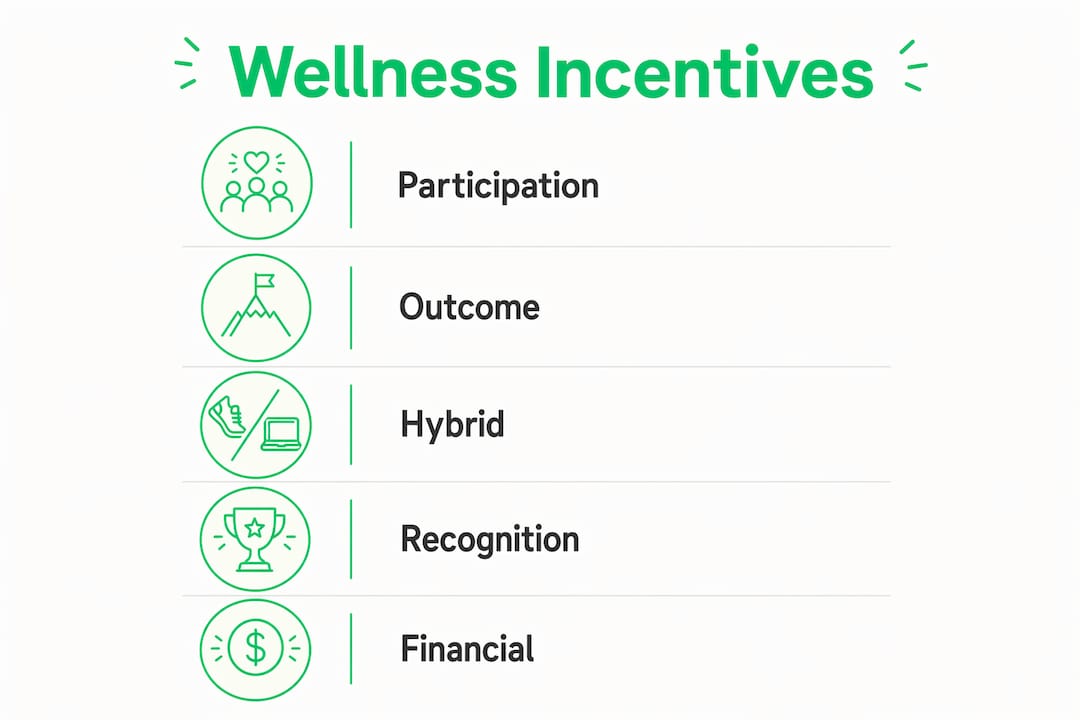
Hybrid programs blend both approaches, often using a points system where participation earns baseline rewards and hitting health milestones unlocks additional tiers.
Breaking down reward types further:
- Monetary rewards: cash bonuses, premium discounts, HSA contributions, debit card credits
- Non-monetary rewards: gift cards, branded merchandise, extra vacation days
- Experiential rewards: wellness retreats, fitness classes, team events
- Cumulative rewards: points programs where employees build toward milestone payouts over weeks or months
How do wellness incentive programs actually work?
Most programs follow a predictable operational arc, though the details vary by employer size and platform.
- Enrollment: Employees register through a portal, often managed by a third-party platform like Personify Health, which powers programs for UVA and Arizona’s state employees.
- Activity tracking: Employees log qualifying activities, from biometric screenings to daily step goals, either manually or through connected devices.
- Points or credit accumulation: Completed activities generate points or direct dollar credits toward a reward threshold.
- Reward payout: Rewards are distributed as paycheck additions, debit card credits, or HSA contributions, typically quarterly or annually.
- Reporting and optimization: Administrators review participation data to adjust program design for the following year.
Technology platforms are what make this manageable at scale. Without automated tracking and reporting, the administrative burden alone would deter most HR teams from running a meaningful program.
Leadership involvement is the factor most often underestimated. When executives and managers visibly participate, participation rates across the organization tend to follow. A wellness program that lives only in an HR portal rarely builds the cultural momentum that sustains engagement year over year.
Pro Tip: Plan for a 3–5 year evaluation window before drawing conclusions about ROI. Programs that look flat in year one often show meaningful health cost reductions and engagement gains by year three, once behavior change has had time to compound.
Real-world examples of wellness incentive programs
Concrete program designs give HR leaders the clearest picture of what is possible.
- UnitedHealthcare Rewards: Employees can earn up to $1,000 per year for completing annual checkups, biometric screenings, and daily step goals.
- UVA’s Hoos Well: Faculty and staff enrolled in qualifying health plans earn up to $500 annually for activities including health assessments, flu shots, coaching sessions, and monthly physical activity challenges.
- Arizona’s Health Impact Program: State employees earn a $200 annual incentive by accumulating 50,000 points through screenings, classes, and wellness activities across the calendar year.
- Charitymiles: Employees walk, run, or bike, and the app converts their miles into charitable donations. Companies sponsor miles at a rate they choose, directing funds to causes that align with their values or letting employees pick their own charities.
- Wellable: Offers gamified wellness challenges with points, leaderboards, and rewards that can be redeemed for gift cards or merchandise.
- Wellness Workdays: Focuses on measurable outcomes in mental health, nutrition, and healthcare cost reduction, with program design built around employer-specific health data.
What separates the programs employees actually use from the ones that gather dust? Simplicity and perceived value. Wellness rewards programs that require employees to jump through multiple administrative steps before seeing any benefit tend to plateau quickly. Programs where the first reward feels achievable within the first month sustain participation far longer.
Charitymiles saw HARMAN achieve an 11x participation increase after launching its Employee Empowerment Program in 2021, with 1,200+ employees generating over $120,000 for charity.
Best practices for designing effective wellness incentive programs
Good program design is where most employers leave value on the table. A few principles separate programs that move the needle from those that generate a spike in enrollment and then fade.
Design for equity, not just averages. Research on the “5 Groups Problem” shows that wellness incentives risk primarily benefiting employees who are already healthy, while employees with chronic conditions or lower health literacy gain less. Offering alternative pathways to earn rewards, not just a single standard, addresses this gap directly.
Make leadership participation visible. When senior leaders share their own wellness activity publicly, it signals that the program is part of the culture rather than an HR checkbox. Visible leadership engagement is one of the strongest predictors of broad employee participation.
Keep compliance front of mind. ADA, HIPAA, and GINA compliance is not optional. Outcome-based programs in particular need a documented reasonable alternative standard for employees who cannot meet a health target due to a medical condition.
Measure over time, not in snapshots. As noted earlier, a 3–5 year evaluation window gives you a stable read on ROI. Year-one data reflects novelty effects as much as genuine behavior change.
Additional practices worth building into your program design:
- Offer inclusive activity options that work for all fitness levels, not just athletes
- Communicate reward opportunities clearly and repeatedly, not just at open enrollment
- Use a mix of individual and team-based challenges to build social accountability
- Audit participation data annually to spot groups that are consistently underrepresented
How Charitymiles turns movement into meaningful engagement
Charitymiles sits at an interesting intersection: it is a corporate wellness program and a CSR platform at the same time. Employees walk, run, or bike, and every mile generates a charitable donation to a cause they care about. The company controls the sponsorship rate and cap; employees control which charity receives the funds.
What makes this model work for sustained engagement is that it removes the performance barrier. Any movement counts, whether that is a lunchtime walk, a bike commute, or a weekend hike. Employees at every fitness level participate on equal footing, which addresses one of the core equity problems in traditional incentive design.
The HARMAN result tells the story clearly: an 11x increase in participation and over $120,000 raised for charity since 2021. That kind of outcome comes from combining three things that most programs treat separately: physical activity, team competition through challenges, and a sense of purpose tied to charitable giving.
Key features of the Charitymiles Employee Empowerment Program:
- Private company teams with configurable sponsorship terms
- Intra-company challenges with leaderboards and friendly competition
- GPS and pedometer tracking for walking, running, and biking
- Reporting tools so HR can measure participation and charitable impact
- No cost to individual employees
If you are evaluating employee engagement platforms and want a program that combines wellness, team-building, and CSR in one place, Charitymiles is worth a close look. The platform has been running since 2012 and has generated tens of millions of dollars for charity through everyday employee movement.
Key Takeaways
Effective wellness incentives combine equitable design, visible leadership, legal compliance, and a long evaluation horizon to drive lasting behavior change.
| Point | Details |
|---|---|
| Incentive types matter | Participation-based programs carry lower legal risk; outcome-based programs require alternative standards for employees with medical conditions. |
| Real reward levels | Programs like UnitedHealthcare Rewards offer up to $1,000 per year; UVA’s Hoos Well offers up to $500 annually. |
| Equity by design | Wellness incentives risk benefiting already-healthy employees; alternative pathways and inclusive activity options close that gap. |
| ROI takes time | Allow 3–5 years to accurately measure program impact before making structural changes. |
| Charitymiles proof point | HARMAN saw an 11x participation increase and raised over $120,000 for charity through the Charitymiles Employee Empowerment Program. |