
Gamification can increase engagement and shift behavior when its mechanics satisfy fundamental psychological needs and get woven into the real experience, not bolted on as a superficial layer. Systematic reviews and meta-analyses consistently show short-term engagement gains, with longer-term results depending heavily on design. The mechanics alone do not drive outcomes. The psychology behind them does.
TL;DR:
- Public leaderboards can motivate top performers but discourage people near the bottom; pair rankings with team goals or percentile bands to protect inclusion.
- A 2017 review found the strongest engagement effects in brief studies, while results weakened over time; measure retention across challenge cycles, not just initial participation.
- Build around autonomy, competence, and relatedness: use meaningful rewards, progressive challenges, and social features, rather than points or badges without a clear purpose.
- For programs using personal or health data, offer genuine opt in, collect only necessary information, explain access, and monitor stress as well as participation.
Table of Contents
- The psychology and neuroscience behind gamification
- What game elements actually do to motivation
- What the research says about gamification’s real effects
- Design principles that make gamification stick
- How gamification plays out across the workplace, learning, and marketing
- The ethical line between motivation and manipulation
- A real-world case: gamification and inclusive movement at Charity Miles
- What practitioners and researchers should prioritize next
- How we help HR and CSR teams put this into practice
- FAQ
- Sources
The psychology and neuroscience behind gamification
Gamification psychology starts with a simple question: what makes people want to keep going? Self-Determination Theory, developed by psychologists Edward Deci and Richard Ryan, points to three needs that drive intrinsic motivation: autonomy (feeling in control of your choices), competence (feeling capable and improving), and relatedness (feeling connected to others). When a gamified system satisfies these needs, people engage because the activity feels worthwhile on its own, not because they are chasing a prize.
This is where the distinction between intrinsic and extrinsic motivation matters. Extrinsic rewards like points and badges can support engagement when they reinforce a sense of progress or mastery. They can also undermine it. A badge that feels like a genuine marker of skill builds competence. A badge that feels like a bribe for compliance can crowd out the internal motivation that was already there, a well-documented risk in motivation research.
Underneath these psychological needs sits a layer of basic neuroscience. Dopamine functions less as a pleasure signal and more as a reward-prediction mechanism: it fires when an outcome is better than expected, which is why unpredictable or variable rewards tend to hold attention longer than fixed ones. Feedback loops that include an element of surprise keep the brain engaged, and well-paced challenge-skill balance is what produces the state researchers call flow, that absorbed, time-distorting focus people report during a satisfying game or workout.
A few mechanics map directly onto these ideas:
- Progress bars build a visible sense of competence by showing movement toward a goal.
- Leaderboards tap relatedness and social comparison, for better or worse depending on who sees them.
- Unlockable levels combine competence and autonomy by letting people choose their own pace toward mastery.
Design choices that ignore this underlying psychology tend to produce short bursts of novelty rather than durable behavior change.
What game elements actually do to motivation
Every gamification element carries a specific psychological signal, and that signal determines whether it helps or backfires.
- Points signal progress and feed competence, but on their own carry little meaning.
- Badges mark achievement and status, supporting competence and sometimes relatedness when shared socially.
- Leaderboards trigger social comparison and can boost short-term motivation, though they often discourage people who land near the bottom.
- Progress bars make incremental effort visible, directly reinforcing competence.
- Levels structure a sense of mastery over time and support autonomy by letting users progress at their own speed.
- Challenges create short-term goals that organize effort and attention.
- Narratives give mechanics meaning by connecting them to a story or purpose larger than the task itself.
- Social features (teams, shared goals, comments) support relatedness, the need most consistently linked to higher engagement in reviews of gamified programs.
The most common failure mode is the public leaderboard that ranks everyone by raw output. It works well for people near the top and demotivates nearly everyone else, an effect noted repeatedly in reviews of gamified engagement, including a PLOS One systematic review that found leaderboards and competition often increase short-term engagement but can reduce perceived competence and inclusion when they are not designed with tiering or relative benchmarks.
Pro Tip: Pair any competitive element (leaderboards, rankings) with a cooperative or tiered one (team totals, percentile bands) so people compete against their own baseline, not just everyone else’s.
What the research says about gamification’s real effects
The evidence base on gamification has matured past isolated case studies into systematic reviews and meta-analyses across education, marketing, and workplace settings, and the pattern that emerges is consistent: gamification works, but its effects vary by context, design quality, and time horizon.
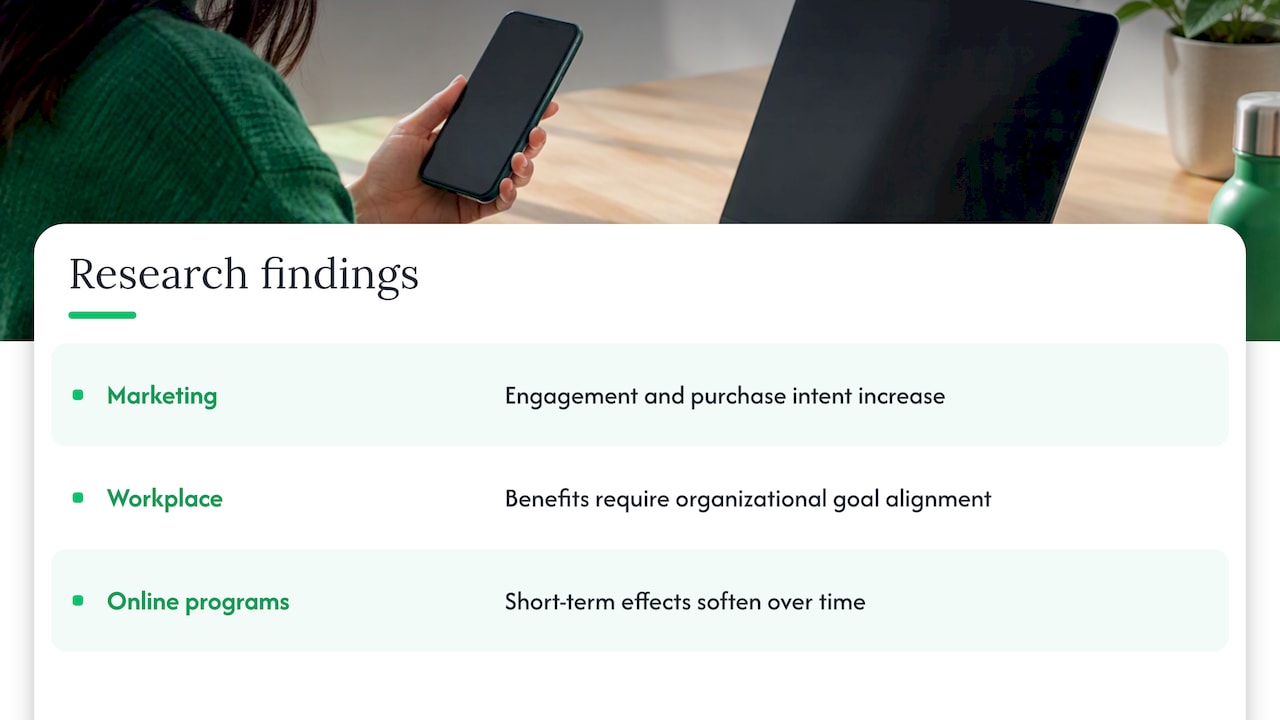
A hybrid systematic review of 119 marketing articles published between 2010 and 2024 found that gamification reliably increases engagement and purchase intent, but effectiveness depends on the form it takes. Leaderboards can lift short-term motivation, while context-sensitive affordances, elements tailored to the specific audience and goal, are what sustain intent over time. The review’s authors explicitly recommend moving beyond the standard points-badges-leaderboards toolkit toward mechanics suited to the specific behavior being targeted.
In workplace settings, a systematic review of organizational gamification research found that well-designed programs integrated into company culture can meaningfully improve employee wellbeing, engagement, and performance, but only when the mechanics align with organizational goals rather than functioning as a standalone novelty.
One 2017 systematic review of gamified online programs found that gamification reliably increases engagement, with the strongest effects appearing in short-term studies and more mixed results over longer periods. This PLOS One review is a useful anchor for setting expectations: medium effect sizes show up often in short-term engagement metrics, but the strength of those effects tends to soften the longer a program runs.
That pattern reflects something researchers call the novelty effect: many gamified systems produce an initial spike in engagement that fades over months as the new mechanic becomes routine, a decline noted across longitudinal and review literature that recommends designing for intrinsic motivation and sustained value rather than relying on the novelty of game mechanics themselves. Programs that survive the novelty curve tend to be the ones that tie mechanics to goals people already care about, rather than treating the game layer as the entire point.
Design principles that make gamification stick
Most gamification programs that fail do so for the same reason: mechanics were chosen for how they look rather than what they do psychologically. A short list of design principles, grounded in the evidence above, separates programs that sustain motivation from ones that produce a brief spike and then flatten out.
- Align mechanics to a real goal. Every point, badge, or challenge should map to a behavior the organization actually wants, not to engagement for its own sake.
- Target all three SDT needs, not just one. A program heavy on competence (progress bars, levels) but light on relatedness (teams, shared recognition) will underperform a balanced design.
- Scaffold difficulty. Challenges that start easy and increase gradually keep people in the flow zone instead of overwhelming beginners or boring advanced users.
- Make rewards meaningful, not just plentiful. A badge tied to a visible, real-world outcome carries more weight than an arbitrary point total.
- Design for social inclusivity. Team-based or percentile-based structures let people at every skill level feel progress, instead of only rewarding the top performers.
- Keep the system transparent. People should understand how points are earned and what they lead to; opaque scoring breeds suspicion rather than motivation.
Tactically, this plays out as progressive challenges that unlock as skill builds, adaptive difficulty that adjusts to individual pace, narrative framing that gives the activity a story worth finishing, and micro-goals with fast feedback loops so progress is visible daily, not just at the end of a quarter.
Measuring success means looking past raw participation numbers. Retention over multiple cycles, downstream behavior change (did people actually walk more, learn more, buy more), and wellbeing indicators like reported stress or burnout all matter more than a single engagement spike in week one.
Pro Tip: Before adding a new mechanic, ask what specific psychological need it is meant to satisfy. If you cannot name one, the mechanic is probably decoration, not design.
For workplace teams specifically, practical formats for leaderboards and team structures are covered in our challenge leaderboard ideas, which translate these principles into ready-to-run formats.
How gamification plays out across the workplace, learning, and marketing
The same psychological principles produce different results depending on where they are applied, because the underlying goal, and the audience’s relationship to it, changes.
In the workplace, gamification shows up most often in employee wellness and CSR-linked movement challenges. Success looks like sustained participation across a quarter, not just a strong first week, and the KPIs that matter include active participation rate, retention across challenge cycles, and measurable downstream outcomes like reduced sick days or higher engagement survey scores. Team-based goals tend to outperform individual leaderboards here because they tap relatedness, a need that matters more in a workplace than almost any mechanic.
In learning and development, gamification works best when it is wired into formative feedback rather than final grades. Mastery paths that let learners retry and improve, paired with visible progress tracking, support competence directly. The relevant metrics are not just completion rates but learning outcomes: did comprehension or skill actually improve, and did the gains persist after the gamified layer was removed.
In marketing and consumer experiences, loyalty mechanics and immersive brand experiences aim at a different target: purchase intent and brand affinity. The hybrid marketing systematic review cited earlier found that gamification does increase purchase intent, but the gap between intent and actual purchase behavior is where many programs quietly underperform. Points-based loyalty programs are common because they are easy to build, but they rarely move behavior as much as mechanics tailored to a specific customer journey.
A single mechanic can succeed in one domain and fail in another:
- Public leaderboards motivate competitive sales teams but demoralize beginner learners in a training course.
- Streak counters build healthy habit loops in fitness apps but can create unhealthy pressure in workplace wellness programs if missing a day feels like failure.
- Badges work well as status markers in community-driven apps but feel hollow in marketing contexts with no social visibility.
Context, not the mechanic itself, decides whether gamification builds motivation or erodes it.
The ethical line between motivation and manipulation
Gamification that uses personal data to personalize challenges and rewards raises real ethical questions, and practitioners who skip past them risk the same backlash that erodes trust in any data-driven system.
The core concern researchers describe is a loss of what some call data mastery, the idea that people should retain meaningful control over information collected about them, even when that data is used to make an experience more engaging. An analysis of ethical issues in data-driven gamification found that designers can unintentionally manipulate behavior and create privacy risks, and called for clearer ethical frameworks across environments including workplace and healthcare settings.
The most common risks include:
- Manipulation, where mechanics exploit psychological triggers rather than support genuine motivation.
- Coercion, where participation feels mandatory due to social or managerial pressure.
- Social pressure, where public metrics shame people rather than encourage them.
- Privacy exposure, where activity or health data is collected without clear consent or purpose.
Practical safeguards drawn from that same ethics analysis include minimizing data collection to what the program actually needs, building genuine opt-in choices rather than default enrollment, making the benefit-sharing arrangement clear (who sees the data, who benefits from it), and monitoring for adverse effects like stress or disengagement rather than only tracking participation. Any program using sensitive health or location data should involve legal review before launch, since data-protection rules vary by jurisdiction and by the type of information collected.
A real-world case: gamification and inclusive movement at Charity Miles
Our Employee Empowerment Program offers a useful real-world illustration of the design principles above in practice. The underlying Charity Miles app tracks walking, running, and biking via GPS and pedometer, and converts logged miles into charitable donations, free for members and free for charities. Companies can create private teams, run challenges, and configure sponsorship terms (rate per mile, total cap, and which charity receives funds).
The design maps directly onto Self-Determination Theory. Autonomy comes from choosing your own activity and charity. Competence builds through visible mile tracking and team progress. Relatedness comes from team-based challenges and shared purpose around a cause employees actually care about. Because any movement counts, not just structured workouts, the program avoids the exclusivity problem that undermines many fitness-based leaderboards.
Since launching its Charity Miles team in 2021, HARMAN reported an increase in employee participation, with many employees generating donations for charity. We report this as a client-supplied program result rather than an independent study, and it illustrates how pairing inclusive mechanics with a meaningful cause can move participation well beyond what a typical step challenge achieves.
HR teams considering a similar approach can follow a short checklist:
- Confirm sponsorship terms (rate, cap, charity selection) before launch.
- Set a team structure that includes every fitness level, not just frequent exercisers.
- Track participation rate, retention across challenge cycles, and total miles or dollars generated.
- Communicate the CSR link clearly so employees see where their effort goes.
Our gamification for employee engagement guide and launch checklist walk through the same steps in more operational detail.
What practitioners and researchers should prioritize next
Having spent this article connecting theory to practice, the clearest gap left is between short pilots and long-term evidence. Most organizations can run a four-week challenge and see a bump in activity. Far fewer track what happens six months later, which is exactly the window where the novelty effect either fades into habit or disappears entirely.
Our view: treat every gamification rollout as a small experiment, not a finished product. Ground the pilot in Self-Determination Theory from day one, measure retention and wellbeing alongside participation, and design for inclusion so the program lifts people who are not already the most competitive or athletic in the room. Teams that share their results, even informally, help the whole field move past points-badges-leaderboards defaults toward mechanics that actually fit the behavior they are trying to change. Start small, measure honestly, and let the data decide what to scale.
— Gene
How we help HR and CSR teams put this into practice
We built our Employee Empowerment Program around the same principle this article has walked through: gamification works when it is inclusive, meaningful, and tied to something employees already value. Because the underlying Charity Miles app counts any movement toward a donation, participation is not limited to your most athletic employees, and because companies control sponsorship terms through our Corporate Sponsorship Opportunities, every program can be configured to fit your budget and your chosen causes.

If your team is ready to design a challenge that reflects the evidence-based principles in this article, our Employee Empowerment program page walks through how private team challenges, flexible sponsorship, and CSR reporting work together. Reach out to request a demo and see how a pilot challenge could look for your organization.
FAQ
What are the four types of gamification?
Definitions vary across sources, but a common framework groups mechanics by the psychological need they target: achievement-based (points, badges, levels), competition-based (leaderboards, challenges), social-based (teams, shared goals), and immersion-based (narrative, progress storylines). Effective programs usually combine more than one type rather than relying on a single category.
What personality traits do gamers have?
Research on player types suggests that engagement with game mechanics varies by what drives a person, such as a preference for achievement, competition, social connection, or exploration, rather than a fixed personality profile. Gamification programs tend to perform better when they offer multiple mechanics so people with different motivational preferences can each find something that resonates.
What is gamification for ADHD?
Gamification techniques like clear progress tracking, immediate feedback, and broken-down micro-goals can support attention and task completion for people with ADHD by making progress visible and rewarding smaller steps along the way. This is an application of general motivation psychology rather than a distinct clinical treatment, so specific use for ADHD support should involve a qualified professional.
What is Piaget’s game-based learning theory?
Jean Piaget’s work on cognitive development emphasized that play and games support learning by letting children actively construct understanding through exploration and problem-solving rather than passive instruction. Modern gamification in education draws loosely on this idea by building feedback and progression into learning tasks, though Piaget’s original theory predates digital gamification by decades.
Does gamification actually improve learning outcomes?
Gamification can improve engagement and participation in learning environments, and reviews point to benefits for perceived autonomy and relatedness in educational settings, though effects on deeper measures like perceived competence tend to be smaller and more mixed. The design of the mechanic, especially whether it supports mastery and feedback rather than just competition, matters more than whether gamification is used at all.
Sources
- What Do We Know About Gamification in Marketing? A Hybrid Systematic Review
- Are gamification strategies effective in increasing engagement in online programs? (PLOS One, 2017)
- Systematic review reporting gamification benefits in workplace contexts
- Ethical issues in data-driven gamification (conference paper)