
The fastest way to raise employee participation in CSR is to combine authentic employee input with low-friction mechanics like mobile tracking, paid volunteer time off, and team challenges. Employees who participate in employer-sponsored volunteer programs report higher job satisfaction than those who don’t. These exact mechanics are applied through an Employee Empowerment Program, and the results back up the theory.
TL;DR:
- Asking employees about causes they care about and simplifying sign-up processes significantly increases their participation in CSR initiatives.
- Providing micro-actions and flexible participation options ensures ongoing engagement and helps scale CSR efforts from pilot to wider implementation.
- Clear roles, fixed budgets, and identifying key KPIs are essential for maintaining CSR programs beyond the initial launch phase.
- Authentic leadership involvement and transparent impact reporting are critical to build trust and sustain employee participation.
- Using platforms like Charity Miles enables personalized, measurable, and socially engaging participation that has proven to dramatically boost employee volunteer activity.
Table of Contents
- Top Tactics to Increase Employee Participation in CSR
- How Do You Design a CSR Program That Scales Past the Pilot?
- What CSR Activities Can Employees Actually Join?
- How Should You Measure and Report CSR Participation?
- Common Barriers to CSR Participation and How to Fix Them
- Charity Miles in Practice: The HARMAN Case Study
- How Do You Run a 6-Week CSR Participation Pilot?
- Author Perspective: Three Priorities HR Should Act on Now
- Why Charity Miles Fits This Playbook
- Sources
Top Tactics to Increase Employee Participation in CSR
Most CSR programs fail for a boring reason: nobody asked employees what they actually wanted to work on. You can fix that in four moves, and you don’t need a new budget line to start.
- Survey before you launch. Ask employees which causes matter to them and what format fits their schedule (a lunchtime walk beats a Saturday build day for most working parents).
- Cut the friction. Adopt mobile tracking and one-click sign-up, and put a clear VTO policy in writing so nobody has to ask permission twice.
- Add team mechanics. Team challenges, matched giving, and public recognition turn a solo good deed into shared momentum.
- Report back often. Show the miles, hours, and dollars generated, not just once a year but on a rolling basis.
Statistic Callout: In a global study, employees who took part in employer-sponsored volunteer programs reported 71% job satisfaction, versus 56% among non-participants. That 15-point gap is bigger than most engagement initiatives ever move the needle.
Authenticity does more work than incentives here. Research from Frontiers in Psychology found CSR boosts engagement mainly when it lets employees bring their whole selves to work, not when it’s a mandated checkbox. Build the menu around what your people already care about, and participation follows.
How Do You Design a CSR Program That Scales Past the Pilot?
Most CSR pilots die at month four, not because employees lost interest, but because nobody defined who owns what once the novelty wears off. Scaling requires a few governance decisions made early.
- Assign clear roles: an executive sponsor for visibility, a program manager for logistics, and employee ambassadors who carry peer credibility.
- Set time and budget rules upfront: a fixed VTO allowance (Salesforce, for example, offers 56 hours of paid VTO annually and sees strong utilization) or a per-mile or per-hour sponsorship rate you can defend to finance.
- Map multiple participation pathways: one-day events, five-minute micro-actions, and skills-based volunteering so every employee has an entry point.
- Pick KPIs both leaders and staff care about: participation rate, repeat rate, hours or dollars generated, and satisfaction change.
- Wire CSR into onboarding and recognition cycles so it’s not a separate program employees have to remember exists.
Practitioner guidance from the Boston College Center for Corporate Citizenship frames this as building a participation architecture rather than issuing a mandate: easy logging, quick feedback loops, and visible recognition sustain behavior long after the launch email stops getting opened.
Pro Tip: Anchor your VTO hours to an existing calendar event, like the first Friday of each quarter, instead of leaving the timing open. Anchoring a new habit to something that already exists on the calendar removes the “when should I do this” hesitation that kills participation.
What CSR Activities Can Employees Actually Join?
The best programs offer a ladder of commitment, not a single event. Employees self-select based on how much time and energy they have that month.
- Micro-volunteering and one-off VTO days: a two-hour park cleanup or a single paid day off for service.
- Recurring team volunteer opportunities and skills-based projects: a marketing team building a nonprofit’s social presence, a finance team doing pro bono budgeting.
- Charity fitness and move challenges: walking, running, or biking miles that convert into donations, blending corporate wellness with giving in one activity.
- Matched giving, dollars-for-doers, and employee-directed donations: the company matches what staff give or donate per volunteer hour logged.
The PHINEO corporate volunteering guidebook notes that these formats generate mutual benefit only when paired with clear objectives and real impact measurement, not just good intentions. Explore more corporate volunteering ideas built around this same ladder structure.
How Should You Measure and Report CSR Participation?
Five metrics tell you almost everything: participation rate, repeat participation, total hours or dollars generated, VTO usage, and the change in employee satisfaction scores after launch. Repeat participation matters more than raw sign-ups. It’s the number that tells you whether people came back voluntarily.
Collecting this data doesn’t require a new system. A volunteer-tracking app, a two-question post-event survey, and a quarterly HRIS export for VTO usage cover most of it.
- Monthly dashboards for the program team.
- One quarterly impact story for leadership and all-hands meetings.
Statistic Callout: Job satisfaction runs 15 points higher among employees who participate in employer-sponsored volunteer programs, which makes participation rate one of the few CSR metrics with a direct line to retention.
Common Barriers to CSR Participation and How to Fix Them
Every stalled program traces back to one of four blockers, and each has a cheap fix.
- Lack of time → Offer VTO and micro-actions employees can complete in under 15 minutes.
- Low perceived relevance → Let employees vote on causes instead of assigning one from the top.
- Administrative friction → Replace paper sign-up sheets with mobile-friendly tracking.
- Authenticity concerns → Have leadership participate visibly and publish impact numbers, good or modest.
Authenticity concerns deserve extra attention. Building genuine trust with any audience, internal or external, comes down to consistent action over polished messaging. Employees notice the gap between a CSR email and an executive who never shows up to an event.
Charity Miles in Practice: The HARMAN Case Study
HARMAN’s experience with Charity Miles shows what happens when the mechanics above actually get implemented together, not piecemeal. Since launching its Charity Miles team in 2021, the company saw an 11x increase in employee participation, with more than 1,200 employees generating over $120,000 for charity.
The jump wasn’t driven by a single incentive. It came from stacking inclusive movement challenges, employer sponsorship controls, team-based competition that made participation social, and transparent reporting showing employees exactly where their effort went.
Statistic Callout: A large increase in participation and a substantial amount of funds raised by many employees is the kind of result that can turn a CSR pilot into a permanent budget item.
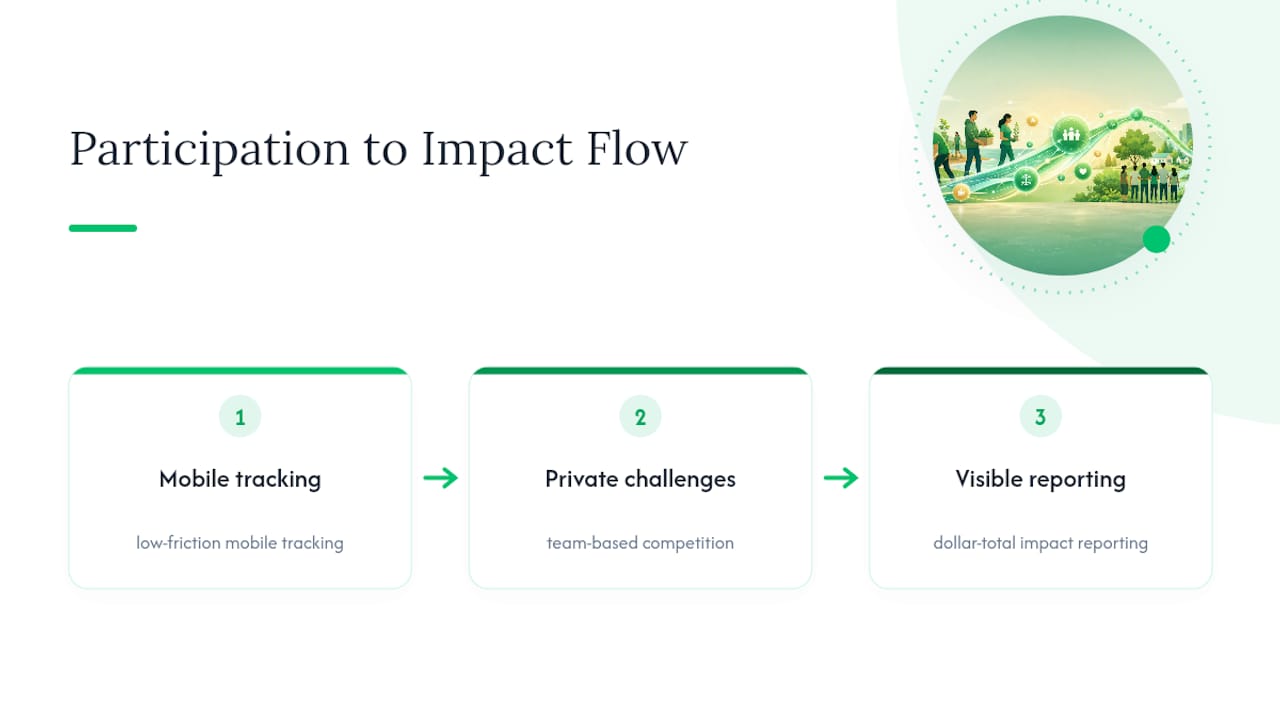
Every mechanic here maps directly to the tactics and measurement approach covered above: low friction (mobile tracking), team mechanics (private challenges), and visible impact reporting (the dollar total itself became the story).
How Do You Run a 6-Week CSR Participation Pilot?
You don’t need executive buy-in for a full rollout to prove this works. A six-week pilot with one team and one clear metric is enough to build a credible internal case study.
- Week 0: Survey employees, pick one goal, and lock in an executive sponsor and a nonprofit or platform partner.
- Weeks 1 to 2: Set up tracking, recruit ambassadors, and send the first round of communications.
- Weeks 3 to 4: Launch the activation and send mid-campaign progress updates to keep momentum visible.
- Weeks 5 to 6: Collect participation data, run a short pulse survey, and present results plus next steps to leadership.
Pro Tip: Keep the pilot to a single team and a single metric. Small companies and lean HR teams see faster, cleaner results from one focused pilot than from a company-wide launch nobody has bandwidth to track properly.
Author Perspective: Three Priorities HR Should Act on Now
Start with employee input, not a pre-built calendar. Lower every point of friction you can find. Measure the first win early enough to show leadership real numbers, not intentions. Scale what genuinely motivates your people, not whatever looks best in a press release. A six-week pilot is the cheapest way to build that case.
— Gene
Why Charity Miles Fits This Playbook
Charity Miles offers a member app, private company teams, configurable sponsorship terms, and built-in reporting all in one platform.
Employees walk, run, or bike, and every mile logged turns into a donation, so participation feels personal rather than mandated. Companies set the sponsorship rate and cap, choose whether funds go to employee-chosen causes or a company partner, and get the transparent reporting that made HARMAN’s results (11x participation growth, $120,000-plus raised) easy to present to leadership. If you’re comparing options for your next engagement initiative, see how Charity Miles stacks up among top employee engagement platform alternatives and request a look at the Employee Empowerment Program for your team.
Sources
- Volunteer Programs Can Build Morale and Improve Retention — SHRM
- Fundamentals of Employee Volunteer Programs — BC CCC
- Corporate volunteering guidebook — PHINEO