
An employee volunteer program (EVP) is a structured company initiative that gives staff paid time, tools, or incentives to serve nonprofits, tracks that participation, and ties it to business goals like engagement and retention. If you’re starting one today, do this first: pick one measurable goal (a participation rate or total volunteer hours) and lock in an executive sponsor plus manager buy-in before you touch a calendar. Two formats to pilot immediately: volunteer time off (VTO) and a small skills-based project.
- Set one KPI (a reasonable participation bar in year one for most mid-size companies is common, but specific targets depend on internal goals.)
- Get a named executive sponsor and at least three manager champions on board
- Choose one in-person and one virtual/movement-based format to launch simultaneously
Proof it works: Civic 50 honorees collectively logged 6.5 million volunteer hours and post higher formal volunteering rates than typical U.S. companies, largely because they built volunteering into HR policy instead of running one-off events.
Key Takeaways
Employee volunteer programs succeed when they pair one measurable goal with an inclusive, low-friction format and consistent manager support rather than a single annual event.
| Point | Details |
|---|---|
| Start with one KPI | Choose participation rate or volunteer hours before launching anything, and secure an executive sponsor. |
| Mix formats deliberately | Combine VTO, skills-based projects, and virtual or movement-based options to reach every employee type. |
| Institutionalize, don’t improvise | Civic 50 honorees hit 6.5 million volunteer hours through embedded HR policy, not one-off events. |
| Pilot before scaling | Test with one department for 60 to 90 days, measure results, then expand with the same nonprofit partners. |
| Consider movement-based volunteering | Charitymiles lets companies sponsor employee miles through private team challenges, driving inclusive, ongoing participation like HARMAN’s 11x engagement increase. |
Table of Contents
- Why Employee Volunteering Pays Off For Everyone Involved
- Which Volunteering Format Fits Your Workforce?
- How Do You Design a Volunteer Program That Lasts?
- How Do You Get Employees to Actually Show Up?
- What KPIs Prove Your Program Is Working?
- What Does a Working Corporate Volunteer Program Look Like?
- Where Volunteer Programs Go Wrong
- Volunteering Ideas You Can Launch This Quarter
- How Volunteering Fits Your Broader CSR Strategy
- What Should You Budget for a Volunteer Program?
- What Tools Help You Run the Program Without Chaos
- What I’ve Learned Watching Programs Succeed and Stall
- Try Charitymiles as Your Low-Friction Volunteer Offering
- Where to Learn More
- Sources
Why Employee Volunteering Pays Off For Everyone Involved
Employee volunteer programs aren’t a feel-good sideline. They’re one of the more reliable levers HR has for engagement, and the return shows up in places leadership actually tracks: retention, skills pipelines, and brand trust.
SHRM’s reporting confirms volunteer programs build morale and improve retention, though it’s honest about the catch: they require real time and administrative investment to run well. That trade-off is worth it. Skills-based volunteering, in particular, doubles as leadership development. When an employee leads a nonprofit’s marketing audit or mentors a small business owner, they’re practicing exactly the skills your succession plan needs, and nonprofits get expertise they’d otherwise have to pay for at market rates.
- Engagement rises when work aligns with personal values, not just paychecks
- Diverse formats (in-person, virtual, skills-based) widen inclusion across ability levels and schedules
- Nonprofits gain donor pipelines and longer-term corporate relationships, not just a single day of labor
Skills-based volunteering delivers outsized value to nonprofits compared to general volunteer hours, which is why it deserves a permanent slot in your program, not an occasional mention.
Which Volunteering Format Fits Your Workforce?
Not every team needs the same format. Match the structure to your goals and your workforce’s actual constraints, remote, hybrid, or on-site.
- Volunteer time off (VTO): Paid hours, typically 8 to 40 per year, that employees use for approved service. Set eligibility (full-time only, or after 90 days) and a manager approval step to prevent scheduling chaos.
- Team volunteer days: A single group event, a park cleanup or food bank shift, run once or twice a year. Efficient for building camaraderie fast, less effective for sustained habits.
- Skills-based volunteering: Employees donate professional expertise, legal review, design, financial planning, to nonprofits that can’t afford it. Pair this with a skills-based volunteering framework so scope and hours stay bounded.
- Volunteer grants (Dollars for Doers): The company donates a set dollar amount per volunteer hour logged, turning time into direct funding.
- Virtual volunteering: Remote-friendly tasks like transcription, mentoring, or virtual volunteering campaigns that don’t require geography to align.
How Do You Design a Volunteer Program That Lasts?
A program that survives its second year is built on structure, not enthusiasm. Follow this order.
- Set measurable objectives. Decide upfront whether you’re optimizing for participation rate, total hours, retention correlation, or skills development. Vague goals (“boost morale”) don’t survive budget review.
- Assign governance. Name an executive sponsor who reports results to leadership and a volunteer program lead who owns day-to-day operations. Without a name attached, programs stall by month three.
- Define scope and eligibility. Decide who qualifies (full-time, part-time, tenure requirements), how many hours are paid, and what the approval workflow looks like. Write this down before launch, not after the first dispute.
- Select nonprofit partners deliberately. Look for organizations with the capacity to absorb corporate groups, clear reporting practices, and mission alignment with your company values. United Way’s guidance on partnering with local affiliates is a solid starting template for sourcing and vetting partners.
- Build the operations checklist. Signup forms, liability waivers, insurance confirmation, transportation or scheduling logistics, and accessibility accommodations all need owners, not assumptions.
Pro Tip: Draft your nonprofit partner agreement before you promote the program internally. Nothing kills momentum faster than 40 excited employees and no confirmed volunteer slot to put them in.
Structured planning and measurement separates programs that last from ones that fade after the launch email.
How Do You Get Employees to Actually Show Up?
A well-designed program still fails if nobody hears about it or managers quietly discourage time away from desks. Pilot first, then promote hard.
- Run a 60 to 90 day pilot with one department or location before rolling out company-wide
- Brief managers directly. If a manager doesn’t understand VTO rules, they’ll default to discouraging it
- Recruit volunteer champions, employees who’ve already participated, to spread word-of-mouth more credibly than any HR email
- Use short internal comms (Slack posts, a two-line newsletter blurb, a photo recap) instead of a single big announcement that gets buried
- Recognize participation publicly, but skip leaderboards that turn service into a competition for prizes rather than a value in itself
Onboarding managers matters more than most HR teams expect. A manager who blocks VTO requests, even unintentionally, undoes months of promotion. Build manager training into your employee engagement rollout so approval isn’t a bottleneck.
What KPIs Prove Your Program Is Working?
Track five numbers: total volunteer hours, participation rate (percentage of eligible employees who volunteered at least once), repeat participation rate, volunteer grant dollars paid out, and community outcomes reported by your nonprofit partners.
- Cross-reference volunteer participation against your existing engagement survey scores to see if the correlation SHRM describes holds true in your own company
- Build a simple quarterly dashboard rather than a once-a-year report buried in a slide deck
- Share results with both leadership (business impact framing) and employees (community impact framing)
The benchmark to beat: Civic 50 honorees logged a combined 6.5 million volunteer hours, a scale reached through institutionalized policy, not annual events. If you want external recognition, applying for the Civic 50 or referencing Points of Light’s benchmarking criteria gives your program a credible external yardstick.
What Does a Working Corporate Volunteer Program Look Like?
Charitymiles runs its Employee Empowerment Program by turning ordinary movement, walking, running, biking, into charitable donations, and letting companies build private teams around it. Employees join a team challenge, log miles through the app, and the company sponsors those miles at a rate and cap it sets, directing funds either to each employee’s chosen charity or a company-selected cause.
HARMAN launched its Charity Miles team in 2021 and saw an 11x increase in employee participation, with more than 1,200 employees generating over $120,000 for charity. The mechanism wasn’t a single big event. It was daily movement, tracked automatically, sponsored consistently.
That structure solves a problem most volunteer programs never crack: sustained participation without constant reorganizing.
- Sponsorship terms (rate per mile, total cap) are set entirely by the company
- Reporting shows hours, miles, and dollars generated in real time
- Recognition happens through team challenges, not one-time certificates
To pilot this yourself: launch a private team with one department, run it 90 days, and measure participation growth against your baseline engagement numbers.
Where Volunteer Programs Go Wrong
Most failures trace to three causes: partnering with a nonprofit that can’t absorb volunteer capacity, vague expectations about hours and approval, and administrative friction that makes signing up harder than it should be.
- Vet nonprofit capacity before promising volunteer slots to 50 employees
- Write policy language covering VTO eligibility, liability coverage, reimbursement rules, and conflict-of-interest situations (an employee volunteering for a client, for instance)
- Scale in stages: pilot with one team, standardize the process, then expand while maintaining the same nonprofit relationships rather than churning through new partners every quarter
Volunteering Ideas You Can Launch This Quarter
Low-friction options work better than ambitious ones nobody finishes.
- Kit-building events: Assemble care packages or school supply kits in a two-hour on-site session.
- Virtual mentoring: Pair employees with students or small business owners over video calls, no travel required.
- Skills-based pro bono projects: A four-person team handles a nonprofit’s website audit or financial review over two weeks.
- Movement-based fundraising: A Charity Miles team challenge lets every fitness level, from casual walkers to marathon runners, contribute equally.
- Document transcription or data entry: Remote-friendly, done asynchronously, ideal for distributed teams.
Time activations around GivingTuesday or Earth Day. Calendar-based hooks create a natural annual rhythm that’s easier to promote than a random Tuesday in March.
How Volunteering Fits Your Broader CSR Strategy
A volunteer program that runs disconnected from your CSR strategy looks like a perk. One that’s integrated into your values statement looks like proof.
Start by mapping your volunteer offerings to the causes your company already claims to care about. If sustainability is part of your mission statement, environmental cleanups and skills-based consulting for climate nonprofits should outnumber generic food drives. This alignment isn’t cosmetic. Employees notice when a company’s stated values and its volunteer calendar don’t match, and that mismatch erodes trust faster than having no program at all.

Integration also means giving volunteering a seat at the same table as your other CSR pillars, sustainability, diversity, community giving, rather than treating it as HR’s separate side project. When your CSR report cites emissions reductions and charitable donations, volunteer hours and skills-based project outcomes belong in that same document. Points of Light’s corporate solutions approach treats institutionalized volunteering as a policy layer sitting underneath the whole CSR strategy, not an event calendar bolted onto it.
Practically, this means your CSR committee, not just HR, should review volunteer partner selection annually. It means volunteer outcomes show up in the same investor or stakeholder communications as your other sustainability metrics. Companies that treat volunteering as a genuine values expression, rather than a morale tactic, tend to keep programs running through budget cuts that kill standalone perks first.
What Should You Budget for a Volunteer Program?
Most mid-size companies underestimate the administrative cost and overestimate the direct cost. The money isn’t the hard part, staffing time is.
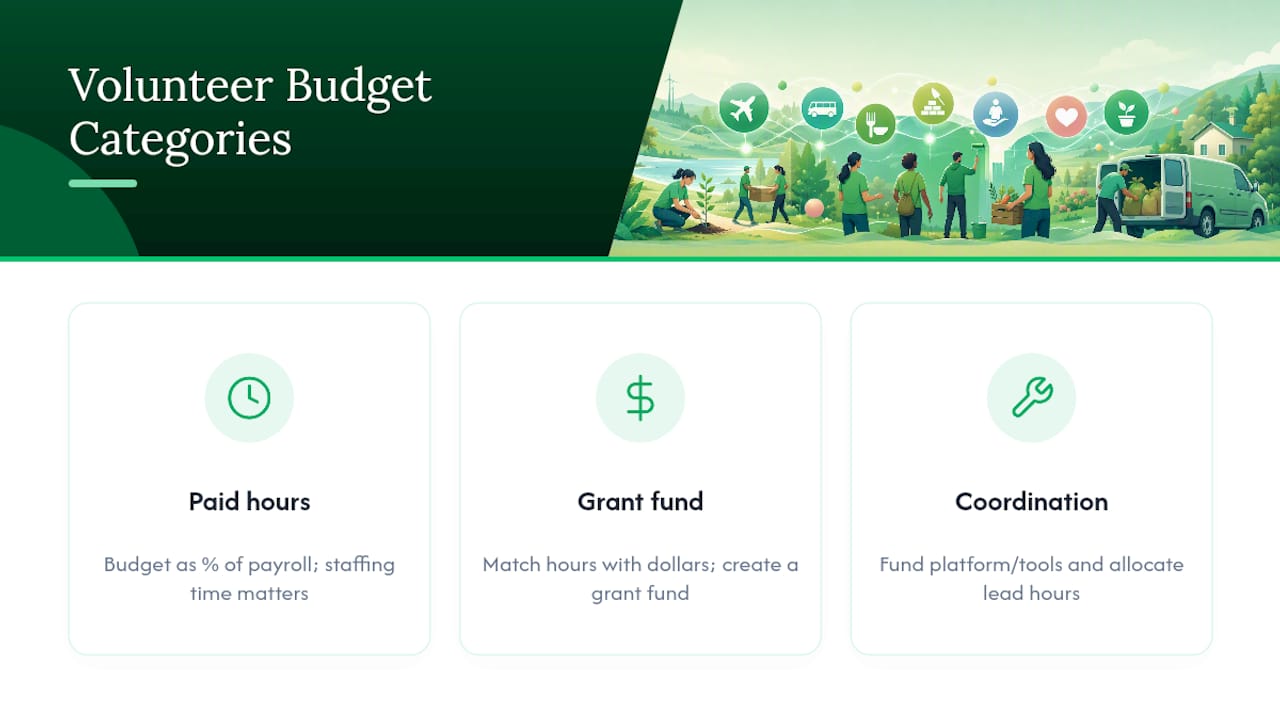
Budget for three categories: paid volunteer hours (calculate this as a percentage of payroll based on expected participation and hours cap), a volunteer grant fund if you’re matching hours with dollars, and platform or coordination tools. A volunteer lead, even part-time, needs actual hours allocated, not a title added to an already full HR role.
Start small. A pilot with one department costs a fraction of a company-wide rollout and tells you what your real participation rate will be before you commit budget at scale.
Resist the instinct to front-load spending into one large annual event. A single all-hands volunteer day is expensive per hour of impact delivered, since it requires venue coordination, transportation, and a full day of lost productivity company-wide. Distributing the same budget across VTO hours, a modest volunteer grant program, and an always-on option like a movement-based team challenge tends to produce more total volunteer hours per dollar spent.
What Tools Help You Run the Program Without Chaos
Spreadsheets work for a ten-person pilot. They break down fast past fifty employees across multiple locations.
Look for platforms that handle four functions: signup and scheduling, hours tracking and verification, reporting dashboards, and communication with both employees and nonprofit partners. Dedicated volunteer management platforms exist specifically to replace the spreadsheet-and-email chaos that kills momentum in year two.
For movement-based or team-challenge formats, an app that automatically tracks activity and converts it into logged participation removes the biggest friction point, manual reporting. Combining daily activity tracking with corporate sponsorship creates what amounts to an always-on volunteering channel instead of a once-a-year event, and it produces measurable data (miles, dollars, participants) without anyone filling out a form.

Whatever platform you choose, prioritize reporting quality over feature count. The dashboard that shows your executive sponsor real-time participation and dollars raised is worth more than a tool with twenty features nobody on your team uses. Ask any vendor for a sample report before you sign anything, and confirm it exports data in a format your existing HR systems can actually use.
What I’ve Learned Watching Programs Succeed and Stall
Most volunteer programs die from complexity, not lack of enthusiasm. The companies that get this right start absurdly small, one team, one nonprofit partner, one clear metric, and resist the pressure to launch something impressive on day one.
The trade-off nobody talks about enough: big single-day events generate great photos and terrible retention. Year-round, low-friction options build habits. If you can only fund one format this year, skip the flagship event and fund the boring, repeatable one instead.
— Gene
Try Charitymiles as Your Low-Friction Volunteer Offering
Most volunteer formats ask employees to carve out a full day or a special skill. Charitymiles asks for a walk you were already going to take. Movement-based volunteering removes the biggest barrier to participation, finding time, because it layers onto routines employees already have: a lunchtime walk, a bike commute, a weekend run.
Companies set the sponsorship rate and cap per mile, direct funds to a chosen cause or let employees pick their own, and get real-time reporting on participation and dollars raised, without organizing a single event. That inclusivity matters: a program that only rewards marathoners excludes most of your workforce, while one that counts every mile, at every pace, keeps participation open to everyone regardless of fitness level. The result, as HARMAN’s 1,200-plus participants and $120,000 raised showed, is sustained engagement rather than a one-time spike. Visit the Employee Empowerment Program page to see how a private team challenge works and request a pilot for your organization.
Where to Learn More
For deeper benchmarking, read Points of Light’s Civic 50 findings and SHRM’s guidance on retention. United Way NCA offers partnership templates, and VolunteerHub’s guide covers measurement frameworks. For a movement-based pilot, explore Charitymiles’s corporate program.
Sources
- Top 50 Companies Donate More than $1.5 Billion and Engage Employees in 6.5 Million Hours of Volunteering – Points of Light
- Corporate Volunteering Ideas: 25+ Ways to Give Back in 2026 – Goodera
- Employee volunteer programs can build morale and improve retention – SHRM
- Employee volunteer programs (United Way NCA)
- Guide to Creating a Corporate Volunteer Program – VolunteerHub