
Burnout is largely preventable when employers fix work design, equip managers, and measure impact. The strongest results come from combining four levers: redesigning jobs and workloads, building manager capability, setting realistic staffing and scheduling rules, and measuring progress consistently. Individual supports like mental health access or movement programs matter too, but they work best as a complement, not a substitute, for structural change backed by WHO, Gallup, and CDC guidance.
TL;DR:
- Redesigning jobs and workloads based on workload audits is essential before implementing individualized mental health supports or movement programs.
- Manager training focused on early signs of burnout and workload negotiation yields faster results than standalone wellness initiatives.
- Addressing systemic factors such as unfair treatment, unclear communication, and unmanageable workload is more impactful than individual support tools alone.
- Different team types, such as remote or shift workers, require tailored policies like no-meeting blocks or advance scheduling notices to effectively reduce burnout risk.
- Pilot programs should measure baseline metrics and introduce small, targeted interventions over 3 to 6 months to assess cost-effective burnout prevention.
Table of Contents
- What burnout actually is and why it matters to your organization
- High-impact organizational policies that reduce burnout risk
- What managers should actually do day to day
- Which individual supports genuinely help
- Building a pilot: timeline, metrics, and the ROI case
- How a movement-with-purpose program fits the picture: the Charity Miles example
- What causes burnout in the first place
- Spotting burnout early and tracking it over time
- Keeping prevention alive after the pilot ends
- Adjusting the approach for different teams
- What I’d tell a leader short on time or budget
- Build energy and connection with the Charity Miles Employee Empowerment Program
- FAQ
- Sources
What burnout actually is and why it matters to your organization
The World Health Organization classifies burnout in the ICD-11 as an occupational phenomenon resulting from chronic workplace stress that has not been successfully managed. It is not a medical diagnosis; it describes a syndrome with three distinct dimensions.
- Energy depletion or exhaustion: a persistent sense of being drained that does not recover with a weekend off.
- Increased mental distance from work: cynicism, detachment, or a growing sense that the job no longer matters.
- Reduced professional efficacy: a felt drop in competence and accomplishment, even when output has not changed.
Burnout differs from routine stress in duration and scope: stress tends to be episodic and tied to a specific deadline, while burnout is chronic and tied to the job itself. Academic reviews note that burnout’s symptoms overlap with depression, and the diagnostic boundary between the two remains debated among researchers. That overlap is a reason to treat burnout as a workplace design problem rather than an individual pathology: the fix belongs in the organization, while clinical symptoms belong with a qualified professional.
Departing employees can cost employers 30% to 200% of their annual salary to replace, a range driven by seniority, recruiting costs, and lost productivity during ramp-up. When burnout drives that turnover, the operational case for prevention writes itself: this is not a wellness nice-to-have, it is a cost center hiding in plain sight.
High-impact organizational policies that reduce burnout risk
Policy changes outperform individual-only fixes because they address the source of the imbalance rather than asking employees to cope better with an unchanged workload. The NIOSH Impact Wellbeing Guide frames this as a six-step process built around reviewing operations, building a dedicated wellbeing team, removing barriers to care, and folding wellbeing into ongoing quality improvement rather than treating it as a side project.
A practical rollout sequence looks like this:
- Audit workload before changing anything. Map hours, task volume, and after-hours activity by team so you know where the imbalance actually sits.
- Redesign jobs where the audit shows strain. Job crafting, letting employees reshape tasks to fit their strengths, improves fit and lowers burnout risk when paired with manager support.
- Set staffing and scheduling rules with teeth. Protected time off that is actually protected, workload caps tied to role, and flexible scheduling where the job allows it.
- Build psychological safety into decisions. Explain the reasoning behind role changes, promotions, and workload shifts; unexplained decisions read as unfair even when they are not.
- Remove intrusive or irrelevant credentialing hurdles that add friction without improving outcomes, particularly in hiring and internal mobility.
- Close the loop with communication. Pair every policy change with a two-way feedback channel so employees can flag what is not working before it becomes a resignation.
Gallup’s research backs the fairness point directly: unfair treatment at work ranks among the five root causes most strongly linked to burnout, alongside unmanageable workload, unclear communication from managers, lack of manager support, and unreasonable time pressure. Four of those five sit squarely inside the manager relationship, which is why policy alone is not enough without the next layer.
Pro Tip: Run the workload audit on existing timesheet and project-management data before adding a new survey. You likely already have the evidence you need.
What managers should actually do day to day
Policy sets the boundaries, but managers determine whether employees experience those boundaries as real. Gallup’s research identifies five manager actions that correlate with lower burnout risk: listening to employees, enabling peer support, inviting opinions into decisions, connecting daily work to a larger purpose, and developing people around their strengths rather than their weaknesses.
Manager training should move beyond generic coaching and cover specific, practicable skills:
- Spotting early signs of exhaustion, cynicism, or withdrawal before they show up in performance reviews.
- Coaching through workload negotiation instead of simply absorbing or redistributing tasks without discussion.
- Running structured one-on-ones that cover capacity and wellbeing, not only project status.
- Knowing the escalation path when an employee needs more support than a manager can provide alone.
CDC/NIOSH guidance identifies manager capability as a top-leverage area: training managers to spot early signs and negotiate workload and role clarity pays off faster than most other interventions because managers touch every employee’s daily experience directly.
A workable cadence: weekly pulse checks that take under two minutes, monthly workload reviews where managers and direct reports compare actual hours against planned capacity, and quarterly check-ins tied to role clarity and growth. None of this requires new software. A shared document and a recurring calendar block will do for a first pilot.
Pro Tip: Ask one consistent question in every one-on-one: “What’s one thing on your plate that shouldn’t be?” It surfaces workload problems faster than a formal survey.
Which individual supports genuinely help
Individual-level supports are valuable, but the evidence is clear about their limits. A systematic review of workplace mental health programs found that participatory organizational interventions, the kind that adjust workload and build team support, produced the most sustained reductions in burnout. Digital-only tools and one-off workshops showed short-term benefits that faded quickly, often alongside high attrition from the programs themselves.
That does not make individual supports useless. It means they belong inside a structural framework, not instead of one. Worth prioritizing:
- Confidential mental health access through an employee assistance program, so help is available before a crisis.
- Flexible leave policies that do not require employees to justify every absence in detail.
- Recovery-friendly scheduling, including real breaks between high-intensity project cycles.
- Inclusive movement programs that build social support and count any activity, not just athletic performance, lowering the barrier for employees who would never sign up for a 5K.
The blend that works combines human support (managers and EAPs), digital tools (pulse surveys, scheduling apps), and policy change (workload caps, protected time off) rather than leaning on any single layer. A digital wellness app alone will not fix a structurally overloaded team, but it can meaningfully support a team whose workload has already been addressed.
Building a pilot: timeline, metrics, and the ROI case
A burnout prevention pilot does not need a year-long rollout to show results. A focused 3 to 6 month pilot with a clear baseline will tell you whether the approach works before you scale it company-wide.
- Establish a baseline. Run a short pulse survey, pull absenteeism and overtime data, and assemble a small stakeholder team spanning HR, a department head, and a frontline manager.
- Introduce two or three interventions at once. Pair a manager-training module with one workload or scheduling change; too many variables at once makes it hard to tell what worked.
- Measure on a fixed cadence. Weekly pulse checks on exhaustion and engagement, monthly tracking of turnover intent and absenteeism, and a productivity proxy like backlog age or overtime hours.
- Compare against baseline at 90 and 180 days, and decide whether to expand, adjust, or stop.
Effective pilots triangulate a worker-level pulse survey with manager behavior metrics and objective proxies like overtime hours and backlog age rather than relying on a single data source.
For deeper sequencing guidance, our 90 to 180 day wellness playbook walks through the measurement cadence in more detail.
How a movement-with-purpose program fits the picture: the Charity Miles example
Structural fixes come first, but inclusive programs that build energy and peer connection earn their place once the foundation is in place. We offer a program letting companies create private teams where employees log walks, runs, or bike rides through a movement-tracking app, with the option to sponsor employee miles on terms the company sets.
- Companies can choose sponsorship terms, a total budget cap, and how donations are allocated among charities.
- Any movement counts, so participation is not limited to employees who already consider themselves athletic.
- Clients who have used the program reported significant increases in employee participation and charitable fundraising.
Movement tied to purpose turns a step challenge into something employees actually stick with, because the miles mean something beyond a leaderboard number.
The right place for a program like this sits above the foundation of manager training and workload fixes, not in place of it. Piloted alongside those structural changes, it adds a low-friction way to build peer support and sustained energy, which is exactly what burnout prevention needs once the heavier lifting is underway.
What causes burnout in the first place
Burnout develops when job demands consistently outpace the resources employees have to meet them. That demand-resource imbalance shows up in a few recurring patterns, and most of them trace back to decisions made above the individual employee’s control.
Workload is the most visible driver. When task volume, deadlines, or on-call expectations exceed what a reasonable week can absorb, exhaustion follows even for employees who enjoy their work. Gallup’s research ties unmanageable workload directly to burnout risk, alongside unreasonable time pressure that compounds the problem.
Lack of manager support is the second major factor, and it often matters more than workload itself. An employee carrying a heavy load with a manager who runs interference, clarifies priorities, and advocates for resources experiences that load differently than one left to manage it alone. Unclear communication from managers about priorities or expectations adds a layer of friction that turns a busy week into a frustrating one.
Unfair treatment rounds out the picture: inconsistent application of rules, unclear promotion criteria, or decisions made without explanation erode trust even among employees whose actual workload is manageable. These five factors, unfair treatment, unmanageable workload, unclear communication, lack of manager support, and unreasonable time pressure, correlate most strongly with burnout across Gallup’s research, which is why structural fixes aimed at any one of them in isolation tend to underperform fixes that address several at once.
Spotting burnout early and tracking it over time
Catching burnout early depends on watching for specific behavioral and attitudinal shifts, not waiting for a resignation letter. The three ICD-11 dimensions translate into observable signs: an employee who used to answer messages promptly starts going quiet for days (exhaustion), someone who was engaged in team discussions starts opting out of optional meetings (mental distance), or a historically confident performer starts second-guessing routine decisions (reduced efficacy).
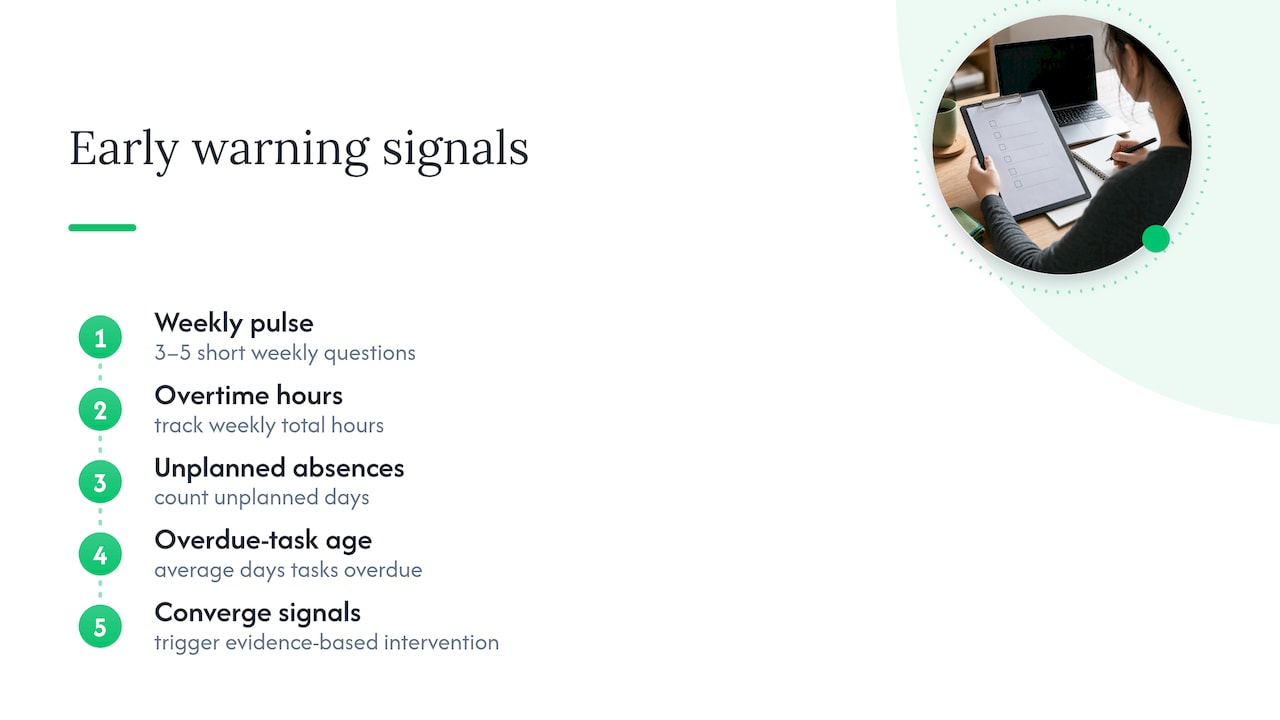
Waiting for annual engagement surveys to catch these shifts is too slow. A weekly or biweekly pulse check, three to five short questions on energy, workload, and manager support, gives teams a running signal instead of a single annual snapshot. Sample items might include “I had the resources I needed to do my job well this week” or “I felt able to switch off after work hours,” scored on a simple scale.
Pulse data works best read alongside a few operational numbers: overtime hours, unplanned absences, and the age of overdue tasks. A team whose pulse scores are dropping while overtime climbs is showing the imbalance in two independent signals at once, which makes the case for intervention much harder to dismiss than a survey score alone. None of this requires sophisticated tooling to start; a shared spreadsheet and a five-minute weekly form will surface the pattern well before it becomes a retention problem.
Keeping prevention alive after the pilot ends
A successful pilot proves the approach works. Keeping it working for years requires treating burnout prevention as an operating discipline rather than a one-time project with an end date.
The NIOSH framework’s emphasis on integrating wellbeing into ongoing quality improvement points at the real answer: fold workload review and manager accountability into the same cycles you already use for budget planning and performance management, rather than running them as a separate wellness initiative that competes for attention.
Three practices sustain momentum. First, revisit workload audits on a fixed schedule, quarterly or at each major project transition, instead of only after a wave of resignations forces the question. Second, keep manager training current as teams and responsibilities shift; a manager promoted into a new department needs the same grounding in workload negotiation and early-warning signs as a first-time manager. Third, treat the pulse survey and operational metrics as a standing dashboard, reviewed at the same cadence as financial reporting, so a slipping score triggers a conversation before it triggers an exit interview.
Culture change follows structure, not the other way around. Leaders who talk openly about workload limits and model reasonable boundaries give employees permission to do the same, which is a cheaper and more durable lever than any single program.
Adjusting the approach for different teams
A single burnout prevention policy rarely fits a whole organization evenly, because the risk factors look different depending on where and how people work.
Remote employees face a distinct version of the demand-resource imbalance: the boundary between work and home blurs, meetings compress into back-to-back video calls with no walking time between them, and the informal peer support that happens near a coffee machine has to be built deliberately instead of happening by accident. Scheduling norms that protect no-meeting blocks and explicit expectations about after-hours availability matter more for this group than for colocated teams.
Frontline and shift-based employees carry a different risk profile, often tied to unpredictable scheduling and limited flexibility rather than overwhelming task volume. For this group, staffing adequacy and advance notice on schedule changes tend to matter more than the job-crafting approaches that help knowledge workers.
Departments also vary. Customer-facing teams absorb emotional labor that a back-office analytics team does not, which argues for different workload caps and different manager training emphases. A one-size policy applied uniformly across these groups usually ends up protecting no one well; a short internal audit asking each department head where their team’s specific strain shows up will do more good than importing a generic wellness checklist.
What I’d tell a leader short on time or budget
The most common mistake is reaching for a wellness-only shortcut, a single workshop or app rollout, and hoping it compensates for an unaddressed workload problem. It will not. Manager capability and workload controls come first because they address the conditions actually producing exhaustion.
If I had to compress this into one sequence: measure first, train managers second, adjust work design third, add supportive programs last. Skipping straight to programs without the first three steps spends budget on the layer with the weakest standalone evidence.
With limited time, two quick wins deliver outsized value. Revise meeting norms to cut recurring meetings that no longer serve their original purpose, reclaiming hours without touching headcount. And institute a simple workload checklist managers run before assigning new work, forcing a five-second check against existing capacity instead of a reflexive yes.
— Gene
Build energy and connection with the Charity Miles Employee Empowerment Program
Once the structural work is underway, our Employee Empowerment Program gives teams an easy, inclusive way to build the energy and social support that make the rest of the plan stick. Employees log walks, runs, or bike rides through the Charity Miles app, and we let companies decide whether to sponsor those miles toward each employee’s chosen charity or a shared cause.

-
- Team challenges designed to include all fitness levels.
- Customizable sponsorship terms to fit company budgets.
- A connection between daily movement and charitable causes.
A four-week inclusive challenge is a low-risk way to pilot this alongside your manager training and workload fixes. Set up your Employee Empowerment Program and see how a few weeks of shared movement can shift the energy on your team.
FAQ
How do you prevent burnout at work?
Burnout prevention works best when organizations fix work design, build manager capability, and set realistic staffing rules, with individual supports layered on top. Gallup research ties burnout most strongly to workload, unfair treatment, unclear communication, and lack of manager support, all of which are structural, not personal, problems.
How to help an employee with burnout?
Start by listening without judgment and reviewing their actual workload against their capacity, since unmanageable workload is a leading driver of burnout. Connect them with confidential mental health support through your employee assistance program if symptoms persist, and address any structural issue, like unclear priorities or unfair scheduling, that may be contributing.
What are the coping strategies for burnout?
Individual coping strategies, like protected recovery time, flexible leave, and movement breaks, can ease symptoms, but a systematic review of workplace mental health programs found these approaches work best alongside organizational changes rather than as a stand-alone fix. Pairing personal coping tools with a manager conversation about workload tends to outlast coping strategies used in isolation.
How to fix job burnout?
Fixing burnout starts with auditing workload and job design, since designing work with better autonomy and manager capability outperforms individual-only interventions. From there, train managers to spot early signs and negotiate workload, and track progress with regular pulse checks rather than waiting for an annual survey.
Sources
- WHO — Burn-out an occupational phenomenon (ICD-11)
- How to prevent employee burnout — Gallup
- Impact Wellbeing™ Guide — NIOSH/CDC (2024)
- Systematic review: workplace mental health programs and burnout reduction (PMC)
- Design work to prevent burnout — MIT Sloan Review