
Yes, when wellness programs are integrated and run year-round, they lower voluntary turnover by cutting burnout and raising engagement. The highest-impact levers are mental health access paired with manager training, and inclusive, purpose-driven participation rather than one-off perks. Track participation rates alongside retention data to prove it’s working, not just assume it.
TL;DR:
- Wellness programs that run continuously and integrate mental health access and manager training significantly lower turnover, especially in high-stress roles.
- Participation is the key driver of retention, with inclusive movement challenges and connecting activity to a purpose boosting engagement over traditional perks.
- Effective programs require coordinated, ongoing efforts with leadership involvement, flexible policies, and regular measurement of participation and retention metrics.
- Launching a successful wellness initiative within 90 to 180 days involves setting clear goals, pilot testing with a department, and securing visible executive sponsorship.
- Purpose-driven activities like Charity Miles generate measurable engagement and culture, with proven participation increases when movement is tied to meaningful causes.
Table of Contents
- Which Evidence-Backed Wellness Strategies Actually Reduce Turnover?
- How Do You Design a Wellness Program That Actually Sticks Year-Round?
- What Gets Employees to Actually Participate?
- What Metrics Prove Wellness Is Reducing Turnover?
- What Wellness Mistakes Quietly Hurt Retention?
- How Do You Launch a Retention-Focused Wellness Program in 90 to 180 Days?
- Why Purpose Beats Perks for Retention
- How Charity Miles Turns Everyday Movement Into Measurable Engagement
- Sources
- FAQ
Which Evidence-Backed Wellness Strategies Actually Reduce Turnover?
Not every wellness perk moves the needle on retention. Some strategies show a measurable connection to whether people stay; others just look good in a benefits deck. Here’s a priority order based on the strength of evidence behind each one.
- Mental health access and EAP visibility. Employees who can reach a counselor or therapist without jumping through approval hoops report higher intention to stay, and holistic well-being investment correlates with lower burnout-driven turnover among large employers. This works best for organizations with high-stress roles or frequent overtime.
- Manager training on burnout recognition. Managers are usually the first to notice disengagement, but most are never trained to act on it. Pair this with clear escalation paths to EAP or HR.
- Flexible scheduling policies. Control over when and how work gets done reduces the friction that pushes people toward burnout in the first place.
- Inclusive movement and team challenges. Programs where walking, biking, or a lunchtime stretch all count tend to pull in employees who’d never sign up for a 5K, which matters because participation itself predicts lower turnover compared with nonparticipation.
- Chronic condition support. Coaching or care navigation for diabetes, hypertension, or similar conditions shows the largest measurable effects when paired with strong participation, according to the same long-running workplace health promotion cohort.
Start with mental health and manager training. They cost less to implement than a full benefits overhaul and touch every employee, not just the ones who already show up to the gym.
How Do You Design a Wellness Program That Actually Sticks Year-Round?
A wellness program that runs once a year during open enrollment isn’t a program. It’s an event, and events don’t change turnover numbers. The CDC’s workplace health model calls for something coordinated, comprehensive, and systematic, meaning safety, benefits, and culture all move in the same direction instead of operating as separate initiatives run by separate departments.
In practice, that means rethinking policy and environment together with benefits:
- Set manager expectations that participation happens during work hours, not on personal time.
- Build flexible scheduling that gives people room to actually use what you offer.
- Keep EAP and mental health resources visible in onboarding, not buried in a PDF nobody opens.
- Offer ongoing incentives instead of a single sign-up bonus that fades by March.
Governance matters as much as design. A cross-functional team, spanning HR, benefits, and a visible executive sponsor, keeps the program from drifting into “whoever has time this quarter” territory.
Pro Tip: Assign one senior leader to personally use the program, not just approve the budget for it. Visible participation from leadership does more for uptake than any incentive structure you’ll design.
What Gets Employees to Actually Participate?
Retention research keeps circling back to one variable: participation. Employees who take part in wellness activities show lower odds of subsequent turnover than those who don’t, and the mechanism makes sense. Opting in creates repeated, low-friction touchpoints that reinforce a sense of belonging to something larger than a job description.
The tactics that raise participation share a common thread: they lower the barrier to entry and connect the activity to something beyond personal fitness.
- Make challenges inclusive of any movement, not just runners or gym regulars.
- Attach activity to a cause employees care about, not just a leaderboard.
- Give teams private spaces to compete and support each other.
- Keep enrollment to under two minutes; friction kills adoption fast.
- Have leadership log miles publicly, not just send a launch email.
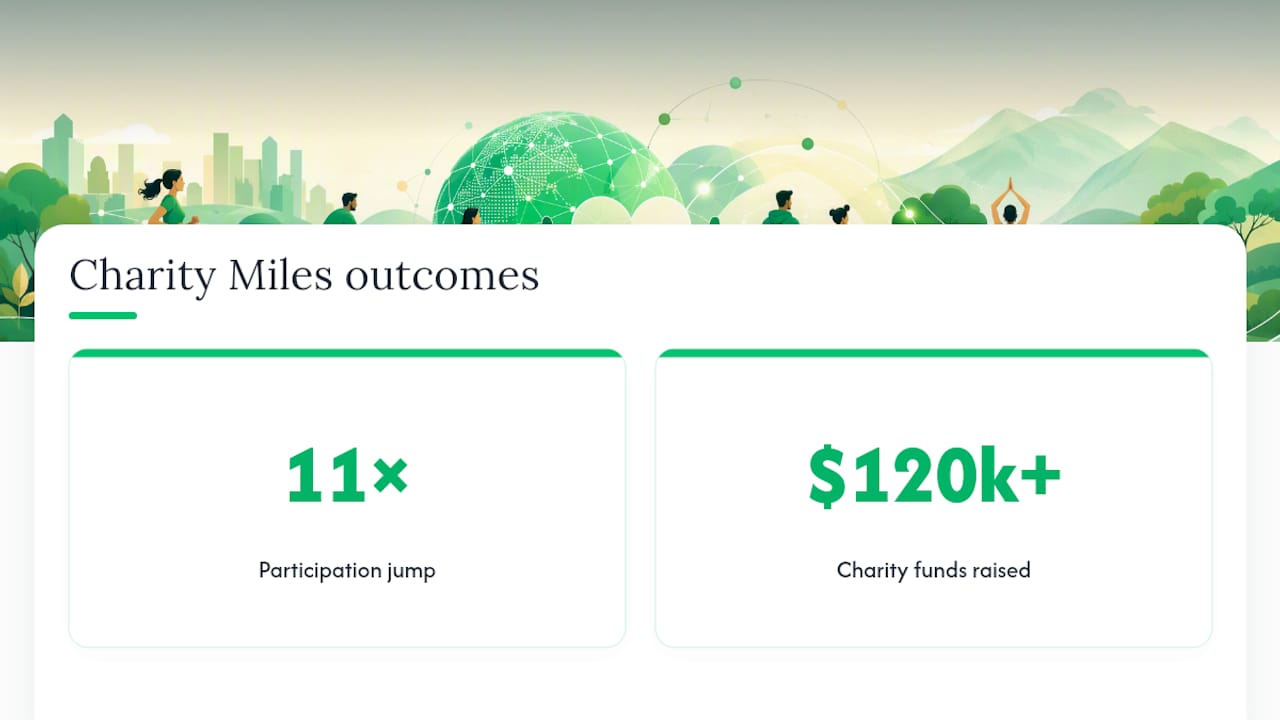
Since launching its private team in 2021, HARMAN saw an 11x increase in employee participation, with more than 1,200 employees generating over $120,000 for charity through Charity Miles’ Employee Empowerment Program.
That kind of jump doesn’t happen through a single wellness fair. It happens when movement is tied to purpose, which is part of why programs that let any activity count, a walk, a bike commute, a run, tend to outperform traditional step challenges that quietly exclude anyone who isn’t already athletic.
For hybrid and frontline teams, the format needs adjusting. Desk workers respond well to team-based mileage challenges they can join from a phone. Frontline employees, who are already on their feet all shift, benefit more from recognition and incentive structures than from movement tracking alone.
Pro Tip: Launch with a private team challenge before rolling out company-wide. A 30-day pilot with one department tells you more about what will actually drive participation than any survey.
What Metrics Prove Wellness Is Reducing Turnover?
Measuring wellness ROI means separating signals you’ll see quickly from the ones that take longer to show up. Voluntary turnover doesn’t shift in a month, but the leading indicators do.
Track these from day one:
- Participation rate by department and role
- EAP utilization trends
- Retention delta between participants and nonparticipants
- Absenteeism and internal mobility changes
- Engagement survey movement quarter over quarter
On the financial side, a long-running CDC cohort study found mean health care cost reductions near $35 per member per month, with an estimated ROI around $2.53 per dollar invested for mature, integrated programs. Those figures come from long-standing programs and won’t generalize to every employer or every program stage.
Be careful with attribution. A cluster randomized trial of a workplace wellness program found improved self-reported behaviors but no significant difference in job tenure after 18 months, a reminder that design and participation intensity shape whether a program actually moves retention. Where possible, compare matched cohorts of participants and nonparticipants over 12 to 24 months rather than relying on before-and-after company-wide averages, which are easy to distort with selection bias.
What Wellness Mistakes Quietly Hurt Retention?
Most failed wellness programs don’t fail because the idea was bad. They fail because of execution gaps that are easy to miss until turnover numbers don’t budge.
- Running a single kickoff event instead of ongoing programming
- Treating wellness as a perk buried in a benefits packet instead of part of daily culture
- Skipping manager buy-in, so participation stalls at the team level
- Designing incentives that mainly reward employees who were already healthy and active
The fix is usually simpler than the original mistake. Build continuous programming with a real cadence, get managers to model participation instead of just approving it, and design challenges inclusive enough that a beginner and a marathoner both feel motivated to join. Watch participation trends monthly. A steep drop-off after week two is an early warning sign, not something to address at the annual review.
How Do You Launch a Retention-Focused Wellness Program in 90 to 180 Days?
- Set SMART objectives tied directly to retention, not just “improve wellness.”
- Map employee needs by department, shift pattern, and role type.
- Secure a visible leadership sponsor before launch, not after.
- Pilot one inclusive engagement tool with a single team or department.
- Collect baseline participation, absenteeism, and engagement survey data before scaling.
- Set a monthly cadence for reporting results and adjusting the program.
Pro Tip: During your pilot, collect at minimum: sign-up rate, weekly active participation, and one engagement survey question about sense of connection to the company. That’s enough to justify scaling or to catch a design flaw early.
Why Purpose Beats Perks for Retention
Most wellness budgets still go toward isolated perks, gym discounts, snack bars, a wellness week, because they’re easy to purchase and easy to announce. The evidence points somewhere less convenient: retention responds to sustained, participatory culture, not transactions. Programs that connect movement to purpose and give employees a reason to keep showing up outperform anything that looks good in a single email blast.
If you’re serious about turnover, pilot something participatory and measure it honestly.
— Gene
How Charity Miles Turns Everyday Movement Into Measurable Engagement
Charity Miles is the alternative to a generic step-challenge app for HR teams who want participation data that actually connects to retention goals. Every mile employees log, walking, running, biking, becomes a donation to a cause they choose, which means the program builds culture instead of just tracking steps nobody looks at after week one.
The Employee Empowerment Program gives your company private team challenges, full control over sponsorship terms, and reporting that shows exactly how participation is trending over time. HARMAN’s team saw participation jump 11x after launch, generating more than $120,000 for charity along the way, proof that when movement has purpose attached, people show up. Companies decide the rate per mile, the sponsorship cap, and whether funds go to employee-chosen charities or a company cause through Corporate Sponsorship Opportunities.
Nonprofit and CSR teams managing donor or volunteer data alongside employee giving programs may also find a nonprofit CRM comparison useful for keeping reporting connected across systems.
If you’re ready to see what a purpose-driven challenge looks like inside your own organization, explore how the app works and set up a pilot team this quarter.
Sources
For deeper reading, consult the CDC workplace health model, the DoL/RAND wellness research report, and Charity Miles’ employee wellness program overview.
- CDC workplace health model
- Impacts of Workplace Health Promotion and Wellness (CDC cohort study)
- Cluster randomized trial of a workplace wellness program
- Wellness program participation and its association with employee turnover
FAQ
What Should HR Do First to Reduce Turnover?
Start by giving employees visible, low-friction access to mental health support and training managers to recognize burnout early, since these two levers show the clearest connection to retention.
What Are the 5 C’s of Retention?
Definitions vary across HR frameworks, but common versions include compensation, career growth, connection, culture, and communication. No single canonical version applies universally, so treat it as a discussion framework rather than a fixed formula.
What Are Five Strategies to Promote Employee Wellbeing?
Mental health access, manager training on burnout, flexible scheduling, inclusive movement challenges like Charity Miles’ Employee Empowerment Program, and chronic condition support cover the strategies with the strongest evidence behind them.
Is 42% of Employee Turnover Preventable?
Specific percentages on preventable turnover vary widely by industry and methodology, and no figure in this article’s research supports a single universal number. What’s well established is that burnout and disengagement, both addressable through wellness design, are major preventable drivers.
How Much Does Charity Miles Cost for Companies?
Pricing for the Employee Empowerment Program isn’t published, since sponsorship terms are set by each company. Current details are available directly through Charity Miles’ program page.