
A wellness champions program is a network of employee volunteers who promote well-being resources, encourage colleagues to take part and help organize activities in their own teams or locations. There is no single standard version in the United States. Universities, state agencies and health systems each define it a little differently, but the pattern is consistent: a defined role, a small time allowance, manager approval, regular meetings and a few measurable goals. This guide shows you how to build one, what to ask of champions, and how a movement-and-giving challenge can give them something worth talking about.
TL;DR
- A wellness champion is a peer volunteer who promotes resources, gathers feedback and helps run local activities. It is not a full-time job and not a one-person show.
- Published U.S. programs ask for roughly 1 to 8 hours a month, a one-year term, manager sign-off and recurring meetings.
- Start with 2 or 3 measurable annual goals, a small committee and a simple communication kit.
- Offer individual and team paths, and make every kind of movement count, so people who dislike competition still join.
- A walk, run and bike challenge that donates to charity, like the one we run at Charity Miles, gives champions an easy, purposeful activity to anchor the year.
Table of Contents
- What a wellness champions program actually is
- What existing U.S. programs ask of champions
- How to start: seven steps
- Keep champions from burning out
- Design activities everyone can join
- Give champions something to champion: movement with a purpose
- What the evidence says about peers and leaders together
- Measure what matters
- Perspective: what we have learned about champions
- Ready to give your champions a challenge?
- FAQ
- Sources
What a wellness champions program actually is
The term describes a peer-led structure, not a product. UNC’s Total WellBeing team frames its champions as employees who bring tools, resources and trainings into their own school or division. UCSF created its program in 2021 to bring together community members who are passionate about well-being and want to spread it across the university. Indiana’s state employee program asks champions to raise awareness and engagement in healthy practices at their worksite.
Three jobs come up again and again:
- Promote. Share classes, screenings, campaigns and events so colleagues actually hear about them.
- Listen. Collect feedback about what people want and what gets in their way.
- Organize. Run or co-run local activities, such as walking groups, challenges or lunch-and-learns.
The word to underline is distributed. The program works because many people each carry a small piece, not because one enthusiastic employee carries all of it.
What existing U.S. programs ask of champions
The published numbers vary a lot, which is useful: you can see the range and pick what fits your size.
| Program | Time commitment | Structure |
|---|---|---|
| UNC | Up to 8 hours per month | Committee of 4 to 12, 2 to 3 annual goals, at least 6 committee meetings a year |
| UCSF | About 1 hour per month on average | One-year term, quarterly meetings |
| State of Indiana | No more than 4 hours per month | Quarterly meetings and calls |
| WorkWell NYC | Varies by agency | A community of more than 400 champions |
Notice what the strongest designs share. They give champions a defined time allowance, they require manager approval, and they group champions into a committee. That last point matters most for sustainability: when one person leaves or burns out, the program does not leave with them.
How to start: seven steps
1. Name a business reason
Write one sentence on why the program exists. Maybe participation in existing benefits is low, or remote teams feel disconnected, or your CSR program needs more employee involvement. CDC author Nicolaas Pronk argues in a paper on workplace movement that movement efforts succeed through a deliberate strategy that starts with a business rationale and an organizing framework, not a flurry of one-off events.
2. Secure leadership and manager support
Champions need permission to spend work time on this. A case study of Merck’s culture of health points to leadership support, a grassroots champion network, a supportive workplace and sustained communication as core elements. Ask a senior sponsor to open the kickoff and to approve the hours in writing. Managers should sign off on each champion, as the university and state programs above require.
3. Recruit a representative group
Aim for champions across locations, shifts, job levels and life stages. If every champion is a marathoner in headquarters, the warehouse team and the night shift will assume the program is not for them. Invite volunteers, but also ask managers to suggest quieter people who are well trusted by their peers.
4. Train them lightly and give them materials
A one-hour onboarding is enough to start. Cover the role, the time allowance, what resources exist, how to answer common questions, and what champions should not do (such as giving medical advice). Provide a ready-made kit: a short message template, a one-page overview, a calendar of events and a place to send feedback.
5. Assess local needs
A five-question survey beats guessing. Ask what activities people would try, what stops them, and when they could take part. A peer-to-peer interview study on participation barriers is a useful reminder that participation in workplace health programs is often low even when benefits are clear, so understanding the obstacles first saves effort.
6. Set two or three measurable goals
Keep them concrete. Examples: 30 percent of employees join at least one activity this year; every site hosts a quarterly event; champions collect feedback from their teams twice a year. UNC requires two to three annual goals for exactly this reason: more than that dilutes attention.
7. Meet on a schedule and review
Quarterly meetings are the most common rhythm in the published programs, with a monthly check-in for active committees. Use each meeting to review numbers, share what worked and plan the next quarter.
Keep champions from burning out
The most common failure is not lack of interest. It is overload. A few guardrails help:
- Cap the hours and put the cap in writing.
- Use a term, such as one year, with the option to renew or step down gracefully.
- Share the work across a committee so no one is the single point of failure.
- Recognize contributions in team meetings and performance conversations, not just with a thank-you email.
- Let champions invite, not pressure. Peer enthusiasm helps, but the same peer-interview research notes that not everyone wants to exercise socially. A champion who nags will lose the room.
Design activities everyone can join
Leaders sometimes assume a wellness program means a fitness program. It does not. Berry and Mirabito, writing in a review on employer wellness, explain that employers cannot simply delegate wellness to employees. They need to encourage and facilitate behavior change by removing barriers, making participation convenient and using social support and incentives appropriately.
In practice that means:
- Offer individual and team paths. Some people want a leaderboard. Others want to quietly log a lunchtime walk.
- Do not rely on public ranking as your only measure of success.
- Count every kind of movement: walking, rolling, cycling, stretching, commuting.
- Think about ability and access from the start. If your champions or event leaders want practical training on including colleagues with disabilities, online disability-inclusion courses for fitness professionals are a good place to build that skill before you design your first challenge.
There is also a research reason to stay flexible. A systematic review of worksite physical activity programs included 16 randomized trials and found improvements in work ability and health measures across the programs studied. But the studies differed in duration, intensity, frequency, modality and population, so the authors could not name one best format, and cost-effectiveness could not be fully analyzed. Choose a design that suits your workforce, and do not promise a guaranteed financial return.
Give champions something to champion: movement with a purpose
A champion with nothing to offer ends up forwarding emails. A champion with a simple, shared activity has a reason to talk to colleagues every week. This is where a movement-and-giving challenge fits well.
With Charity Miles, employees walk, run or bike, the app tracks distance through GPS and pedometer, and money is donated to a charity for every mile logged. The app is free for members and free for charities. Because any movement counts, a lunchtime walk and a long bike commute both contribute, which keeps the challenge open to all fitness levels.
For companies, our Employee Empowerment Program lets you create a private team, run friendly intra-company challenges and, if you choose, sponsor your employees’ miles on your own terms. You pick the rate per mile, the total sponsorship cap, and whether donations go to each employee’s chosen charity or a company-selected cause.
Here is how it maps to a champions program:
| Champion task | How a movement challenge supports it |
|---|---|
| Promote participation | A simple invitation: join the team, log a walk, support a cause |
| Gather feedback | Ask which charities and challenge lengths people prefer |
| Organize local activity | Site-versus-site or department challenges, walking meetings, group walks |
| Report progress | Team miles and participation give you numbers for quarterly reviews |
If you want formats to borrow, we have written about four-week fitness challenges for community engagement and how to evaluate fitness challenge ideas for workplace wellness. Letting people direct the donation also matters: see our piece on why employees value choosing their charity.
A real example
Since launching its Charity Miles team in 2021, HARMAN saw an 11x increase in employee participation, with more than 1,200 employees generating over $120,000 for charity. That is one company’s result, not a guarantee, and it came from a program woven into company culture rather than a single event. You can read more in our workplace walking safety story.
What the evidence says about peers and leaders together
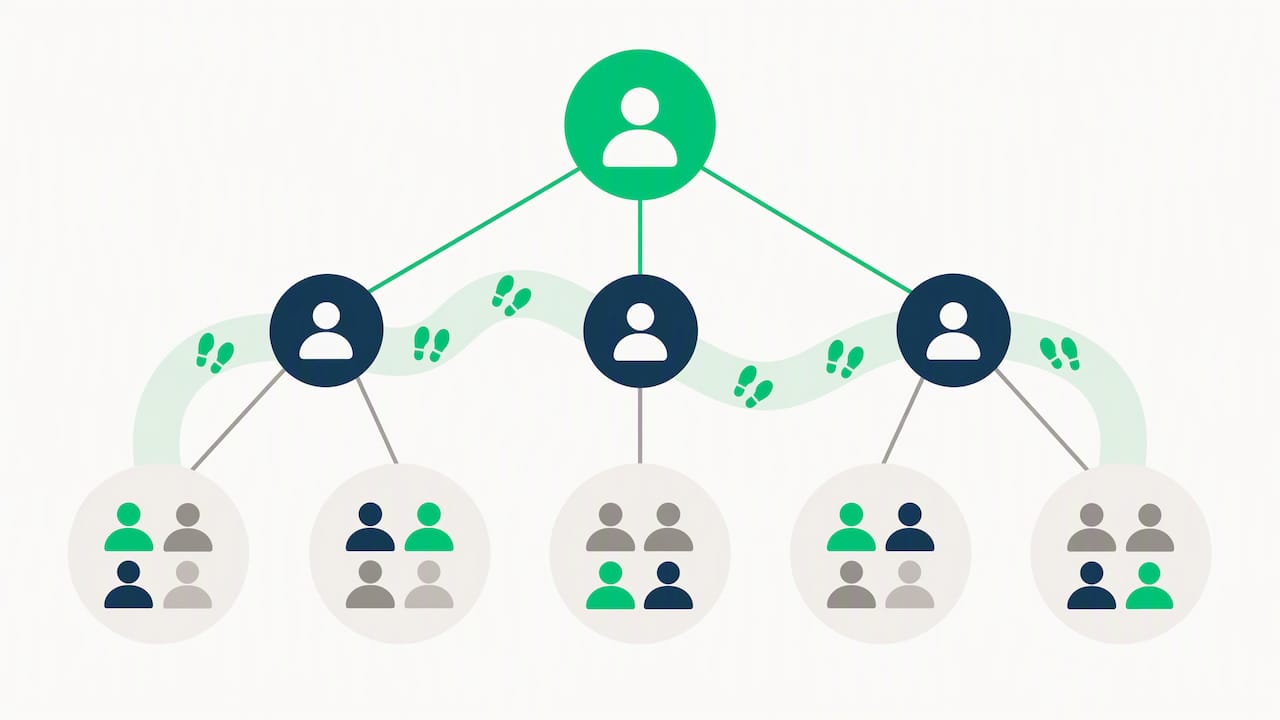
Grassroots champions work best when leaders are visibly behind them. The Merck case above ties together a champion network, supportive conditions and sustained communication. The Mayo Clinic’s joy-in-the-workplace initiative goes further: every employee has the opportunity to become a well-being champion. Employees also report that encouragement from a supervisor can help people who would not otherwise enroll, as the participation-barriers study describes.
The lesson for your design: pair peer champions with a senior sponsor who takes part publicly. If an executive logs a walk and shares it, champions have permission to do the same.
Measure what matters
A movement challenge produces tempting numbers, but do not let one number stand for everything. We suggest tracking four things separately:
- Participation: the share of employees who join, by site and role.
- Movement: total miles or active minutes, and how many people keep logging after the first month.
- Perceived well-being: a short pulse survey before and after, such as energy, stress and sense of connection.
- Charitable impact: dollars donated and causes supported.
The CDC’s guidance, as summarized in the Pronk paper, stresses leadership, relevance, partnership, communications, data-driven design and compliance. That last one is practical: decide who sees individual data, tell employees plainly, and report team totals rather than personal details.
There is also an equity angle. A CDC scoping review of workplace culture of health examines whether employer programs address health inequities. Compare participation across locations and job types, and if one group is missing, ask its champion why.
Perspective: what we have learned about champions
We think the best wellness champions programs are built on a simple idea: people join for a reason that matters to them, and they stay because it is easy. Fitness alone is a narrow reason. Many employees will never be excited by a step count. They are, however, willing to take a walk when it helps a cause they picked.
That is why we built Charity Miles around purpose. Charitable giving gives relevance and meaning to everyday movement, and it gives a champion a conversation that is not about weight, speed or ability. At the same time, purpose does not replace program design. You still need leadership support, a manageable role for champions, clear communications and honest measurement. Our job is to make the activity part effortless so your champions can spend their limited hours on people.
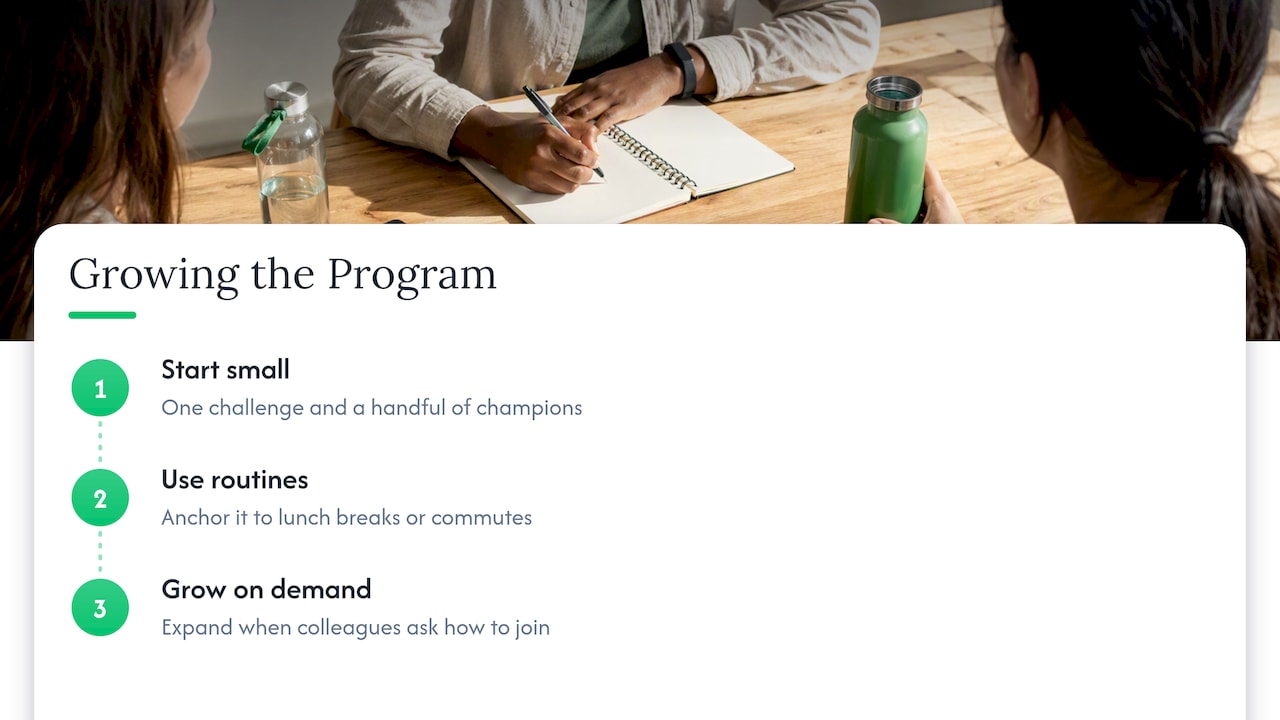
Our advice: start small, with one challenge and a handful of champions. Anchor it to routines people already have, such as the lunch break or the commute. Let it grow once colleagues start asking how to join.
— Gene
Ready to give your champions a challenge?
If you are an HR, CSR or wellness leader planning a champions network, see how our Employee Empowerment Program lets you set up private teams, choose your sponsorship terms and give champions a purposeful activity from day one. If you want to sponsor miles at a larger scale, our corporate sponsorship options are the place to start.
FAQ
How much time should a wellness champion spend?
Published U.S. programs range widely. UCSF describes an average of about 1 hour a month, Indiana asks for no more than 4 hours, and UNC allows up to 8 hours a month. Start at the low end, put the cap in writing and raise it only if champions ask.
How many champions does a company need?
There is no fixed ratio. UNC requires a committee of 4 to 12 people, which is a sensible starting range for one division or a mid-size company. Make sure each site, shift and major job group has at least one champion.
Is a wellness ambassador program the same thing?
In most workplaces, yes. Ambassador and champion are two names for the same peer-led role: a volunteer who promotes resources and encourages participation. Choose whichever label fits your culture and define the duties clearly.
Do champions need health training?
Not clinical training. They need onboarding on the program, its resources and its limits. Champions should point colleagues to qualified professionals, such as a doctor or your employee assistance program, for medical or mental health concerns, not advise on them.
Can a charity-based challenge replace a wellness champions program?
No, it works best as one part of it. The challenge gives champions a shared activity, while the program supplies the structure: sponsors, time allowances, meetings, goals and measurement.
Sources
- UNC Human Resources: Wellness Champions
- UCSF Human Resources: Wellness Champions
- State of Indiana: Wellness Champions
- WorkWell NYC: Wellness Champion Program
- Implementing movement at the workplace (CDC)
- Effectiveness of worksite wellness programs based on physical activity: a systematic review
- Workplace Culture of Health and Equitable Workforce Well-Being: A Scoping Literature Review
- Barriers and facilitators for participation in workplace health promotion programs
- Building a Culture of Health and Well-Being at Merck
- Joy in the Workplace: The Mayo Clinic Experience
- Berry and Mirabito on employer wellness and behavior change