
Movement-based charity challenges work as embedded CSR: they raise real money, boost participation, and improve wellbeing all at once, without the overhead of a one-off fundraiser. The fix is straightforward: run an inclusive, trackable challenge with a clear sponsorship model, and use a platform built for it, like Charity Miles. The immediate next step is simple. Pick a four-week pilot, set a modest sponsorship cap, and let the results make the case for scaling it.
TL;DR:
- Movement-based charity challenges increase participation by including all activity types, such as walking and biking, with no minimum pace or distance required.
- A private, company-only team structure and low sponsorship caps promote trust, inclusivity, and sustained engagement, as demonstrated by HARMAN’s success with over 1,200 employees.
- Setting clear, multiple goals—participation, donation, and wellbeing—helps track program impact and secure ongoing support from leadership.
- Running a four-week pilot with a modest sponsorship cap and comprehensive reporting forms a strong foundation for scaling future challenges.
- Prioritizing recognition and storytelling over prize budgets maintains high participation past week two and fosters a genuine culture of embedded CSR.
Table of Contents
- Why Fitness-Linked Charity Challenges Boost Engagement and Wellbeing
- How to Design a Fitness-Based Employee Giving Program
- A 4-Week Inclusive Fitness Challenge Template
- Measuring Results: KPIs That Prove ROI and Wellbeing Impact
- What HARMAN’s Charity Miles Program Actually Achieved
- Step-by-Step Timeline for Launching Your First Challenge
- How to Evaluate a Fitness-Challenge Vendor Platform
- Managing Privacy Risk When Tracking Employee Movement
- The Overlooked Gap in Most Workplace Wellness Advice
- How Charity Miles Makes This Easy to Run
- Sources
- FAQ
Why Fitness-Linked Charity Challenges Boost Engagement and Wellbeing
The link between corporate social responsibility and employee behavior isn’t a soft correlation. A meta-analysis of employee perceptions found medium-to-large effect sizes tying CSR perception to engagement, commitment, job satisfaction, and organizational citizenship behavior, with employee identification acting as a key mediator in several of those outcomes. In plain terms: when employees see their company doing good, they work harder, stay longer, and help colleagues more often, largely because they start to see the company’s values as their own.
The type of CSR matters just as much as its presence. Research on 297 employees found that embedded CSR reduces turnover intentions directly, while peripheral CSR, the kind that lives in a press release rather than a daily habit, only works indirectly through organizational citizenship behavior. A movement-based charity challenge sits squarely in the embedded category because it happens inside the workday, not around it.
What actually drives participation:
- Meaning: employees choose the cause, so the effort feels personal rather than assigned.
- Social identity: team-based formats turn individual movement into shared purpose.
- Gamification: leaderboards and mini-challenges add friendly competition without pressure.
- Low-barrier inclusivity: counting every walk, ride, or commute removes the fitness gatekeeping that kills participation in step challenges.
Statistic Callout: Companies weaving CSR into daily employee activity see stronger identification and retention effects than companies running CSR as a separate, occasional initiative.
How to Design a Fitness-Based Employee Giving Program
Before you launch anything, get four decisions locked with your CSR and finance stakeholders. Skipping this step is the most common reason these programs stall after week one.
- Set three goals, not one. Pick a participation target (say, 40% of eligible employees active weekly), a donation target tied to your sponsorship cap, and a wellbeing signal you’ll track through a pulse survey.
- Choose your sponsorship model. Decide between a flat per-mile company match, a capped pool split across the team, or a hybrid where the company matches employee-selected charities up to a limit. Charity Miles lets companies set the rate per mile, the total cap, and whether funds go to employee-chosen or company-selected causes.
- Write the inclusivity rule once, and repeat it everywhere. Walking counts. Biking to work counts. A ten-minute lunch loop counts. There is no minimum pace or distance requirement, because the goal is participation, not athletic performance.
- Pick your team structure and cadence. Four-week cycles with department-based teams of 8 to 15 people balance camaraderie against fatigue.
- Line up the budget categories. Sponsorship dollars, recognition items (shoutouts, small prizes), internal communications, and the modest admin time needed to run reporting.
Pro Tip: Cap the sponsorship per employee, not just per team. An uncapped per-mile match can accidentally reward overexertion instead of steady, sustainable movement.
A 4-Week Inclusive Fitness Challenge Template
Structure beats improvisation here. A tight four-week arc with clear weekly beats keeps momentum without burning out your comms team.
Pre-launch (the week before kickoff):
- Publish sign-up instructions and a plain-language privacy notice covering what movement data is collected and why.
- Explain how to join a team inside the app and confirm the sponsorship terms in writing.
- Send a kickoff email that names the charity options and the company’s matching commitment.
Week 1: Onboarding and baseline. Everyone logs their first miles, teams see an early leaderboard, and HR shares one short story about why the challenge exists.
Weeks 2 and 3: Sustained engagement. This is where most programs either build momentum or lose it.
- Run a cross-team match challenge (highest average miles per person, not raw totals, to keep it fair).
- Spotlight two or three employees each week, focusing on effort and consistency, not speed.
- Send a mid-run nudge highlighting the running donation total.
Week 4: The close. Push for a final surge, tally the total dollars raised, and share concrete impact language, like how many meals or hours of support the total funds buy. Close with a company-wide recognition moment and a short internal report for leadership. Charity Miles’ fitness challenge ideas offer ready-made themes if you want a head start on the weekly hooks.
Measuring Results: KPIs That Prove ROI and Wellbeing Impact
Executives want numbers, not vibes. Track a small set of metrics consistently and you’ll have a real story to tell by week four.
Engagement metrics:
- Participation rate (percent of eligible employees who logged at least one activity)
- Active days per person across the challenge window
- Total miles logged and dollars raised per employee
Wellbeing proxies:
- A two-question pulse survey on energy and stress, run before and after the challenge
- Absenteeism trends during the challenge window
- Any movement on your existing engagement-survey scores
CSR metrics:
- Total dollars donated and number of charities supported
- Internal and external reach of any recognition posts or newsletters
Statistic Callout: Programs that embed CSR into daily routines, rather than treating it as a once-a-year event, show stronger links to talent retention through motivation and trust than programs run as isolated campaigns.
Report these numbers biweekly during the challenge and roll them into a one-page summary afterward. That single page is what gets you budget for the next cycle.
What HARMAN’s Charity Miles Program Actually Achieved
Numbers convince skeptics faster than theory does. Since HARMAN launched its Charity Miles team in 2021, employee participation grew 11x, with more than 1,200 employees generating over $120,000 for charity.
The jump wasn’t driven by a bigger prize pool or a flashier app screen. It came from three structural choices: a private team that made the challenge feel like theirs, inclusive counting rules that let every employee participate regardless of fitness level, and full company control over how sponsorship dollars were allocated.
Three things worth replicating from that result:
- Keep the team private to your company. A closed group builds trust faster than an open, public leaderboard.
- Set the inclusivity bar low from day one. HARMAN’s growth wasn’t about elite runners logging more miles; it was about far more people logging any miles at all.
- Let the company decide the sponsorship structure up front, rather than negotiating it mid-challenge.
Step-by-Step Timeline for Launching Your First Challenge
Give yourself six weeks from decision to celebration. Rushing the setup phase is the fastest way to end up with a confused rollout and low sign-ups.
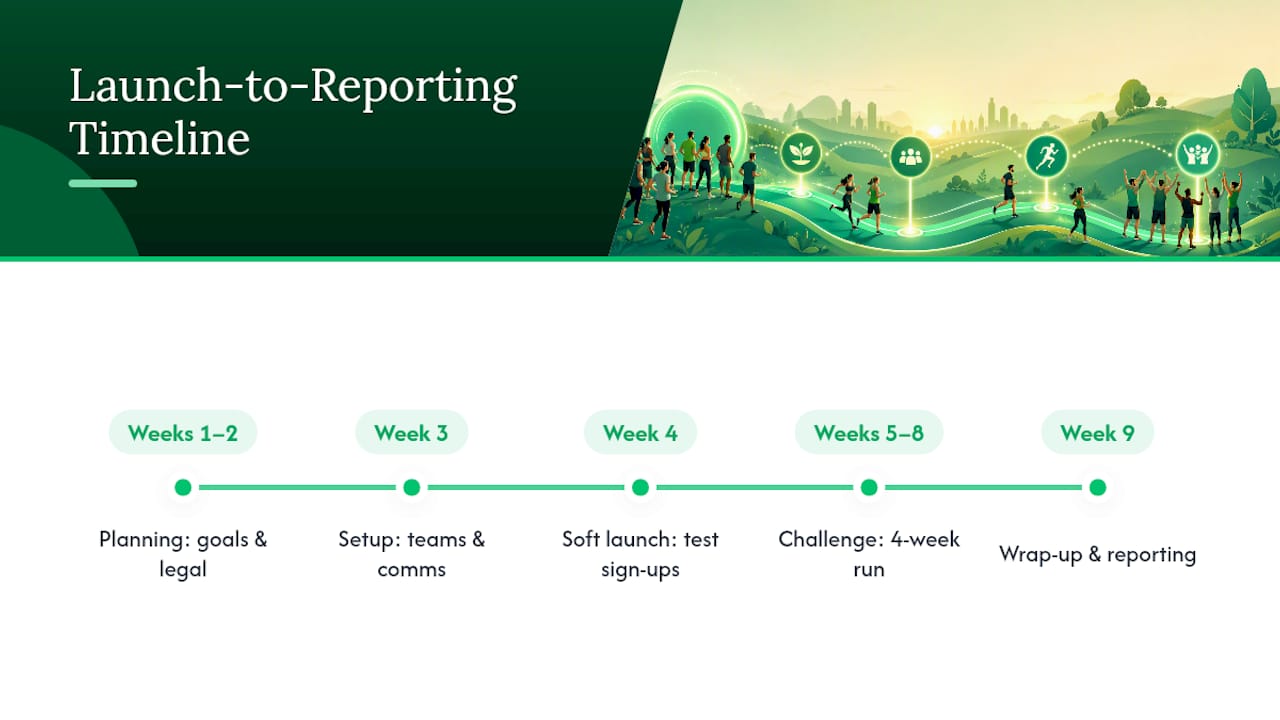
Weeks 1 to 2 (planning): Confirm your three program goals, finalize the sponsorship model and cap, and choose your platform. Draft the privacy notice and get it reviewed by legal or compliance.
Week 3 (setup): Configure private teams, load charity options, and build your communications calendar. Brief team leads so they can champion sign-ups inside their own departments, since peer invitations outperform company-wide blasts.
Week 4 (soft launch): Open sign-ups a few days before the official kickoff so early adopters can test the tracking flow and surface any confusion before the full rollout.
Weeks 5 through 8 (the challenge itself): Run your four-week cycle as designed, with weekly check-ins on participation numbers so you can course-correct fast if one team is lagging.
Week 9 (wrap-up and reporting): Tally the final donation total, publish the impact summary, and hold a short recognition event. Immediately survey participants while the experience is fresh; that feedback shapes your second cycle far more than a survey run months later.
Treat the first cycle as a pilot, not a permanent commitment. A six-to-nine week timeline gives you enough runway to test the mechanics without overcommitting budget before you know what resonates with your workforce.
How to Evaluate a Fitness-Challenge Vendor Platform
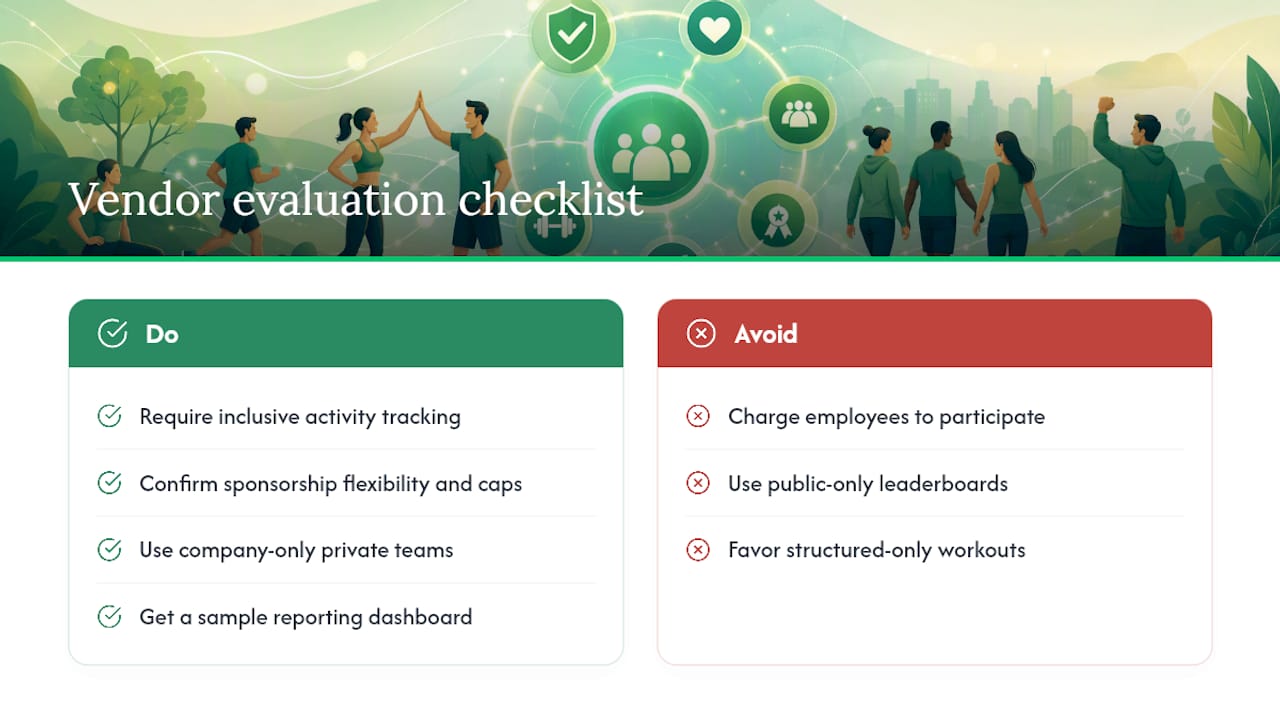
Not every step-tracking app is built for corporate CSR, and the gap shows up fast once you try to run private teams or route donations. Evaluate any vendor against five practical criteria before signing anything.
Inclusivity of tracked activity. Does the platform count walking, biking, and short commutes, or does it favor structured workouts that exclude less athletic employees? A platform that only rewards intense activity will quietly shrink your participation numbers.
Sponsorship flexibility. Can your company set the per-mile rate, the total cap, and choose whether funds go to employee-selected or company-selected charities? Charity Miles builds this control directly into its Employee Empowerment Program, which matters if your CSR team wants to direct funds toward strategic partners some cycles and let employees choose freely on others.
Private team structure. A closed, company-only environment tends to outperform an open public leaderboard because employees are competing with people they actually know.
Reporting depth. Ask for a sample dashboard before you commit. You need participation, mileage, and donation totals in a format you can hand straight to leadership.
Cost to employees. Confirm the app itself is free for individual users. Any platform that charges employees to participate in a company wellness initiative undermines the entire pitch.
Managing Privacy Risk When Tracking Employee Movement
Movement data is personal, even when it’s just miles and minutes. Treat it that way from the first announcement email.
Start with consent, not assumption. Employees should opt in explicitly, understand exactly what’s tracked (typically distance and activity type, not real-time location history), and know they can leave the challenge at any time without consequence. Publish a short, plain-language privacy notice before sign-ups open, not buried in a longer HR policy document nobody reads.
Limit what you actually collect. You don’t need granular GPS trails to run a successful challenge. Aggregate mileage and participation counts are enough to hit your KPIs, and collecting less data reduces both your compliance burden and the chance employees feel surveilled.
Separate wellness data from performance reviews entirely. The moment employees suspect their walking habits are feeding into a performance conversation, participation drops and trust erodes. Make that separation explicit in your communications, not just in policy.
Finally, vet your vendor’s data practices directly. Ask how long activity data is retained, who inside the company can see individual-level detail versus aggregate team numbers, and whether the platform sells or shares data with third parties. A program that fails on privacy will lose the goodwill it was built to create.
The Overlooked Gap in Most Workplace Wellness Advice
Most workplace wellness content treats fitness challenges as a nice-to-have layered on top of the “real” CSR program, the annual volunteer day or the year-end donation match. The research doesn’t support that hierarchy. Embedded CSR activities, the ones woven into daily work rather than scheduled once a year, show a more direct relationship to reduced turnover than peripheral programs do. A movement-based challenge that runs quarterly and touches every employee’s daily routine is, structurally, a stronger retention lever than a single volunteer afternoon.
The conventional advice also overemphasizes prize budgets. What sustains participation past week two is recognition and storytelling, not gift cards. Spotlighting a colleague’s consistency or sharing what the donation total actually funds does more than a bigger prize pool ever will.
If you take one thing from this playbook, prioritize the inclusivity rule over everything else. A program that only rewards runners will always underperform one where a ten-minute walk counts the same as a five-mile ride. Get that right before you touch sponsorship math or leaderboard design.
— Gene
How Charity Miles Makes This Easy to Run
Certain platforms offer private company teams, control over sponsorship rate and cap, and inclusive tracking that counts walking, running, and biking equally, so participation isn’t limited to the most athletic employees.
Start with a single four-week pilot. Set a modest sponsorship cap, choose whether donations go to employee-selected or company-selected charities, and use the built-in reporting to bring real numbers to your next CSR review. It’s the same structure that helped HARMAN grow participation 11x and raise over $120,000 for charity. Visit the Employee Empowerment Program page to see how private teams work, or explore Corporate Sponsorship Opportunities if you’d rather sponsor an existing employee movement than build a challenge from the ground up. Request a walkthrough and see what a pilot could look like for your team.
FAQ
What Is an Embedded CSR Fitness Challenge?
It’s a charity fundraising program woven into daily employee movement, like walking or biking, rather than run as a single annual event. Research shows embedded CSR reduces turnover intentions more directly than one-off initiatives.
How Long Should a Corporate Fitness Charity Challenge Run?
Four weeks is the recommended cycle length, long enough to build momentum without causing fatigue. Most companies pair it with a two-week setup window before launch and a wrap-up week for reporting.
Does Charity Miles Cost Anything for Employees?
No, the Charity Miles app is free for individual users, and companies control the sponsorship terms through the Employee Empowerment Program. Pricing for the corporate program itself is available directly through Charity Miles.
What Counts as Movement in an Inclusive Fitness Challenge?
Any tracked walking, running, or biking activity counts, including short walks and bike commutes, with no minimum pace or distance required. This inclusive counting approach is what keeps participation high across all fitness levels.
How Do You Measure Wellbeing Impact From a Fitness Challenge?
Use a short pulse survey on energy and stress before and after the challenge, alongside absenteeism trends and any shifts in your regular engagement survey. These proxies work alongside participation and donation totals to show a fuller picture of impact.