

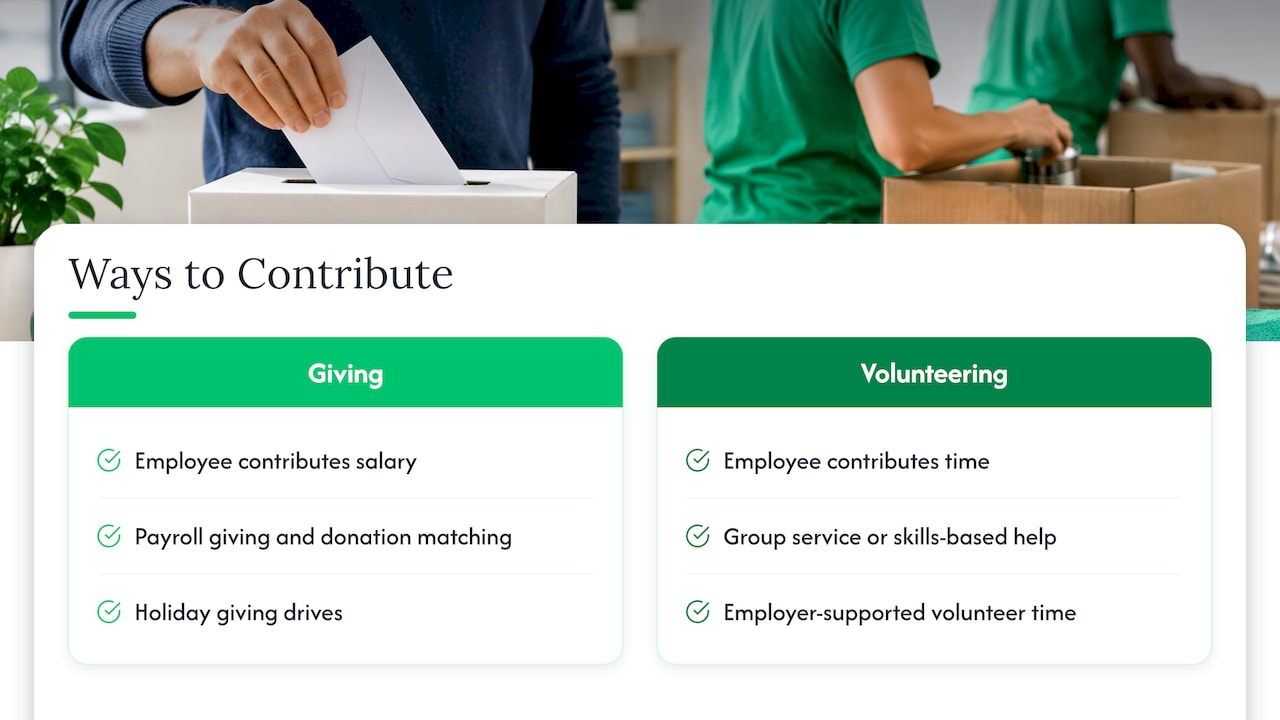
Workplace giving and volunteering are not rivals. Workplace giving moves money to charities through payroll deductions, matches and giving drives. Volunteering moves employee time and skills. Most companies get the best result by offering both. They also add a low-barrier way in, so the employees who never sign up for either can still take part. Movement is a good example: when every mile an employee walks, runs or bikes becomes a donation, giving and doing happen in the same action. That is the idea behind the Charity Miles Employee Empowerment program.
This guide explains the difference, what the evidence says about each, and how to decide what fits your people. It is written for HR, CSR and wellness leaders. Individuals and charities will find their own angle too.
TL;DR
- Workplace giving is money: payroll deductions, employer matches and giving campaigns. Volunteering is time and skills, on or off the clock.
- Each does something the other can’t. Money is flexible and steady for charities. Volunteering builds connection to a cause and, in the research, is linked to better well-being.
- Giving and volunteering overlap among donors. A 2020 Fidelity Charitable report found that 62 percent of philanthropic individuals had recently volunteered.
- Participation is the real hurdle. Programs that let any movement count, from a lunchtime walk to a bike commute, lower the barrier for all fitness levels.
- The strongest programs offer a menu: giving, volunteering and an easy everyday option, with the company deciding how much to sponsor.
Table of Contents
- What workplace giving and volunteering each mean
- How big workplace giving really is
- What volunteering adds that a payroll deduction does not
- Side by side: giving, volunteering and activity-based giving
- What the evidence says about people and well-being
- How leading employers combine both
- The gap neither option closes: everyday participation
- A simple way to decide
- What this means for individuals and charities
- Our perspective
- Start a team-based program for your company
- FAQ
- Sources
What workplace giving and volunteering each mean
Workplace giving covers the ways an employer helps employees donate money. The classic form is payroll giving, where a regular amount comes out of each paycheck and goes to charity. Fidelity Charitable takes a wider view: it describes workplace giving programs as any employee benefit that supports and encourages donating or volunteering, including donation matching and holiday giving drives. A match means the company adds its own dollars to what an employee gives.
Employee volunteering is donated time. It can be a group day at a food bank, a skills-based project such as helping a nonprofit with its finances, or an individual choice that the employer supports. Some employers pay for the hours through volunteer time off (VTO), and some turn volunteer hours into dollars for the charity, which is called a volunteer grant.
The terms blur in practice, which is why search results mix them. The useful distinction is what the employee contributes: a portion of salary, or a portion of the workday.
How big workplace giving really is
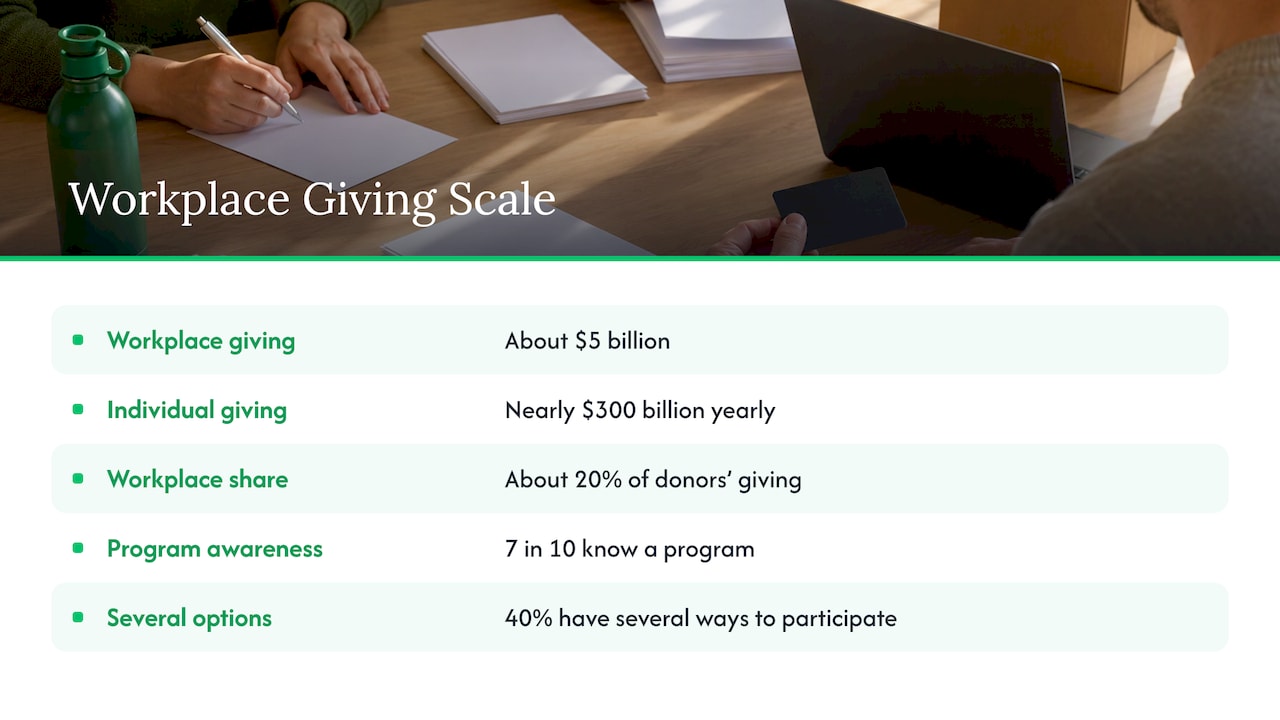
Workplace giving is a meaningful channel but a modest one. The Urban Institute estimates that aggregate American workplace giving is roughly $5 billion, a small share of the nearly $300 billion that individuals give each year. The same report notes that donors who give at work typically make about 20% of their overall giving through that channel.
The point for a company is that workplace giving does not need to be huge to matter. For the employee it is a convenient habit, and for the charity it is steady income that arrives without a fundraising event.
Awareness is already high. Fidelity Charitable’s report states that seven in 10 employees know of at least one workplace giving program their employer offers, and forty percent have several ways to participate, with large companies offering the most options. Having a program is no longer the differentiator. Whether employees use it is.
What volunteering adds that a payroll deduction does not
Volunteering brings something money alone does not: closeness to the cause. Fidelity Charitable’s research on volunteering says that, when it is meaningful, volunteers can give charities labor, financial support, network connections, professional skills and advocacy. It also says those opportunities help nonprofits build lasting connections with current and future donors.
The overlap is large. The same report notes that before the pandemic, 62 percent of philanthropic individuals had recently volunteered. People who give money often give time too, so a program that supports only one leaves value on the table.
The Urban Institute’s Balancing Act study adds a design lesson for charities. Organizations that rely on volunteers report higher net benefit scores, and the best results come when volunteers have a variety of roles, from direct service to bookkeeping to advocacy. Charities that use volunteers mainly for office tasks score notably lower. If you are a charity, that is a reason to offer supporters more than one way to help.
One practical accounting note: volunteer hours are not tax-deductible for donors and should not appear in a nonprofit’s financial statements, though tracking them is still useful for internal reporting and for showing community support to funders. Employees who want a tax deduction should look at money gifts and ask their tax adviser about their own situation.
Side by side: giving, volunteering and activity-based giving
| Workplace giving | Volunteering | Activity-based giving | |
|---|---|---|---|
| What employees contribute | Money from pay | Time and skills | Everyday movement, which triggers a donation |
| Who funds the donation | The employee, often with an employer match | No cash donation unless the employer converts hours to a grant | The company or sponsor, on terms it sets |
| Effort to join | Low once set up | Higher: scheduling, travel, time away from work | Low: any walk, run or ride counts |
| Best at | Steady, flexible funding | Connection, skills, team bonding | Broad participation and wellness |
| Tax treatment for the employee | Donations may be deductible; ask a tax adviser | Hours are not deductible | Depends on how the company structures it |
The third column is where Charity Miles sits. Members walk, run or bike, the app tracks distance by GPS and pedometer, and money is donated to the member’s chosen charity for every mile. The app is free for members and free for charities. In a company program, the employer can choose the rate per mile, the total sponsorship cap, and whether donations go to each employee’s chosen charity or to a company-selected cause.
What the evidence says about people and well-being
The reason to care about this choice is not only dollars. It is also how employees feel about their work and each other.
- Values alignment. Fidelity Charitable’s study found that 86% of employees say it is important for an employer’s values to align with their own, and 35% of Millennial and Gen Z workers say their workplace giving programs factor into staying at their current job.
- Participation is growing. The Association of Corporate Citizenship Professionals’ 2025 survey found that 61% of CSR professionals reported increased employee participation in workplace volunteer programs, the third consecutive year of growth since pandemic lows.
- Feeling better. A 2016 national survey of 2,705 U.S. adults, run for UnitedHealthcare and VolunteerMatch, found that 93 percent report an improved mood and 79 percent lower stress levels from volunteering. It also found that almost three-fourths of employees who volunteer through work feel better about their employer.
- A standout in wellness research. A 2024 study in the Industrial Relations Journal analyzed responses from 46,336 workers across 90 interventions. Charity or volunteer work was the single notable exception, with workers appearing to have improved well-being. The study was done in the United Kingdom, but the signal is clear: meaning does something that many wellness perks do not.
- Participation can scale. A five-year VTO initiative at Baylor College of Medicine’s School of Health Professions, reported in Medical Science Educator, saw participation rise from 4% to 95%, with 90% of respondents satisfied.
Taken together, the lesson is that purpose-driven activity helps retention, mood and loyalty. That is true whether the activity is a donation, a volunteer shift or a mix.
How leading employers combine both
Large employers rarely choose one. They build a menu.
- In 2025, Solventum matched eligible employee donations and volunteer time, resulting in over $760,000 in combined giving to more than 1,900 nonprofits.
- IDEX offers employees up to $500 in annual matching contributions and a Dollars-for-Doers initiative that matches $20 per hour of volunteer work. In 2024, employees volunteered 4,736 hours through Foundation-led events.
- Novartis lets permanent-contract employees choose when, where and how to engage, with no upper limit on giving or volunteering hours, and volunteering is allowed during work hours.
- Eaton’s community involvement teams run employee-giving campaigns and organize volunteer activities side by side.
The common thread is choice. Employees pick the cause and the way to take part. That matters for mid-size companies without a foundation or a large budget, who still want the same breadth.
The gap neither option closes: everyday participation
Payroll giving asks for money, and for many employees that is a personal budget decision. Volunteering asks for time, and a scheduled group day is hard for shift workers, remote employees and parents. Both work well for the people who opt in. The challenge for HR and CSR teams is the large group who would care but never take the first step.
Three design principles help.
- Make the first step tiny. If joining takes one tap and one walk, more people join. Any movement counts in Charity Miles, so a lunchtime walk qualifies the same way a long run does, and the program is inclusive of all fitness levels.
- Let people pick the cause. Choice ties the activity to personal values, which is what the values-alignment research points to. Our own HR playbook on employee charity choice goes deeper on this.
- Make it social. Private teams and friendly intra-company challenges turn an individual habit into shared culture instead of a one-off event.
A step challenge is the familiar model. Activity-based giving adds a purpose to it: the miles mean something beyond a leaderboard.
A simple way to decide
Use these questions to set the mix for your company.
- What is the goal? If it is steady funding for specific nonprofits, start with payroll giving and a match. If it is culture and connection, add volunteering. If it is participation and well-being across the whole workforce, add an everyday activity option.
- Who works for you? Mostly desk-based, hybrid or distributed teams usually find scheduled volunteer days hard to attend. A program employees can do from anywhere fits them.
- What can you sponsor? Decide a rate and a cap you are comfortable with, and whether donations follow each employee’s choice or a company cause. In Charity Miles, the company controls both.
- How will you report? Track dollars, hours and participants from day one, so leadership sees results in the same terms.
- Can employees stay with it? A one-day event fades. A program that fits into existing routines, such as the commute or the lunch break, keeps going.
For more on the trade-offs between employee giving and corporate sponsorship, see our piece on employee giving vs corporate sponsorship. If volunteering is your priority, our guides to corporate volunteering ideas and what employee volunteer programs actually deliver cover it in depth.
What this means for individuals and charities
If you are an individual, you do not have to choose between getting fit and giving back. Download the free app, pick a charity, and every mile you log is donated on your behalf by a sponsor. If your employer offers a team, you can join it and compete with colleagues.
If you are a charity, this is a way to engage grassroots supporters who may not yet give or volunteer. Charity Miles is free for charities, and supporters can choose your organization as the cause their miles support. Pair that with the Balancing Act finding: variety in how people can help tends to benefit nonprofits. You can learn more on the Charity Miles page for charities.
Our perspective
We built Charity Miles on a simple observation: most people want to help, and most of them are stopped by friction, not by indifference. A form to fill in, a Saturday to clear, a donation to budget for. Each one is a small reason to wait.
That is why we do not think of workplace giving and volunteering as a contest. Money gives charities flexibility. Time gives employees a face to put to the cause. Both are good, and companies should keep them. What we add is the part in the middle: something people can do on an ordinary Tuesday without planning.
When a walk to the train or a lunchtime loop becomes a donation to a charity you picked, giving stops being a separate task. It becomes part of the day. When a company sponsors those miles on its own terms, choosing the rate, the cap and where the money goes, leaders get a program that is easy to run and easy to explain.
The results we are proudest of come from participation. Since launching its team in 2021, HARMAN saw an 11x increase in employee participation, with 1,200+ employees generating over $120,000 for charity. That is what a low barrier can do.
Gene
Start a team-based program for your company
If you want one program that adds everyday participation to your giving and volunteering, the Employee Empowerment program is built for that. Companies create private teams for their employees, run friendly challenges, and can sponsor miles by choosing the rate per mile, the total cap and where donations go. It reaches employees at every fitness level, from a lunchtime walk to a bike commute.
Brands and companies that want to sponsor a wider community can see the corporate sponsorship opportunities. Individuals can start with the free app.
FAQ
Is workplace giving the same as volunteering?
No. Workplace giving is about money, such as payroll deductions, employer matches and giving drives. Volunteering is about time and skills. Some programs bundle both under one umbrella, and Fidelity Charitable’s definition of workplace giving programs includes both donating and volunteering.
Which is better for a company: workplace giving or volunteering?
It depends on the goal, and many employers use both. Giving provides steady funding for nonprofits, while volunteering builds connection to the cause. An everyday activity option such as Charity Miles broadens participation for employees who are not drawn to either.
Is paid volunteering a thing?
Yes. Some employers offer volunteer time off so employees can volunteer during work hours. Novartis, for example, permits volunteering during work hours. Others convert hours to dollars through volunteer grants, such as IDEX’s Dollars-for-Doers match of $20 per hour.
Are volunteer hours tax-deductible?
No. Volunteer hours are not tax-deductible for donors. Money donations to qualified charities may be deductible, depending on your situation, so ask a tax adviser about your own return.
Can employees give to charity just by walking or running?
Yes. With Charity Miles, members walk, run or bike, the app tracks distance, and money is donated to their chosen charity for every mile. In a company program, the employer can sponsor those miles and set the rate and cap.
Sources
- Giving in the Workplace: How Companies and Employees Bring Giving to Work (Fidelity Charitable)
- The Past, Present, and Future of Workplace Giving in the US (Urban Institute)
- The Role of Volunteering in Philanthropy (Fidelity Charitable)
- Balancing Act (Urban Institute)
- What Are In-Kind Donations? (GrantStation)
- 86% of employees say employer values should align with their own (Fidelity Charitable)
- Volunteerism Data for #GivingTuesday (ACCP)
- Doing Good Can Make You Feel Good: Study on Volunteerism
- Workplace Wellness Programs Have Little Benefit, Study Finds (The New York Times)
- The Triple Win: Institution-Sponsored Volunteer Time Off (Medical Science Educator)
- Sustainability and social impact initiatives (Solventum)
- The IDEX Foundation: A Decade of Giving
- Giving, Matching & Volunteering (Novartis)
- Community involvement (Eaton)