
Finding a workplace giving platform that aligns with global program needs, compliance, and ease of rollout challenges HR and CSR teams. Many popular options demand custom quotes, complex integrations, or lengthy setup that slow down adoption. This comparison highlights pricing, integration hurdles, and participant engagement so HR and CSR leaders can match a platform to their real needs without wasted time.
Table of Contents
- Charity Miles
- Benevity Enterprise Impact Platform
- YourCause by Blackbaud
- Groundswell
- Bonterra DEED
- Percent Pledge
- Comparison of Alternatives
Charity Miles
At a Glance
Companies can sponsor employee miles by setting a rate per mile and a total sponsorship cap, and choose whether donations go to employee-selected charities or a company-selected cause. The vendor advertises Charity Miles has operated since 2012 and has generated tens of millions of dollars for charities. The app is free for members and free for charities, supported by corporate sponsors and donations.
Core Features
Charity Miles logs movement using a phone pedometer and GPS and converts walking, running, or biking into donations for chosen charities. Companies create private teams for employees, run intra-company challenges, and set sponsorship terms including per mile rate and total cap. The app supports multiple charities and includes social sharing and community features that keep members visible to colleagues and supporters.
Key Differentiator
Every mile an employee logs can become a tangible donation under company-controlled sponsorship terms. That direct link between routine movement and measurable giving connects wellness, team activity, and CSR in a single member-driven workflow.
Pros
Charity Miles is free for individual members and for charities, so adoption barriers are low and employees can join without cost. Any movement counts, so members with varied fitness levels can participate and sustain momentum. Companies control sponsorship mechanics, which lets HR or CSR teams budget donations and choose whether funds follow employee choice or a company partner. The vendor advertises that HARMAN saw an 11x increase in participation after launching a Charity Miles team, with over $120,000 raised by 1,200 plus employees; that case illustrates how the platform can scale engagement when leadership backs it.
Cons
- Relies on member activity. Low average activity reduces campaign impact and makes corporate sponsorships less effective.
Who It’s For
This fits HR and CSR leaders at mid-size to enterprise companies that want regular employee participation rather than one-off events. It also suits wellness teams that want to tie daily movement to measurable giving. Charities and community organizations looking to grow grassroots support through active members will find it useful.
Unique Value Proposition
Companies can budget CSR spending by setting a per mile sponsorship rate and a total cap, turning predictable payroll or donation line items into recurring, measurable giving. That setup shifts part of donor acquisition to everyday employee behavior, so you measure both engagement and charity dollars as a single program metric. The platform remains free to members and charities, which lowers friction for broad internal adoption.
Real World Use Case
A global HR team launches a three month wellness challenge and creates private teams by department. The company sets a modest sponsorship rate per mile and a cap per team. Employees track daily walks and bike commutes, compete in friendly challenges, and generate visible donations that the CSR team reports to leadership and prospective hires.
Website: https://charitymiles.org
Benevity Enterprise Impact Platform
At a Glance
According to the company, Benevity reports a 99.7% payment success rate across more than 200 countries. The vendor also advertises that nearly 1,000 large enterprises use the platform. Benevity combines employee giving, volunteering, grants, and impact reporting into one enterprise SaaS solution built for global disbursement and compliance.
Core Features
Benevity bundles employee giving, volunteer tracking, grants management, employee groups, and challenge management into a single platform with unified reporting. The platform includes AI-native automation and risk detection, with tools such as Match Assurance and Grant App Summaries, plus dashboards and data export APIs for impact measurement. A global disbursement network and employee mobilization tools support remote and in-field participation.
Key Differentiator
The platform centers on AI-native automation and embedded risk management across its modules. That payment success figure and the vendors global reach underline where the product focuses: moving funds reliably while automating compliance checks and impact measurement at scale.
Pros
A single system reduces administrative overhead compared with multiple point solutions and centralizes audit trails for compliance. The reporting suite provides outcome-focused dashboards and exportable data for regulators and stakeholders. Global money movement, fraud detection, and the platforms automation capabilities improve accuracy and free CSR teams to concentrate on strategy rather than manual reconciliation.
Cons
- Implementation can be complex depending on organizational size and existing systems. This may require outside consultancy or extended internal project management.
- Cost details are not published and pricing is likely high for smaller organizations or immature CSR programs. Budgeting requires a custom quote.
- Adoption needs significant change management when replacing disparate tools and processes. Expect training and phased rollouts.
When It May Not Fit
Smaller organizations or companies with ad hoc CSR activities will find the scale and cost difficult to justify. Teams that need a lightweight donor platform or only local disbursement will likely prefer simpler, lower-cost tools. Organizations unwilling to commit to a multi-month implementation and change program should look elsewhere.
Notable Integrations
Benevity offers multiple API integrations for HRIS, payroll, ERP, and BI tools. Those integrations let you sync employee data, automate payroll donations, and push impact data into financial and analytics systems.
Who It’s For
Large enterprises with 1,000 or more employees and mature CSR programs that need centralized control, global disbursement, and compliance reporting will get the most value. Teams that must report outcomes to regulators or investors will benefit from the platforms audit and measurement features.
Real World Use Case
A global technology company unified employee donations, volunteering, and grants on Benevity to centralize compliance and reporting. The company used the built-in automation to reduce manual vetting and to generate impact reports for its board and regulators. That consolidation made program ROI visible to stakeholders.
Pricing
Price is not publicly listed. Benevity follows an enterprise SaaS model and provides custom quotes based on program scope, global reach, and integration requirements. Expect negotiation and a formal statement of work for large deployments.
Website: https://benevity.com
YourCause by Blackbaud
At a Glance
The vendor advertises AI-powered impact storytelling paired with an established network of vetted nonprofits and ACH electronic payments to speed funding. The platform sits inside Blackbaud’s broader ecosystem, which the company says improves data visibility across CSR work. That positioning targets teams that want program automation and richer impact narratives.
Core Features
YourCause combines employee giving, volunteering, and matching gift tools with grantmaking automation and an indexed, verified nonprofit network. The platform highlights automated impact reporting and storytelling driven by AI and supports electronic ACH disbursement for donations. It also ties into Blackbaud systems and common CRM solutions to centralize program data.
Key Differentiator
The most distinct element is that combination of AI storytelling and a large vetted nonprofit network. That combination aims to shorten the route from employee activity to visible impact and to speed funds to partners. For teams focused on measurable narratives and partner discovery, this pairing is the primary draw.
Pros
Deep ties to Blackbaud systems give you a single place for CSR data and reporting, which helps HR and CSR teams present consistent impact metrics. The verified nonprofit network reduces vetting time when you add corporate partners or employee-selected charities. Automation for grants and volunteer tracking reduces manual admin and keeps programs active without frequent hands-on maintenance. Electronic ACH payments move funds faster than paper checks, which helps nonprofit partners start work sooner.
Cons
-
Limited independent user feedback was provided, so reported ease of use and real-world challenges remain unclear.
-
The platform can feel complex for smaller teams that want a lightweight, plug-and-play giving solution.
-
Full functionality depends on Blackbaud’s ecosystem, which may require additional Blackbaud products or integrations.
When It May Not Fit
If your company runs a simple one-off giving program, this platform may be more capability than you need. If your IT environment does not include Blackbaud systems, integrating every feature may add time and cost. Small nonprofits or corporate teams with minimal staff might prefer a simpler standalone tool.
Who It’s For
HR and CSR teams at medium to large organizations that want automation, centralized reporting, and a broad nonprofit network. You will get the most value if your organization already uses Blackbaud products or has resources to manage integrations. Teams focused on storytelling and audited impact measurement will find the feature set relevant.
Real World Use Case
A multinational corporation uses YourCause to run global volunteer programs, automate grant approvals and disbursements, and generate AI-assisted impact stories for annual CSR reports. The company aggregates volunteer hours and donation flows into a single reporting view to share with executives and community partners. That consolidated output makes stakeholder reporting faster and more consistent.
Website: https://yourcause.com
Groundswell
At a Glance
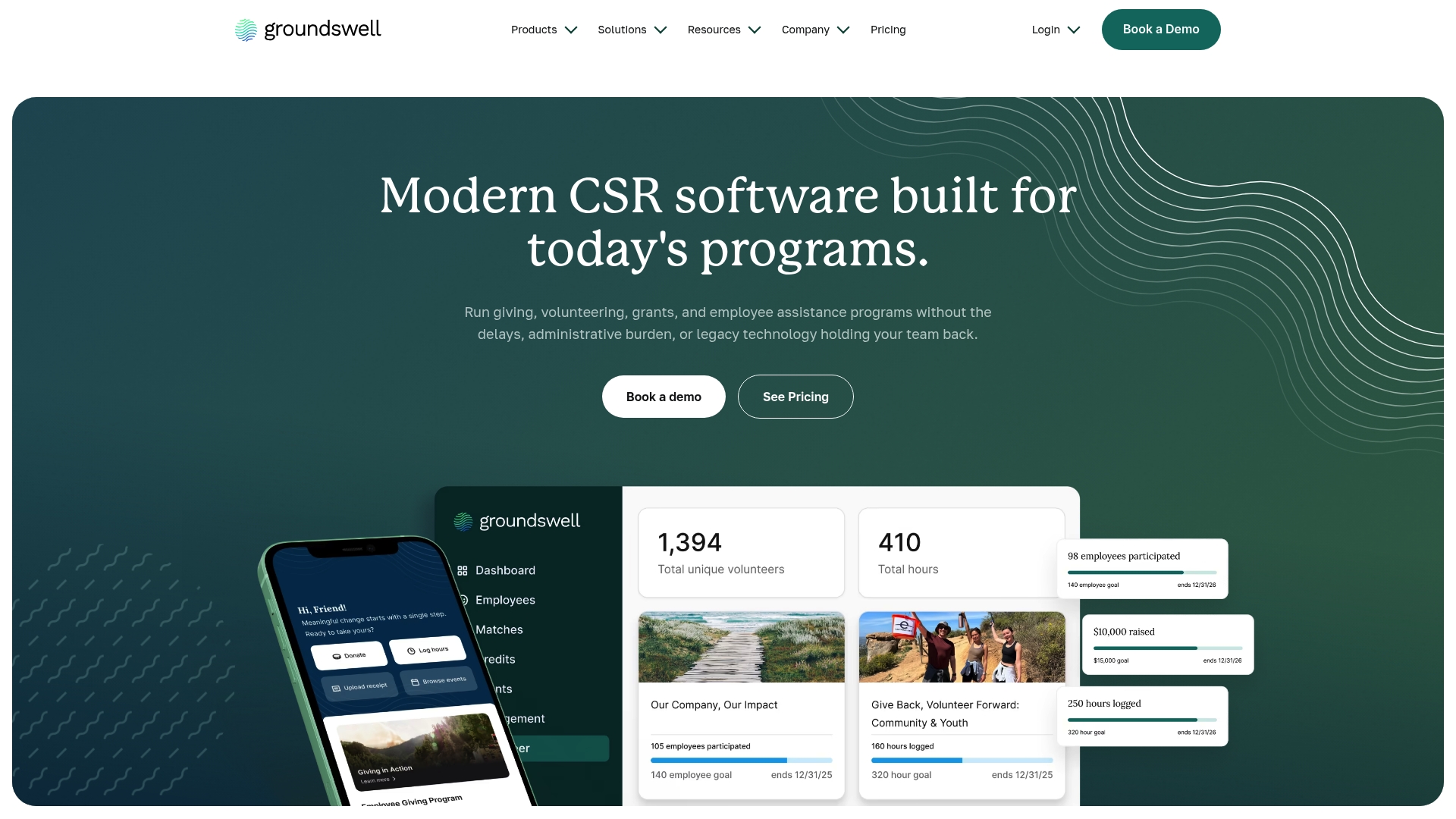
Groundswell’s marketing materials state funds are delivered within 24 hours. That quick disbursement claim targets companies that need fast support for employee hardship and grant payouts. The platform also emphasizes a single interface for giving, volunteering, grants, and reporting.
Core Features
Groundswell combines employee giving and matching, volunteer management, grant distribution, and employee assistance funds into one product. Grant workflows include AI-powered scoring, and reporting delivers unified impact analytics across web and mobile. The platform supports multiple languages, customizable branding, multiple donor-advised funds, and lists SOC 2 as its security standard.
Key Differentiator
That delivery claim sets Groundswell apart by promising near-immediate impact. Paired with its integrated feature set, the platform removes the need for separate volunteer, grants, and giving tools. The result aims to shorten the time from pledge to payout and centralize program data.
Pros
Groundswell earns strong marks for usability with an intuitive UI that reviewers describe as easy to navigate. The vendor advertises rapid fund delivery, which helps programs respond to employee hardship and emergency grants quickly. Offering giving, volunteering, grants, and reporting in one place reduces administrative handoffs and cuts reporting complexity. The mobile app helps reach distributed teams and supports localized content for global workforces.
Cons
-
Pricing tiers above the listed levels are not publicly specified, which makes budgeting for very large programs harder.
-
The product page lists few specific third-party integrations, so custom integrations may require vendor involvement.
-
Organizations needing highly specialized philanthropic features may find the platform less tailored to niche workflows.
-
Premium capabilities such as white labeling and API access appear tied to higher plans or custom contracts.
When It May Not Fit
If your team requires extensive out of the box integrations, Groundswell may require extra vendor work. Large enterprises seeking transparent enterprise pricing could find the published tiers too sparse. If you need built in, niche philanthropic modules not described here, another specialist tool may fit better.
Who It’s For
CSR and impact teams at medium to large enterprises that want a single platform for employee giving, volunteering, grants, and hardship funds. Organizations running global CSR programs will value language support and mobile access. Teams that need fast payouts and consolidated reporting will find this product relevant.
Real World Use Case
A multinational company runs global giving campaigns on Groundswell, letting employees donate and sign up for volunteer events in localized languages. Managers pull unified impact reports for each region and for corporate headquarters. Because the vendor advertises the fast payout timeline, the company uses the platform for employee hardship support as well.
Pricing
Groundswell lists tiered annual pricing: $4,500/year for Benefactor, $12,500/year for Philanthropist, and custom quotes for Visionary plans. Higher tier features such as white labeling and API access typically require the Visionary plan or a custom arrangement.
Website: https://groundswell.io
Bonterra DEED
At a Glance
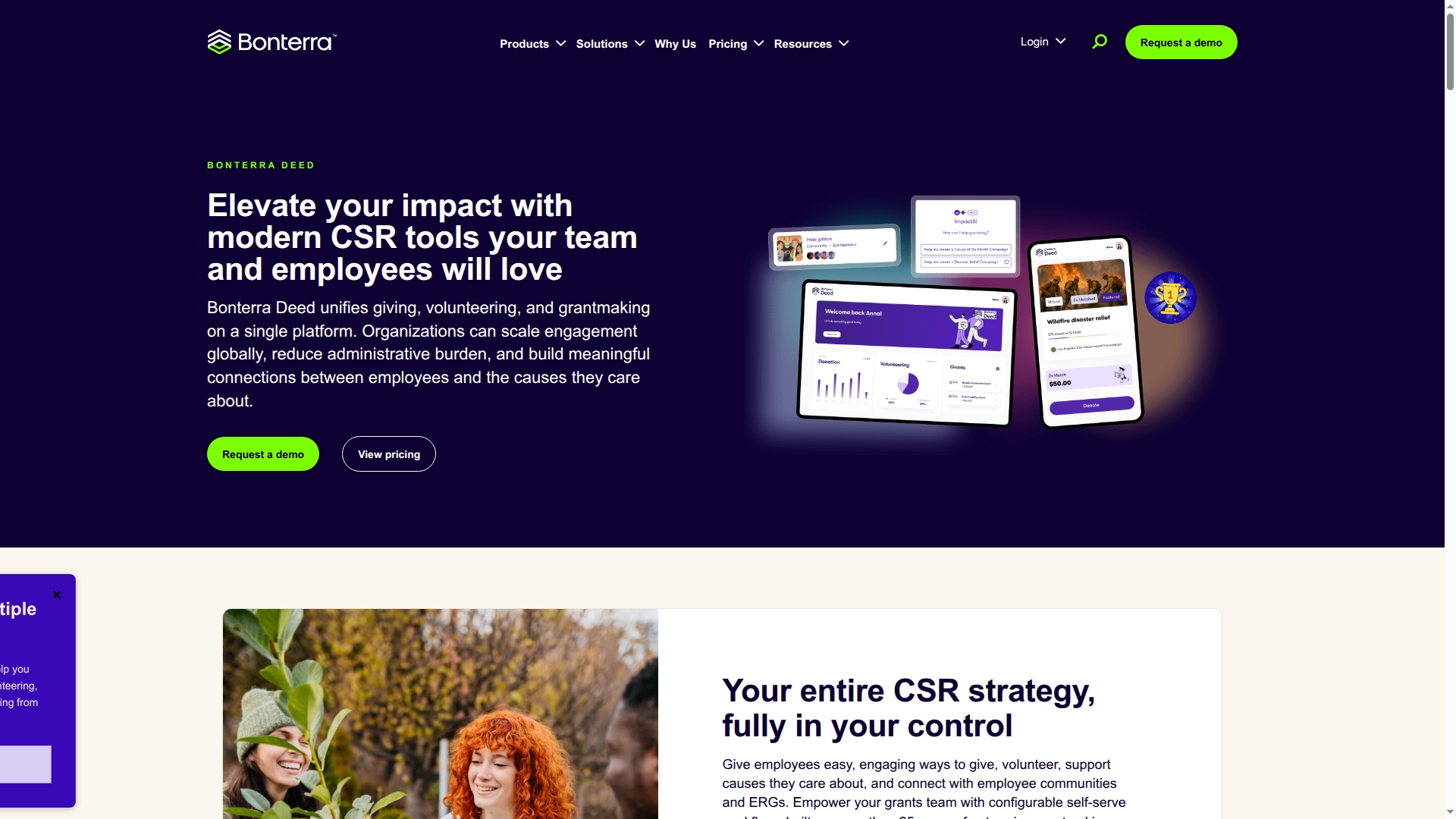
Bonterra Deed’s marketing materials state it supports programs in 170+ countries. The vendor advertises that many Fortune 100 companies and US financial institutions use the platform. Deed combines donations, volunteering, grants management, employee resource group support, and impact measurement into a single product aimed at enterprise programs.
Core Features
Deed centralizes giving, volunteering, and grantmaking while offering configurable workflows for enterprise grant processes. The platform uses AI-powered automation and personalization to reduce manual steps and tailor employee experiences. It also provides multilingual, multi-currency support and gamification tools such as badges and leaderboards for engagement.
Key Differentiator
The product’s standout claim is enterprise-focused AI automation and personalization that routes tasks, suggests matches, and accelerates approvals for scaled programs. That emphasis on automated workflows and tailored employee journeys is the chief angle that separates it from simpler giving tools.
Pros
The vendor reports a 2x increase in employee participation after deployment in some customers, which suggests the platform can boost engagement when adopted at scale. Deed centralizes multiple CSR activities into one administrative interface and offers real-time dashboards for impact tracking. Global support and AI automation reduce repetitive work for CSR teams and help localize campaigns across offices.
Cons
-
Setup complexity: third-party reviews note implementation can be complex for large organizations, with steep configuration work.
-
Pricing transparency: public materials give limited detail on costs, and pricing appears available only on request.
-
Change management needed: successful rollouts may require dedicated internal resources and communication plans.
When It May Not Fit
If your company favors lightweight, out-of-the-box tools with minimal setup, Deed may demand more implementation effort than you want. Organizations without a budget for enterprise licensing or without staff to manage change may struggle. If you need simple donor pages or point solutions rather than an integrated platform, this product could be the wrong scale.
Who It’s For
CSR and employee impact teams at large, multinational corporations that need unified management for giving, volunteering, and grants will find this product relevant. Teams that must run multilingual, multi-currency programs across many offices will benefit from its global features. You should have internal capacity for implementation and governance to get full value.
Real World Use Case
o9 Solutions used Deed to consolidate employee impact programs onto one system. The company reported higher participation and tighter impact reporting after the consolidation. Deed then served as the central source for program metrics and storytelling across global offices.
Pricing
Pricing is listed as available on request and follows an enterprise-tier model. Expect custom quotes based on modules selected, user counts, and localization needs since public figures are not listed.
Website: https://joindeed.com
Percent Pledge
At a Glance
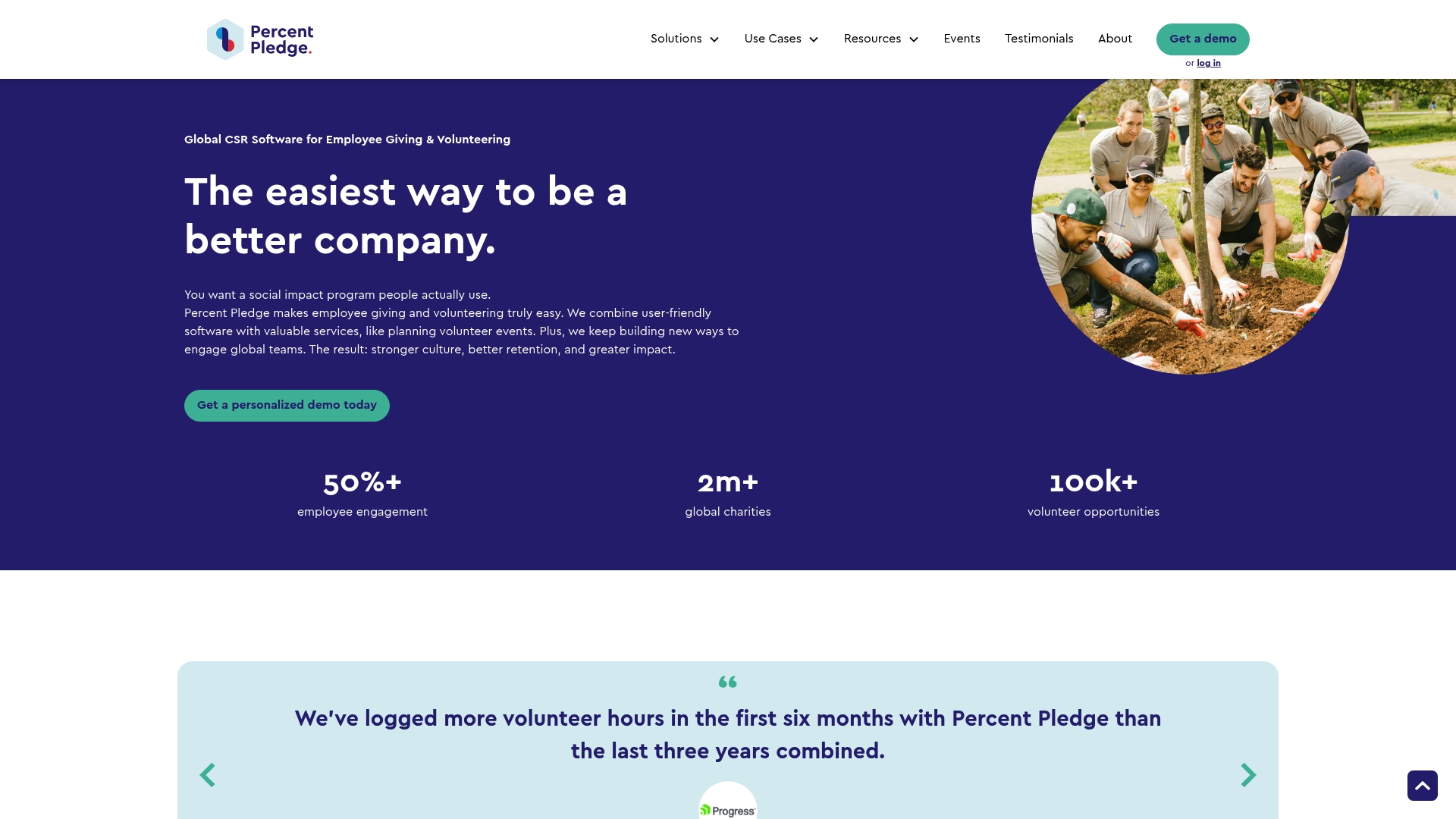
Percent Pledge reports logging over 2 million volunteer hours in six months. The platform pairs centralized donation and volunteer tracking with services for planning virtual and in person events. That mix targets companies that want measurable CSR activity without heavy internal project management.
Core Features
The product centralizes workplace giving, volunteer management, and volunteer events alongside impact reporting and campaigns. It includes tools named Feed Your Impact and Grow Your Impact for building measurable activities and planting impact trees. The platform also offers an AI communications kit, impact badges, charity vetting, and integrations with payroll and HR systems.
Key Differentiator
The vendor advertises the lowest donation fees industry wide, combined with an emphasis on ease of rollout and ongoing product changes. Percent Pledge pairs dedicated Social Impact Managers with product updates and new impact tools. That combination aims to reduce administrative friction while keeping programs fresh for employees.
Pros
The vendor reports employee engagement above 50% and states product updates arrive every two weeks. The system is highly intuitive, so teams can launch quickly with little training. Dedicated Social Impact Managers provide hands on program support, and the platform centralizes donations, volunteer hours, and impact reports to reduce administrative work.
Cons
-
May be less suitable for very small organizations that run mostly offline CSR activity. This is a common limitation noted by reviewers.
-
Migrating from another CSR platform can require process adjustment, even though customers report minimal disruption. Expect some workflow change during onboarding.
-
The product focuses on online tracking and event management. Organizations that prefer paper based or entirely manual CSR processes will find it a poor fit.
When It May Not Fit
Percent Pledge may not fit teams that lack dedicated CSR staffing or that run strictly offline volunteer programs. Small nonprofits or tiny companies with no event coordination needs will get limited value. Companies that need a purely manual giving process should look elsewhere.
Notable Integrations
The platform integrates with common payroll and payments systems to reconcile donations and volunteer stipends. Notable connections include Stripe, Workday, and Gusto, with additional links to Plaid and ADP. Those integrations simplify payroll giving and automated reporting for HR teams.
Who It’s For
This product fits medium to large companies seeking a full CSR platform that handles both virtual and in person volunteer programs. It suits HR, CSR, and employee wellbeing leaders who want low administrative overhead and visible impact. It also fits firms that plan to sponsor employee giving or provide volunteer stipends.
Real World Use Case
According to the company, Progress Software logged more volunteer hours in six months than in the prior three years combined. That result illustrates how a fast launch plus active communications and event support can rapidly increase participation. The example shows the platform working for companies that can mobilize internal champions.
Pricing
Pricing details are not listed publicly and are described as informational only. Buyers should contact Percent Pledge for a tailored quote based on company size and program scope. The vendor typically combines software access with managed services for event planning and support.
Website: https://percentpledge.com
Comparison of Alternatives
Charity Miles excels at integrating employee wellness activities with measurable donations, creating a unique convergence of physical activity and charitable support. In evaluating workplace giving platforms, important considerations include system scalability, employee engagement models, and administrative overhead.
Employee Participation and wellness Integration
Charity Miles stands out by transforming employee movement into tangible donations, enabled through an intuitive app interface and tailored sponsorship settings. Benevity Enterprise Impact Platform and YourCause by Blackbaud centralize CSR activities, yet Benevity focuses heavily on scaled disbursement, supporting extensive international programs that demand compliance mechanisms. Groundswell combines similar core functions, emphasizing rapid fund delivery, though larger enterprises may require additional integrations for specialized purposes.
Scalability and Implementation Complexity
Benevity Enterprise Impact Platform showcases its global reach, supporting vast disbursements with its 99.7% payment success rate. Bonterra DEED also prioritizes large-scale operations through multilingual, multi-currency support and extensive administrative interfaces. However, these platforms necessitate significant setup resources, which may include change management and third-party consultation for successful deployment.
Best Fit
- Utilize Charity Miles to achieve consistent employee contributions directly connected to corporate wellness initiatives.
- Choose Benevity Enterprise Impact Platform when requiring global CSR operations with streamlined handling and compliance-reporting capabilities.
- Consider YourCause by Blackbaud for engaging CSR campaigns, leveraging narrative storytelling and a verified nonprofit network.
Our Pick
Charity Miles is ideal for organizations aiming to align wellness objectives with community impact initiatives, leveraging employee activity for sustained engagement. However, enterprises focused solely on large-scale, compliance-heavy international disbursement might find Benevity a more suitable option. For community-tailored campaigns with narrative-driven approaches, YourCause emerges as competitive.
To determine the best workplace giving platform for your organization’s needs, consider the following features and details of each option:
| Platform | Key Feature | Best For | Pricing | Limitation |
|---|---|---|---|---|
| Charitymiles | Converts physical activity into charitable donations | HR and CSR leaders at mid-size to enterprise firms | Free to members/charities | Activity-based donations require consistent engagement |
| Benevity Enterprise Impact Platform | Comprehensive CSR management tools | Large enterprises with mature programs | Price not published | Implementation may require significant setup and cost |
| YourCause by Blackbaud | AI-powered impact storytelling | Medium to large organizations using Blackbaud | Price not published | Full features require additional Blackbaud ecosystems |
| Groundswell | Rapid fund disbursement within 24-hour timeframe | Enterprises requiring fast payout solutions | $4,500–$12,500/year | Not well-suited for highly specialized philanthropic needs |
| Percent Pledge | Low donation fees with event management | Medium to large firms planning diverse programs | Price not published | Best suited for organizations with online and event focus |
How Can Workplace Giving Platforms Drive Real Employee Engagement and CSR Impact?
Choosing a workplace giving platform that connects employee movement with measurable charitable donations solves several pain points for HR, CSR, and employee-wellness leaders. Charitymiles turns daily walking, running, or biking into donations that employees feel proud to generate. It creates ongoing participation by linking employee well-being with purpose and gamified team challenges. Companies retain full control over sponsorship terms while supporting employee-chosen causes or strategic partners.
Charitymiles empowers companies to:
- Increase employee engagement through inclusive, daily activity
- Turn CSR from occasional events into consistent impact
- Help employees improve wellness while giving back
See how your company can build healthier, more engaged teams with measurable giving on the Charitymiles homepage. Learn more about driving participation with the Employee Empowerment Program that made an 11x engagement jump for HARMAN.
Start turning employee movement into real charity donations today at charitymiles.org.
FAQ
What unique feature does Charitymiles offer for employee wellness initiatives?
Charitymiles connects daily movement to donations, making wellness and corporate social responsibility (CSR) efforts tangible. The platform logs walking, running, or biking miles and converts them into donations for chosen charities. This feature allows companies to budget CSR spending effectively by setting a per mile sponsorship rate and a total cap.
How does Benevity compare to Charitymiles for managing employee engagement?
Benevity offers an enterprise SaaS solution that centralizes giving, volunteering, and grants management, making it ideal for larger organizations seeking a comprehensive overview. Charitymiles excels in fostering everyday movement into measurable donations, making it a better fit for companies desiring regular employee participation rather than just one-off events.
Which platform supports quick financial disbursements for charities?
Groundswell claims to deliver funds within 24 hours, catering to companies needing fast support for employee hardship and grant payouts. Charitymiles, while focused on employee wellness, serves well for companies looking to engage employees through daily activities but may not have as rapid a payment feature as Groundswell.
Can companies implement challenges using Charitymiles effectively?
Yes, Charitymiles allows companies to create private teams for employees to engage in friendly challenges, which can boost participation and donations. This feature fosters healthy competition and collective goals, underlining its use in wellness initiatives.
What is the pricing model for Charitymiles compared to other platforms?
Charitymiles is free for members and charities, making it accessible for organizations wanting to engage employees without upfront costs. In contrast, platforms like Benevity and Groundswell typically follow an enterprise model with custom quotes based on program complexity.