
Here are 12 employee-focused workplace CSR ideas you can put into motion this quarter, each one built for real participation, not a one-day photo op. We picked these because they scale, they measure well, and employees actually show up for them. Pick one, assign an owner, and move.
- Movement-for-good team challenge — Turns everyday walking, running, or biking into charity donations; boosts wellness and giving at once. Owner: HR or wellness team.
- Skills-based volunteering days — Employees donate professional expertise (marketing, finance, design) to nonprofits; deeper impact than manual labor. Owner: CSR team.
- Donation matching program — Company matches employee gifts dollar-for-dollar up to a cap; doubles individual generosity. Owner: HR/Finance.
- Volunteer time-off (VTO) policy — Paid hours employees can use for community service; removes the “no time” excuse. Owner: HR policy team.
- Green office challenge — Month-long competition to cut waste, energy use, or single-use plastics by department. Owner: Facilities/CSR.
- ERG-led giving campaigns — Employee Resource Groups choose causes tied to their community; builds ownership and inclusion. Owner: ERG leads.
- Payroll giving/round-up program — Employees donate spare change or a fixed amount per paycheck automatically. Owner: HR/Payroll.
- Disaster relief rapid-response fund — Pre-approved company fund that activates matching gifts within 48 hours of a crisis. Owner: CSR leadership.
- Mentorship and STEM pipeline programs — Employees mentor students or early-career workers in underrepresented communities. Owner: CSR + business unit leads.
- Sustainability innovation challenge — Cross-team competition to pitch and pilot waste-reduction or supply-chain fixes. Owner: Sustainability office.
- Wellness-linked charity step challenges — Ties physical activity goals to a giving pool, sponsored per mile or per participant. Owner: Wellness/CSR.
- Board and nonprofit service placements — Senior employees serve on local nonprofit boards, sharing governance skills. Owner: Executive sponsor/CSR.
Each of these can start as a four-to-eight-week pilot with a single sponsor, a small budget, and one or two KPIs. The rest of this guide shows you how to pick the right one, launch it without stalling in committee, and prove it worked.
Table of Contents
- Why Workplace CSR Ideas Matter More Than Ever
- A Practical CSR Idea Catalog by Category
- How to Design and Launch a CSR Pilot Program
- How to Measure CSR Impact and Which KPIs Matter
- Sustaining and Scaling CSR Beyond a Single Pilot
- Case Study: How Charity Miles Turned Movement Into Measurable CSR
- What Patagonia, American Express, TCS, and RTX Get Right
- Start Simple, Measure Honestly, Then Scale
- How Charity Miles Helps You Launch a Measurable CSR Program
- Key Takeaways for Building Your CSR Program
- Frequently Asked Questions
- Sources
Why Workplace CSR Ideas Matter More Than Ever
CSR investment pays off in three concrete ways: it builds your talent pipeline, it improves retention and engagement, and it earns measurable trust with customers and employees alike. That’s not a feel-good claim. It’s a business case you can put in front of a CFO.
Start with the engagement gap, because it’s larger than most leaders assume. BCG’s research on civic engagement cites Gallup data showing only some workers reported being engaged in 2025. That’s the baseline most companies are working against, and it’s exactly the gap that employee-focused CSR programs are built to close. When employees see their company acting on causes they care about, and get to participate directly, engagement moves. BCG’s analysis also found that companies recognized as most trusted generated substantially more value creation than market-average companies, which turns “trust” from a soft metric into something closer to a growth lever.
Three business-facing benefits stand out when you’re building the case internally:
- Talent pipeline and development. Skills-based volunteering and mentorship programs give employees growth opportunities that traditional training budgets rarely fund, while building goodwill with future hires.
- Retention and engagement. Programs that connect personal purpose to company mission reduce the quiet disengagement that shows up as turnover six months later, not immediately.
- Brand and trust value. Visible, employee-driven CSR work shows up in recruiting conversations, customer perception, and even investor relations decks.
If you need a one-line citation for a leadership deck, this works: “BCG finds that companies leading on civic engagement see measurable gains in employee engagement, talent development, and trust, even as most workers remain disengaged.” Drop it into a slide, attach the source link, and move to the next agenda item.
A Practical CSR Idea Catalog by Category
Not every idea fits every company, so it helps to sort by category and resource level before you commit. Here’s a working library organized around the five areas HR and CSR teams consistently need to cover: environmental, philanthropy, volunteering, workplace policy, and wellness-linked impact.
Environmental and sustainability
- Green office audit — One-line description: employees audit waste, energy, and supply habits by department. Impact: cuts costs and carbon footprint. Resource level: low. Tip: pair with facilities team and run it as a friendly interdepartmental competition.
- Commuter incentive program — Rewards biking, walking, or carpooling to work. Impact: reduces emissions and supports employee wellness. Resource level: medium. Tip: tie rewards to an existing recognition platform.
Philanthropy and giving
- Matching gift program — Company matches employee donations up to a set cap. Impact: doubles individual generosity and signals shared values. Resource level: medium. Tip: Goodera’s benchmark data puts average annual employee donations around $744, with average company matches near $730, so a dollar-for-dollar match roughly doubles employee giving.
- Payroll round-up giving — Employees donate spare change automatically each paycheck. Impact: low-friction, high-participation giving. Resource level: low. Tip: default employees into opt-out rather than opt-in enrollment.
Volunteering and skilled volunteering
- Skills-based volunteer days — Employees apply professional skills (design, legal, financial) to nonprofit projects. Impact: deeper nonprofit value than generic labor and stronger professional development for staff. Resource level: medium. Tip: partner with a volunteer-matching platform to reduce coordination overhead.
- Annual volunteer day — Company-wide day off for group service projects. Impact: builds camaraderie and visible community presence. Resource level: medium. Tip: offer multiple project options so employees can pick causes that resonate personally.
Workplace policy and internal ethics
- Volunteer time-off (VTO) — Paid hours dedicated to service. Impact: removes the biggest participation barrier, which is time. Resource level: low to medium (opportunity cost of paid hours). Tip: start with 8 hours per year and expand based on uptake.
- Pay equity and inclusive hiring reviews — Internal audits ensuring fair pay and hiring practices. Impact: strengthens internal trust as much as any external program. Resource level: medium. Tip: publish a summary of findings annually, even briefly, to show accountability.
Employee wellness linked to impact
- Movement-for-good challenges — Physical activity tied to charitable donations, sponsored per mile or per milestone. Impact: combines wellness gains with visible giving. Resource level: low to medium. Tip: a corporate step challenge format works well here because it’s inclusive of every fitness level, not just competitive athletes.
- Mental health and giving-back days — Wellness days that include a service or giving component. Impact: reduces burnout while reinforcing purpose. Resource level: low.
Technology matters here more than most CSR plans account for, including access to clean water and office environmental improvements as detailed in how to create a healthy workplace environment. Wellness-for-good platforms, volunteer-matching tools, and giving-management software each remove friction from a different step in the process, and the right pairing depends on which category you’re piloting.
Pro Tip: Tie every new CSR idea to an existing Employee Resource Group before launch. ERGs already have built-in trust and communication channels, which means faster adoption and less internal marketing work on your end.
How to Design and Launch a CSR Pilot Program
Run your first idea as an 8 to 12 week pilot with one named sponsor and no more than three success metrics. That’s the entire prescription. Everything else is execution detail.
The sponsor matters more than the budget. A pilot with an engaged executive sponsor and a $5,000 budget will outperform an unsponsored pilot with $50,000, because sponsorship drives internal visibility and removes bureaucratic friction. MIT Sloan’s research on community engagement makes a related point: programs work better when they’re built as a conversation with stakeholders rather than dropped in from the top. Apply that internally too. Talk to the employees and ERGs who’ll actually run the pilot before you finalize the plan.
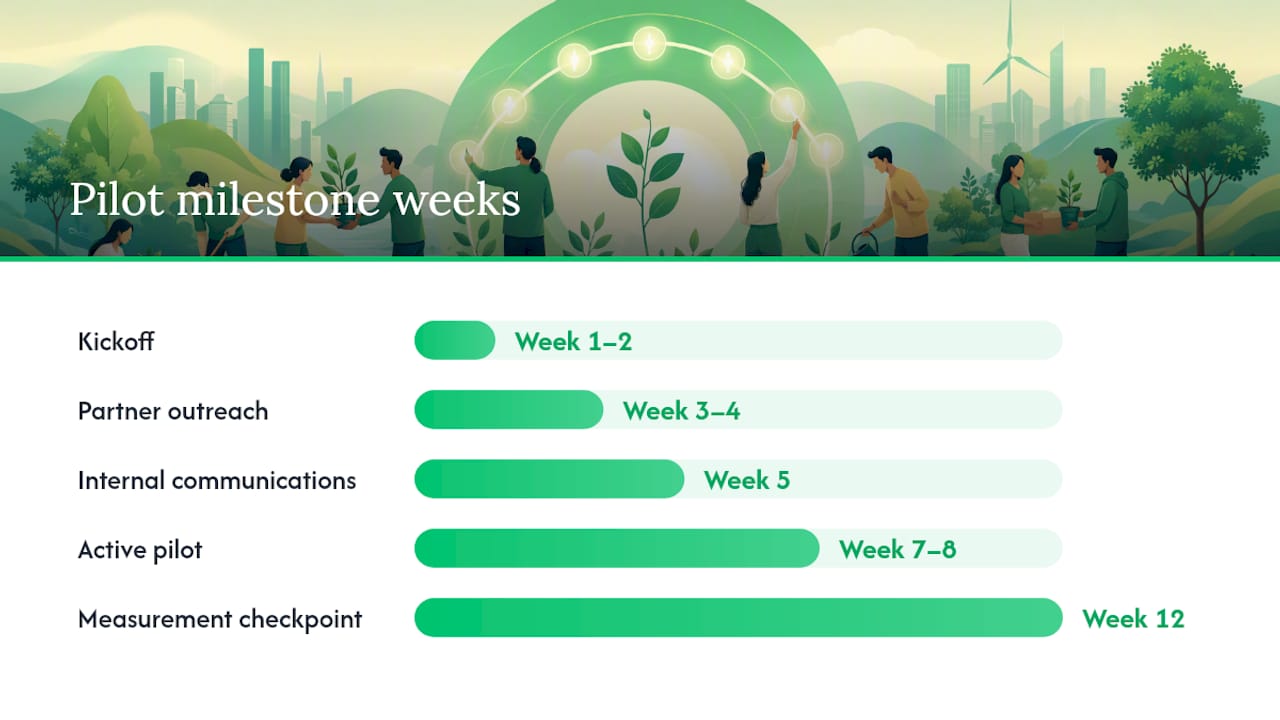
Here’s a sample timeline that works for most idea categories:
| Week | Milestone |
|---|---|
| 1-2 | Kickoff: assign sponsor, define 2-3 KPIs, select pilot team or department |
| 3-4 | Partner outreach: confirm nonprofit or platform partner, finalize logistics |
| 5 | Internal communications: launch announcement, sign-up mechanism, manager briefing |
| 7 to 8 | Active pilot: program runs, weekly participation check-ins |
| 10 | Data collection: gather participation, donation, and feedback metrics |
| 12 | Measurement checkpoint: report results, decide go/no-go for scaling |
Budget ranges vary widely by idea, but three buckets show up in almost every pilot:
- Staff time — Usually the largest hidden cost; budget for 5-10 hours per week from the program owner during active weeks.
- Partner or platform fees — Ranges from near-zero for a volunteer day to several thousand dollars for a licensed engagement platform, depending on company size.
- Matching pool or sponsorship fund — Low scenario might be a few hundred dollars for a small team pilot; high scenario can run into tens of thousands for company-wide matching campaigns.
Before you greenlight full rollout, run through this checklist:
- Did the pilot hit at least one of its three defined KPIs?
- Did participation exceed a reasonable threshold (aim for at least 15-20% of the eligible group for a first pilot)?
- Did the sponsor stay engaged through the full pilot period, not just the kickoff?
- Is there budget and staff capacity to sustain the program beyond the pilot?
- Did employees give feedback that the program felt authentic, not performative?
If you can answer yes to at least four of these, scale it. If not, adjust the idea or the execution before trying again. For teams looking at implementation depth beyond a single pilot, proven CSR activities for teams is worth a closer read.
How to Measure CSR Impact and Which KPIs Matter
Track three KPIs for any employee-focused CSR program: participation rate, dollars donated or matched, and volunteer hours logged. These three numbers tell you whether a program is working long before annual engagement surveys catch up.
Participation rate is the leading indicator. It tells you whether the program design and communication actually reached employees, and it moves faster than retention or engagement scores, which lag by months. Dollars donated (including any company match) shows the tangible community impact and gives you a clean number for leadership reporting. Volunteer hours logged captures the time-based programs that don’t have a dollar figure attached, like skills-based volunteering or mentorship.
A simple way to calculate impact-per-employee: divide total program impact (dollars donated plus a reasonable dollar-value estimate for volunteer hours) by the number of eligible employees, not just participants. This shows the true program reach rather than inflating results by only counting active participants.
| Metric | What it shows | Reporting cadence |
|---|---|---|
| Participation rate | Percentage of eligible employees who engaged | Monthly |
| Dollars donated/matched | Direct financial community impact | Monthly |
| Volunteer hours logged | Time-based contribution, useful for skills programs | Monthly |
| Retention delta (participants vs. non-participants) | Whether CSR involvement correlates with staying longer | Quarterly |
| Engagement score change | Movement in pulse survey scores among participants | Quarterly |
Your monthly CSR dashboard for HR and executives should include participation rate by department, cumulative dollars donated, volunteer hours, and a short qualitative note on employee feedback. Quarterly, layer in the retention delta and engagement score change, since those numbers need a longer window to mean anything. Pull participation and dollar data from your program platform directly, and pull retention and engagement data from your existing HR systems so you’re not building a second data pipeline. For teams building this connection out further, corporate social responsibility and employee engagement covers the relationship between these two metric sets in more depth.
Sustaining and Scaling CSR Beyond a Single Pilot
Scale a CSR program by formalizing governance and committing to multi-year partnerships, not by running more one-off events. A single successful pilot proves the concept. Governance is what keeps it alive past the first budget cycle.
The U.S. Chamber Foundation’s research on corporate citizenship points to a consistent pattern among large-scale programs: they align business capabilities with community needs and commit for years, not quarters. That’s a structural choice, not a budget size. A mid-size company can build the same durability into a smaller program.
A working governance checklist looks like this:
- Named executive sponsor who reports program results at least quarterly.
- Cross-functional steering committee including HR, CSR, at least one ERG representative, and a finance contact.
- Defined funding model (annual budget line, not a discretionary request each time).
- Reporting cadence tied to the KPI dashboard, shared with leadership monthly and the broader company quarterly.
- Multi-year partnership commitments with one or two core nonprofit or cause partners, rather than a new partner every quarter.
Watch for three pitfalls that derail otherwise good programs. Fragmented efforts, where every department runs its own uncoordinated initiative, dilute both budget and message. Lack of measurement turns a promising pilot into an unsupported anecdote by year two, since no one can prove it worked. And unpaid ERG labor, where employee resource groups end up running CSR programs on top of their day jobs with no budget or recognition, burns out your most engaged people first. The fix for all three is the same: fold CSR governance and ERG support into the same budget line, with the same reporting structure, so nothing runs on goodwill alone.
Pro Tip: Give your ERGs a small discretionary budget tied to CSR, even $2,000 to $5,000 annually. It signals real investment rather than asking volunteer labor to carry a program that benefits the whole company.
Case Study: How Charity Miles Turned Movement Into Measurable CSR
HARMAN launched a private Charity Miles team; since 2021 it has seen strongly increased employee participation, generating significant charity donations. It worked because it combined something employees already do (walk, run, bike) with something they wanted to feel good about (giving), and removed every barrier in between.

| Metric | Result |
|---|---|
| Participation increase | multiple times since launch |
| Total raised for charity | Over $100,000 |
| Timeframe | Since 2021 |
| Employees engaged | over one thousand |
The mechanics matter as much as the outcome. Charity Miles’ Employee Empowerment Program lets companies set up private teams for employees, run internal challenges, and choose their own sponsorship terms, including the rate per mile and whether donations go to each employee’s chosen charity or a company-selected cause. That flexibility is what makes it replicable across company sizes and cultures. A wellness team can layer it onto an existing step-challenge calendar. A CSR team can connect it directly to an ERG’s chosen cause. An HR team can use it as a low-lift way to show measurable engagement gains without building a program from scratch.
Movement-based giving works because it doesn’t ask employees to add something new to their day. It asks them to let something they already do count for more.
For an internal pitch, HR and CSR leaders can reuse a simple framing: a movement-for-good program tied to team challenges increased one client’s participation elevenfold and generated a substantial amount for charity in under four years, with no cost to individual employees and full company control over sponsorship terms.
What Patagonia, American Express, TCS, and RTX Get Right
Four companies illustrate four different, valid shapes a CSR program can take, and each shows a design principle worth borrowing.
- Patagonia built environmental activism directly into its product and business model, not as a side initiative. Employees participate through activism grants, environmental internships, and a company culture that treats sustainability as core identity rather than an add-on. Takeaway: aligning CSR with your actual product or mission builds authenticity that a bolt-on program can’t match.
- American Express has run disaster relief and community grant programs for decades, often mobilizing rapid-response funding when crises hit. Takeaway: a pre-approved rapid-response fund lets you act within days instead of convening a committee first.
- TCS leverages its core technology capability to run large-scale workforce development and digital literacy programs in the communities where it operates. The U.S. Chamber Foundation cites this as a model of aligning business skill with community need. Takeaway: your most scalable CSR idea is probably the skill your company already has in abundance.
- RTX invests heavily in STEM pipeline programs, connecting employee volunteers with students in engineering and technical fields. Takeaway: mentorship programs tied to your industry’s talent needs double as recruiting and CSR at once.
None of these require your company’s size or budget. They require a clear-eyed look at what your company is actually good at, and a willingness to point that capability at a community need.
Start Simple, Measure Honestly, Then Scale
The biggest mistake I see in workplace CSR planning is designing for scale before proving the concept works at all. Start with one idea, one sponsor, and one small group of willing participants. A pilot that succeeds with 40 employees teaches you more than a company-wide launch that stalls out from complexity nobody tested first.
Listen to the people closest to the work before locking in a plan. That means ERG leaders, the nonprofit partners you’re considering, and a handful of employees who’d actually use the program. MIT Sloan’s community engagement research makes this point well: co-created programs outperform imposed ones, and that logic holds just as true inside your own company as it does with external community partners. Pick the CSR idea that matches a capability you already have, whether that’s a skilled workforce, a wellness culture, or an existing giving budget, rather than importing a program that worked somewhere else for different reasons.
Run the pilot. Track the three KPIs that matter. Then decide, with real data instead of instinct, whether to scale it.
How Charity Miles Helps You Launch a Measurable CSR Program
The Charity Miles Employee Empowerment Program combines wellness, giving, and measurable CSR into one platform employees already know how to use: their own two feet. Companies set up private team challenges, and employees log the walking, running, and biking they’re already doing, turning movement into charitable donations at no cost to the individual.
A ready-to-run pilot fits the 8 to 12 week timeline outlined earlier: pick a sponsor, set your mileage sponsorship rate and cap, choose whether donations go to employee-selected charities or a company cause, and launch to a pilot group before rolling out company-wide. You get participation and donation reporting built in, so the KPI tracking from your measurement plan is already handled, no separate dashboard to build. If your team is comparing this against a full engagement software overhaul, the best employee engagement software breakdown shows where a focused wellness-and-giving program fits versus a broader platform investment. Start by scoping a pilot team size and mileage sponsorship budget, then reach out to get your private team set up.
Key Takeaways for Building Your CSR Program
A successful workplace CSR program starts with a small, sponsored pilot, tracks participation and dollars donated from day one, and scales only after the data proves it works.
| Point | Details |
|---|---|
| Pick one idea and a sponsor | Choose a single CSR idea from the catalog and assign a named executive or department sponsor before launch. |
| Run an 8-12 week pilot | Keep the pilot short, define no more than three KPIs, and set a clear go/no-go checkpoint. |
| Track participation, dollars, and hours | Monitor participation rate, dollars donated or matched, and volunteer hours as your core monthly metrics. |
| Formalize governance before scaling | Add an executive sponsor, cross-functional committee, and dedicated budget line before expanding company-wide. |
| Consider movement-based giving | Charity Miles’ Employee Empowerment Program helped HARMAN significantly increase participation and raise over $100,000 since 2021, using activity employees already do. |
Frequently Asked Questions
What are the easiest workplace CSR ideas to launch first?
Payroll round-up giving, a movement-for-good step challenge, and volunteer time-off policies tend to launch fastest because they require minimal new infrastructure and low upfront budget.
How long should a CSR pilot program run?
Most successful pilots run 8 to 12 weeks, long enough to gather meaningful participation data but short enough to keep momentum and stakeholder attention.
What KPIs should HR track for CSR programs?
Track participation rate, dollars donated or matched, and volunteer hours monthly, then layer in retention and engagement score changes quarterly once you have a longer data window.
How do we get employees to actually participate in CSR activities?
Tie programs to Employee Resource Groups, remove time barriers with volunteer time-off, and choose activities employees are already inclined to do, like movement-based challenges, rather than asking for entirely new behavior.
Should CSR programs include internal policies, not just external giving?
Yes. Pay equity reviews, inclusive hiring practices, and mental health support count as CSR and often matter as much to employees as external philanthropy does.
How much should a company budget for a first CSR pilot?
A first pilot for a single team or department can run on a few hundred to a few thousand dollars, primarily covering staff time and a small matching or sponsorship pool.
Sources
These sources back the data and design principles used throughout this guide, and each one is worth pulling into an internal presentation or deeper research session.
- Why CEOs Should Invest in Local Civic Engagement | BCG
- How to engage your business in community and economic development | MIT Sloan
- Corporate Citizenship Programs That Make a Community Impact | U.S. Chamber of Commerce Foundation
- Corporate Giving Ideas: Ways to Give Back to the Community | Goodera