
A wellness program is an organized initiative, most commonly offered through the workplace, designed to improve and promote health and fitness. Employers and insurance plans use these programs to encourage healthier behaviors through tangible incentives like premium discounts, gym memberships, and cash rewards. The scope has grown well beyond physical fitness: today’s programs address mental, financial, and social health alongside traditional exercise and nutrition goals.
Here is what a well-designed wellness program typically includes:
- Health screenings and risk assessments to identify and address individual health risks early
- Physical activity challenges such as step competitions, fitness goals, and group exercise
- Mental health support including coaching, mindfulness resources, and employee assistance programs (EAPs)
- Nutrition education through workshops, healthy eating guides, and meal planning resources
- Financial wellness tools covering budgeting, debt management, and retirement planning
- Incentives such as premium discounts, health savings account (HSA) contributions, and gift cards
Two U.S. examples worth knowing: the EHA Wellness Program offers challenges on nutrition, hydration, mindfulness, and financial mindset, with partner access to Headspace meditation subscriptions and MoneyWellth financial coaching, all free to member group employees. OMADA LLC specializes in digital health and lifestyle programs built around sustained behavior change for employee populations.
What do workplace wellness programs actually aim to achieve?
The primary goals are straightforward: reduce medical spending, improve productivity, and raise overall employee well-being. The financial case is strong. Harvard researchers found that medical costs fall $3.27 for every dollar invested in wellness programs, with absenteeism costs dropping an additional $2.73 per dollar. That adds up to roughly a 6:1 return when both healthcare savings and productivity gains are counted together.
Statistic spotlight: A significant portion of employees report they would be more likely to stay with an employer that offers mental health benefits aligned with their needs, and many U.S. organizations plan to expand wellness benefits in the near future.
Program design matters as much as program content. Research consistently shows that supportive, personalized frameworks outperform punitive or incentive-only models. Employees respond better when programs offer flexible scheduling, social connection, and genuine mental health support rather than penalties for non-participation. The shift from “comply or pay more” to “we support your choices” reflects a broader cultural evolution in how leading employers think about employee wellness programs.

What do wellness programs actually look like in practice?
Activities vary widely by employer, but the most effective programs combine digital tools with human-led support. A digital platform alone rarely delivers lasting results; pairing it with coaching and community makes the difference.
Common program components include:
- Biometric screenings (blood pressure, cholesterol, BMI) conducted on-site or at partner clinics
- Fitness and step challenges run through mobile apps with team leaderboards
- Mental health coaching and access to therapy or counseling platforms
- Nutrition workshops and personalized meal guidance
- Financial literacy sessions covering savings, debt, and benefits optimization
- Meditation and mindfulness apps such as Headspace, offered through partners like the EHA Wellness Program
| Component | Basic Program | Comprehensive Program |
|---|---|---|
| Digital platform | Yes | Yes |
| Health screenings | Sometimes | Yes |
| 1:1 health coaching | No | Yes |
| Mental health / EAP | No | Yes |
| Financial wellness tools | No | Yes |
| Incentive structure | Basic | Tiered and personalized |
Pro Tip: Programs that integrate activity into the normal workday, such as “walk and talk” meetings or lunchtime group challenges, consistently see higher participation than those requiring employees to carve out separate time.

How much does a wellness program cost?
Costs range from modest to substantial depending on program depth. Basic digital programs run $150–$400 per employee per year, covering a platform, wellness challenges, and basic content. Mid-tier programs with coaching, biometric screenings, and EAP integration typically land at $300–$500 per employee. Comprehensive programs including disease management and financial wellness can exceed $1,000 per employee annually.
The industry average spend in 2024 was about $275 per employee, with most small and mid-size companies clustering between $300 and $500 once incentives are included.
Key cost components to budget for:
- Platform or software license: $24–$60 per employee per year at the basic tier
- Health coaching: Can add $58–$100+ per employee per month at premium tiers
- Incentives: Typically $100–$300 per employee per year in premium discounts, gift cards, or HSA contributions
- Biometric screenings: Usually $45–$75 per employee per event
- EAP or mental health platform: $0.75–$14 per employee per month depending on service depth
The cost of doing nothing is often the most persuasive number in this conversation. Absenteeism alone costs U.S. employers $1,685 per employee per year. A program that reduces turnover by even 10–15% can generate returns that exceed its total cost within the first year.
What are the seven dimensions of wellness programs address?
Wellness programs work best when they treat employees as whole people, not just bodies to keep healthy. The seven widely recognized dimensions of wellness are:
- Physical: Exercise, nutrition, sleep, and preventive health screenings
- Emotional: Stress management, mental health coaching, and resilience building
- Intellectual: Learning opportunities, skill development, and cognitive engagement
- Social: Team connections, community belonging, and peer support networks
- Spiritual: Sense of purpose, values alignment, and meaning in work
- Environmental: Safe, healthy workspaces and access to nature or clean air
- Occupational: Job satisfaction, work-life balance, and career growth
Some models, including the framework used by Ohio State University, extend this to nine dimensions by adding financial and creative wellness. These dimensions are interdependent: financial stress, for example, directly affects emotional and physical health. Programs that address only physical fitness miss the broader picture that drives sustained behavior change and genuine well-being.
Common challenges and how to overcome them
Low participation is the most common failure point in workplace wellness programs. Employees often cite lack of time as the primary barrier, which means programs that require separate effort outside normal work hours will always struggle. The fix is integration: build activity into the workday rather than adding it on top.
Other frequent challenges include:
- One-size-fits-all design: Programs that ignore diverse fitness levels, health conditions, or schedules exclude the employees who need support most. Offering a range of activity types, from walking to mindfulness to financial check-ins, broadens access.
- Poor communication: Employees cannot participate in programs they do not know exist. Regular, clear communication through multiple channels drives awareness and enrollment.
- Incentives that feel punitive: Penalties for non-participation backfire. Positive rewards tied to effort rather than outcomes tend to build lasting engagement.
- Platform without people: Digital tools alone underperform. Pairing technology with human coaching, team challenges, and manager support produces measurably better outcomes.
How do you measure whether a wellness program is working?
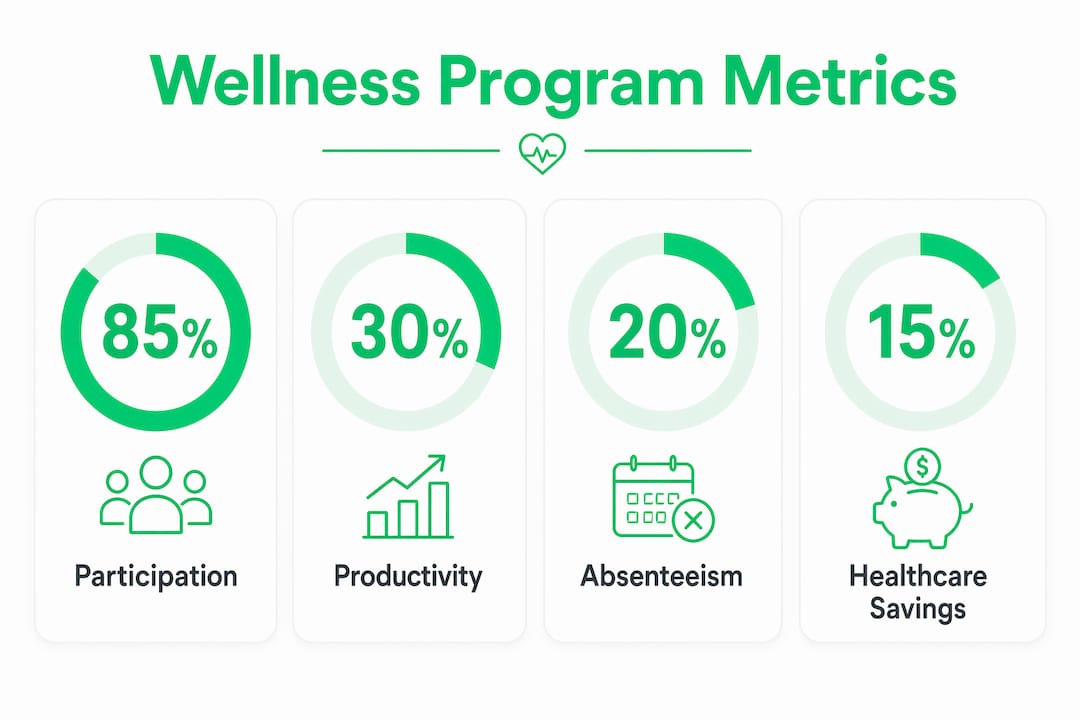
Measuring effectiveness requires looking at multiple data points, not just participation rates. A program with high sign-ups but no behavior change is not succeeding.
Useful metrics include:
- Participation rate: What percentage of eligible employees actively engage?
- Health risk scores: Do biometric screenings show improvement over time?
- Absenteeism data: Are sick days and unplanned absences declining?
- Employee satisfaction surveys: Do employees feel the program meets their needs?
- Healthcare claims data: Are medical costs trending down year over year?
- Retention and turnover rates: Is the program contributing to employees staying longer?
The strongest programs track these metrics annually and adjust program design based on what the data shows. A single metric tells an incomplete story; the combination reveals whether the investment is genuinely moving the needle on employee health outcomes.
Legal and privacy considerations you need to know
Wellness programs in the U.S. operate under several overlapping regulations. The Department of Labor and the Affordable Care Act govern how employers can use health-contingent incentives, including caps on the value of rewards tied to health outcomes. The Americans with Disabilities Act (ADA) and the Genetic Information Nondiscrimination Act (GINA) set limits on what health information employers can collect and how they can use it.
Key principles to follow:
- Voluntary participation: Employees cannot be coerced into sharing health information or participating in screenings.
- Confidentiality: Individual health data must be kept separate from employment decisions and accessible only to authorized personnel.
- Reasonable alternatives: Employees who cannot meet a health standard due to a medical condition must be offered an alternative way to earn the same incentive.
- ACA incentive caps: Health-contingent wellness program incentives are capped at 30% of the cost of employee-only coverage (50% for tobacco cessation programs).
Working with legal counsel when designing incentive structures protects both employees and the organization.
How to drive real employee engagement in wellness programs
Engagement does not happen by accident. The programs that sustain participation over time share a few consistent traits: they make participation easy, they connect individual effort to something meaningful, and they build community around shared goals.
Practical techniques that work:
- Tie activity to purpose: When employees know their steps or miles generate a donation to a cause they care about, participation becomes intrinsically motivating rather than just another HR checkbox. Charitymiles does exactly this, turning everyday movement into charitable donations through team wellness challenges that combine fitness, giving, and friendly competition.
- Use team challenges: Group accountability and friendly competition drive far higher engagement than individual tracking alone. HARMAN’s Charitymiles team saw an 11x increase in employee participation after launch, with 1,200+ employees generating over $120,000 for charity.
- Recognize effort publicly: Acknowledging participation and milestones, not just outcomes, builds a culture where wellness feels celebrated rather than monitored.
- Keep the barrier low: Any movement counts. Walking to a meeting, a bike commute, a lunchtime stroll. Inclusive programs that welcome all fitness levels retain far more participants than performance-focused ones.
If you are evaluating how to build or improve a wellness initiative, the corporate wellness ROI guide from Charitymiles offers a practical framework for HR and wellness leaders.
Key Takeaways
A well-designed wellness program delivers measurable returns on both health and financial outcomes, but only when it addresses the full range of employee needs rather than physical fitness alone.
| Point | Details |
|---|---|
| Core definition | A wellness program is an employer-led initiative using activities and incentives to improve physical, mental, and financial health. |
| Financial return | Medical costs fall $3.27 per dollar invested, with absenteeism savings adding another $2.73 per dollar. |
| Typical cost range | Most programs run $150–$1,000+ per employee per year; the 2024 industry average was about $275. |
| Seven dimensions | Effective programs address physical, emotional, intellectual, social, spiritual, environmental, and occupational wellness. |
| Engagement driver | Connecting movement to purpose and team challenges sustains participation far better than incentive-only models. |