
The fastest way to boost wellness program participation is to pair visible leadership support with low-friction, inclusive challenges and immediate, positive incentives. Without any reward, median participation hovers around 20%, and incentives alone rarely fix the gap. Employers who combine structural access, encouragement from leadership, and simple positive rewards see meaningfully stronger and more durable enrollment.
TL;DR:
- Employers reported participation near 20% without incentives, 40% with rewards, and up to 73% with penalties, yet one $600 smoking penalty raised it only 8%.
- Shift schedules, upfront costs, language gaps, and unreliable internet can exclude lower wage and minority employees; offer free access, phone or text options, and asynchronous activities.
- Make activity logging, not rankings, the basis of challenges; keep leaderboards optional, require one daily action, and allow manual entry for employees without smartphones.
- Track monthly active participation and subgroup rates by role, pay, and shift; one large evaluation found no detectable clinical effects after 18 months.
- Federal rules cap rewards tied to health outcomes and require a reasonable alternative standard for employees who cannot meet a health target.
Table of Contents
- High-Impact Tactics You Can Implement Right Away
- Designing Programs That Remove Structural Barriers to Participation
- Incentives and Framing That Actually Increase Participation
- Running Challenges and Mechanics That Sustain Participation
- Measuring Participation and Evaluating Real Impact
- A Real-World Example: How One Company Scaled Participation
- Connecting Wellness Programs to Existing Benefits and HR Systems
- First Impressions: Onboarding That Maximizes Early Participation
- Keeping Participation Alive Beyond the First Few Months
- Protecting Privacy and Data Security for Participant Tracking
- Customizing Programs for Different Teams and Workforces
- What We Would Prioritize First
- A Practical Next Step for Your Team
- FAQ
- Sources
High-Impact Tactics You Can Implement Right Away
Participation climbs fastest when leaders remove friction and show up themselves. A few changes, rolled out together, tend to outperform any single tactic on its own.
- Have leaders join first. When executives log their own steps or minutes publicly, teams treat the program as real rather than optional.
- Cut enrollment to one tap. A mobile sign-up that takes under a minute beats a multi-page benefits portal every time.
- Remove cost and time barriers. Employer-paid access and asynchronous activities let shift workers and parents participate on their own schedule.
- Recruit department-level champions. A peer who checks in casually creates social accountability without feeling like surveillance.
- Offer more than one path in. Steps, mindful minutes, and financial-wellness workshops each pull in a different segment of your workforce.
Rolling these out in sequence, rather than all at once, gives HR time to see which lever moves the needle for a specific team.
Pro Tip: Ask your department champions to share their own first-week activity publicly; peer visibility often drives more signups than a company-wide email.
Designing Programs That Remove Structural Barriers to Participation
Low enrollment is rarely about motivation alone. The CDC/NIOSH systems-based model finds that nonparticipation clusters among low-wage and minority employee groups, driven by a mix of employer design choices and everyday employee barriers like shift schedules, upfront costs, limited language support, and inconsistent internet access.
Fixing this takes deliberate design work, not just better marketing:
- Offer no-upfront-cost sponsorship so employees never have to pay to join.
- Provide phone and SMS options for employees without reliable data or app access.
- Build short, asynchronous micro-activities that fit around rotating shifts.
- Create alternative activity credit for employees with mobility limitations.
- Translate materials and instructions into the languages your workforce actually speaks.
Gathering input directly from underserved groups, through short pulse surveys, employee resource group consultations, or small focus groups, surfaces barriers that a standard engagement survey tends to miss.
Incentives and Framing That Actually Increase Participation
How you frame a reward matters as much as the reward itself. Survey data compiled in the RAND/EBSA workplace wellness report show employer-reported participation rates of roughly 20% with no incentive, climbing to about 40% when rewards are offered, and reported as high as 73% when penalties or surcharges are attached.
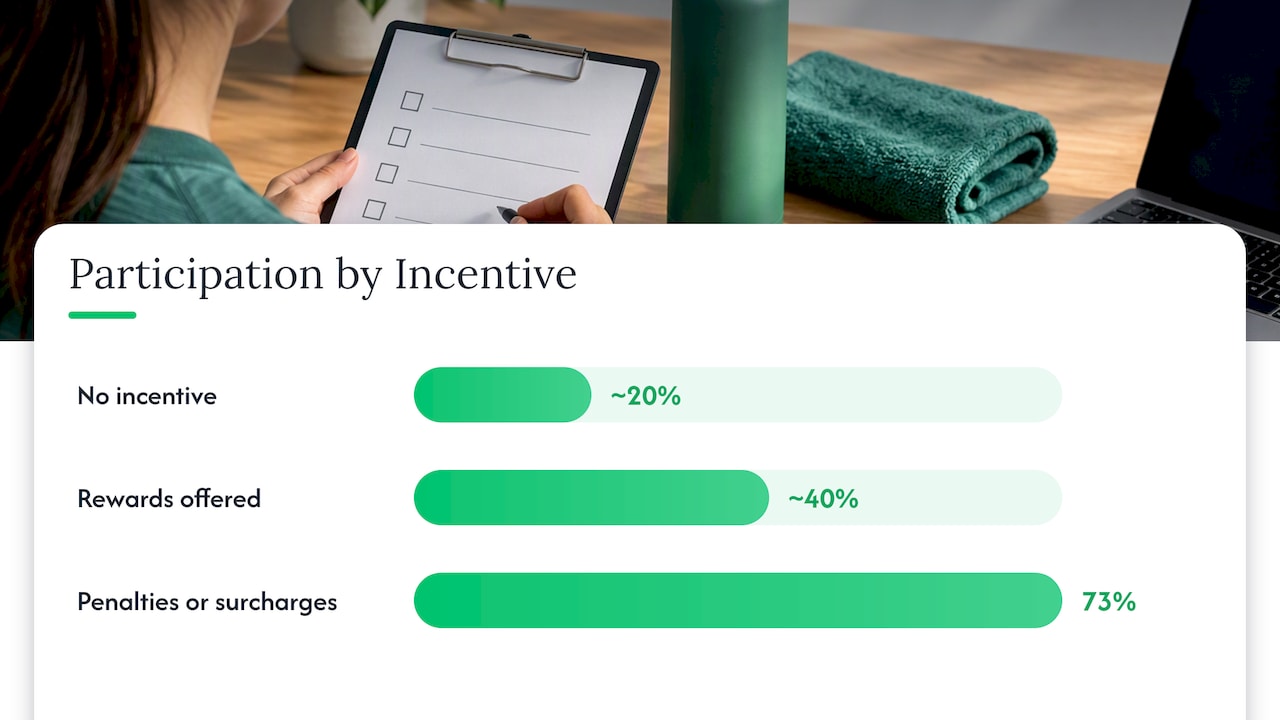
Penalties look powerful on paper but underperform in practice. The same report notes a $600 smoking-cessation penalty at one large employer raised participation by only 8%, far below what the survey-reported penalty rates would suggest.
Design rules worth following:
- Favor positive, modest, immediate rewards over large deferred ones.
- Use recognition and social proof alongside any monetary incentive.
- Avoid high-stakes penalties, which tend to fall hardest on lower-wage employees.
- Offer a reasonable alternative standard whenever a reward is tied to a health outcome.
On the compliance side, federal wellness program rules cap health-contingent rewards and require that programs be reasonably designed, with a genuine alternative path for employees who cannot meet a specific health standard. Communicating tax treatment and timing of any reward up front avoids confusion later.
Running Challenges and Mechanics That Sustain Participation
Challenge format shapes who shows up and who stays. A leaderboard-driven competition pulls in your most athletic employees; a participation-focused challenge, where logging activity matters more than ranking, tends to draw a broader slice of the company.
- Choose a participation-based format as your default, reserving leaderboards for an opt-in bonus track.
- Let employees log activity through a mobile app, with a manual entry option for anyone without a smartphone.
- Open with a visible kickoff event, ideally with leadership participating on day one.
- Send a midpoint boost, a short nudge or mini-reward that re-engages anyone who stalled.
- Deliver recognition and rewards quickly after the challenge ends, while the effort is still fresh.
Pro Tip: Keep data entry to a single action per day. Every extra step in a tracking flow quietly loses participants.
Measuring Participation and Evaluating Real Impact
Tracking the right numbers tells you whether a program is working or just busy. Start with a small, consistent KPI set and review it on a monthly cadence rather than waiting for an annual report.
- Eligible population and total sign-up rate at launch.
- Active participation measured monthly, not just at enrollment.
- Completion and retention rates through the full challenge period.
- Subgroup participation by role, pay band, and shift pattern.
| Metric | What it reveals |
|---|---|
| Sign-up rate | Initial reach versus eligible population |
| Monthly active participation | Whether engagement holds beyond week one |
| Completion/retention | Program stickiness over the full cycle |
| Subgroup participation | Equity gaps by pay, role, or shift |
Short post-initiative surveys and simple pilot comparisons, testing one framing against another with a small group before a full rollout, give you fast, low-cost signal. A large randomized evaluation of a multicomponent wellness program found module participation averaging just under one-third of eligible employees, with modest gains in self-reported exercise but no detectable effect on clinical measures after 18 months, a useful reminder not to overinterpret short-term health outcomes from participation data alone. Report subgroup numbers to leadership every time, not just the topline rate.
A Real-World Example: How One Company Scaled Participation
HARMAN’s experience shows what combining these tactics can produce.
These tactics map closely to the playbook above:
- CSR alignment that gave every mile walked or run a visible charitable purpose.
- Team-based challenges that built social accountability without requiring athletic performance.
- Leadership involvement that signaled the program mattered.
- Configurable sponsorship, letting the company set its own rate per mile and total budget.
For a mid-size or enterprise rollout, this suggests starting with a single private team challenge, confirming leadership visibly participates, and expanding sponsorship once initial engagement data looks solid.
Connecting Wellness Programs to Existing Benefits and HR Systems
A wellness initiative that lives outside your existing HR stack tends to get forgotten. Linking participation data and communications to tools employees already use, your benefits portal, intranet, or HRIS, keeps the program visible instead of buried in a separate app nobody opens twice.
Practical integration points include surfacing enrollment links inside the benefits portal during open enrollment, syncing participation milestones with recognition programs already run through HR, and routing challenge announcements through the same channels used for other employee communications. When a wellness challenge shows up in the same place as payroll and time-off requests, it reads as part of the job, not an optional extra.
For CSR-linked programs specifically, connecting participation data to existing giving or volunteer-tracking systems lets a single report show HR, benefits, and CSR impact together. That consolidated view also makes it easier to justify budget, since leadership can see wellness, engagement, and philanthropy numbers side by side rather than in three separate spreadsheets.
Keep the integration light. The goal is fewer logins and fewer separate accounts, not a new system to maintain. If adding a tool creates another password for employees to remember, it is working against the low-friction design that drives participation in the first place.
First Impressions: Onboarding That Maximizes Early Participation
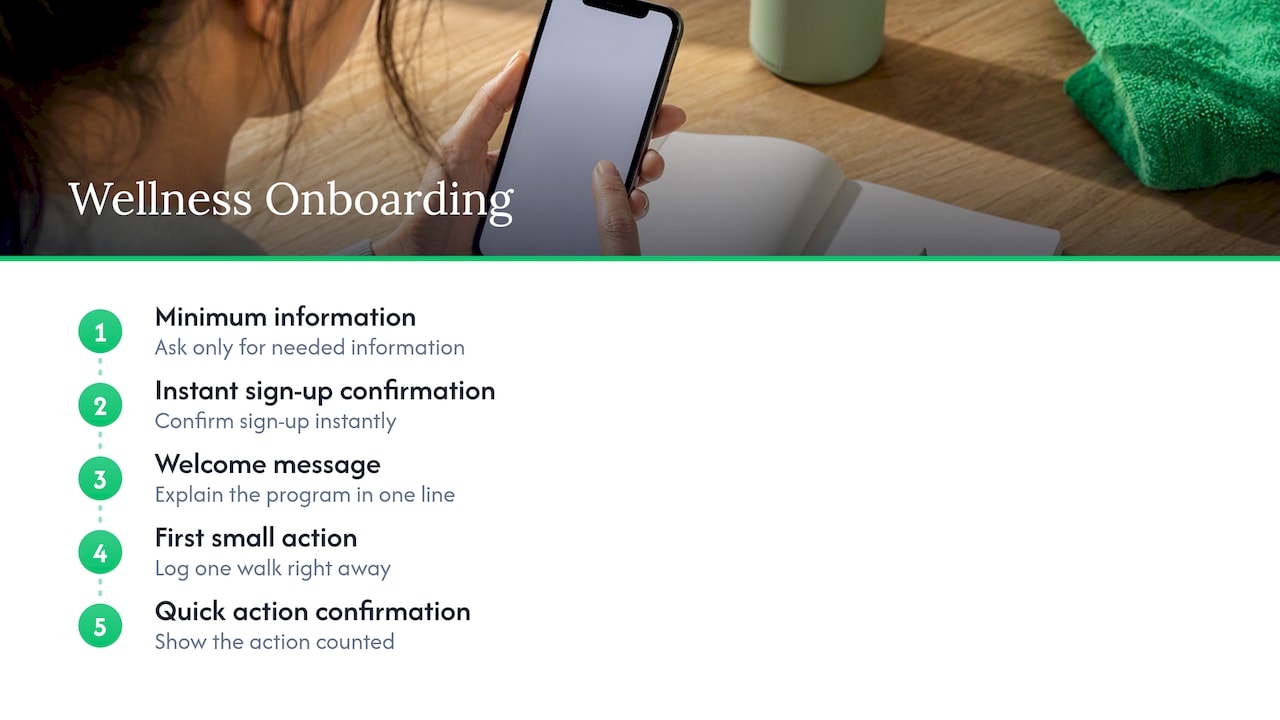
The first five minutes with a new wellness program decide whether an employee becomes a regular participant or quietly drops off. Enrollment should ask for the minimum information needed, confirm sign-up instantly, and show the employee exactly what to do next, ideally within the same screen.
A strong onboarding sequence usually includes an immediate welcome message with a one-line explanation of how the program works, a first small action the employee can complete right away (logging a single walk, picking a cause, joining a team), and a quick confirmation that the action counted. That early win matters more than any feature list. Employees who complete one small action in week one are far more likely to come back in week two.
Avoid front-loading onboarding with every available feature. Introduce team challenges, financial-wellness workshops, or advanced tracking options after the employee has already had one successful interaction. Layering complexity in later keeps the first experience simple and gives HR natural points to re-engage someone a few weeks in, rather than overwhelming them on day one.
Mobile-first design matters here as much as anywhere else in the program. An onboarding flow that requires a desktop login will quietly exclude shift workers and field employees who never sit at a company computer during the day.
Keeping Participation Alive Beyond the First Few Months
Initial enrollment is the easy part. Sustaining participation past the first ninety days requires a rhythm of fresh content, recognition, and reasons to come back, not a single big launch followed by silence.
Rotating challenge themes every few weeks, alternating step-based challenges with mindfulness months or financial-wellness workshops, keeps the program from feeling repetitive. Recognition should arrive on a predictable schedule: a monthly shout-out, a small reward tier, or a simple leaderboard refresh gives employees something to look forward to beyond the initial kickoff.
Champions and peer networks matter more over time, not less. The colleague who checks in casually after month two often does more to sustain participation than any email from HR. Giving champions small, repeatable tasks, posting a weekly update, welcoming new joiners to a team, keeps that peer energy going without burning out any one volunteer.
Revisiting incentive framing periodically also helps. A reward that felt fresh in January can lose its pull by summer, so testing a new framing or reward type every quarter keeps the program from running on inertia. Tracking subgroup participation over this longer window, not just at launch, shows whether early equity gains are holding or quietly eroding as novelty fades.
Protecting Privacy and Data Security for Participant Tracking
Any program that tracks movement, health behaviors, or location data takes on a responsibility to protect that information carefully. Employees are more likely to participate when they trust that their activity data stays private and is not used against them.
Clear, simple communication about what is tracked, who can see it, and how long it is kept goes a long way toward building that trust. Aggregate reporting to leadership, rather than individual-level detail, keeps the focus on program impact instead of surveillance. Where a reward is tied to a health outcome, federal rules require a reasonable alternative standard and reasonable design, which also means data collection should be limited to what the program actually needs.
Giving employees control, letting them choose what to share, opt out of specific tracking types, or delete their data, reduces hesitation at signup and supports effective employee security training steps for HR managers. A privacy policy written in plain language, not legal boilerplate buried in a settings menu, signals that the program was built with employees in mind rather than around them.
Customizing Programs for Different Teams and Workforces
A single program design rarely fits every team in a company. A desk-based office team, a distributed sales force, and a shift-based manufacturing floor all have different schedules, access to technology, and reasons to participate.
Customization starts with the activity types offered. Desk workers may respond well to step challenges and mindful-minute tracking, while field and shift employees often need activities that fit broken or rotating schedules, asynchronous logging, and manual entry options matter more here than leaderboard features. Company culture matters too: a competitive sales team may embrace team leaderboards that would feel alienating in a more collaborative department.
Language, generational differences, and regional norms also shape what resonates. A younger, tech-forward workforce may prefer app-based gamification, while a more tenured team might respond better to simple paper logs or manager check-ins. Building a few optional tracks into the same program, rather than a single rigid format, lets each team opt into what fits without fragmenting the overall initiative.
What We Would Prioritize First
If we had to choose one lever, it would be removing friction before adding incentives. Adding rewards without streamlining the sign-up process can reduce program effectiveness.
Run a short pilot: one inclusive challenge, zero cost to employees, and a leader logging activity publicly from day one. Measure subgroup participation before scaling further.
— Gene
A Practical Next Step for Your Team
The tactics above, low-friction enrollment, inclusive challenges, visible leadership, and modest positive incentives, are exactly what our Employee Empowerment program is built around. We let companies create private team challenges, track activity through a free mobile app that counts walking, running, or biking, and configure sponsorship terms on our own schedule and budget.
Because we handle the mechanics, your team can focus on the leadership visibility and communication that drive real participation. If you want to see how the tracking and donation mechanics work or talk through a pilot for your workforce, we are glad to walk through it with you.
FAQ
What are some wellness activities?
Common activities include step and activity challenges, mindfulness or meditation minutes, financial-wellness workshops, and team-based fitness challenges that count walking, running, or biking. The most inclusive programs offer several activity types so employees at different fitness levels and schedules can all participate.
What are the 5 pillars of wellness?
Definitions vary across organizations, but a common version includes physical, mental, financial, social, and occupational wellness. Workplace programs that touch more than one pillar, pairing movement challenges with financial-wellness workshops, for example, tend to appeal to a broader share of employees.
What do employee wellness programs include?
Most programs combine an activity or fitness component, such as step or team challenges, with incentives, educational resources, and sometimes financial or mental-wellness workshops. Many now use mobile apps for tracking, which federal guidance treats as subject to the same reasonable-design and alternative-standard rules as other wellness benefits.
Why don’t employees participate in wellness programs?
Nonparticipation is often tied to structural barriers like shift schedules, upfront costs, limited language support, and inconsistent internet access, which the CDC/NIOSH systems-based model finds fall disproportionately on low-wage and minority employee groups. Removing these barriers through no-cost access and flexible, asynchronous activities tends to raise participation more reliably than incentives alone.
Sources
- Workplace wellness programs — participation and incentives (RAND/EBSA report summary on PMC)
- Why don’t employees participate in well-being programs? A research-informed systems-based model (NIOSH/CDC)
- DOL/EBSA FAQs on wellness program rules