
Wellness data privacy means understanding how your steps, heart rate, sleep, mood entries, and even location tied to medical visits get collected, stored, and often shared by the apps and programs you use. The single most urgent move: check who has access to that data right now. Individuals should audit app permissions and revoke anything unnecessary; employers should demand a data-flow diagram and written privacy terms from every wellness vendor before renewing a contract.
TL;DR:
- Revoke unnecessary app permissions and use per-app privacy controls to limit data collection from wellness apps and wearables.
- Ensure wellness apps use encrypted transmission and keep updated, clear privacy policies that specify data sharing, retention, and deletion practices.
- Verify whether wellness vendors are HIPAA-covered entities or subject to other laws, and demand written privacy and security commitments before contracting.
- Focus on programs that collect minimal data, use aggregated reporting, and clearly explain their privacy protections to foster long-term trust.
- Demand contract clauses that specify data minimization, purpose limitation, breach notification, and no sale of health data for any wellness vendor agreement.
Table of Contents
- A Six-Step Checklist You Can Run Today
- How Do Wellness Apps and Wearables Actually Collect Your Data?
- What Laws Actually Cover Wellness Data?
- What Should Individuals Do to Protect Their Own Data?
- How Should Employers Design Privacy-Respecting Wellness Programs?
- What Should You Demand From a Wellness Vendor Contract?
- What Does a Low-Data, Privacy-Forward Wellness Program Look Like?
- Why Privacy-First Design Wins Long Term
- A Wellness Program That Doesn’t Ask for Your Medical History
- Where to Verify This Guidance Yourself
- Sources
A Six-Step Checklist You Can Run Today
You don’t need a compliance degree to tighten up your wellness data privacy posture. Work through this list in order, and you’ll close most of the obvious gaps within an hour.
- Open your wellness app’s settings and revoke access to sensors or HealthKit data it doesn’t need to function.
- Skim the privacy policy for three words: sharing, retention, and deletion.
- Turn on device encryption and two-factor authentication, then export your data and request deletion if you’re done with the app.
- If you run a program, map every place employee data flows, from the app to the vendor’s servers to any third party.
- Push your vendor toward aggregated or anonymized reporting instead of individual-level metrics.
- Document consent and offer a reasonable alternative for any incentive tied to a health outcome.
Each step takes minutes. Skipping all six is how a well-meaning step challenge turns into a data liability.
How Do Wellness Apps and Wearables Actually Collect Your Data?
A fitness tracker doesn’t just count steps. It typically logs GPS coordinates, heart rate, sleep cycles, mood journal entries, photos, and device metadata, then feeds that raw stream into models that infer things you never explicitly told it, like stress levels or fertility windows. That inferred layer is often more sensitive than the raw numbers, and it’s rarely disclosed in plain language.
The technical path is where things get murky. Data usually moves from local storage to cloud sync, then through analytics software development kits, and sometimes straight into ad networks or data broker pipelines. A systematic assessment of 79 accredited health and wellness apps found that 89% transmitted personal information to online services, and 20% had no privacy policy at all. Many transmissions weren’t even encrypted.
Common gaps show up in predictable places:
- Privacy policies that are missing, outdated, or written to permit broad third-party sharing.
- Analytics endpoints that send behavioral data to advertising partners without clear disclosure.
- Unencrypted transmission of sensitive fields like location or mood entries.
- App store accreditation badges that imply vetting but don’t guarantee privacy compliance.
Accreditation isn’t proof of privacy. The same research found real compliance gaps even in apps carrying clinical certification, which tells you app store trust signals and actual data protection are two different things entirely.
What Laws Actually Cover Wellness Data?
This is where most people, and more than a few HR teams get tripped up. HIPAA feels like it should blanket everything health related, but it doesn’t.
- HIPAA applies only to covered entities, their business associates, and certain group health plans. Whether it reaches a specific workplace wellness program depends entirely on how that program is structured and who holds the data, according to HHS guidance on workplace wellness programs.
- Consumer-facing apps downloaded straight from an app store are usually outside HIPAA’s reach, meaning vendors can often share non-protected wellness data with advertisers or brokers unless another law or a contract clause stops them, per Duke Today’s reporting on wellness app privacy.
- ACA and DOL rules cap health-contingent incentive rewards, generally at 30% of coverage cost (50% for tobacco cessation programs), and require employers to offer a reasonable alternative standard, per the tri-Department guidance on nondiscriminatory wellness programs.
- EEOC rules come into play when a program asks disability-related questions, triggering ADA and GINA considerations around voluntary participation.
- FTC enforcement and state consumer health data laws increasingly fill the gap HIPAA leaves open, especially when apps misuse data for targeted advertising.
For employers, the practical takeaway is simple: don’t assume “health app” means “HIPAA protected.” Verify it, in writing, with every vendor.
What Should Individuals Do to Protect Their Own Data?
Reading a privacy policy in full is unrealistic, but scanning for five things takes under two minutes: sharing terms, retention period, deletion process, opt-out mechanism, and a working contact email. If any of those five are missing or vague, treat that as a warning sign.
Device-level controls matter more than most people realize. On iOS, dig into HealthKit privacy settings and restrict per-app access to only what’s functionally necessary. On Android, Health Connect gives you similar granular control, letting you unlink an app’s access without deleting the app itself.
Account hygiene rounds out the basics:
- Use a unique password for every wellness app, ideally through a password manager.
- Enable two-factor authentication wherever it’s offered.
- Export your historical data periodically, then request deletion once you no longer use a service.
- Think twice before logging sensitive entries, like mental health notes or GPS locations tied to a medical appointment, in apps with weak privacy track records.
Pro Tip: Before you log a sensitive entry, ask yourself whether you’d be comfortable with that data sitting in an advertiser’s database in five years. If not, keep it out of the app entirely.
How Should Employers Design Privacy-Respecting Wellness Programs?
Employers carry a heavier responsibility here because they’re handling data for dozens or thousands of people at once, often under legal scrutiny they don’t fully anticipate.
- Collect only the data the program genuinely needs, and default to aggregated reporting over individual-level metrics whenever possible.
- Build a vendor due-diligence checklist that requires a data-flow diagram, documented encryption standards, a breach-notification timeline, a deletion process, and a written no-sale clause.
- Structure any health-contingent incentive to meet ACA and DOL nondiscrimination rules, including a clearly disclosed reasonable alternative.
- Communicate program terms in plain language and make participation opt-in, not just technically voluntary.
Programs that treat transparency as a checkbox tend to see participation stall. Programs that treat it as a selling point, explaining exactly what’s collected and why, tend to see the opposite, since clear alternatives and disclosure double as both a legal requirement and a trust-building tool.
Pro Tip: Put your data-minimization policy on one page and hand it to employees before launch. A program that explains itself in one page usually gets more signups than one that hides behind a 40-page policy document.
What Should You Demand From a Wellness Vendor Contract?
Procurement teams and legal counsel need concrete deliverables, not vague assurances. Before signing with any wellness vendor, require:
- Contract clauses covering data minimization, purpose limitation, individual access and deletion rights, breach notification within a set window, and an explicit no-sell clause for health-derived data.
- Technical proof of TLS 1.2 or higher for data in transit and AES-256 encryption for sensitive fields at rest, along with documented authentication practices and a SOC 2 or equivalent audit report.
- Operational commitments around employee-data segregation, standard export formats, defined retention windows, and the right to audit vendor practices.
A detailed consumer health data privacy policy example shows what responsible technical safeguards look like even outside HIPAA’s reach. Treat a vague privacy policy or the absence of an incident-response plan as a disqualifying red flag, not a minor gap to negotiate later.
What Does a Low-Data, Privacy-Forward Wellness Program Look Like?
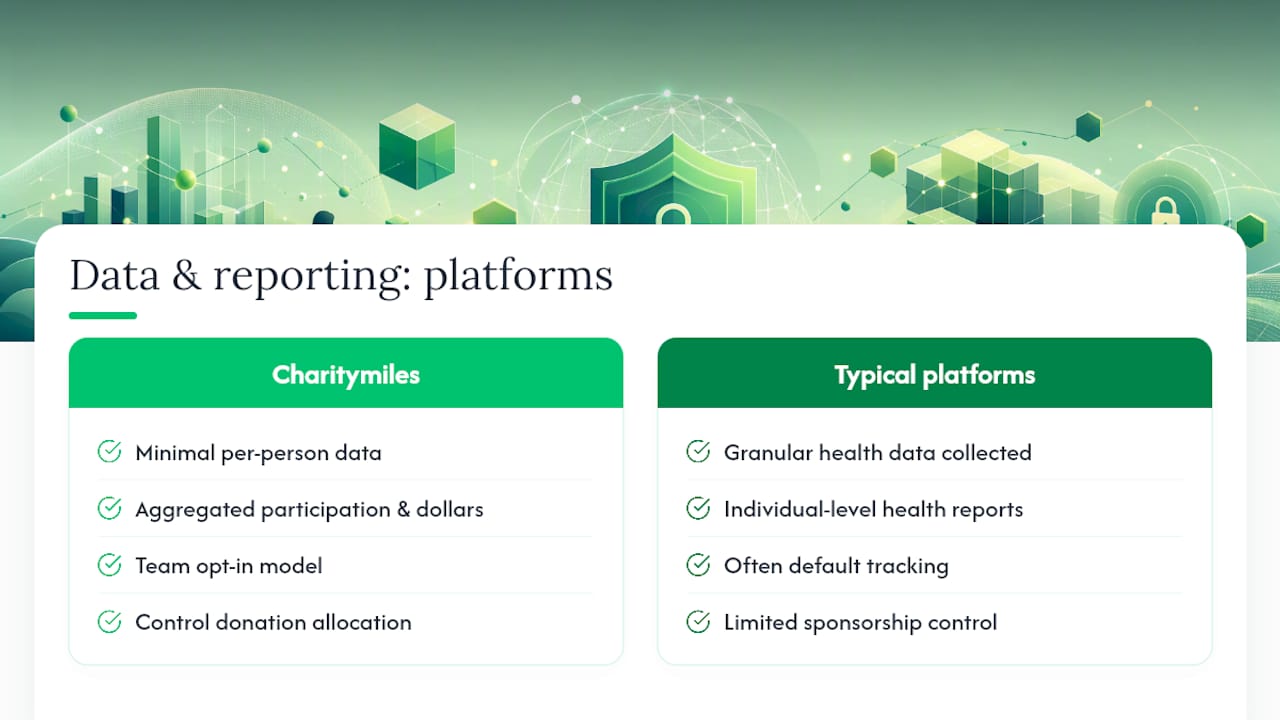
Charitymiles built its Employee Empowerment Program around a simple design principle: track movement, not medical detail. The app logs miles walked, run, or biked through GPS and pedometer data, and that’s the extent of the personal health footprint required to participate.
- Teams are opt-in, so no employee is defaulted into a program collecting their activity data.
- Per-person health fields stay minimal since the core mechanic is distance, not biometrics or medical history.
- Companies get aggregated reporting on participation and dollars raised, not granular individual health profiles.
- Since launching its Charity Miles team in 2021, HARMAN saw an 11x increase in employee participation, with more than 1,200 employees generating over $120,000 for charity.
That combination, broad participation with a narrow data footprint, is what a privacy-forward wellness program looks like in practice, not just in policy language.
Why Privacy-First Design Wins Long Term
Programs that over-collect data almost always trade short-term insight for long-term trust erosion. In my read of how these programs actually perform, the ones that survive year over year are the ones that ask for less and explain themselves more clearly. Plain language and visible impact reporting do as much for participation as any encryption standard. Review your program’s data footprint every year, not just at launch, because what felt minimal in year one can quietly expand by year three.
— Gene
A Wellness Program That Doesn’t Ask for Your Medical History
If your organization is weighing a new step challenge or activity-based CSR program, Charitymiles is worth a serious look for one specific reason: it drives engagement without requiring the granular health data most competing platforms collect by default.
The Employee Empowerment Program fits HR and CSR teams that want an inclusive activity program tied to charitable impact. Teams are opt-in, the per-person data footprint stays minimal, and reporting comes back aggregated, so leadership sees participation and dollars raised without wading into individual health records. Companies control aspects of the sponsorship and donation allocation.
Explore how the Employee Empowerment Program for corporations works, or check the corporate wellness benefits and ROI guide to see how a low-data program fits into your broader wellness strategy. If you’re comparing platforms outright, the employee engagement software comparison is a good next stop.
Where to Verify This Guidance Yourself
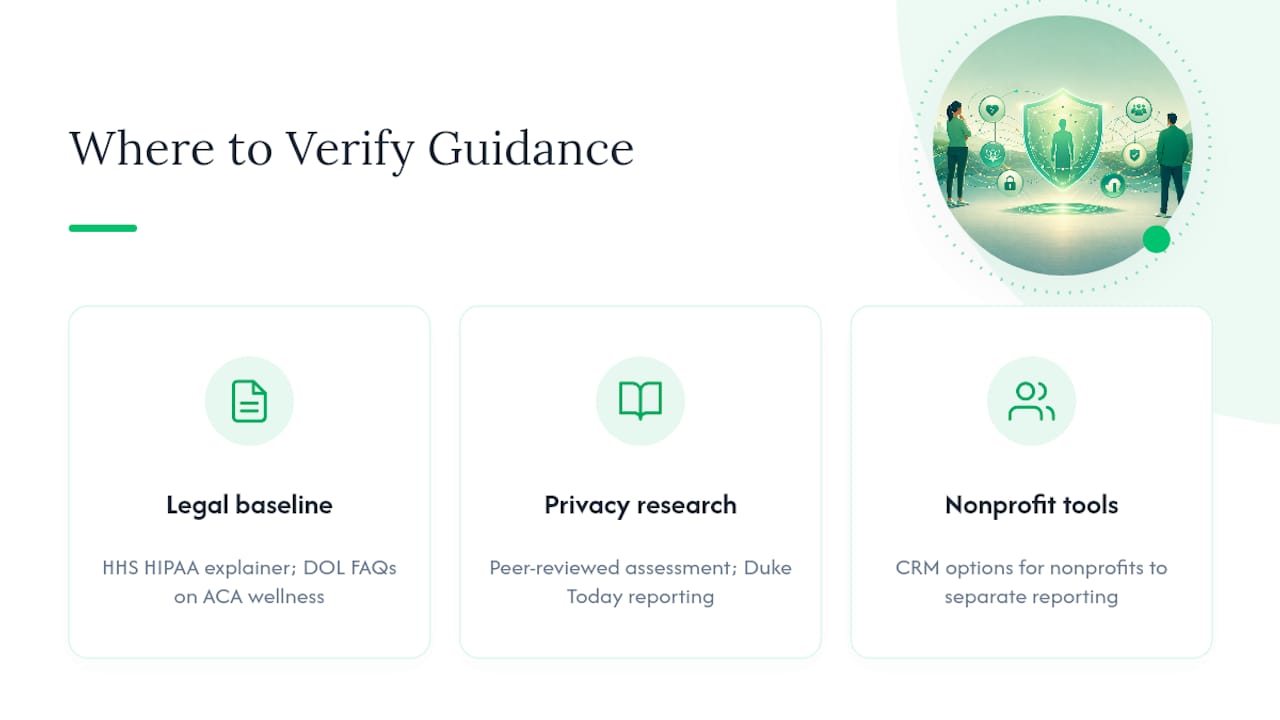
For the legal baseline, read HHS’s explainer on HIPAA and workplace wellness programs and the DOL’s FAQs on ACA wellness program implementation. For the privacy risk data behind this guide, review the peer-reviewed assessment of accredited wellness apps and Duke Today’s reporting on consumer wellness app privacy. Nonprofit teams managing donor and volunteer data alongside wellness metrics may also find CRM options built for nonprofits useful for keeping reporting systems separate and purpose-limited.
Sources
- Unaddressed privacy risks in accredited health and wellness apps: a cross-sectional systematic assessment
- How wellness apps can compromise your privacy | Duke Today
- HIPAA and workplace wellness programs — HHS
- Guidance on incentives for nondiscriminatory wellness programs (tri-Department guidance)