
The fastest path to a successful wellness challenge is a 14-day pilot or 30-day challenge, not a sprawling annual program. Before you touch a template, write one SMART objective and assign one owner to run it. Keep participation voluntary, skip any collection of medical data unless legal counsel has signed off, and let the pilot’s results tell you whether to scale.
TL;DR:
- Running a 14-day or 30-day wellness pilot is faster and more effective for engagement than longer programs, with clear metrics focused on participation and connection.
- A successful challenge requires strong leadership support, manager briefings, and voluntary participation, avoiding medical data collection without legal approval.
- Including low-impact activities, mental health tasks, and accessible logging methods ensures inclusivity for all employees regardless of physical ability or tech access.
- Establishing a SMART objective beforehand, such as reaching 40% participation in a two-week movement challenge, helps measure success and guides promotion efforts.
- Using a platform like Charity Miles can simplify setup, facilitate scalable tracking, and reinforce a meaningful corporate social responsibility story behind employee movement.
Table of Contents
- Why Run a Wellness Challenge in the First Place?
- Ready-to-Copy Wellness Challenge Templates You Can Launch This Week
- How Do You Write a SMART Objective for a Wellness Challenge?
- What’s the Step-by-Step Rollout Timeline?
- Simple Tracking Systems and the 5 KPIs That Matter
- How Do You Design a Wellness Challenge That’s Actually Inclusive?
- What Privacy and Legal Guardrails Should You Build In?
- What Does Sustained Engagement Actually Look Like?
- What I’d Tell Any HR Team Running Their First Challenge
- Turn Movement Into Something Employees Actually Want to Track
- Sources
- FAQ
Why Run a Wellness Challenge in the First Place?
A short wellness challenge will not lower anyone’s blood pressure in two weeks, and you should stop promising it will. What it does reliably deliver is engagement: people talking to each other, forming small habits, and feeling like the company noticed they exist. That’s the realistic win, and it’s worth chasing on its own merits.
Employees who feel their employer actively supports their well-being tend to participate more and stick with programs longer. The CDC’s Worksite Health ScoreCard framework found that organizational supports, things like manager buy-in, visible sponsorship, and incentives paired with real programming, correlate with better implementation and stronger perceived employer support among staff. In plain terms: the activity list matters less than whether your leadership actually shows up behind it.
That’s why the most common mistake HR teams make isn’t picking the wrong activities. It’s launching a challenge with no manager briefing, no communications plan, and no one checking in after week one.
Statistic Callout: Workplace tracking programs are linked to only modest biometric changes, according to CDC research on employee outcomes in health promotion programs. Treat a short pilot as an engagement and habit-building tool, not a substitute for clinical care.
Set expectations accordingly. A 14-day or 30-day challenge should aim to answer questions like: Will people sign up? Will they keep going past day 3? Do they feel more connected to coworkers and to the company’s mission? Those are the metrics that actually move in a short window, and they’re the ones worth building your objective around.
Ready-to-Copy Wellness Challenge Templates You Can Launch This Week
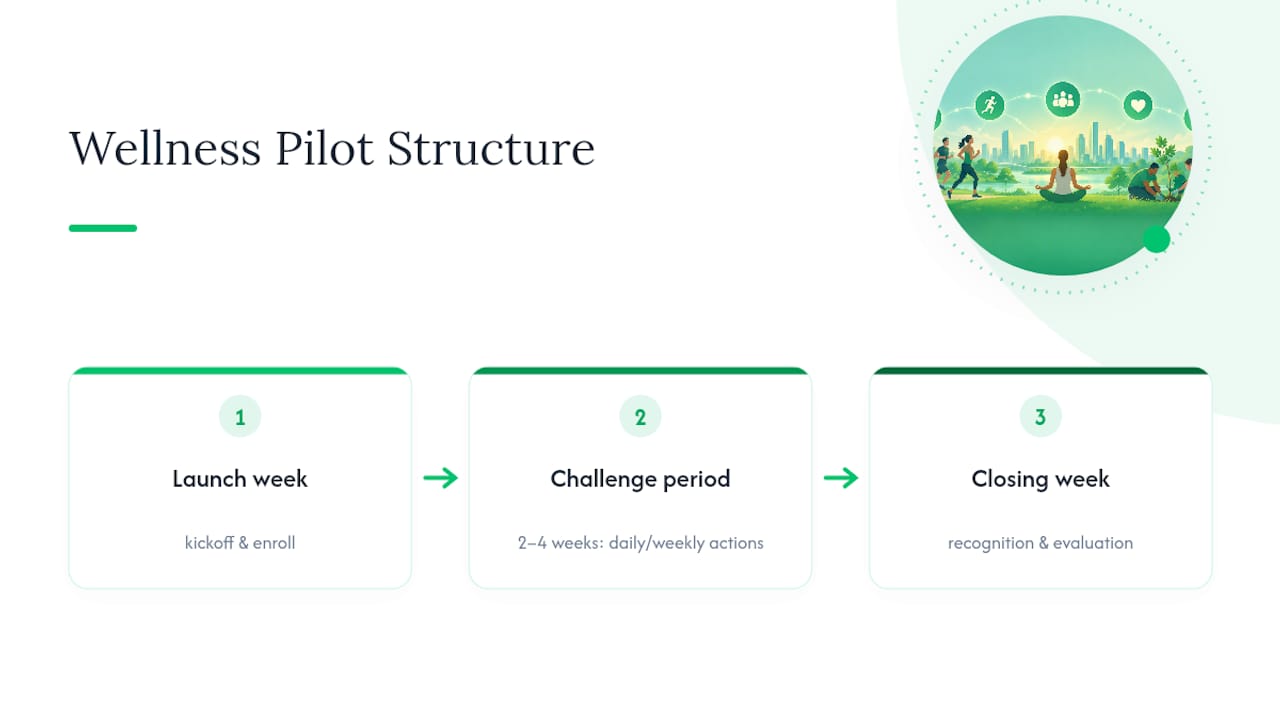
Most successful pilots follow a familiar shape: a launch week, two to four weeks of simple daily or weekly actions, and a closing week built around recognition and evaluation. That structure shows up again and again in published examples, from university wellness offices to hospital systems running monthly challenges. Below are four ready formats you can adapt without reinventing anything.
The 14-day pilot (fastest to launch)
This is the template we’d recommend for a first-time challenge, especially if you’ve never run one before and want proof of concept before asking for budget.
Launch checklist (complete before day 1):
- Assign one program owner and one backup.
- Pick a sign-up method (a shared form works fine for a pilot).
- Brief managers with a two-sentence script they can repeat to their teams.
- Confirm your tracking tool and a non-digital logging alternative.
- Send the announcement email 3 to 5 days before launch.
Daily task outline:
- Day 1: Kickoff, sign-ups close, teams or solo tracks assigned.
- Days 2 to 4: Movement focus, walk, bike, or stretch for at least 10 minutes.
- Days 5 to 7: Hydration and nutrition micro-goals, no penalties for missed days.
- Day 8: Midpoint check-in email with a leaderboard snapshot or a simple encouragement note.
- Days 9 to 11: Mindfulness focus, five-minute breathing breaks or a short walk without a phone.
- Days 12 to 13: Connection focus, invite a colleague to join an activity.
- Day 14: Close tracking, send the wrap email, and recognize participation publicly.
Wrap recognition script: “Thank you for making this pilot a success. Many of you logged at least one activity, and together the team completed numerous activities. We’re using what we learned here to shape our next challenge.”
The 4-week / 30-day challenge
This format works well once you’ve run a pilot and want a fuller month. Structure it around weekly themes rather than daily tasks, which reduces fatigue and gives people breathing room.
- Week 1: Movement, any walk, ride, or workout counts.
- Week 2: Nutrition and hydration, small daily swaps.
- Week 3: Mindfulness and sleep, journaling or a wind-down routine.
- Week 4: Connection and reflection, team shoutouts and a closing survey.
For scoring, decide upfront whether you’re running team versus individual tracks. Team scoring (aggregate points or miles) tends to boost camaraderie and works well for larger departments; individual scoring rewards personal consistency and suits remote or hybrid teams better. You can also run both in parallel; team totals for morale, individual completion for recognition.
The 31-day, calendar-aligned variant
Align this one to an actual month, useful if you want it to double as an awareness-month tie-in (heart health in February, mental health in May, and so on). The structure mirrors Mayo Clinic Health System’s 31-day programs: a mix of activity, nutrition, mindfulness, sleep, gratitude, and self-care prompts spread across the full month, with no single day carrying more weight than another. This format has enough flexibility for inclusive team formats if you want to keep the competitive element light.
Year-long theme calendar
If you’re planning further out, assign a loose theme per month rather than trying to script twelve full challenges at once:
- January: Movement reset
- March: Nutrition basics
- May: Mental health awareness
- July: Outdoor activity
- September: Sleep and recovery
- November: Gratitude and connection
Fill the other six months based on your workforce’s interests or existing company observances.
Sample communication snippets
Announcement: “Starting Monday, we’re launching a two-week wellness challenge. No fitness level required, just show up and move in whatever way works for you.”
Midpoint reminder: “Halfway there. [X] teammates have logged an activity so far. Keep it simple, a short walk counts.”
Celebration: “That’s a wrap. Thank you for showing up for yourself and each other this month.”
Printable and editable versions of these formats are common; several organizations distribute their weekly grids as Canva-based newsletters, which makes it easy to swap in your own branding without starting from a blank page.
How Do You Write a SMART Objective for a Wellness Challenge?
Every template above works better, or worse, depending on the objective behind it. A vague goal like “get people healthier” gives you nothing to measure and nothing to adjust. A SMART objective forces the specifics before you launch.
Here’s what each letter means in practice for a workplace pilot:
- Specific: Name the behavior and the population. “Increase daily movement among headquarters staff” beats “improve wellness.”
- Measurable: Attach a number you can actually track. “40% of eligible employees log at least one activity.”
- Achievable: Base the target on your current participation baseline, not an aspirational guess.
- Relevant: Tie it to something leadership already cares about, retention, morale, or a CSR goal.
- Time-bound: Give it a clear start and end date, ideally matching your 14-day or 30-day window.
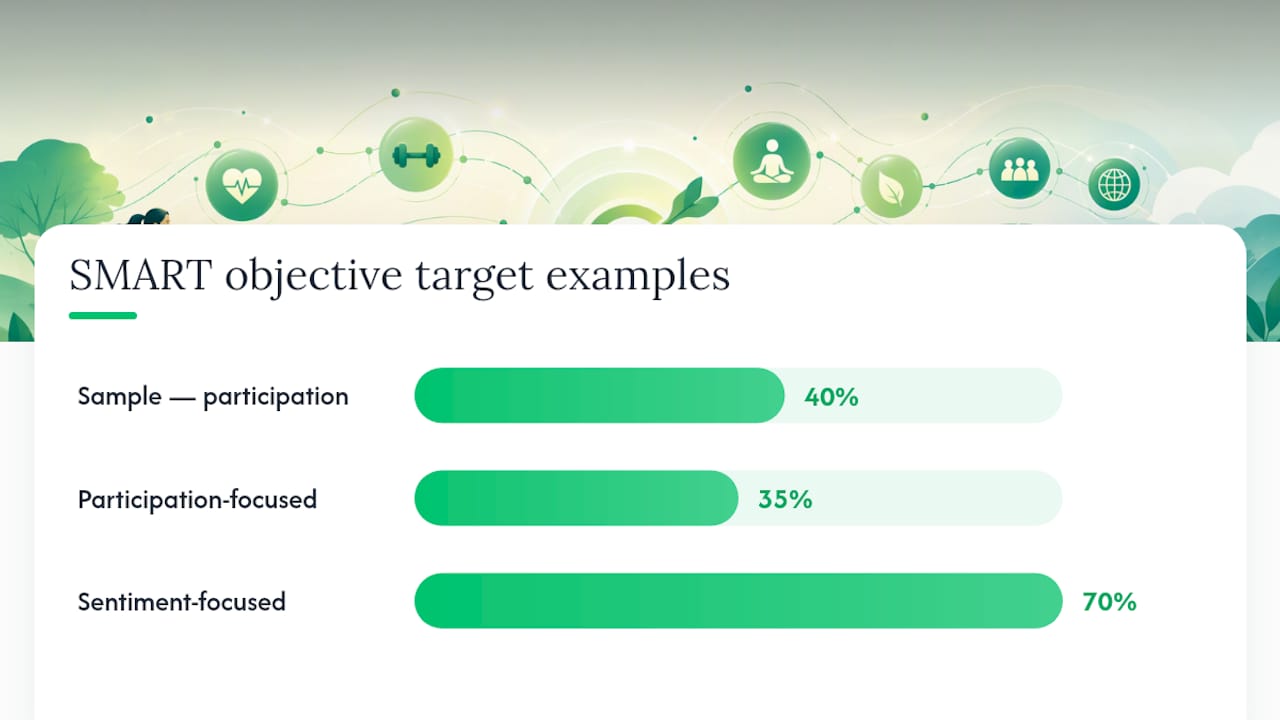
Sample objective: “Achieve 40% voluntary participation among headquarters employees in a 14-day movement challenge, measured by sign-up and activity logs, by the end of the pilot period.”
Three ready-to-use objectives, depending on what you’re optimizing for:
- Participation-focused: “Reach 35% sign-up rate across all departments within the first 3 days of launch.”
- Behavior-focused: “Increase average weekly logged activities per participant from 1 to 3 over 30 days.”
- Sentiment-focused: “Achieve a post-challenge pulse survey score where 70% of respondents report feeling more supported by their employer.”
Participation-focused objectives are easier to hit and easier to defend to leadership on a first pilot. Outcome-focused objectives (behavior change, sentiment shifts) are more meaningful long-term but require a baseline survey and more patience before you can call them a success. Most first-time programs should lean participation-focused and layer in sentiment measurement once they’ve run a second or third cycle.
Pro Tip: Write your objective before you pick your activities, not after. Working backward from “what would count as a win” keeps you from designing a challenge that’s fun but unmeasurable.
A written planning framework, like the checklist approach outlined by WELCOA, also helps here: pairing your objective with a defined timeline, budget, and evaluation plan up front keeps the whole rollout from drifting.
What’s the Step-by-Step Rollout Timeline?
A wellness challenge template is only as good as the rollout around it. Here’s the compact sequence that keeps a pilot from stalling in week one.
- Two weeks before launch: Assign the owner, choose your sign-up and tracking method, and confirm any accommodation plan for employees who can’t participate in standard formats.
- One week before launch: Send the announcement, brief managers with a short script, and post the challenge details somewhere visible (intranet, Slack, email).
- Launch day: Open sign-ups, confirm team or individual tracks, and send a welcome message that states the objective plainly.
- Active weeks: Send a midpoint reminder, spotlight one or two participants (with permission), and nudge low-engagement teams individually rather than publicly.
- Final days: Close tracking, notify participants of the deadline, and prepare your recognition messaging.
- Wrap week: Send a short anonymous pulse survey, share results and recognition publicly, and document what worked for the next cycle.
Manager involvement is the piece HR teams skip most often, and it’s the one the CDC’s organizational supports research points to as most predictive of participation. A one-line script for managers (“Our team is joining a two-week movement challenge, no pressure, just log what you can”) does more for turnout than any prize.
Simple Tracking Systems and the 5 KPIs That Matter
You don’t need an enterprise platform to run a pilot. A shared spreadsheet or a simple form works fine for 14 to 30 days, and it keeps your data footprint small, which matters once you start thinking about privacy. If you want automated tracking, apps that log steps, miles, or minutes reduce manual entry, but always pair them with a non-digital logging option (a paper sheet or an HR entry form) so desk-based or lower-tech employees aren’t excluded from participating or from the leaderboard.
Five KPIs are enough to evaluate almost any pilot:
- Sign-up rate: Percentage of eligible employees who register.
- Weekly engagement: Percentage of participants logging at least one activity per week.
- Completion rate: Percentage who finish the full challenge window.
- Self-reported wellbeing delta: Change in pulse survey responses from pre- to post-challenge.
- Manager-observed engagement: Informal feedback from managers on team morale and participation.
Statistic Callout: Because tracking programs tend to show only modest biometric change over short windows, weight your KPIs toward participation and sentiment rather than health outcomes you can’t reliably measure in 30 days.
Your pulse survey doesn’t need more than five questions. Keep it anonymous, ask about perceived employer support, whether the challenge felt inclusive, and whether they’d participate again. A clear leaderboard rule set before launch, aggregate points versus raw miles, team versus solo, prevents disputes and keeps the focus on participation rather than competition. For a deeper look at building out KPIs beyond the pilot stage, see how to measure corporate wellness impact.
How Do You Design a Wellness Challenge That’s Actually Inclusive?
A challenge that only rewards runners and cyclists will lose half your workforce by day three. Design for the full range of physical ability, schedule, and access from the start, not as an afterthought once someone complains.
Practical rules that make a real difference:
- Include low-impact options (stretching, seated exercises, short walks) worth equal points to higher-intensity activities.
- Add mental health and mindfulness tasks (journaling, five-minute breathing breaks) as full credit, not bonus credit.
- Allow substitutions when someone can’t complete a listed task for medical or personal reasons, no explanation required.
- Offer both team and solo tracks so introverted or remote employees aren’t forced into group dynamics.
- Provide a non-phone logging method (paper form, HR-managed spreadsheet) so employees without smartphones or company data plans aren’t shut out. This matters more than most HR teams expect. If your only tracking method is a mobile app, you’ve quietly excluded warehouse staff, some hourly workers, and anyone whose role doesn’t come with a company device.
Write your challenge copy in plain language and keep it to one reading level below where you’d normally pitch to leadership. Complicated rules discourage participation faster than a hard activity.
Pro Tip: Ask one person outside HR, ideally someone with a physical limitation or a non-desk job, to read your challenge rules before launch. If anything confuses or excludes them, fix it before you send the announcement.
What Privacy and Legal Guardrails Should You Build In?
The single most important operational rule for any wellness challenge: keep it voluntary, and never penalize non-participation. That principle sits at the center of federal guidance and it should sit at the center of your design too.
If your challenge only tracks steps, miles, or minutes, and doesn’t ask for health screenings, blood pressure, or genetic information, you’re in relatively low-risk territory. The moment you introduce biometric screenings, health risk assessments, or anything touching family medical history, you move into territory governed by the EEOC’s rules on employer wellness programs, which apply ADA and GINA protections. Those rules require that programs be voluntary, that employers provide clear notice about what’s collected and how it’s used, and that any medical information stay confidential and separate from personnel files.
A short participation-only pilot rarely triggers these requirements, but it’s worth building good habits early:
- Never make participation a condition of any benefit, raise, or performance review.
- Report data in aggregate only, never call out individual names in leaderboards without explicit opt-in.
- Provide alternative standards for employees who can’t meet a specific task due to disability or medical condition.
- If you ever plan to collect health screenings, involve legal counsel or your benefits team before launch, not after.
- Store any personal data separately from general HR files and limit who can access it.
For a deeper walk-through on separating consent from convenience, see how to fix wellness data privacy for both individuals and employers. When in doubt, the safest default for a first pilot is simple: track activity, not health status.
What Does Sustained Engagement Actually Look Like?
Most wellness challenges fade after the first cycle because the activity itself was never the reason people showed up. What sustains participation is a sense that the effort means something beyond a leaderboard.
Charity Miles built its Employee Empowerment Program around that idea: private company teams, movement of any kind counted toward a shared goal, and company-controlled sponsorship that turns logged miles into real charitable dollars.
The lesson isn’t that fundraising alone drives participation. It’s that when movement is tied to a cause employees actually care about, and when the company visibly sponsors that effort, engagement stops depending on novelty and starts depending on meaning.
That mirrors what the CDC’s organizational supports research found in a more academic context: visible management commitment and incentive structures tend to predict participation better than the activity list itself. A private team structure, sponsor-controlled donation rates, and public recognition of impact aren’t just nice features. They’re the organizational supports that keep a wellness challenge from becoming a one-time event nobody remembers by March.
What I’d Tell Any HR Team Running Their First Challenge
Start smaller than feels ambitious. A 14-day pilot with a substantial participation rate and genuinely useful feedback beats a longer program that fizzles early due to lack of planning past launch day. Measure participation honestly, even when the number disappoints you, and celebrate it publicly anyway. People notice when effort gets acknowledged, not just outcomes.
Assign a single named owner before you write a single line of challenge copy. Diffuse ownership is the fastest way for a wellness initiative to quietly die between two other people’s job descriptions. And brief your managers directly. A two-sentence script repeated by ten team leads does more for turnout than any prize you could offer.
Run your first pilot expecting to learn, not to prove a return on investment. The data you collect in that first cycle is what makes your second one better.
— Gene
Turn Movement Into Something Employees Actually Want to Track
If you’ve read this far, you’ve already seen how much work goes into building a wellness challenge from scratch: writing copy, briefing managers, building a tracking sheet, and hoping people stay motivated past week two. Charity Miles removes most of that friction by giving you a platform built specifically for this, where movement of any kind, walking, running, biking, counts toward a shared goal your employees actually care about.
The Employee Empowerment Program lets you set up private company teams, choose your own sponsorship rate and cap, and decide whether donations flow to each employee’s chosen charity or a cause your company selects. That’s the difference between a DIY spreadsheet challenge and a program built to scale: you get the inclusive logging and leaderboard structure without building it yourself, plus a CSR story that’s visible and personal to every participant, not just a line in an annual report. Companies exploring corporate sponsorship opportunities can layer in brand activation on top of the same movement data.
If your organization is weighing a DIY spreadsheet pilot against a turnkey program, the deciding factor is usually scale and reporting needs, if you need clean participation data across departments or want the challenge tied directly to a CSR goal, a built platform saves weeks of setup. Ready to see how it fits your team? Launch an employee challenge and request a walkthrough of the program.
Sources
For legal grounding, review the EEOC’s final rules on employer wellness programs and the CDC’s Worksite Health ScoreCard framework. For ready-made structures, Kent State’s monthly challenge examples and the Brigham and Women’s Hospital challenge PDF offer field-tested templates.
- Monthly challenges — Kent State People and Culture
- EEOC issues final rules on employer wellness programs
- Using the CDC’s Worksite Health ScoreCard as a Framework to Examine Worksite Health Promotion and Physical Activity — CDC
- Pathways to Employee Outcomes in a Workplace Health Promotion Program — CDC
FAQ
What Is the 5-3-1 Rule for Wellness?
The 5-3-1 rule is a simple weekly movement target: aim for 5 servings of fruits or vegetables, 3 sessions of exercise, and 1 hour of screen-free time each day. It’s often used informally in wellness challenges as a memorable daily or weekly checklist rather than a strict clinical guideline.
What Are Some Good Ideas for a Wellness Challenge?
Strong ideas mix movement, nutrition, mindfulness, and connection so no single fitness level is favored. Options include a walking or step log, a hydration tracker, a five-minute daily mindfulness break, or a team-based movement challenge where miles convert into charitable donations.
What Are the 7 Basic Principles of Wellness?
Definitions vary by source, but most workplace wellness frameworks group principles around physical, emotional, social, occupational, financial, intellectual, and environmental well-being. A good challenge touches at least two or three of these categories rather than focusing on physical activity alone.
What Are Some Ideas for a 30-Day Wellness Challenge?
A 30-day challenge works well structured around four weekly themes: movement, nutrition, mindfulness and sleep, and connection. Each week can carry a simple daily task, like a short walk, a hydration goal, or a gratitude note, scored on completion rather than intensity.
Does Charity Miles Work for a Short Employee Wellness Pilot?
Yes. The Employee Empowerment Program supports private team challenges of any length, including short pilots, and lets companies control sponsorship rates and caps from day one. Pricing details are available directly through the program page rather than published publicly.