
A well-designed wellness challenge leaderboard boosts engagement when it rewards effort and meaning, not just raw speed or step count. If you’re weighing whether to add one to your next challenge, the answer is yes, with the right structure. Three approaches work reliably:
- A simple steps leaderboard for short, low-lift challenges where everyone tracks the same metric.
- A points-based inclusive leaderboard that converts different activities into comparable scores, so a swimmer competes fairly with a walker.
- A CSR-linked mileage-to-charity leaderboard, like the model Charity Miles runs for corporate teams, where movement funds donations instead of just bragging rights.
Pick your program goal and metric first. Everything else follows from that choice.
Key Takeaways
CSR-linked leaderboards that reward inclusive, percent-based progress sustain participation longer than prize-only rankings built on raw activity totals.
| Point | Details |
|---|---|
| Choose fair scoring | Use percent-improvement or normalized points instead of raw totals to keep the board competitive across fitness levels. |
| Update often | Daily or real-time leaderboard updates sustain engagement better than weekly postings. |
| Build in privacy | Make rankings opt-in with an anonymity option and document your data retention window before launch. |
| Rotate challenge formats | Alternate weekly, 28-day, and monthly micro-challenges to prevent burnout from repeat formats. |
| Link movement to purpose | Charity Miles’ CSR-linked model helped HARMAN reach an 11x jump in participation, showing how mileage-to-charity leaderboards outperform prize-only boards. |
Table of Contents
- What Is a Wellness Challenge Leaderboard, Exactly?
- How Do You Score a Wellness Leaderboard Fairly?
- Which Challenge Format Should You Run First?
- What Keeps People Coming Back to the Leaderboard?
- How Should You Collect and Protect Participant Data?
- How Do You Actually Launch a Leaderboarded Challenge?
- How Did HARMAN’s Charity Miles Leaderboard Change Engagement?
- Where Can You Learn More About Leaderboard Design?
- Why CSR-Linked Leaderboards Outperform Prize-Only Boards
- Turn Your Wellness Leaderboard Into a CSR Win
- Frequently Asked Questions
- Sources
What Is a Wellness Challenge Leaderboard, Exactly?
A wellness challenge leaderboard ranks participants or teams by activity, points, or progress over a set period, updated on a schedule everyone can see. Two design decisions matter more than any software feature: real-time versus cumulative scoring, and individual versus team competition.
Real-time leaderboards update as data syncs, which keeps momentum high during short sprints. Cumulative leaderboards total scores over the full challenge window, which suits longer programs where consistency matters more than daily bursts. Team formats build camaraderie and pull in employees who’d never chase an individual ranking alone; individual formats reward personal accountability but can discourage lower-activity staff if left unchecked.
Inclusion should be built in, not bolted on. A few proven techniques:
- Normalize points instead of raw distance, so a 20-minute walk and a 20-minute swim earn equal credit.
- Use tiers or divisions based on baseline activity, similar to the custom divisions sports platforms like KettleBoards use to keep competition fair across skill levels.
- Convert non-step activities (cycling, swimming, yoga) into a shared unit so nobody’s excluded by device type.
Match the leaderboard type to your actual goal. Chasing participation? Go team-based and inclusive. Building CSR visibility? Tie the board to charitable miles rather than pure ranking.
How Do You Score a Wellness Leaderboard Fairly?
Three scoring formulas cover most workplace challenges:
- Cumulative totals — sum steps, miles, or minutes across the whole period. Best for straightforward challenges with one activity type.
- Percent change from baseline — measures improvement rather than absolute output, which levels the field between a marathoner and someone just starting out.
- Points-based scoring — assigns point values per activity type (steps, minutes of yoga, bike miles), then ranks by total points.
Normalizing non-step activity is where most leaderboards break down. If your challenge includes cycling, use a documented conversion factor rather than an arbitrary guess. Charity Miles publishes a cycling-to-steps conversion guide that HR teams can adapt for their own rules, and writing the formula into your challenge documentation up front avoids disputes later.
Display options matter almost as much as the math.
Pro Tip: Default to percent-improvement or normalized points instead of raw totals. It rewards effort at every fitness level and keeps your best-conditioned employees from locking the podium for the entire quarter.

Which Challenge Format Should You Run First?
Match the format to your timeline and goal before picking software or prizes.
- 7-day sprint: Objective is a quick engagement bump. Real-time steps leaderboard, small teams of 4 to 6, prize is a half-day off or gift card.
- 28-day habit builder: Objective is consistency. Cumulative points leaderboard, department-based teams, milestone badges every 7 days.
- 8-week fitness push: Objective is measurable health improvement. Percent-improvement leaderboard, individual or paired accountability, tiered rewards at 25%, 50%, and 100% goal completion.
- Monthly micro-challenge: Objective is sustained low-pressure participation. Rotating themes (walking one month, cycling the next) with a cumulative board reset monthly to avoid burnout.
- CSR-linked mileage challenge: Objective is charitable impact plus movement. Miles convert to donations through a program like Charity Miles’ corporate step challenge model, with a leaderboard tracking dollars generated instead of just distance.
Rotate formats quarterly. Running the identical steps challenge four times a year is the fastest way to watch participation decline by the third round.
What Keeps People Coming Back to the Leaderboard?
Recognition, not just competition, sustains a wellness leaderboard past week two.
- Award digital badges for milestones (first 10 miles, 7-day streak, top-3 finish) rather than reserving recognition for the overall winner.
- Post a weekly spotlight naming a top performer, most-improved employee, or standout team, separate from the leaderboard rankings.
- Build in team rivalries between departments or offices; they generate more sustained chatter than individual rankings alone.
- Tie prizes to wellness or CSR themes: extra PTO, a donation match to the winning team’s chosen charity, or branded gear, instead of only cash.
Update cadence matters. Frequent updates, ideally daily or real-time, keep motivation higher than a single end-of-week posting, a pattern that shows up clearly on competitive platforms like the CrossFit Games leaderboard, where standings shift constantly and participants check in far more often as a result. Pair that update rhythm with a communication plan: a launch email, a midpoint nudge, and a closing recap tend to outperform a single announcement that gets buried in inboxes.
How Should You Collect and Protect Participant Data?
Reliable leaderboards run on verified data, not the honor system. Pull activity from connected fitness trackers, smartphone GPS, or app-based logging rather than manual self-report, which is easy to inflate and hard to audit.
Aggregation rules should be documented before launch: decide whether you’re averaging daily activity or summing it, and pick a display interval, daily is usually the sweet spot between real-time noise and stale weekly postings.
Privacy has to be opt-in by design. The CDC’s workplace health promotion guidance recommends measurable, inclusive activity goals precisely because performance-only visibility can discourage lower-activity employees rather than motivate them.
- Make leaderboard visibility opt-in, with an anonymized-name option for anyone uncomfortable being publicly ranked.
- State your data retention window in the challenge rules, and delete individual activity data once reporting closes.
- Report participation rate, average activity change, and total impact (miles, dollars raised) to stakeholders, not individual scores.
How Do You Actually Launch a Leaderboarded Challenge?
- Pre-launch (2 weeks out): Confirm goal and metric, draft scoring rules, announce via email and team channels.
- Enrollment and baseline (week 1): Open sign-ups, collect device/app connections, capture a baseline activity snapshot for percent-improvement scoring.
- Active challenge (ongoing): Update the leaderboard on your set cadence, send a midpoint engagement nudge, spotlight top performers weekly.
- Close-out (final week): Verify final data, distribute rewards, and compile an impact report covering participation and outcomes.
Assign a single coordinator to own data verification. Disputed rankings almost always trace back to unclear scoring rules, not bad intentions.
How Did HARMAN’s Charity Miles Leaderboard Change Engagement?
HARMAN launched a private Charity Miles team in 2021, and the results reframe what a leaderboard can accomplish beyond ranking steps.
Since launching its Charity Miles team, HARMAN saw an 11x increase in employee participation, with a substantial number of employees generating significant funds for charity.
Tying miles to donations changes the incentive entirely: employees aren’t climbing a leaderboard for a gift card, they’re climbing it because every mile funds a cause they chose. Companies set the sponsorship rate per mile, the total cap, and whether funds go to employee-selected charities or a company partner, then let the leaderboard track dollars raised alongside distance. That structure explains why participation stayed high long after the novelty of a typical step challenge would have worn off.
Where Can You Learn More About Leaderboard Design?
The CDC’s workplace health promotion guidance and Harvard Health’s walking research support activity-based goals. America’s Health Rankings offers benchmarks for contextualizing program impact. For setup help, see Charity Miles’ step challenge guide.
Why CSR-Linked Leaderboards Outperform Prize-Only Boards
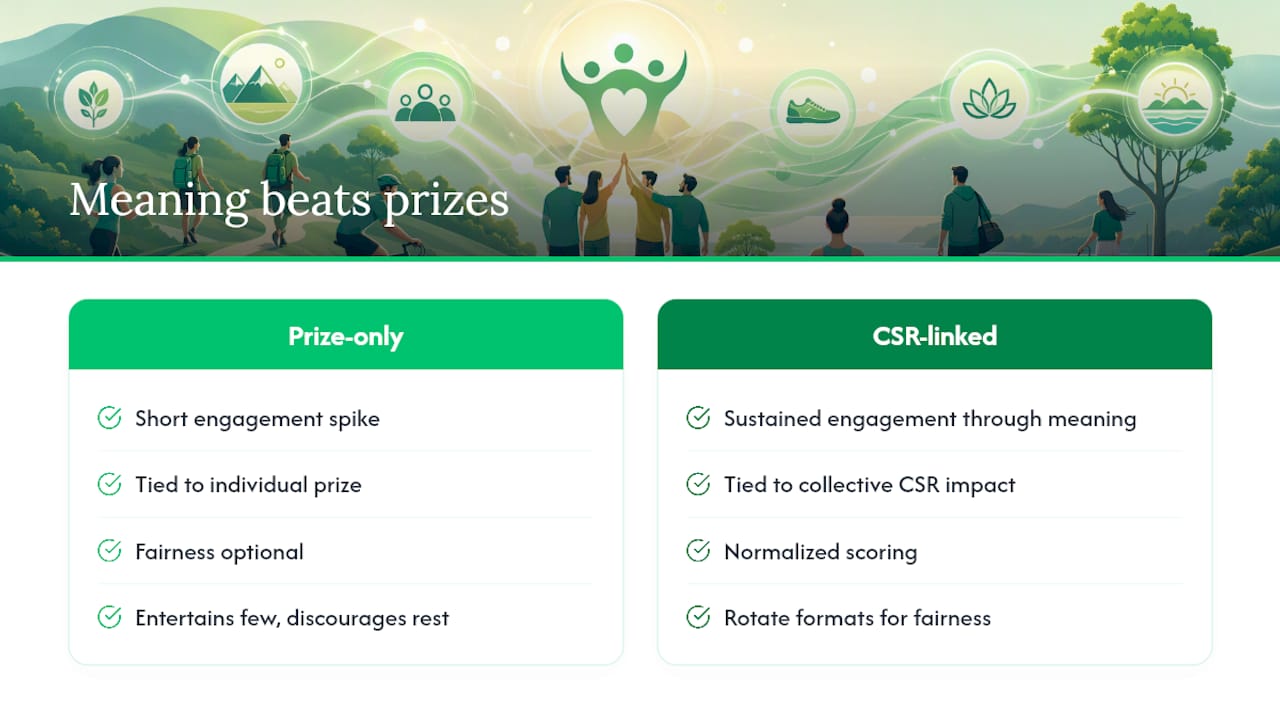
Most wellness program advice still treats the leaderboard as a motivation hack: rank people, dangle a prize, watch engagement spike for two weeks, then fade. That model isn’t wrong, it’s just incomplete. The prize wears off because it was never tied to anything bigger than the individual chasing it.
What the HARMAN numbers actually suggest is that meaning outlasts incentive. It happens because the leaderboard stopped being about who’s fastest and started being about who’s contributing more to something employees already cared about.
The overlooked mistake in most leaderboard design is treating fairness as a nice-to-have instead of the foundation. If your top scorers are always your fittest employees, you’ve built a leaderboard that entertains a fraction of your workforce while quietly discouraging everyone else. Normalize the scoring, rotate the format, and give the effort somewhere to go beyond a ranking. The companies getting real retention out of these programs aren’t the ones with the flashiest dashboard. They’re the ones who figured out that a mile means more when it’s funding something.
Turn Your Wellness Leaderboard Into a CSR Win
If you’ve been running standard step challenges with gift-card prizes, Charity Miles offers a different payoff: every mile your employees log also funds a cause they care about, so the leaderboard drives participation and social impact at once. Through the Employee Empowerment Program, you set up private team challenges, choose your sponsorship rate per mile, and decide whether donations go to employees’ chosen charities or a company partner.
This fits naturally if you’re already thinking about how to make your next wellness challenge stickier without adding vendor complexity. The reporting is built for HR: participation rates, total miles, and dollars raised, ready to share with leadership. Explore Charity Miles’ corporate wellness programs to see sponsorship options and request a walkthrough of how a private team challenge could look at your organization.
Frequently Asked Questions
What’s the difference between a real-time and cumulative wellness challenge leaderboard?
Real-time boards update as activity syncs, which suits short sprints. Cumulative boards total scores over the full challenge and work better for longer programs focused on consistency.
How do you make a wellness challenge leaderboard fair for different fitness levels?
Use percent-improvement scoring or normalized points instead of raw totals, and consider tiers or divisions based on baseline activity so newer participants can still compete.
Should wellness challenge leaderboards be individual or team-based?
Team-based boards tend to drive higher participation and inclusivity, especially for CSR-linked or beginner-friendly challenges. Individual boards work well for shorter, fitness-focused sprints.
How often should you update a wellness program leaderboard?
Daily updates strike the best balance between motivating momentum and avoiding data overload; real-time updates work well for week-long sprints specifically.
Can a wellness challenge leaderboard link to charitable giving?
Yes. Programs like Charity Miles convert tracked miles into donations, giving the leaderboard a purpose beyond ranking and helping sustain participation well past a typical challenge’s usual drop-off point.