

A good walking meeting policy fits on one page. It says which meetings can be held on foot, makes participation voluntary, sets simple rules for route, group size, pace and weather, and keeps sensitive conversations seated. This guide gives you each of those pieces, the evidence behind them, and a sample policy you can adapt. It also shows how to turn the walking habit into something the whole team can see and feel good about, which is where Charity Miles comes in: our free app counts every mile walked and turns it into a donation to a charity the employee chooses.
TL;DR
- A walking meeting is a work meeting with a purpose and an agenda, held on foot. It is not a break or a social stroll.
- Keep it small (two to four people), short (30 minutes or less) and paced to the slowest walker.
- Make it optional, give advance notice, and always keep a seated alternative. Keep disciplinary and confidential topics in the office.
- Plan the route for safety and access, and treat accommodations under the ADA as part of the policy.
- Research on walking meetings is small-scale but encouraging. Tracking and rewarding the miles helps the habit stick.
Table of Contents
- What a walking meeting policy needs to cover
- Which meetings belong on a walk
- Make it voluntary, with notice
- Group size, length, pace and route
- What the evidence says
- Accessibility and accommodations
- A sample walking meeting policy
- Making the habit stick
- Bring your walking program to your whole team
- FAQ
- Sources
What a walking meeting policy needs to cover
The Safe Routes Partnership guide defines a walking meeting as a work meeting held while walking, with a specific purpose. That definition matters in a policy. If people think “walking meeting” means a casual lap around the block, the format drifts into social time, and managers stop treating it as real work.
A workable policy answers seven questions:
- Which meetings qualify, and which do not?
- Is participation voluntary, and how does someone decline?
- How many people, for how long, and at what pace?
- Who plans the route and checks it for safety and access?
- How are notes and action items captured?
- What happens in bad weather?
- Who do employees talk to if they need an accommodation?
The sections below take these in turn.
Which meetings belong on a walk
The Safe Routes Partnership guide names brainstorming, check-ins, professional networking and conflict-resolution conversations as good candidates. It treats meetings that need detailed notes, or that involve working on a visual or written product, as poorer fits. A 2019 employment-law briefing from Fisher Phillips agrees, suggesting walk-and-talks for small conversations about creativity, strategy or ideation rather than document-heavy sessions.
There is a reason brainstorming tops the list. Stanford researchers Marily Oppezzo and Daniel Schwartz found that walking improved creative responses in controlled tasks, as summarized in Psychology Today. That supports using walks for idea generation. It does not mean every kind of work gets better on foot, so the policy should be specific about which meetings are in scope.
A simple sorting table helps managers decide:
| Meeting type | Walk it? | Why |
|---|---|---|
| One-on-one check-in | Yes | Conversation-driven, little paperwork |
| Brainstorm, strategy, ideation | Yes | Walking supports idea generation |
| Mentoring or networking chat | Yes | Easy to talk side by side |
| Status review with slides or documents | No | Needs screens and a table |
| Meeting that needs detailed minutes | No | Hard to write while walking |
| Disciplinary or confidential conversation | No | Keep it private and seated |
Fisher Phillips advises keeping sensitive discussions, especially disciplinary meetings, in the office. Penn State’s walking meeting guidelines likewise advise avoiding confidential conversations on a walk, because people nearby can overhear. Put this in the policy in plain words so no manager has to guess.
Make it voluntary, with notice
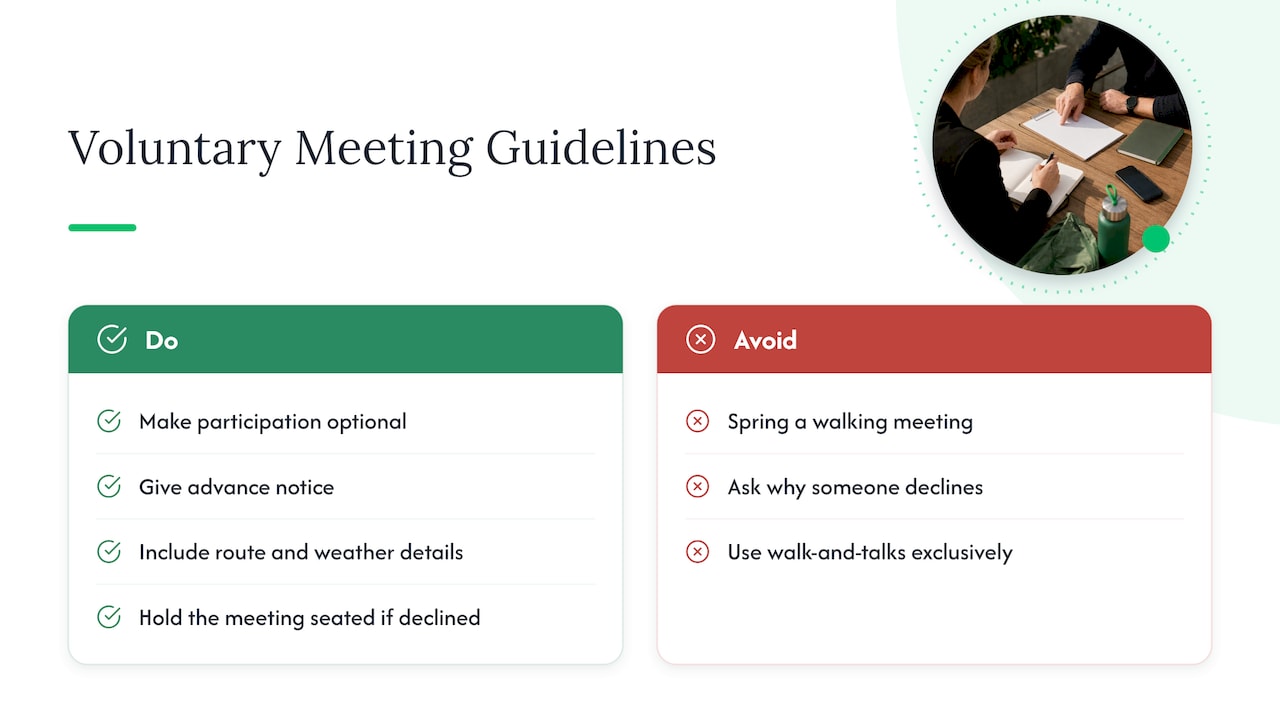
The most important sentence in any walking meeting policy is that participation is optional. Penn State’s guidelines state that participation should always be voluntary and that invitees should get advance notice. Fisher Phillips says not to spring a walking meeting on someone, to accept a decline graciously, and to go ahead with the planned seated meeting instead. It also advises against using walk-and-talks exclusively.
There are many reasons someone might say no: a medical condition, footwear, weather, a long day of back-to-back calls, or simply a preference. The policy should not ask for the reason. A good rule reads: “Any employee may decline a walking meeting at any time without explanation. The meeting will be held seated instead.”
Advance notice does practical work too. The Safe Routes Partnership guide recommends it so employees can bring suitable footwear and outerwear. Put the start point, route, expected length and a weather plan in the invitation.
Group size, length, pace and route
Here is what the published guidance converges on:
- Length. The Safe Routes Partnership guide says to keep walking meetings to 30 minutes or less and to set the route to fit the meeting length. Other guides run longer for informal discussions, but a policy needs a clear default, and 30 minutes is easy to schedule.
- Group size. The same guide recommends four or fewer, noting that larger groups make it harder to hear and stay engaged. Walking Scotland’s 2025 guide suggests two to five. A mixed-methods study of office workers in Denmark found that talking while walking was difficult in groups larger than two. A sensible policy default is two to four.
- Pace. Match the pace to the slowest participant. Penn State asks participants to speak up if the pace is uncomfortable, and Walking Scotland recommends a comfortable conversational pace.
- Agenda. Share a short agenda in advance. Walking Scotland recommends a simple one, and Emory’s walking meeting handout recommends planning both route and agenda ahead.
- Phones. The Safe Routes Partnership guide suggests establishing cellphone rules. Keep it short: phones away unless the group needs one to look something up.
Route and safety
Penn State’s guidelines say the route should avoid busy roads and noisy places and offer safe sidewalks and crossings, and that walkers should obey traffic laws. Walking Scotland recommends assessing the route for safety and inclusion and sharing the details in advance: start point, duration, weather alternatives, hazards, clothing, rest needs and accessibility.
In practice, name two or three approved loops of different lengths, such as 10, 20 and 30 minutes, and publish them on the intranet. A pre-set route removes the planning burden and means nobody ends up on a road without a sidewalk. Indoor options count too: Walking Scotland notes that walking meetings can take place in sufficiently spacious indoor areas, which gives you a rain and heat plan.
Notes and follow-up
Emory’s handout recommends assigning a note-taker, minimizing interruptions, and reviewing decisions and action items afterward. The CDC’s pilot protocol, described below, ended with a seated wrap-up for paperwork. Borrow that idea: walk for the conversation, then sit for five minutes, or send a short written summary within the day.
What the evidence says
Be honest about the evidence in your rollout communication. It is encouraging but modest, and it is strongest on physical activity and creativity.
- In a CDC pilot, average weekly work-related moderate-to-vigorous activity rose from 107 minutes at baseline to 114 in week two and 117 in week three when office workers held walking meetings. The study was small and short and was not designed to prove cause and effect. Its protocol used an agenda, a set time and place, comfortable shoes, water and sun protection, assigned group roles, a prescribed route and at least 30 minutes of walking.
- The Florida Walking Meeting Pilot followed 18 university white-collar workers over three weeks, with one walking meeting a week in weeks two and three. Higher moderate occupational activity correlated with less work time missed for health reasons and less work impairment from health reasons.
- The Danish study found standing meetings were used regularly across offices, while few walking meetings were completed. It listed the barriers: weather, needing to write or use a computer, difficulty talking in bigger groups, lack of discretion in public places, focus, preparation time and the feeling of leaving work.
That last list is useful. Each barrier maps to a policy line: approved indoor and rainy-day routes, groups of two to four, seated alternatives for document work, a ban on confidential topics, and pre-planned routes so nobody spends time on preparation.
Accessibility and accommodations
Inclusion is about route and format, not just goodwill. Walking Scotland’s guide says walking meetings should welcome people of different abilities, including wheelchair users and people using walking aids, and that ability, route length, pace, rest stops, weather and clear hazard information all affect who can take part.
In the United States, the Americans with Disabilities Act requires employers to provide reasonable accommodations so employees with disabilities can enjoy equal terms, conditions, benefits and privileges of employment, as the EEOC explains. For a walking meeting policy, that means:
- Voluntary participation, with the seated meeting always available and no penalty or comment for choosing it.
- Step-free, smooth, well-lit routes in your approved list, with benches where possible.
- A named contact, usually HR, for accommodation requests, and a statement that medical information is kept confidential.
- Flexibility on pace and length for anyone who asks.
Because accommodation rules depend on your employer size and circumstances, have HR or your employment counsel review the final wording before you publish it.
A sample walking meeting policy
Adapt this to your company:
Purpose. Walking meetings let colleagues combine focused conversation with light physical activity.
Eligible meetings. Check-ins, brainstorms, strategy and ideation sessions, and mentoring conversations. Meetings that need screens, documents or detailed notes, and any disciplinary or confidential conversation, are held seated.
Voluntary. No one is required to join a walking meeting. Anyone may decline without giving a reason, and the meeting will be held seated instead.
Notice. Organizers send the agenda, start point, route, expected length and weather plan in advance.
Format. Two to four people, 30 minutes or less, on an approved route, at the pace of the slowest walker. Phones stay away unless needed.
Safety and access. Use only approved routes with sidewalks and safe crossings. Obey traffic laws. Anyone who needs an adjusted route, pace or format can contact HR.
Follow-up. The organizer names a note-taker and sends decisions and action items within one working day.
Making the habit stick
A policy gets a first wave of walks. Keeping them going is a different problem, and it is mostly about motivation. Our app, Charity Miles, is built for exactly that. Employees log walking, running or biking miles through GPS and pedometer tracking, and money is donated to a charity of the member’s choice for every mile. Because any movement counts, a lap with a colleague at lunch registers the same as a run. For more ideas on building the routine, see our look at walking meeting benefits and our guide to workplace walking safety.
Teams that want a shared goal can also run a fitness challenge alongside the policy, so the miles from walking meetings feed into something the whole company can see.
Some employees will also want to pair their walking with strength and bone-health work, and in-person bone density wellness services are one route they can explore on their own time.
Our perspective
We see the walking meeting as a small habit with an outsized effect on culture, and the policy is what protects it. The rules that make it work, voluntary participation, small groups, a planned route and a seated option, are the same ones that make any wellness program feel inclusive rather than imposed.
What keeps people walking is meaning. A step count on its own fades. A mile that turns into a donation to a cause you chose is something you mention to a colleague, and that is why we built Charity Miles around it. Any movement counts, so the program works for the marathoner and the person who simply prefers a stroll to a conference room.
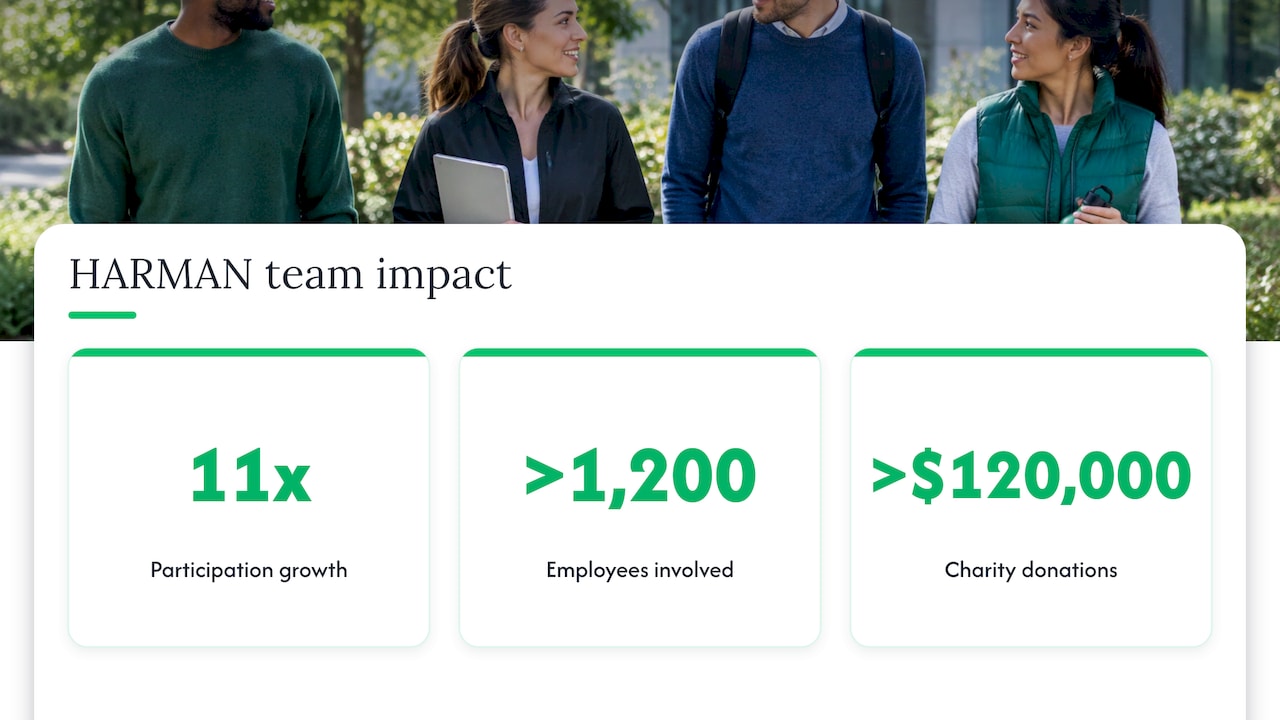
For companies, our Employee Empowerment Program lets you create private teams, run friendly challenges and, if you choose, sponsor your employees’ miles on your terms: the rate per mile, the total cap, and whether donations go to each employee’s chosen charity or a cause the company selects. Since launching its team in 2021, HARMAN has seen an 11x increase in employee participation, with more than 1,200 employees generating over $120,000 for charity. A walking meeting policy gives people a reason to walk during the workday. A shared challenge gives them a reason to keep going.
Gene
Bring your walking program to your whole team
If you are rolling out a walking meeting policy, the Employee Empowerment Program gives you private team challenges, configurable company sponsorship of employee miles, and reporting for your CSR and wellness goals. Employees use the app for free.

Want to see the wider picture first? Our guides to corporate wellness ideas and employee wellness programs cover how walking fits into a broader program. Individuals can download the app and start logging miles today.
FAQ
How long should a walking meeting last?
Thirty minutes or less is the default in the Safe Routes Partnership guide, with the route set to match the meeting length. The CDC pilot protocol used at least 30 minutes of walking. For longer discussions, plan a seated break to review notes.
Can an employer require walking meetings?
A policy should not. Penn State’s guidelines say participation should always be voluntary, and Fisher Phillips advises accepting a decline graciously and holding the planned seated meeting instead. Making the format optional also supports your accommodation obligations under the ADA.
How many people can join a walking meeting?
Two to four works best. The Safe Routes Partnership recommends four or fewer because larger groups make it harder to hear and stay engaged, and the Danish study found conversation difficult beyond two people.
Which meetings should never be walking meetings?
Disciplinary, confidential and sensitive conversations, plus meetings that depend on screens, documents or detailed notes. Fisher Phillips advises keeping sensitive discussions in the office, and Penn State’s guidelines advise avoiding confidential topics on a walk.
How do we encourage employees to actually walk?
Give them a clear policy, approved routes and a reason to care. Many companies add a team challenge. With Charity Miles, each mile an employee walks can generate a donation to a charity they choose, and the company can sponsor those miles at a rate and cap it sets.
Sources
- Walking Meetings, Safe Routes Partnership
- Opportunities for Increased Physical Activity in the Workplace, CDC
- Walking Meeting Effects on Productivity and Mood, PubMed
- Standing Meetings Are Feasible and Effective in Reducing Sitting Time, PMC
- Why Does Walking Stimulate Creative Thinking?, Psychology Today
- Walking Workplaces: Walking Meetings Guide, Walking Scotland
- The Ins And Outs Of The Walk-And-Talk Meeting, Fisher Phillips
- Walking Meeting Guidelines, Penn State
- Walking Meetings handout, Emory University
- Visual Disabilities in the Workplace and the ADA, EEOC