
The fastest way to make a workplace walking challenge stick is a four-week themed program tied to one clear, inclusive goal, ideally with a charity purpose baked in. Charity-linked themes give people a reason to move beyond the leaderboard, and platforms that make that connection simple by letting companies sponsor employee miles and route the results to a cause.
TL;DR:
- Charity-linked themes significantly boost participation by attaching miles to causes employees care about, as shown by an elevenfold increase at HARMAN.
- Using simple, automated tracking systems like apps or spreadsheets sustains engagement and reduces dropout rates across large teams.
- Designing challenges around low-effort daily prompts or quick milestones yields faster momentum and maintains motivation through consistency.
- Virtual map journeys, streaks, and charity-focused themes adapt well to remote or hybrid teams, while location-based scavenger or seasonal challenges suit local groups.
- A four-week duration balances habit formation with avoiding fatigue, with longer challenges suitable for sustained behavior change and shorter trials for testing new themes.
Table of Contents
- Creative Walking Challenge Ideas Organized by Category
- How to Choose the Right Theme for Your Group and Goal
- Tracking, Fairness, and Inclusion Rules That Keep It Honest
- Prizes, Recognition, and the Motivation Mechanics Behind Them
- What Charity Miles Learned From a Real Corporate Rollout
- What Two Pilot Challenges Taught Us About Momentum
- How Charity Miles Powers a Themed Team Challenge
- Sources
- FAQ
Creative Walking Challenge Ideas Organized by Category
Not every group needs the same theme. A remote sales team scattered across three time zones needs something different from an in-office finance department that already eats lunch together. Here’s a working set of themed walking challenge ideas grouped by what they’re actually good at, each with a launch template and a quick fairness note.
Virtual map journeys
These convert team miles into progress along a real or fictional route, and they work well for virtual walking challenges with distributed teams.
- Walk Around the World — Team miles combine to circle the globe (24,901 miles), with milestone check-ins at famous cities. Goal rule: total team miles. Fairness tip: report progress as team totals, not individual rankings, so slower walkers never feel exposed.
- Route 66 Road Trip — Walk the mileage equivalent of the historic highway (2,448 miles) as a team relay. Goal rule: cumulative miles. Launch template: post a weekly “you are here” map graphic.
- Walk to Everest Base Camp — A stretch goal for fitness-focused teams chasing a big number over a full quarter.
- Choose Your Own Walking Adventure — Branch the route based on team votes each week, borrowing from the choose-your-path format that keeps momentum from going stale.
Scavenger and photo themes
Photo scavenger hunts turn a routine walk into something people want to post about, and they’re strong for mixed-ability groups because contribution isn’t tied to distance.
- Photo Safari — Daily prompt (find something red, find a dog, find a mural). Goal rule: one photo per day, no mileage minimum.
- Color Hunt — Each week focuses on a single color; participants snap what they find. Fairness tip: score participation, not photo quality.
- Neighborhood Landmarks — Photograph five local landmarks over the challenge period. Works best for in-person or local groups.
- Where’s Waldo Walk — A rotating “spotter” hides a small object along a shared trail each morning.
Streaks and consistency
Streak-style formats build psychological momentum. Once someone hits day 15, the fear of breaking the chain often does more work than any prize.
- 30-Day Streak — Daily minimum of 15 minutes or 2,000 steps. Goal rule: consecutive days, not total volume.
- Habit Stack Walk — Anchor the walk to an existing routine (after coffee, before the first meeting).
- 5,000 Step Sunrise Club — Early-morning walkers log in before 9 a.m.
Seasonal and holiday themes
- 12 Days of Walking — A December mini-challenge with a small daily task.
- Spring Bloom Walk — Track flowering plants or trees spotted each week.
- Turkey Trot Tally — A November mileage push leading up to Thanksgiving.
- New Year, New Route — January reset challenge with a fresh route each week.
Story and fictional-route themes
- Walk to Mordor — A cumulative mileage goal (roughly 1,779 miles) popularized by library and workplace step programs, complete with milestone badges at key landmarks.
- Hogwarts Express Trek — Teams “travel” the mileage between London and a fictional Scottish destination.
- Pirate Treasure Walk — Weekly riddles unlock the next leg of a map.
Charity-purpose themes
- Walk for a Cause — The company matches a set donation per mile logged, run through a private Charity Miles team.
- Steps for Students — Miles convert to a per-mile donation toward a scholarship fund.
- Miles for Meals — Each team milestone unlocks a meal donation to a local food bank.
Kid- and family-friendly themes
- Family Fitness Passport — Employees log walks with family members on weekends; goal rule counts household totals.
- Bedtime Story Walk — Parents narrate a chapter of an audiobook during evening walks, logged as bonus minutes.
- Weekend Park Bingo — A bingo card of playground features to find with kids in tow.
Flag remote-friendly options first: map journeys, streaks, and charity-mile themes travel well across time zones. Scavenger hunts, seasonal themes, and family challenges work best when most of the group shares a location.
How to Choose the Right Theme for Your Group and Goal
Start with the outcome you actually want, not the theme that sounds fun. Habit-building goals pair naturally with streak formats, since the daily check-in is the whole mechanism. Social bonding goals do better with scavenger hunts or story-based map journeys, because they give people something to talk about besides step counts. CSR goals belong with charity-linked mileage themes, where the payoff is visible and shared.
Next, size up your group honestly:
- Fitness mix: if abilities vary widely, use minutes walked instead of miles or steps. Time is the one metric everyone can hit.
- Remote or hybrid: favor themes with digital check-ins (photo uploads, app logging) over anything requiring a shared physical location.
- Time availability: busy teams do better with a low daily minimum than an ambitious weekly total they’ll cram in on Sunday.
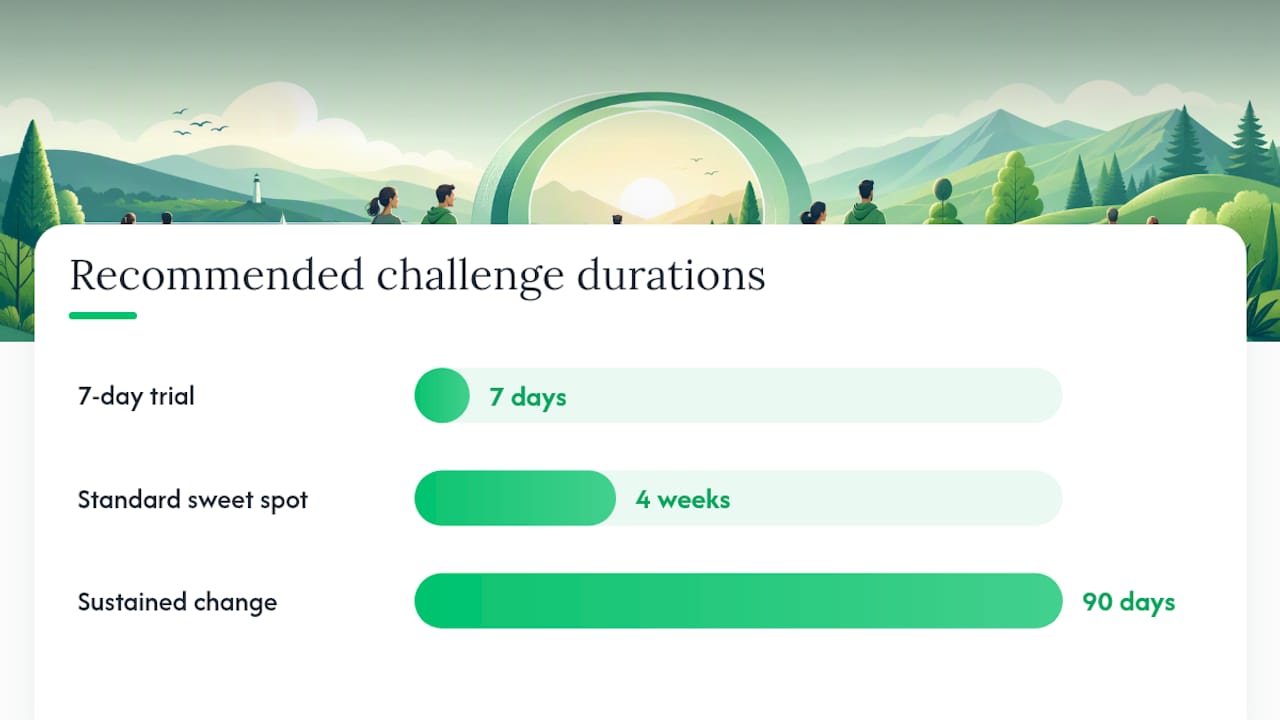
On duration, a 7-day trial works for testing a new theme with skeptical teams. A 4-week challenge is the standard sweet spot: long enough to build a habit, short enough to avoid fatigue. A 90-day format suits teams chasing sustained behavior change, particularly when it’s tied to a wellness program rather than a one-off event.
Pro Tip: Announce the theme and rules in one short email or Slack post, then repeat the daily prompt or milestone update in the same channel every day. Consistency in communication matters as much as the challenge rules themselves.
Tracking, Fairness, and Inclusion Rules That Keep It Honest
Pick one conversion standard and post it publicly before day one. The common benchmark is roughly 2,000 steps per mile, and most organizers convert biking distance at a lower ratio (often half the point value of walking) to keep it fair to non-cyclists. Minutes walked is the simplest unit for mixed-ability groups because it removes any debate over stride length or terrain.
For tracking, low-friction beats sophisticated:
- A shared spreadsheet with one row per person and a weekly submission deadline.
- A basic form (Google Forms or similar) that team captains compile into a single weekly total.
- A private team inside an app built for this, where GPS and pedometer data log automatically.
Workplace step-count challenges produced measurable health improvements in a 2025 study from the University of Stirling, reinforcing that even simple tracking setups deliver real value once people participate consistently.
For prize eligibility, require a screenshot or app export rather than a self-reported number when real money or a significant prize is on the line. It’s a small step that prevents disputes later.
Prizes, Recognition, and the Motivation Mechanics Behind Them
A tiered prize ladder outperforms a single grand prize because it rewards people at more than one point in the challenge. Weekly micro-rewards (a coffee gift card, a casual dress pass) keep early momentum going. Milestone badges mark meaningful distances. A larger end-of-challenge prize or raffle gives the finish line weight.
Non-monetary recognition costs nothing and works surprisingly well:
- Digital badges posted to a team channel or intranet.
- A shout-out in the company newsletter naming top participants or most-improved walkers.
- Earned PTO minutes or a free casual-dress day for hitting a milestone.
Behind the scenes, a few mechanics do most of the heavy lifting. Streak protection (one “skip day” allowed per week) prevents a single missed day from tanking motivation. Randomized prize draws, rather than pure leaderboard rankings, keep less-competitive walkers engaged since anyone entered has a shot. Team leagues turn individual effort into shared accountability. And when a challenge includes a CSR donation match, the miles carry meaning beyond personal fitness.
What Charity Miles Learned From a Real Corporate Rollout
HARMAN’s experience is the clearest data point available for what a charity-linked walking theme can do at scale.
Since launching its Charity Miles team in 2021, HARMAN saw an 11x increase in employee participation, with more than 1,200 employees generating over $120,000 for charity.
That result didn’t come from a bigger prize budget. It came from three structural choices any organizer can copy:
- Private teams gave employees a sense of belonging inside a larger company initiative rather than a generic public challenge.
- Company-sponsored mile rates meant every logged mile had a visible dollar value attached to a cause, not just a step count.
- Visible impact reporting let leadership and employees both see the running donation total, which reinforced why the challenge mattered.
Three takeaways to steal directly: tie miles to a cause employees actually care about, set milestones people can see updating in real time, and keep the tracking mechanism dead simple so nobody drops out over friction.
What Two Pilot Challenges Taught Us About Momentum
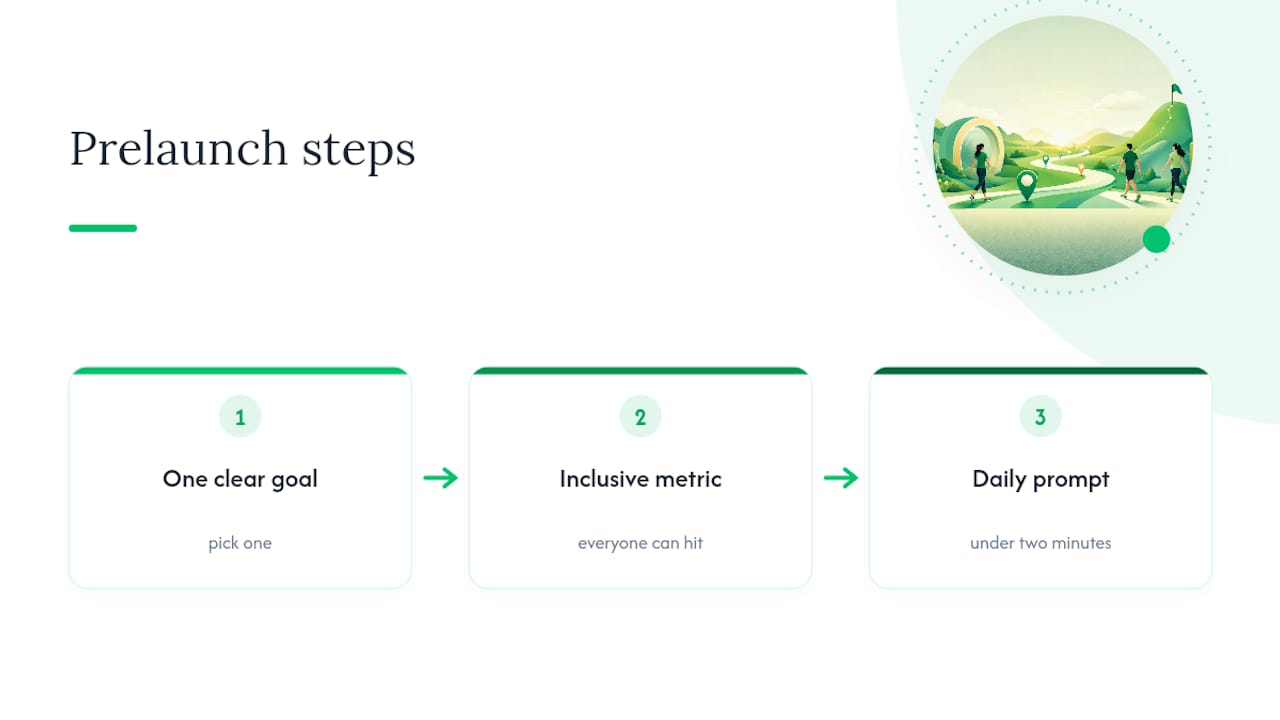
Two lessons stood out from watching early pilot challenges unfold. Participation jumped fastest when the theme included a daily prompt people could complete in under two minutes. It dropped off earliest when the tracking method required more than one login step.
Three things to do before launch: pick one clear goal, choose a metric everyone can hit regardless of fitness level, and announce the challenge with a simple daily prompt instead of a long rulebook.
How Charity Miles Powers a Themed Team Challenge
Running a themed challenge by spreadsheet works for a small pilot, but it gets messy fast once dozens of employees and multiple teams are logging miles weekly. Charity Miles’ Employee Empowerment Program solves that by giving you private company teams, sponsorship controls where you set the per-mile rate and total budget cap, and reporting that shows exactly how much impact your walking theme generated.
A typical pilot starts with setting up your private team, choosing whether donations go to each employee’s own charity or a company-selected cause, and picking a sponsorship cap that fits your CSR budget. From there, reporting runs automatically, so you’re not manually tallying miles in a spreadsheet every Friday. It’s the same mechanism that helped HARMAN scale participation elevenfold. If you’re weighing this against other corporate wellness programs, the deciding factor is usually how much manual tracking work your team wants to avoid. Set up a private team and launch your first themed challenge through the Employee Empowerment Program page to see sponsorship options and reporting details for your company.
Sources
A few resources are worth keeping open while you plan. The Mayo Clinic’s walking research backs the health case for any walking program. The University of Stirling’s 2025 workplace study supports the case for step challenges specifically. Mixbook’s scavenger hunt list and visual storytelling tips help with photo-based themes, and Charity Miles’ step challenge guide covers implementation details.
FAQ
What are some good walking challenge ideas for a workplace?
Streaks, virtual map journeys like Walk Around the World, and charity-linked mileage themes tend to perform best because they give employees a reason to check in daily.
What are some catchy walking challenge slogans?
Short, action-oriented phrases work best, like “Every Step Counts,” “Walk the Talk,” or “Miles With Meaning” for charity-linked themes.
What are some creative names for a walking challenge?
Try names tied to your theme’s structure, such as “Walk to Mordor,” “Route 66 Relay,” or “Photo Safari Challenge,” since a specific name gives people something to rally around beyond a generic step count.
What are good award ideas for a walking challenge?
A tiered structure works well: small weekly prizes, milestone badges, and a larger raffle or grand prize at the end, paired with non-monetary recognition like newsletter shout-outs or earned PTO.
How long should a workplace walking challenge run?
Four weeks is the standard length for building a habit without causing fatigue, though a 7-day trial suits first-time programs and 90 days suits teams focused on long-term sustainability.