
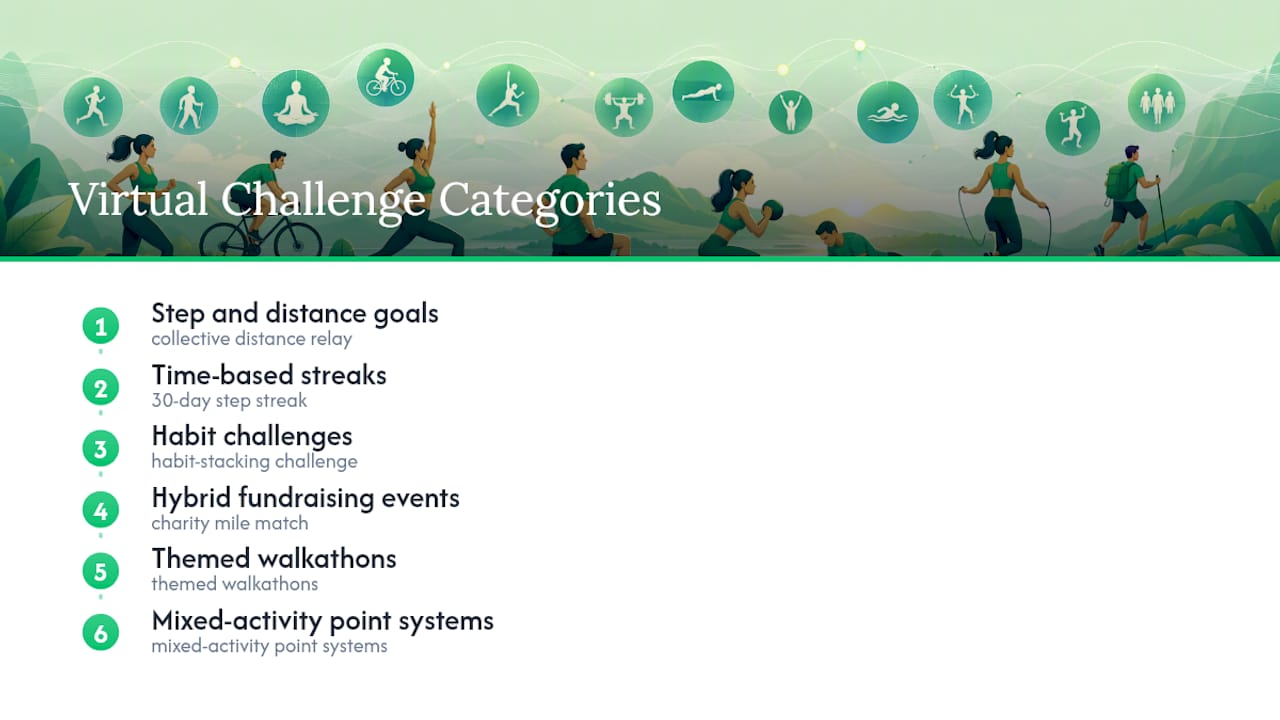
The highest-impact virtual fitness challenges fall into six categories: step and distance goals, time-based streaks, habit challenges, hybrid fundraising events, themed walkathons, and mixed-activity point systems. For a fast start, try a 30-day step streak, a collective distance relay, a habit-stacking challenge, or a charity mile match. Accountability structures like team leaderboards can improve completion rates by up to 95%, and a platform like Charity Miles turns any of these formats into a fundraising engine.
Key Takeaways
A virtual fitness challenge succeeds when it combines a clear scoring rule, an inclusive tracking method, and a purpose bigger than the leaderboard itself.
| Point | Details |
|---|---|
| Pick the right format first | Match team relays and points leaderboards to groups, streaks and milestones to solo participants. |
| Keep duration between 4 and 12 weeks | This window supports habit formation without losing momentum, per Give River. |
| Plan a midpoint engagement boost | A surprise event or bonus point day at the halfway mark counters the typical week-two dip. |
| Link the challenge to a charity | Charity-tied walkathons raise significantly more funds than events without one. |
| Consider Charity Miles for workplace rollouts | It combines automatic activity tracking with configurable sponsorships, delivering a large participation lift for HARMAN. |
Where to Find More Challenge Templates and Tracking Tools
- Charity Miles’ virtual walking challenge guide for planning and recruitment templates.
- The complete guide to organizing a step challenge for charity for tracking and promotion tips.
- Darebee’s free challenge library for workout ideas across fitness levels.
Table of Contents
- 12 Virtual Fitness Challenge Ideas Ready to Launch Today
- How Do You Set Up and Run a Virtual Fitness Challenge?
- Should You Run a Team Challenge or an Individual Challenge?
- What Keeps Participants Engaged Once the Challenge Starts?
- What Should You Look for in a Fitness Challenge Tracking Platform?
- Case Study: How One Challenge Multiplied Employee Participation
- Give Your Next Challenge a Fundraising Engine
- Frequently Asked Questions
- Sources
12 Virtual Fitness Challenge Ideas Ready to Launch Today
Each idea below comes with a scoring method and a “best for” label so you can match the format to your group before you write a single rule.
- 30-Day Step Streak. Participants log daily steps; winners are the top three cumulative totals or anyone who hits a streak of 25+ days. Best for beginners and remote employee wellness programs.
- Collective Distance Relay. Teams pool miles from walking, running, or biking toward one shared target, like “cross the country.” Scoring is simple addition, tracked on a shared dashboard. Best for teams and workplace groups.
- Charity Mile Match. Every logged mile triggers a donation to a chosen cause, sponsored by the individual or their employer. Best for fundraising and CSR-minded organizers, and it pairs naturally with the Charity Miles app.
- Weekly Personal Best. Participants try to beat their own prior week’s total minutes or distance. Scoring is percentage improvement, not raw volume. Best for solo participants who dislike direct competition.
- Habit Stack Challenge. Combine movement with one wellness habit (hydration, sleep, stretching) and award points for each completed habit daily. Best for holistic wellness programs.
- Themed Virtual Walkathon. Pick a seasonal or cause-based theme (Heart Health Month, a local shelter fundraiser) and set a group mileage goal. Teams tied to a real charity raise roughly three times more than untied events. Best for fundraising and community-building.
- Strength and Mobility Points. Award points for completed strength sessions, stretching routines, or yoga minutes instead of distance, a format supported by local wellness centers like OsteoStrong Tysons VA for strength and recovery. Best for participants recovering from injury or focused on flexibility.
- Time-Zone Friendly Minute Bank. Everyone banks active minutes on their own schedule; totals sync weekly regardless of when the activity happened. Best for distributed or global teams.
- Beginner Milestone Ladder. Set tiered goals (5, 15, 30 miles) so participants “level up” instead of racing a leaderboard. Best for new exercisers and inclusive workplace rollouts.
- Competitive Points League. Convert steps, minutes, and workouts into a single point currency, then rank participants weekly. Best for competitive teams that want a game-like structure.
- Family or Buddy Challenge. Pair employees with a partner (inside or outside work) for combined mileage goals. Best for engagement-focused programs targeting work-life balance.
- Monthly Recurring Streak. Run the same lightweight challenge every month with a fresh theme, using automated check-ins to track progress. Coaches use this repeatable structure because automated tracking scales retention without adding organizer workload. Best for ongoing wellness calendars rather than one-off events.
Pro Tip: Pick at least two charity-linked formats for any workplace challenge calendar. Purpose-driven challenges consistently outperform pure competition on long-term sign-up rates.
How Do You Set Up and Run a Virtual Fitness Challenge?
Running a challenge well comes down to five decisions made before launch day, not clever gimmicks during it.
- Set a SMART goal. Define a specific target (10,000 collective miles, 80% daily check-in rate) with a deadline.
- Pick your duration. Four to twelve weeks is the sweet spot for habit formation, according to Give River’s wellness research.
- Choose your scoring model. Decide whether steps, minutes, or a hybrid point system determines the winner.
- Select your tracking tool. Match the tool to your audience size and technical comfort level.
- Build in incentives. Plan rewards and recognition moments before you announce the challenge.
Sample timeline:
- Week 0: Announce rules, send sign-up links, confirm tracking method.
- Week 1: Launch with a kickoff email or team meeting.
- Midpoint: Send a progress recap and shout out top performers.
- Final week: Close scoring, tally results, celebrate publicly.
Pro Tip: Build in asynchronous participation from day one. Remote teams span time zones and ability levels, so a challenge that only rewards same-day activity quietly excludes half your roster.
Should You Run a Team Challenge or an Individual Challenge?
Team formats work best for building camaraderie and hitting bigger collective goals; individual formats work best when you want to reward personal growth without peer pressure.
Team templates:
- Relay: teams take turns logging miles toward one target.
- Collective distance: every mile from every member adds to one shared total.
- Points leaderboard: teams earn points for steps, minutes, and bonus activities combined.
Individual templates:
- Streaks: reward consecutive days of activity, not total volume.
- Personal bests: score by percentage improvement over a baseline week.
- Tiered milestones: participants “graduate” through mileage levels at their own pace.
A simple scoring conversion, like 100 steps equals 1 point, lets you blend step counts with logged workout minutes into one hybrid leaderboard. For workplace rollouts, offer a non-competitive tracking option, keep individual data private unless someone opts to share it, and always publish results in a way that respects time-zone differences.
What Keeps Participants Engaged Once the Challenge Starts?
Sign-ups are easy. Sustained participation through week three is where most challenges quietly die. Combat that with layered incentives: digital badges for milestones, small physical rewards (water bottles, gift cards), charity-match bonuses for hitting group goals, and public recognition in a team channel or newsletter.
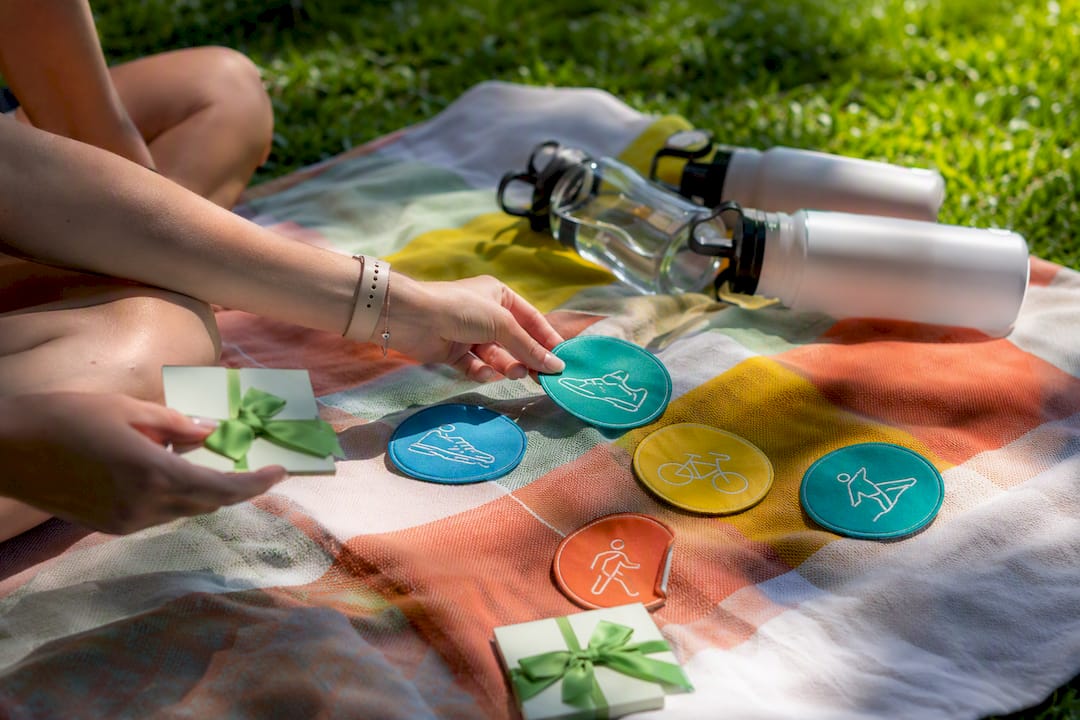
Simple gamification helps too: a weekly leaderboard, milestone badges at 25%, 50%, and 75% completion, and randomized mini-prizes that reward participation, not just performance. A shared photo prompt (“show your workout spot”) or a mid-challenge Slack thread keeps momentum visible.
Pro Tip: Plan one surprise event at the challenge’s halfway point, like a bonus point day or a flash prize drawing. Interest naturally dips around week two, and a small jolt there does more for completion rates than any incentive announced on day one.
What Should You Look for in a Fitness Challenge Tracking Platform?
The right tracking tool depends on group size and how much manual effort you’re willing to accept. Look for automatic sync with Apple Health or Google Fit, team dashboards that update in real time, a manual entry fallback for people without smartphones, basic anti-fraud safeguards, and export options for CSR or HR reporting.
- Spreadsheets and manual entry: free and flexible, but slow to update and easy to game.
- Consumer fitness apps: good GPS and step tracking, but rarely built for group challenges or fundraising.
- Enterprise engagement platforms: built for team dashboards and reporting, often at a higher cost or complexity.
| Tracking option | Best for | Tradeoff |
|---|---|---|
| Manual entry/spreadsheet | Small, informal groups | High organizer workload, low accuracy |
| Consumer fitness app | Solo tracking, casual challenges | Limited team or fundraising features |
| Charity Miles | Workplace and fundraising challenges | Requires app adoption across participants |
For organizers who want fundraising and employee engagement in one place, Charity Miles tracks GPS and pedometer activity automatically and converts it into donations, with sponsor configuration and reporting built for workplace rollouts.
Case Study: How One Challenge Multiplied Employee Participation
HARMAN launched a Charity Miles team in 2021 to boost employee wellness and CSR participation. The results reframed what a “step challenge” could accomplish inside a large organization.
The Employee Empowerment Program delivered an 11x increase in employee participation, with over 1,200 employees generating more than $120,000 for charity through everyday walking, running, and biking.
- Participation didn’t require athletic ability, just consistent movement.
- Donations were tied to causes employees already cared about.
- The program ran as an ongoing structure, not a one-time event.
The takeaway for organizers: pairing movement with a real charitable outcome turns a routine wellness initiative into something employees actually want to keep doing.
What makes virtual challenges stick
Fun and fairness get people to sign up, but purpose is what keeps them showing up in week four. Mixing charity into a wellness challenge, the way Charity Miles does by design, gives participants a reason to log a mile even on the days motivation alone would not cut it.
Give Your Next Challenge a Fundraising Engine
You don’t need a spreadsheet, a side app, and a separate donation platform to run a challenge that actually raises money. Charity Miles combines all three: private team challenges, configurable sponsorship rates, and reporting your HR or CSR team can hand straight to leadership.
Companies set the sponsorship terms themselves, choosing the rate per mile, the total cap, and whether funds go to a company cause or each employee’s own charity. It costs individual employees nothing to join, and the reporting gives you a measurable CSR outcome instead of a vague wellness initiative nobody can point to. If you’re comparing options for your next employee wellness push, start with the corporate wellness program details and see how a sponsored team challenge could work for your organization.
Frequently Asked Questions
What is the easiest virtual fitness challenge to start with no budget?
A step streak using free phone tracking (Apple Health or Google Fit) with a shared spreadsheet works well for small groups and costs nothing to run.
How long should a virtual wellness challenge calendar run?
Most organizers plan a wellness challenge calendar around monthly themes, using four-week blocks that roll into a longer, year-round wellness program.
Can a virtual fitness challenge include non-athletic participants?
Yes. Habit-based and milestone-ladder formats reward consistency and improvement rather than raw performance, which keeps beginners and non-athletes engaged alongside stronger performers.
Does adding a charity component really increase participation?
Themed events tied to a real cause tend to see higher fundraising and completion rates than challenges built purely around competition, since participants have a reason beyond the leaderboard.
What’s the best platform for a company-wide fitness contest?
For workplace-scale challenges that need fundraising, sponsorship controls, and CSR reporting in one place, Charity Miles is built specifically for that use case.
Sources
- Fitness Challenge Ideas for Personal Trainers (2026) | My PT Hub
- 25 Ultimate Virtual Walkathon Ideas for Team Building (2026) – Walkathon Virtual™
- Darebee challenges