
A virtual charity challenge is a fitness or activity-based fundraiser participants complete on their own schedule, from wherever they are, while raising donations for a cause they choose. It works well for individual fundraisers chasing a personal goal, nonprofits that want national reach without venue costs, and corporate teams building wellness and giving into everyday work life. If you want low overhead, broad accessibility, and measurable outcomes, this format delivers all three.
TL;DR:
- Virtual challenges eliminate venue and travel costs, allowing charities to expand their reach nationwide and reduce overhead expenses significantly.
- GPS tracking or app screenshots improve credibility and participant accountability, especially for larger campaigns, by reducing opportunities for inflated reporting.
- Tiered incentives, such as medals or shirts at specific donation thresholds, boost both participation rates and total funds raised by creating multiple small goals.
- Engagement tactics like team formation, midpoint re-energization, and rotating leaderboard categories sustain motivation and increase donations throughout the campaign.
- Carefully planning promotion, setting low initial goals, and complying with legal and privacy requirements are critical for a successful, credible virtual challenge.
Table of Contents
- What Is a Virtual Charity Challenge? How the Model Works
- Why Virtual Challenges Work for Charities and Participants
- Common Types of Virtual Charity Challenges (With Examples)
- How to Plan and Run a Virtual Charity Challenge
- Tracking, Verification and Tech Options for Organizers
- Engagement Tactics That Boost Fundraising and Retention
- Case Studies: Evidence the Virtual Challenge Model Works
- Quick-Start Checklist for Your First Virtual Charity Challenge
- Legal and Compliance Considerations for Virtual Charity Challenges
- Post-Event Follow-Up and Donor Engagement Strategies
- Why Virtual Challenges Are Here to Stay
- How Charity Miles Supports Virtual Charity Challenges
- Sources
- FAQ
What Is a Virtual Charity Challenge? How the Model Works
A virtual charity challenge asks participants to complete an activity, usually walking, running, or biking a set distance, over a defined period, then log or report their results while collecting donations. There’s no shared starting line, no rented space, no travel. Everyone moves on their own terms and reports in.
The typical participant journey follows a simple arc. You register, set up a personal fundraising page, invite friends or coworkers to donate, complete the activity during the challenge window, and then get recognized when it wraps up.
Most organizers build this around a few standard pieces:
- A peer-to-peer fundraising page where each participant sets a personal goal and shares a donation link
- Milestone markers (25%, 50%, 75%, 100% of a distance or dollar goal) that keep momentum visible
- A public or team leaderboard showing progress in near real time
- A verification method, ranging from a simple honor-system check-in to app-based GPS tracking
That last piece, verification, is where organizers make their first real decision. Some campaigns trust participants to self-report mileage or minutes. Others require screenshots from a fitness app, or use a dedicated platform that logs GPS and pedometer data automatically. Both approaches show up across the nonprofit world, and the right one depends on how much rigor your donors expect and how much friction you’re willing to add at registration.
Why Virtual Challenges Work for Charities and Participants
The financial case is straightforward. No venue rental, no catering, no insurance for a physical gathering, no printed race bibs. That savings goes straight into the potential donation pool, and organizers can put a fundraiser in front of anyone with an internet connection instead of just the people who can drive to a starting line. Charities now build virtual charity events into their permanent fundraising calendars rather than treating them as a pandemic-era stopgap.
Reach beyond geography is the real unlock. A participant in Boise and a donor in Boston can join the same campaign without either one leaving home, which matters enormously for causes with a national or dispersed supporter base.
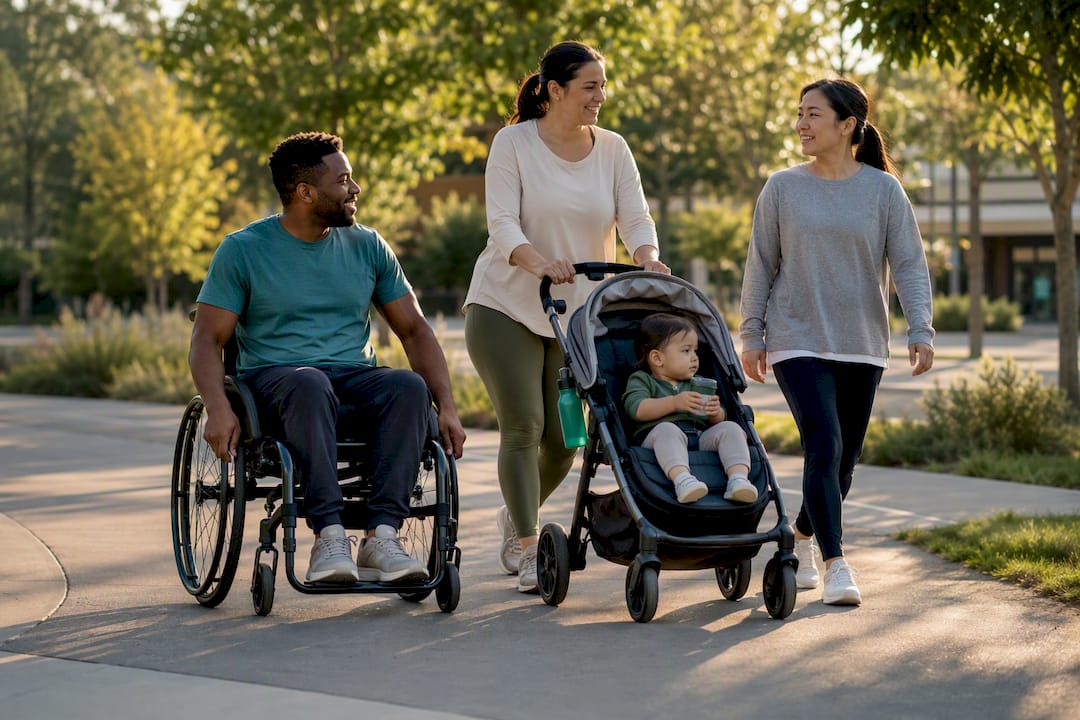
Accessibility follows close behind. A challenge built around minutes moved or steps logged, rather than finish-line speed, welcomes a wheelchair user, a new parent squeezing in a stroller walk, and a marathoner training for a fall race, all inside the same event. Nobody gets sorted into “athletic” and “everyone else.”
Then there’s the data. Every registration, donation, and activity log generates information a charity can use for stewardship, from thank-you emails timed to a specific milestone to segmentation that identifies which supporters are ready for a bigger ask next year. Virtual peer-to-peer fundraising captures far more of this donor data than a one-day in-person event ever could, simply because the entire interaction happens on a platform designed to record it.
Common Types of Virtual Charity Challenges (With Examples)
Format determines who shows up and how much they raise, so picking the right one matters more than most organizers realize going in. Four categories cover most of what’s working right now.
Distance and step challenges remain the most popular entry point because the rules are instantly understandable: walk, run, or bike a set number of miles within a window, and report progress along the way. A “100 miles in 30 days” template scales from a single office team to a nationwide campaign, and it’s the format most easily adapted from an existing virtual walking challenge framework.
Time- or repetition-based micro-challenges ask for consistency instead of distance. Think 20 minutes of movement daily for four weeks, or 10,000 push-ups spread across a team. These formats suit people who can’t commit to long sessions but can show up briefly, every day.
Livestream and gaming fundraisers turn screen time into donations. Streamers play for a set number of hours while viewers pledge per hour or per in-game milestone, often through dedicated platforms like Tiltify layered on top of a livestream. Campaigns such as the International Rescue Committee’s Streamers for Humanity show how a matched-donation hook, where a sponsor doubles every dollar raised during the stream, can dramatically lift conversions.
Creative and social challenges skip physical activity altogether: a 30-day art prompt, a themed recipe swap, a photo challenge tied to a hashtag. These rely almost entirely on social sharing to spread, which makes them cheap to run but harder to predict.
Sample campaign templates worth copying:
- A four-week “step streak” with weekly mileage targets and a badge for each completed week
- A single-day livestream marathon with a corporate sponsor matching donations for the first two hours
- A 30-day creative prompt calendar that participants post to social media, tagging the charity each day
- A team-based mileage relay where five coworkers combine their daily totals toward one shared goal
How to Plan and Run a Virtual Charity Challenge
Every successful campaign starts with numbers on paper before it starts with a registration link. Here’s the sequence that keeps a first-time organizer from scrambling in week two.
- Set your fundraising and participation targets first. Decide how many participants you need and what average dollar-per-participant makes the campaign worth running, then work backward into a timeline, usually two to six weeks for the activity window itself.
- Choose your audience and format. A public peer-to-peer challenge open to anyone behaves very differently from a closed corporate team challenge restricted to employees. The public version needs broader marketing; the corporate version needs internal champions and manager buy-in.
- Build the registration and fundraising page. Capture name, email, team affiliation (if any), and a personal fundraising goal at minimum. Display a progress bar, a short cause description, and social share buttons directly on the page, since pages with visible progress tend to convert better on repeat visits.
- Plan your promotion cadence. A realistic schedule looks like: launch announcement by email and social two weeks out, a mid-registration reminder one week out, a “challenge starts tomorrow” push, then weekly progress updates once the challenge is live. Our guide to virtual fundraising ideas covers channel-specific messaging in more depth.
- Design your incentive structure. Tiered prizes tied to dollar thresholds, a shirt at $25, a medal at $100, consistently pull in more registrations and higher totals than a flat “thanks for participating” model.
- Budget realistically. Line items typically include a fundraising platform fee, any physical incentives (shirts, medals), email or SMS tools, and optional paid social promotion. Cost-saving options include digital-only badges instead of shipped items and volunteer-run social media instead of paid ads.
Pro Tip: Set your first fundraising goal deliberately low. A campaign that blows past its stated target in the first three days generates far more social proof and momentum than one that grinds toward a number nobody hits until the final hour.
Tracking, Verification and Tech Options for Organizers
The honor system works fine for low-stakes internal challenges, casual friend groups, and campaigns where the donation, not the mileage, is the real point. It’s fast to set up and asks nothing of participants beyond trust. The tradeoff is obvious: without any check, a handful of inflated numbers can undercut a leaderboard’s credibility, and donors occasionally ask questions once real money is on the line.
App-based tracking solves that credibility gap. A platform that logs GPS or pedometer data automatically removes the guesswork and gives organizers a clean export for reporting. Manual submissions (screenshots of a workout app, a typed-in mileage log) sit in the middle: more credible than pure honor system, still labor-intensive to verify at scale. Spreadsheets work for small campaigns under a few hundred participants but become unmanageable fast beyond that.
Whatever method you choose, plan for basic reporting and privacy needs upfront:
- Decide what data you’ll collect (name, email, activity total) and state it plainly on the registration page
- Avoid displaying full names next to sensitive health or fitness data on public leaderboards
- Export activity and donation data on a schedule so you’re not scrambling for numbers at the finish line
- Use automated milestone badges and leaderboard updates to cut down on manual recognition work
Publishing a weekly leaderboard alongside a short beneficiary story helps close the accountability gap that honor-system tracking leaves open, since participants stay engaged when they can see both their own progress and the format that fits their challenge.
Engagement Tactics That Boost Fundraising and Retention
Individual fundraisers plateau. Team fundraisers rarely do, because a social multiplier kicks in the moment someone doesn’t want to let five teammates down. That single structural choice, team versus solo, tends to move average fundraising totals more than any single incentive tweak.
A few tactics consistently raise both participation and dollars:
- Build teams of four to six people instead of leaving everyone to fundraise solo
- Set tiered goals (bronze, silver, gold participation levels) so mid-pack participants still have something to chase
- Schedule a midpoint virtual meetup, even a 15-minute video call, to re-energize participants before fatigue sets in
- Run a light user-generated-content push, asking for a photo or short video at the halfway mark, to keep the campaign visible on social feeds
- Rotate leaderboard categories (most improved, most consistent, biggest team) so the same three people don’t dominate every ranking and discourage everyone else
Mixing short-term weekly goals with one longer campaign milestone keeps momentum steady instead of letting it spike at launch and die by week two.
Case Studies: Evidence the Virtual Challenge Model Works
Charity Miles offers an Employee Empowerment Program built around a fitness-plus-fundraising model, where companies create private team challenges and employees log miles while the company sponsors donations according to its own terms.
A well-structured incentive tier does more work than most organizers expect. WomenHeart’s Charity Challenge charges a registration fee and layers prize thresholds at multiple donation levels, turning a single donation ask into a series of achievable checkpoints participants actually chase.
That structure isn’t unique to one cause. Tangible, tiered rewards, a shirt at one level, a medal at another, materially increase both sign-ups and total dollars raised compared to a flat thank-you message. The lesson for a first-time organizer is simple: don’t design one big goal and hope people hit it. Design several small, visible wins along the way, and let participants collect them one at a time.
Quick-Start Checklist for Your First Virtual Charity Challenge
Getting from idea to live campaign doesn’t require a large team or a big budget. It requires sequencing.
- Pick your format (distance, time-based, livestream, or creative) and set a two-to-six week timeline
- Set a realistic fundraising target and a participation goal
- Build your registration and fundraising pages with a visible progress bar
- Choose a tracking method and write one plain-language sentence about what data you’re collecting
- Design a tiered incentive structure with at least two prize thresholds
- Schedule your promotion calendar: launch, midpoint reminder, final push
- Plan a midpoint check-in and a post-campaign thank-you and report
| Checklist Item | Why It Matters |
|---|---|
| Format and timeline | Determines audience size and campaign complexity |
| Fundraising and participation targets | Anchors your promotion and incentive design |
| Registration and fundraising pages | First impression that drives conversion |
| Tracking method and privacy note | Builds credibility and protects participant data |
| Incentive tiers | Directly correlated with higher totals raised |
| Promotion calendar | Prevents a slow start and a rushed finish |
Legal and Compliance Considerations for Virtual Charity Challenges
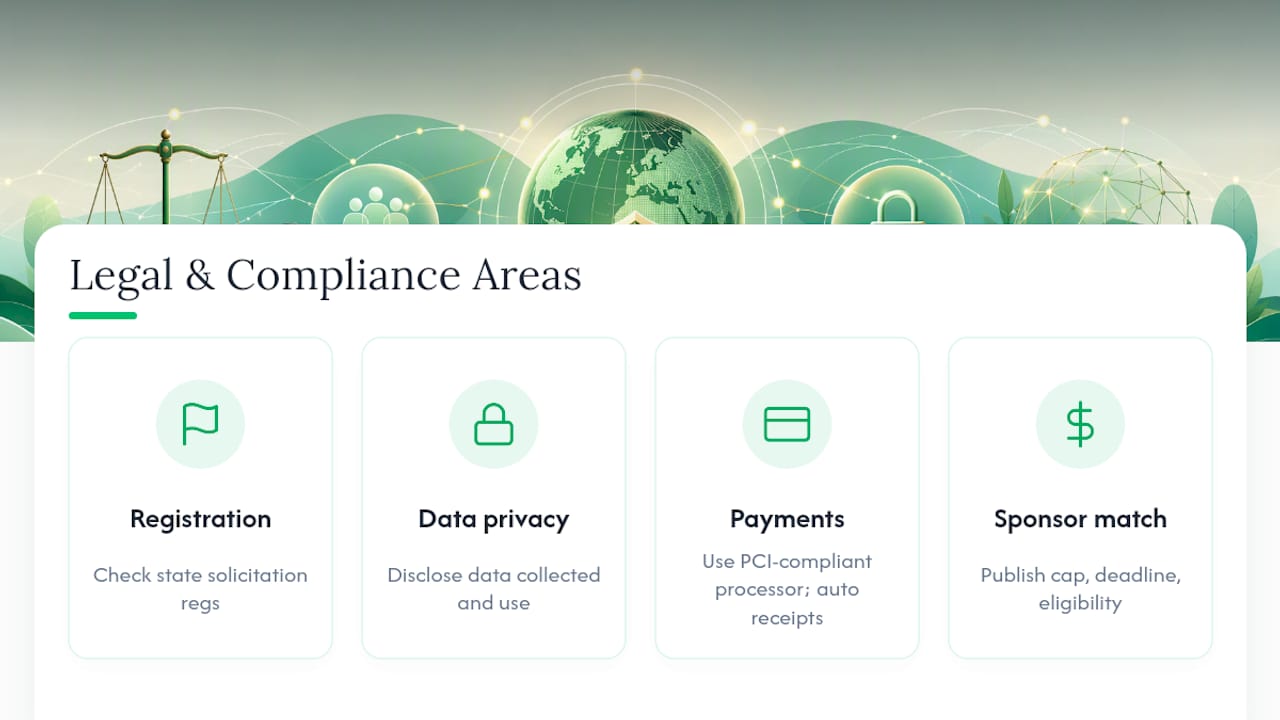
Running a virtual charity challenge means running a fundraiser, and fundraisers carry real compliance obligations regardless of the format. Most US states require charitable solicitation registration before a nonprofit raises money from residents of that state, and a national virtual campaign can trigger registration requirements in far more states than a single in-person event ever would. Check with your state’s charity regulator or a nonprofit attorney before launching broadly, especially if you’re a smaller organization without existing multi-state registration.
Data privacy is the second major area. Any registration page that collects names, emails, and activity or health-adjacent data (steps, mileage, heart rate exports) should state plainly what’s collected and how it will be used. If your platform or app captures location data through GPS tracking, disclose that clearly at sign-up rather than burying it in fine print.
Payment processing adds its own layer. Whatever platform handles donations needs PCI-compliant payment processing, and organizers should confirm the platform issues proper tax-deductible donation receipts automatically. Skipping this step creates donor-trust problems fast.
Finally, if your challenge involves a corporate sponsor matching donations, put the match terms (cap, deadline, eligible donations) in writing and publish them where donors can see them. Ambiguous match language is one of the most common sources of donor complaints after a campaign closes.
Post-Event Follow-Up and Donor Engagement Strategies
The campaign closing doesn’t mean the relationship closes. What happens in the two weeks after your virtual charity challenge ends often determines whether a participant comes back next year or quietly disappears.
Start with a personalized thank-you that includes a real number, total miles or minutes the individual or their team logged, and the specific dollar amount their effort generated. Generic “thanks for participating” messages get ignored; specific ones get shared.
Follow that with an impact report within a few weeks, showing what the total campaign raised and, where possible, a concrete example of what that money funds. Donors who see impact tied to their specific contribution are measurably more likely to give again.
Segment your post-event list based on behavior during the campaign. Top fundraisers deserve a different follow-up (an invitation to a leadership role next year, perhaps) than someone who registered but never activated their page. Middle-tier participants often respond well to an early-bird invitation for the next challenge, sent before general promotion opens.
Keep the leaderboard and badge data around, too.
Why Virtual Challenges Are Here to Stay
Virtual charity challenges succeed because they strip away everything that makes traditional events expensive and exclusive, while keeping the two things that actually move donors: a personal goal and a visible community cheering it on. That’s the same principle behind Charity Miles’ mission of turning ordinary movement into charitable impact.
My one caution: the honor system alone won’t survive scrutiny once real money and corporate reputation are on the line, so build in at least basic verification before you scale past a small group.
Start small. Pilot a two-week challenge with one team before you commit to a six-week campaign across an entire organization.
— Gene
How Charity Miles Supports Virtual Charity Challenges
Charity Miles offers a program for companies that want a virtual charity challenge with private team challenges, configurable sponsorship terms, and reporting tools for HR teams.
A corporate wellness program example shows what that structure can produce at scale, including a strong increase in employee participation and significant funds raised for charity since the program’s launch. If you’re weighing options for a corporate wellness or CSR initiative, Charity Miles’ corporate wellness program is worth reviewing before you build a challenge from scratch, and the charity fitness challenge format guide will help you figure out which structure fits your team size and goals. Request a walkthrough of the program and see what a pilot could look like for your organization.
Sources
The American Cancer Society’s virtual challenge page shows live campaign examples and registration flows. St. Jude’s online fundraising guide covers livestream and social formats. WomenHeart’s Charity Challenge page demonstrates tiered incentive pricing in practice.
- Virtual Challenges | Virtual Charity Events | American Cancer Society
FAQ
What Is the 30/70 Rule for Charities?
The 30/70 rule is a common fundraising-efficiency benchmark suggesting charities should spend no more than 30% of funds raised on overhead and fundraising costs, keeping at least 70% directed to programs. Virtual charity challenges tend to score well against this benchmark because they cut venue, catering, and staffing costs that in-person events carry.
Are There Virtual Walking Challenges Happening in 2026?
Yes. Charities and corporate wellness programs run virtual walking and step challenges year-round, with many organizations launching fresh campaigns each quarter rather than tying them to a single annual date. A virtual walking challenge can be launched by an individual team or a nationwide nonprofit campaign at any point in the year.
What Is the Best Online Fundraiser?
There’s no single best format. It depends on your audience: distance and step challenges work best for broad, inclusive participation, while livestream and gaming fundraisers work best for reaching a younger, screen-engaged donor base. The strongest campaigns typically combine a clear activity goal with tiered incentives and a visible leaderboard.
What Is the Best Virtual Walking Challenge?
The best virtual walking challenge is one with a realistic distance goal, a clear tracking method participants trust, and tiered rewards tied to fundraising milestones. Programs like Charity Miles’ Employee Empowerment Program build this structure directly into private team challenges, which is part of why corporate pilots like HARMAN’s produced an 11 times jump in participation.