
The most effective team fitness challenge is a short consistency format like a 30-day streak or step and mileage challenge, built with a low daily floor, an optional stretch ceiling, and a visible team scoreboard. Fitness bingo and habit-based “beat your baseline” challenges work well too. If you’re launching your first one, start there, and consider a charity-linked option like Charity Miles to keep everyone motivated past week one.
TL;DR:
- Consistency-based challenges with a low daily activity floor and visible team score tend to sustain engagement longer than high-intensity contests.
- Incorporating charity-linked goals significantly increases participation and motivation, as employees value meaningful movement contributions beyond personal scores.
- Use simple tracking methods like manual logs or flexible app options and build pods of small groups to enhance accountability and social bonding.
- Short-term challenges of two to four weeks with regular prompts and recognition boost participation and visibility without overcomplicating the setup.
- Focus on participation, effort, and moral wins rather than elaborate scoring systems to maintain sustainability and inclusive involvement.
Table of Contents
- Team Fitness Challenge Ideas Organized By Format
- How To Design And Run Your Team Fitness Challenge
- What Happened When Harmon Kardon’s Parent Company Linked Fitness To Charity
- Making It Work For Remote, Hybrid, And Every Fitness Level
- A Ready-To-Run 4-Week Challenge Template
- What To Measure And Report Back To Leadership
- What Most Organizers Get Backwards About Fitness Challenges
- Let Charity Miles Run The Heavy Lifting For You
- Sources
Team Fitness Challenge Ideas Organized By Format
The best office fitness challenge ideas aren’t one-size-fits-all. Different teams respond to different mechanics, so it helps to think in categories before you pick a winner.
Daily habit and streak challenges
These reward consistency over intensity, which makes them naturally inclusive.
- 30-day walk streak: Floor of 10 minutes of walking a day, ceiling of 60 minutes, scored by team average consistency rather than total distance. Fits sedentary teams and anyone easing back into activity.
- Hydration and movement combo streak: Pairs a short walk with a water-intake goal, logged once daily. Works well for teams recovering from a “step challenge fatigue” year.
- Morning mobility streak: Five minutes of stretching before 9 a.m., tracked with a simple checkbox. No equipment, no wearable required.
Cumulative tracking challenges
These are the classic corporate fitness competitions, built on steps, miles, or minutes stacked over time.
- Team mileage challenge: Combine walking, running, and biking miles into one team total, with prizes for participation milestones instead of just the leaderboard’s top individual. Corporate step challenges work especially well here because they let every activity level contribute.
- Department relay: Each employee logs a mile at a time, passing a virtual baton to a teammate. Good for cross-functional bonding.
Event-style challenges
- Virtual 5K or fun run: Employees run or walk a 5K on their own schedule during a set week, then compare times or simply confirm completion. Virtual fitness challenge formats make this one of the easiest group workout challenges to run across time zones.
- Home obstacle course: Employees design a five-move mini-circuit at home or in the office and video a walkthrough for a lighthearted “judged” segment.
Creative and fun challenges
- Fitness bingo: A 5×5 grid mixing movement (10 pushups), mindfulness (5-minute breathing break), and habit squares (drink 8 glasses of water). Anyone can complete a row regardless of fitness level.
- Costume or theme workout day: Pairs a themed dress-up element with a short group workout, useful for teams that respond better to fun than competition.
- Scavenger hunt walk: Employees complete a walking route that includes photo checkpoints around the neighborhood or office campus.
Low-lift micro-move challenges
- Desk stretch challenge: Three 90-second stretch breaks daily, which lines up with guidance from Harvard Health on the importance of stretching for reducing musculoskeletal strain during long workdays.
- 1-minute move challenge: One minute of movement every hour, tracked with a simple tally rather than GPS or a wearable.
CSR and charity-linked challenges
- Charity mileage challenge: Every mile walked, run, or biked converts into a company-sponsored donation, which is the model Charity Miles’ Employee Empowerment Program runs for corporate clients.
- Team give-back goal: Set a collective mileage target that unlocks a donation milestone once the whole team hits it together, rewarding cooperation over individual scores.
Each of these formats scales up or down. A general fitness challenge idea guide can help you match a format to your team’s size and culture before you commit to one.
How To Design And Run Your Team Fitness Challenge
A challenge succeeds or fails based on setup, not enthusiasm. Follow this sequence:
- Define your objective first. Decide if you’re optimizing for participation rate, total activity minutes, or dollars raised for charity. Pick one primary KPI so scoring doesn’t get muddled.
- Set a realistic timeline. Two to six weeks tends to produce the highest completion rates; anything longer risks drop-off before the finish line.
- Build in a floor and a ceiling. A low floor lets the least-active employees participate meaningfully, while an optional ceiling gives your most competitive people something to chase, according to guidance from Habit Huddle’s group challenge research.
- Adopt a resume-and-continue policy. Don’t reset participants to zero after a missed day. Momentum matters more than perfection, and one skipped day shouldn’t tank someone’s motivation for the rest of the month.
- Pick your tracking method. App-based logging, manual spreadsheets, or a hybrid of both all work, as long as non-wearable employees have an easy way to self-report.
- Promote through peers, not mandates. Challenges launched by a wellness committee or peer champions see better uptake than ones announced top-down by HR, per WorkHuman’s research on workplace fitness challenges.
- Build a communication cadence. Kickoff message, midweek nudges, and a leaderboard update at least once a week keep the challenge visible without becoming noise.
Pro Tip: Form pods of four to six people instead of one giant company-wide leaderboard. Smaller groups create real social accountability, while a 500-person leaderboard just becomes background noise most employees ignore.
For a ready-made framework, Charity Miles’ implementation guide for employees walks through goal-setting and rules in more detail.
What Happened When Harmon Kardon’s Parent Company Linked Fitness To Charity
Since launching its Charity Miles team in 2021, HARMAN saw a substantial increase in employee participation, with a large number of employees generating significant funds for charity.
That kind of jump isn’t accidental. Charity-linked challenges add a layer of meaning that a plain leaderboard can’t match. Every walk, run, or bike ride turns into something visible and tangible, and because any movement counts, employees who’d never sign up for a “fitness” competition show up anyway. Organizers can configure sponsorship in a few ways: a fixed rate per mile, a total company cap on donations, and the choice to let employees pick their own charity or direct funds to a company-selected cause.
Making It Work For Remote, Hybrid, And Every Fitness Level
Inclusivity isn’t an add-on.
- Offer manual, asynchronous logging for employees without a smartwatch or fitness tracker.
- Count low-impact goals like activity minutes, seated exercises, or mobility check-ins as equally valid entries, not consolation prizes.
- Use flexible check-in windows instead of live events so time zones don’t lock anyone out.
- Build local or regional pods so hybrid teams still get face-to-face camaraderie where possible.
- Recognize consistency and effort publicly, not just raw mileage totals.
A Ready-To-Run 4-Week Challenge Template
- Week 1: Onboard the team, capture a baseline, and form pods of four to six people.
- Week 2: Push for daily consistency with a midweek nudge and a Friday leaderboard update.
- Week 3: Introduce a stretch goal or a mid-challenge virtual event to reignite energy.
- Week 4: Wrap with a recognition day, highlighting participation streaks over pure totals, then outline next steps.
Keep the communication simple: one kickoff email, two nudges per week, and a Friday leaderboard post. Inclusive prizes work best when they reward showing up, not just winning.
What To Measure And Report Back To Leadership
The benefits of a well-run challenge show up fast: better morale, a small but real bump in activity, and visible CSR wins if you’ve linked it to charity. Workplace movement programs consistently show measurable gains in employee wellbeing, supported by broader research on physical activity interventions.
Track these five numbers and you’ll have everything leadership needs:
- Participation rate (percentage of eligible employees who signed up)
- Completion rate (percentage who finished the full challenge)
- Total miles, steps, or minutes logged
- Funds raised, if charity-linked
- A few lines of qualitative feedback from participants
A one-page dashboard with those five data points tells the whole story without burying anyone in spreadsheets.
What Most Organizers Get Backwards About Fitness Challenges
Most companies over-engineer their first challenge. They build elaborate scoring systems, mandate participation, and set the bar too high for anyone but the office runners to hit.
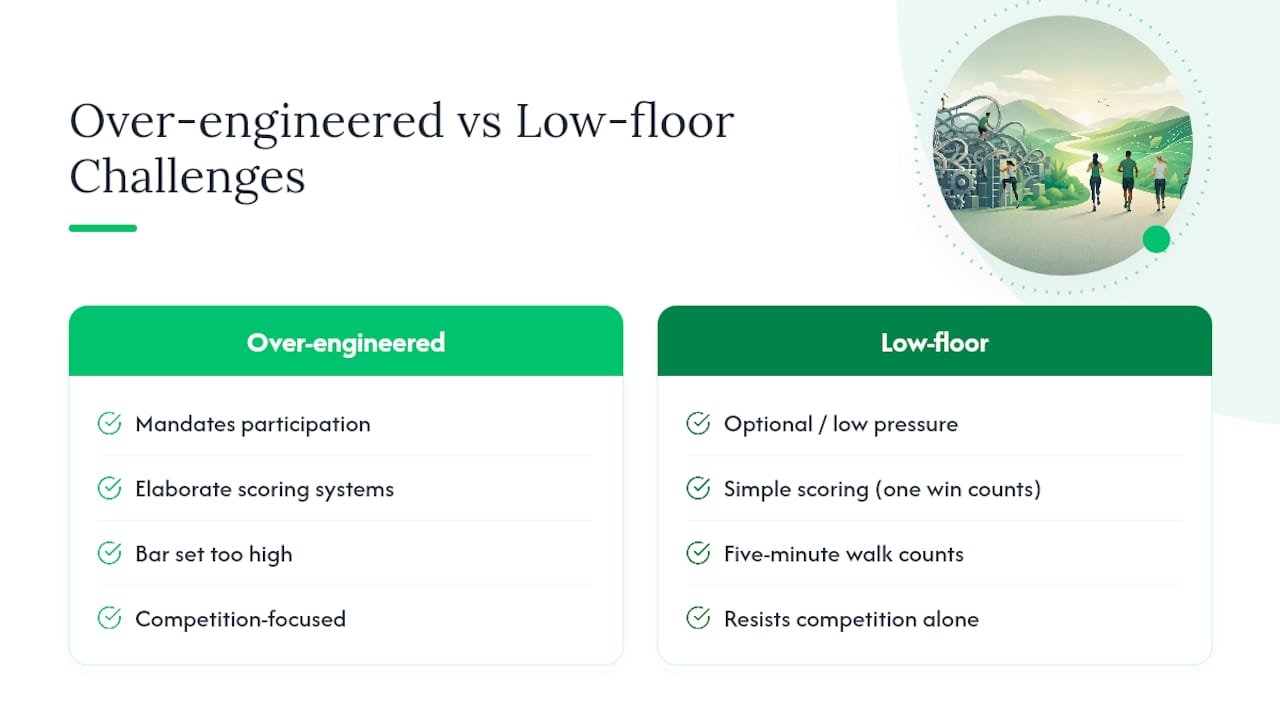
The teams that actually sustain engagement do the opposite. They start small, keep the floor low enough that a five-minute walk counts as a real win, and they resist the urge to make it about competition alone. Charity Miles built its Employee Empowerment Program around that exact insight: movement sticks when it means something beyond the leaderboard. A step challenge with a $50 gift card prize gets a burst of interest and a quiet fade by week two. A challenge where every mile turns into a real donation tends to hold attention longer, because the payoff isn’t just personal.
If you’re planning your first challenge this quarter, don’t overthink the format. Pick a low-floor consistency challenge, give people an easy way to log their movement, and consider tying it to a cause your team actually cares about. Start smaller than feels impressive. It’ll outperform the elaborate version you were about to build anyway.
— Gene
Let Charity Miles Run The Heavy Lifting For You
Charity Miles turns a standard step challenge into something employees actually want to finish, because their miles fund a cause they chose, not just a spot on a leaderboard.
The Employee Empowerment Program lets you create private team challenges, choose your own sponsorship terms (rate per mile, total budget cap, and whether donations go to employee-selected charities or a company cause), and launch without building tracking infrastructure from scratch. It’s free for employees to use, and companies control the entire sponsorship structure from day one. Explore Charity Miles’ corporate wellness programs to see how the setup works, or request a pilot to test it with one team before rolling it out company-wide.
Sources
- 10 Group Fitness Challenge Ideas That Actually Work (With Templates)
- Organizing Fitness Challenges With Fun Ways To Keep Members Motivated (WorkHuman)
- Scientific review on physical activity interventions (NCBI)
- The importance of stretching (Harvard Health)