
A stress management program for employees is a structured set of initiatives designed to reduce workplace stress, protect mental health, and improve organizational performance. Chronic stress drives absenteeism, presenteeism, and turnover, costing companies far more than any wellness program ever would. The American Institute of Stress recognizes workplace stress as a leading driver of lost productivity across American industries. HR managers and business leaders who treat these programs as core workforce infrastructure, not optional perks, see measurable returns in engagement, retention, and output. This guide breaks down what works, what to include, and how to make it stick.
What components make up effective stress management programs for employees?
The most effective programs combine multiple initiatives rather than relying on a single solution. Multi-component programs that include assessments, in-the-moment coping techniques, and manager training consistently outperform standalone apps or one-off workshops. No single intervention addresses the full range of stressors employees face.
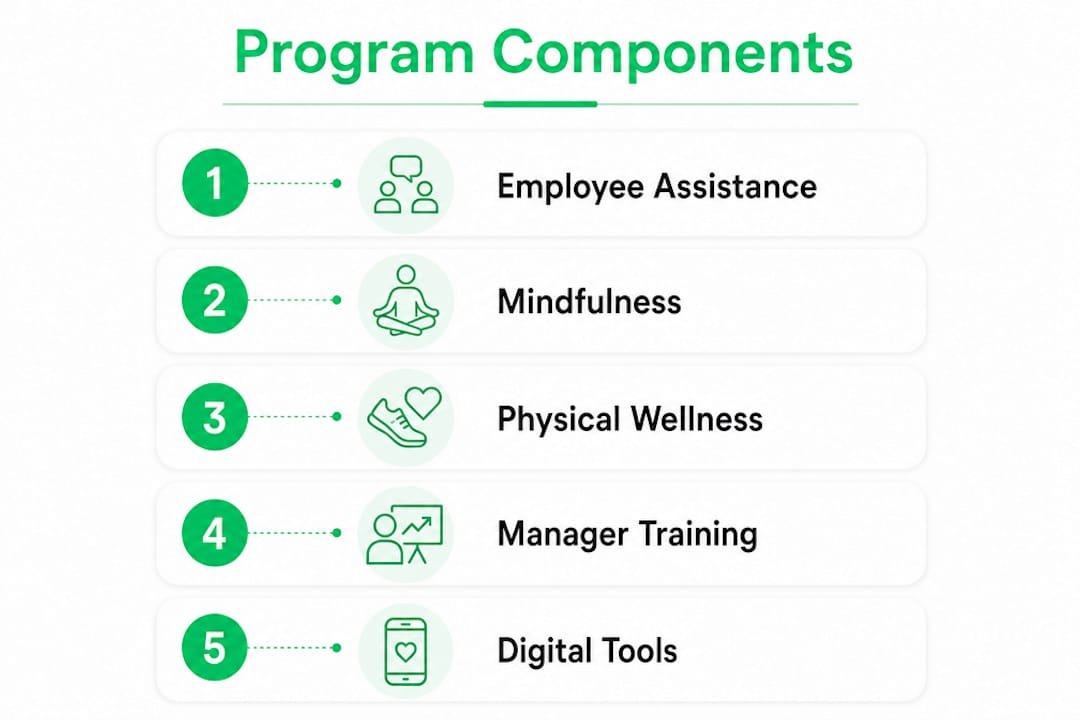
The core building blocks of a well-designed employee stress management program include:
- Employee Assistance Programs (EAPs): Confidential counseling and referral services that give employees access to licensed mental health professionals.
- Mindfulness and resilience training: Structured sessions teaching breathing techniques, cognitive reframing, and emotional regulation skills employees can use immediately.
- Cognitive behavioral therapy (CBT) tools: Digital CBT platforms offer time management training, mood tracking, and progress monitoring between sessions.
- Manager training: Teaching supervisors to recognize burnout signs, adjust workloads, and hold supportive check-ins.
- Physical wellness initiatives: Walking challenges, fitness stipends, and movement-based programs that reduce cortisol and improve mood.
- Practical life support: Financial wellness resources, childcare referrals, and flexible scheduling that remove external stressors before they enter the workplace.
The table below shows how common program components map to specific outcomes.
| Component | Primary benefit |
|---|---|
| Employee Assistance Program | Confidential mental health access |
| Mindfulness and resilience training | Immediate stress reduction skills |
| CBT-based digital tools | Sustained behavioral change over time |
| Manager training | Early burnout detection and workload relief |
| Physical wellness programs | Lower cortisol, improved energy and mood |
| Flexible work arrangements | Reduced daily operational stressors |
Pro Tip: Pair digital tools with human coaching. A hybrid delivery model combining self-paced apps with counselors significantly improves employee adherence over app-only solutions.
How do stress reduction programs benefit organizations and employees?
Effective stress management programs improve job satisfaction, reduce burnout, and enhance performance while lowering absenteeism and turnover costs. That combination makes them one of the highest-return investments HR can make. The benefits fall into two clear categories: organizational and individual.
For the organization, the gains are concrete:
- Lower absenteeism: Employees with access to stress support miss fewer days. Chronic stress drives both absenteeism and presenteeism, and addressing it directly cuts productivity losses.
- Reduced turnover costs: Replacing an employee costs a significant portion of their annual salary. Programs that reduce burnout keep people in their roles longer.
- Stronger engagement: Gallup research shows companies with engaged employees are 21% more profitable. Stress reduction programs directly support the conditions that drive engagement.
- Better team performance: Employees who manage stress well make fewer errors, collaborate more effectively, and sustain output over time.
For individual employees, the benefits are equally clear. Regular access to mental health resources, physical wellness support, and manager check-ins reduces anxiety, improves sleep, and builds the coping capacity needed for high-demand roles. Employees who feel supported by their employer report higher job satisfaction and stronger loyalty to the organization.
Digital behavioral health programs require sustained engagement beyond four weeks to show improvements in cognitive function and workplace focus. This means short-term programs rarely deliver lasting results. Investing in ongoing support, not one-time events, is what moves the needle on employee burnout and retention.
How can organizations implement stress management programs effectively?
Implementation is where most programs fail. A well-designed program that employees never use, or never hear about, delivers no value. The steps below reflect what actually works in mid-size to large American companies.
-
Conduct a needs assessment. Survey employees to identify their primary stressors before selecting any program components. Anonymous pulse surveys and focus groups surface issues that leadership often cannot see from the top. Data from this step shapes every decision that follows.
-
Communicate clearly and repeatedly. Employees must know what resources exist and feel psychologically safe using them. A single email at launch is not enough. Use multiple channels, including team meetings, manager conversations, and internal platforms, to keep program awareness high.
-
Embed support into daily workflows. Programs that sit outside normal work routines get ignored. Integrating manager check-ins and reducing operational friction, such as unclear priorities or excessive meeting loads, creates conditions where stress management becomes part of how work gets done, not a separate task.
-
Train managers as frontline responders. Supervisors are the first people to notice when an employee is struggling. Equip them with language, tools, and authority to act. This includes adjusting deadlines, redistributing workloads, and initiating supportive conversations without waiting for HR to intervene.
-
Measure and iterate. Track participation rates, absenteeism data, and engagement scores quarterly. Use that data to refine the program. What works for a 200-person tech company may not work for a 5,000-person manufacturing operation.
Pro Tip: Anchor stress management habits to existing routines. Scheduling a five-minute mindfulness exercise before a weekly all-hands meeting costs nothing and builds the habit without adding to anyone’s calendar.
Physical wellness is one of the most underused tools in workplace stress reduction programs. Programs like Charitymiles turn everyday movement, walking, running, or biking, into a shared team activity that reduces stress while building camaraderie. Since HARMAN launched its Charitymiles team in 2021, over 1,200 employees have generated more than $120,000 for charity. That kind of participation signals a program employees actually want to use.

What role do managers play in workplace stress management programs?
Manager support is the single biggest driver of program participation and success. When supervisors model healthy boundaries, employees feel permission to do the same. When managers ignore the program or visibly work through their own burnout, participation drops regardless of what HR offers.
Effective managers in a stress-aware workplace do the following:
- Spot burnout early. They notice changes in output, communication, and attitude before an employee reaches a breaking point.
- Hold proactive check-ins. Regular one-on-ones focused on workload and well-being, not just task status, build the trust employees need to speak honestly.
- Model boundaries visibly. Cultural norms like leaders not sending emails after hours have a measurable effect on team stress levels. What leadership does sets the standard for what is acceptable.
- Refer employees to resources. Managers who actively mention EAPs, mindfulness tools, and counseling options normalize their use and remove the stigma that keeps employees from seeking help.
Tailored psychosocial support and team mentorship strengthen employee coping in high-stress environments. Mentorship and proactive communication improve team resilience and mental health outcomes. This finding reinforces that stress management is not solely an HR function. It lives in the day-to-day relationship between a manager and their team.
“Viewing stress programs as a lifeline with immediately usable tools shifts them from perks to critical workforce support.” The American Institute of Stress frames this distinction as the difference between programs employees tolerate and programs that actually change how people work.
Why most stress programs underdeliver, and what to do instead
Most stress programs I have seen fail for the same reason: they are designed to check a box, not to change a culture. A company rolls out an EAP, sends one announcement, and considers the job done. Participation stays low, leadership never mentions it again, and the program quietly disappears from the benefits catalog.
The programs that work are the ones where leadership treats stress management as a business priority, not a wellness add-on. That means the CEO talks about it in all-hands meetings. It means managers are trained and held accountable for team well-being, not just output. It means the program is visible, accessible, and woven into how the organization actually operates.
I have also seen companies over-invest in digital tools while under-investing in human connection. Apps are useful, but they do not replace a manager who notices that someone is struggling and takes five minutes to ask how they are doing. The hybrid approach combining digital self-guided content with human coaching consistently outperforms digital-only solutions. That gap is not small.
The other mistake is treating stress management as a one-time event. A workshop in january does not address the stress employees feel in october. Sustainable programs require ongoing investment, regular communication, and a leadership team that models the behaviors they want to see. If your senior leaders are visibly burned out, no wellness app will convince employees that the company actually cares.
— Gene
How Charitymiles supports employee well-being and engagement
Physical activity is one of the most evidence-backed tools for reducing workplace stress. Charitymiles gives HR leaders a way to make movement a shared, purposeful part of company culture without adding complexity to anyone’s schedule.

The Charitymiles Employee Empowerment Program lets companies create private employee teams, run friendly movement challenges, and optionally sponsor miles for charity. Employees walk, run, or bike, and every mile generates a donation to a cause they care about. The result is a program that reduces stress, builds team connection, and ties individual effort to something larger than the job. Companies like HARMAN have seen an 11x increase in employee participation using this model. If you are building out your employee wellness strategy, Charitymiles is a practical, proven addition that employees actually look forward to.
FAQ
What is a stress management program for employees?
A stress management program for employees is a structured set of initiatives, including counseling, training, digital tools, and manager support, designed to reduce workplace stress and improve well-being and performance.
How long does it take for a stress management program to show results?
Digital behavioral health programs require sustained engagement beyond four weeks to show measurable improvements in cognitive function and focus. Ongoing programs consistently outperform short-term interventions.
What is the most effective component of an employee stress reduction program?
Manager support is the single biggest driver of participation and program success. Without active leadership involvement, even well-designed programs see low adoption.
How should companies communicate stress management resources to employees?
Employees need to know what resources exist and feel psychologically safe using them. Use multiple channels, including manager conversations, team meetings, and internal platforms, and communicate consistently, not just at program launch.
Can physical activity programs reduce workplace stress?
Yes. Regular movement reduces cortisol, improves mood, and lowers burnout risk. Programs that make physical activity social and purposeful, like Charitymiles team movement challenges, drive higher participation and sustained engagement than solo fitness initiatives.
Key takeaways
The most effective stress management program for employees combines multi-component support, manager training, and daily workflow integration to produce lasting reductions in burnout and turnover.
| Point | Details |
|---|---|
| Use multi-component programs | Combine EAPs, CBT tools, mindfulness, and physical wellness for best results. |
| Embed support into workflows | Programs integrated into daily routines see higher adoption than standalone initiatives. |
| Train managers as first responders | Supervisors who spot burnout early and hold check-ins drive participation and outcomes. |
| Communicate consistently | Employees must know resources exist and feel safe using them to benefit fully. |
| Choose hybrid delivery | Combining digital tools with human coaching outperforms app-only solutions for adherence. |