

Social impact employee benefits are perks that let your people do good through work: paid volunteer time, donation matching, giving budgets, cause-driven challenges and community service. The strongest ones are easy to join, tied to your company’s values and measured from day one. Below, we cover the main types, what the research says they deliver, how to design one, and how to track results.
TL;DR
- Social impact benefits connect everyday work life to community outcomes. Common formats are volunteer time off, matching gifts, giving budgets and activity-based challenges.
- In CECP’s 2025 data, the main employee-side payoff companies report is higher engagement scores, followed by better retention and talent attraction.
- Participation is the hard part. Benefits that fit into an ordinary day, such as a lunchtime walk, tend to reach more people than ones that need a free Saturday.
- Start with your values, listen to employees, pilot small, and measure with the surveys and HR data you already have.
- We built the Charity Miles Employee Empowerment Program so any employee, at any fitness level, can turn movement into donations.
Table of Contents
- What counts as a social impact employee benefit
- What the numbers say about adoption
- Benefits for employees and for employers
- How to design a benefit people will actually use
- Choosing between formats
- How to measure results
- Our perspective on social impact benefits
- Where Charity Miles fits
- A practical rollout plan
- FAQ
- Sources
What counts as a social impact employee benefit
Most benefits packages are market-driven: they match what competitors offer or satisfy compliance rules. Health insurance and retirement plans are the classic examples. A social impact benefit works differently. According to Nava Benefits, values-driven benefits are created on purpose to reinforce a company’s core values, so they act as a tangible extension of its purpose.
In practice, a social impact benefit does two jobs at once. It gives the employee something worth having, such as time, money to direct, a team to belong to or a reason to move. It also sends value to a community or cause. That second half is what separates it from a standard perk.
The category is broad. Here are the formats employers use most:
- Paid volunteer time. Hours off to serve a nonprofit.
- Donation matching. The company matches what employees give, usually at a 1:1 ratio.
- Giving budgets. A set amount each employee directs to a cause of their choice.
- Employee resource groups. Communities of employees that often drive volunteering and mentoring.
- Service-based wellness. Wellness programs that include community service and group activities. USF’s overview of corporate wellness lists community service alongside gym access, mental health days and wellness incentives.
- Movement-for-charity challenges. Employees walk, run or bike, and every mile triggers a donation.
What the numbers say about adoption
These benefits are mainstream among larger employers. CECP’s Giving in Numbers 2025 report found that 93% of companies offered matching-gift programs in 2024. The same report shows volunteer participation averaging 25%, and 94% of companies supporting Employee Resource Groups.
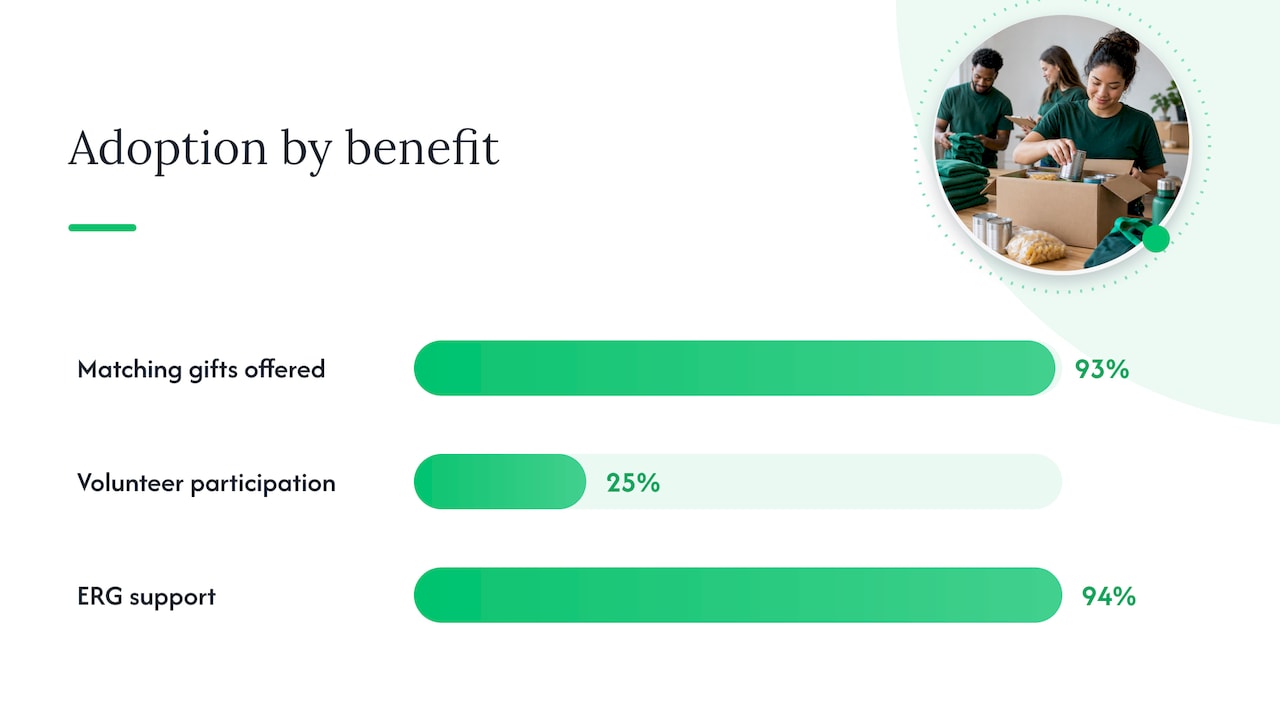
The 25% participation figure matters. It means that at a typical company, three in four employees do not take part in volunteering. If you are designing a program, the question is rarely whether to offer one. The question is how to make it something the other 75% will actually use.
Some well-known examples show how varied the designs are. Per the Nava Benefits guide, Salesforce gives employees seven days of paid volunteer time. Bell Bank gives each full-time employee $1,000 a year to donate to causes they choose, and employees have contributed over $30 million since the program began 17 years ago. Both are generous, and both are built around a clear company value.
Benefits for employees and for employers
What employers report
According to CECP, the main employee-related benefit of community investment remained an increase in employee engagement scores. Better retention and the ability to attract high-quality talent came next. Companies also see brand effects: 35% measured brand-related outcomes in 2024, and among them the top reported benefit was improved reputation and trust scores, at 38%.
The Conference Board’s research on global pro bono points the same way. In that survey, 95% of companies named leadership development as one of their top three reasons for investing. Generating sustainable social impact and building employee satisfaction and loyalty tied for the next spot, both at 86%.
What the research says about employees
A 2024 systematic literature review of CSR and employee outcomes found a positive direct and indirect relationship between CSR and employee creativity and innovative behavior. It also notes that employers can use CSR programs to build employees’ skills and competencies.
There is company-level evidence too. In SHRM’s Mapping Success in Employee Volunteering report, Aetna found a statistically significant positive correlation between employees’ participation in its volunteering program and their rating Aetna a good place to work. That is a correlation, not proof of cause, but it is the kind of signal you can look for in your own survey data.
The wellbeing angle
Social impact and wellness overlap more than most benefits teams assume. In the USF piece, Rexroad explains that wellness programs encourage employees to get up and do something active, which matters most for desk workers. The same article describes a spirit dimension of wellness: a sense of purpose through the organization’s mission, volunteer outings and community. A benefit that combines movement with purpose touches both.
How to design a benefit people will actually use
The SHRM report describes six Drivers of Effectiveness for employee volunteering programs: cause-effective configuration, strategic business positioning, sufficient investment, a culture of engagement, strong participation and actionable evaluation. You do not need to be running a volunteer program to borrow the list. It works as a checklist for any social impact benefit.
Nava Benefits suggests a six-step path for values-driven benefits, which we have adapted here.
- Clarify your values. Pick the two or three the company genuinely stands behind. A benefit that contradicts daily culture will feel hollow.
- Audit what you already offer. You may have giving or volunteering options that few people know about.
- Listen to employees. Use surveys and employee resource groups to learn which causes and formats appeal.
- Prioritize high-impact options. Choose the one or two that fit your people, not every idea on the list.
- Pilot before scaling. Run a single team, office or quarter first.
- Communicate the why. Connect the benefit to a value in your internal messaging, so employees see why it exists.
The academic review adds a point worth keeping in mind: involving employees in CSR activities, from planning through implementation, helps build a positive employer-employee relationship. Let employees help choose causes and run the program. Do not hand them a finished one.
Remove friction first
Most participation problems are logistics problems. A volunteer day asks someone to give up a weekday, arrange childcare and show up at a specific place. A giving budget asks them to research charities. Neither is a bad benefit, but both ask for effort.
Lower-friction formats fit inside the day as it already is. Think of a ten-minute walk after lunch, a bike commute or a weekend run, each of which counts toward a shared goal. This is the idea behind anchoring a new habit to an existing routine: the less mental effort a person needs to join, the more likely they are to keep going.
If you want more ideas on this theme, see our guides to corporate volunteering ideas and what employee volunteer programs actually deliver.
Make it inclusive
A benefit only works if every employee can use it. Remote staff, shift workers, people with caregiving duties and people with different physical abilities all need a way in. Offer more than one format: a giving option, a volunteering option and an activity option, for example. Keep the activity option open to any movement, not only athletic effort.
Choosing between formats
The table below compares the main formats on the points that tend to decide success. These are general characteristics, not rankings.
| Format | What the employee does | Main barrier to participation | Best for |
|---|---|---|---|
| Paid volunteer time | Serves a nonprofit during work hours | Scheduling and finding a fit | Teams that value hands-on service |
| Donation matching | Gives, and the company matches | Employees must have money to give | Companies wanting a simple, scalable perk |
| Giving budget | Directs company funds to a chosen cause | Choosing a charity | Values of autonomy and trust |
| Employee resource groups | Joins a community around shared identity or interest | Awareness | Culture and belonging goals |
| Movement challenge | Logs walks, runs or rides for a team | Staying motivated over time | Wellness, remote and hybrid teams |
Most mature programs combine two or three of these. The mix matters less than making sure each option has a clear owner and a clear message.
How to measure results
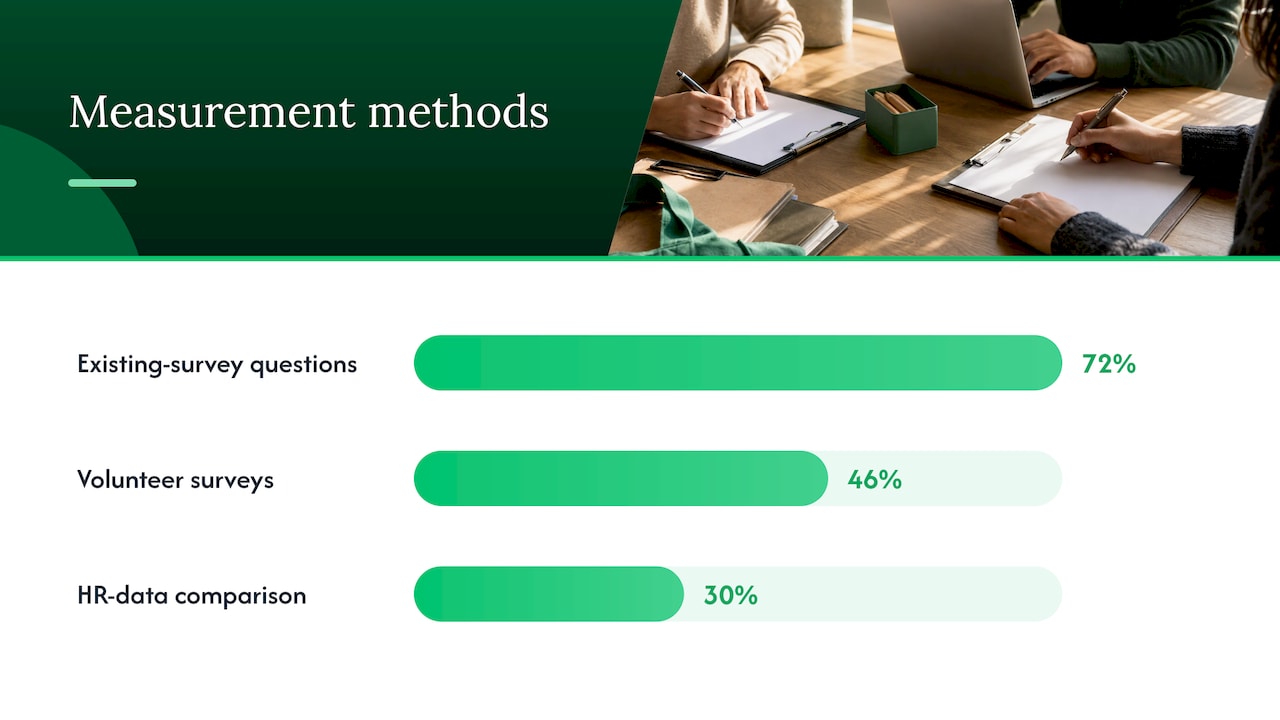
Measurement is where many programs stall. CECP found that 46% of companies actively measured the employee-related value of their community investments in 2023. The most common approach was to add questions to existing employee surveys (72%). Nearly half (46%) built dedicated surveys for volunteers, and only 30% used HR data to compare volunteers with non-volunteers on retention and performance.
You can start with a simple setup:
- Participation rate. Employees who took part, divided by employees eligible.
- Engagement question. Add one or two items about the program to your next engagement survey, as Aetna, Allstate and JCPenney did with their volunteering programs, per SHRM.
- Retention comparison. Compare turnover among participants and non-participants. Treat it as a signal, not proof, since people who join may already be more engaged.
- Community output. Dollars donated, hours served or miles logged, depending on the format.
The literature review also recommends continuous monitoring of how employees perceive CSR initiatives, with managers responding promptly to what they hear. A quarterly pulse question does that without much work.
For more on the link between CSR and engagement, read our piece on corporate social responsibility and employee engagement and our guide to improving engagement with your volunteerism.
Our perspective on social impact benefits
We have watched a lot of benefits programs launch with good intentions and fade within a year. The pattern is usually the same: the program asks employees for something extra, so only the already-motivated take part.
We think the better design starts from what people already do. Almost everyone moves during the day. A lunchtime walk, a bike commute or a Saturday run can carry a donation, and the employee does not need to change their schedule to join. That is why Charity Miles counts all movement, not just athletic activity. A first-time walker and a marathoner sit on the same team and add to the same total.
We also believe the company should control its terms. In our Employee Empowerment Program, companies create private teams, run friendly challenges, and can optionally sponsor miles on their own terms: the rate per mile, the total cap, and whether donations go to each employee’s chosen charity or a company-selected cause. That keeps the budget predictable and the message consistent with your values.
Our results point in the same direction. Since launching its Charity Miles team in 2021, HARMAN saw an 11x increase in employee participation, with 1,200+ employees generating over $120,000 for charity. We will not promise every company the same outcome, but it shows what happens when joining is easy and the cause is personal.
Gene
Where Charity Miles fits
Charity Miles is a free mobile app for iOS and Android. Members walk, run or bike, the app tracks distance with GPS and pedometer, and money is donated to a charity of the member’s choice for every mile logged. It is free for members and for charities.
For employers, our Employee Empowerment Program adds private company teams, intra-company challenges and optional sponsorship, so a social impact benefit can sit alongside your wellness and CSR goals in one place. It works like a step challenge, but it is woven into company culture instead of running as a one-off event.
If you want to see how a program could look for your company, start on our Employee Empowerment page. If you want to understand sponsorship options first, see our corporate sponsorship opportunities. Individual employees can get the app from our download page.
A practical rollout plan
Here is how we would sequence a first year, using the steps above.
First 30 days: listen and decide
Survey employees on causes and formats. Ask what would make joining easy, and what has stopped them from joining past programs. Review your current benefits for any giving or volunteering options that already exist but are underused.
Days 30 to 90: pilot
Pick one or two teams, ideally with different working patterns, such as an office team and a remote one. Set a simple goal, a clear time frame and a named champion for each team. Share the why in plain language: which value this supports and which cause benefits.
Months 3 to 12: scale and report
Expand to more teams once the pilot shows steady participation. Report back to employees on what their activity achieved, because people stay involved when they see the result. Feed the participation and survey data into your regular benefits review, and adjust.
For related ideas on keeping people involved, see our employee engagement ideas and our overview of employee wellness programs.
FAQ
What are examples of social impact employee benefits?
Common examples include paid volunteer time off, donation matching, annual giving budgets, employee resource groups and activity challenges that convert movement into donations. Salesforce’s seven days of paid volunteer time and Bell Bank’s $1,000 annual giving amount are two documented cases. Most companies combine more than one format.
Do social impact benefits improve retention?
Companies say they help. In CECP’s 2025 data, higher engagement scores were the top employee-related benefit, followed by better retention and talent attraction. Aetna also found a positive link between program participation and rating the company a good place to work. Track your own data to see what holds true for your workforce.
How much does it cost to start?
That depends on the format. A volunteer time policy costs paid hours, matching costs a share of what employees give, and a giving budget is a fixed amount per person. With Charity Miles, the app is free for members, and companies choose their own sponsorship rate and cap if they sponsor miles. Contact us through our Employee Empowerment page to discuss a program.
How do I get more employees to participate?
Reduce the effort needed to join. Offer formats that fit into the normal day, include all fitness levels and locations, let employees help choose causes, and report results back to them. Pilot with a few teams, then scale what works.
How should I measure a social impact benefit?
Start with participation rate and one or two engagement survey questions. If you can, compare retention for participants and non-participants. CECP found that most companies that measure rely on existing employee surveys, so you do not need new tooling to begin.
Sources
- Values-driven employee benefits: a how-to guide (Nava Benefits)
- Giving in Numbers 2025 (CECP)
- Developing Global Leaders Through Service (The Conference Board)
- How to Create an Employee Wellness Program That Actually Works (USF)
- Maximizing Corporate Impact: Donation Matching Programs (ASE Online)
- Mapping Success in Employee Volunteering (SHRM)
- CSR and employee outcomes: a systematic literature review (Springer)