
An app-based “run for charity” program converts employees’ everyday walking, running, and cycling into verified charitable donations, tracked automatically by a mobile platform. The recommended immediate action: launch a 6–8 week private-team pilot on Charitymiles with one named charity partner and a defined sponsor rate-per-mile. Assign a single pilot owner, set a participation rate target of 40% or higher, and measure total dollars donated by week eight.
- Any movement counts: a lunchtime walk, a bike commute, a Saturday run.
- Employees choose their charity, or the company directs funds to a strategic partner.
- The company controls the sponsorship rate, the total cap, and the reporting cadence.
- No cost to individual employees; the platform handles donation routing and receipts.
According to Gallup, companies with highly engaged employees are 21% more profitable than those with low engagement. A movement-for-charity program is one of the fastest ways to close that gap, because it ties physical wellbeing to a purpose employees already care about.
Table of Contents
- Why does running or moving for charity actually improve engagement?
- How does the app convert movement into charitable donations?
- What design choices keep participation high past week two?
- What should you measure, and how do you report it?
- What do legal and finance teams need to approve this?
- Ready-to-use templates for your pilot launch
- Key Takeaways
- What most programs get wrong about sustaining momentum
- Charitymiles turns daily movement into measurable CSR impact
- Useful sources
Why does running or moving for charity actually improve engagement?
The mechanism is not intuitive at first glance, but the research is consistent. A peer-reviewed study published in Management Sciences found that employee wellness programs perceived as CSR fully mediate the relationship between wellness participation and employee engagement. In plain terms: when employees believe their company’s wellness program is genuinely doing good in the world, their engagement rises beyond what the wellness benefit alone would produce.
The engagement case compounds further when you look at connection data. 65% of workers report a stronger connection to their employer through CSR activities. Programs that embed charity into daily movement create that connection repeatedly, not just at an annual volunteer day.
Wellbeing outcomes follow the same pattern. Wellness programs that move beyond gym-centric assumptions and offer flexible, inclusive options, such as walking clubs, running groups, and cycling challenges, show stronger participation and better health outcomes than those that assume everyone wants a treadmill. Charitymiles is built on exactly that premise: any movement, any pace, any fitness level.
How does the app convert movement into charitable donations?
The end-to-end flow is straightforward. An employee opts in, downloads the Charitymiles app (iOS or Android), and joins the company’s private team. The app tracks distance via GPS and pedometer. Miles aggregate at the team level, and the company’s sponsorship rate converts those miles into a dollar donation routed to the employee’s chosen charity or a company-selected cause. Charitymiles handles the payment processing and issues donation receipts.
| Sponsorship model | How it works | Best fit |
|---|---|---|
| Per-mile sponsorship | Company pays a fixed rate for every mile logged | Ongoing programs, sustained engagement |
| Capped-match model | Per-mile rate applies until a total dollar cap is reached | Budget-controlled pilots |
| Event-match top-up | Company adds a flat donation when a team hits a milestone | Short campaigns, awareness moments |
Employees select their charity from Charitymiles’s vetted list, or the company narrows the field to strategic partners. All opt-in data is collected with explicit consent, GPS data is used solely for distance tracking, and employees can choose step-based tracking as an alternative to GPS if they prefer. Donation receipts go to the company for accounting and to the designated charity for their records.
What design choices keep participation high past week two?
Drop-off is the most common pilot failure, and it almost always traces back to a single static goal. Research on multi-year workplace wellness programs shows that evolving, rotating team challenges sustain participation far longer than a single cumulative target, and they do so without large financial incentives.
Pro Tip: Rotate the challenge theme every two weeks: a team distance relay in weeks 1–2, a “most active days” competition in weeks 3–4, and a charity-milestone push in weeks 5–6. Variety keeps intrinsic motivation alive.
Inclusivity is equally critical. A corporate fitness challenge that counts only running excludes cyclists, walkers, and employees with mobility differences. Charitymiles converts all movement types into the same charitable metric, so a wheelchair mile and a running mile carry equal weight. That parity matters for both participation rates and your DEI commitments.
- Appoint team captains who post weekly updates and celebrate individual milestones.
- Share the running donation total in your company Slack channel so employees see real-time impact.
- Use small branded rewards (water bottles, branded gear) tied to sponsor-match milestones rather than large cash prizes.
- Publish charity impact stories mid-pilot to reconnect employees with the “why.”
Gamification and digital tools during company health events measurably increase engagement and improve wellbeing outcomes. Leaderboards, team fundraising targets, and shared milestones are not gimmicks; they are evidence-based mechanics.
What should you measure, and how do you report it?
| Metric | Dashboard field | Reporting cadence |
|---|---|---|
| Unique participants | Employee opt-in count | Weekly (pilot), quarterly (ongoing) |
| Active participation rate | Active users / enrolled users | Weekly |
| Miles aggregated | Team total miles | Weekly |
| Donation dollars | Sponsor rate × miles, net of cap | Weekly |
| Charity distribution | Donation split by org | End-of-pilot, quarterly CSR disclosure |
| Receipt IDs | Donation receipt reference numbers | As issued, for audit |
For the executive one-pager at week eight, lead with participation rate and total donated, then show the per-employee cost against the engagement NPS shift. That framing speaks directly to the ROI question finance will ask. For external CSR disclosure, the charity distribution field and receipt IDs provide the audit trail most ESG frameworks require.
65% of workers report a stronger connection to their employer through CSR activities, so tracking NPS alongside donation dollars gives you both the financial and the human story.
What do legal and finance teams need to approve this?
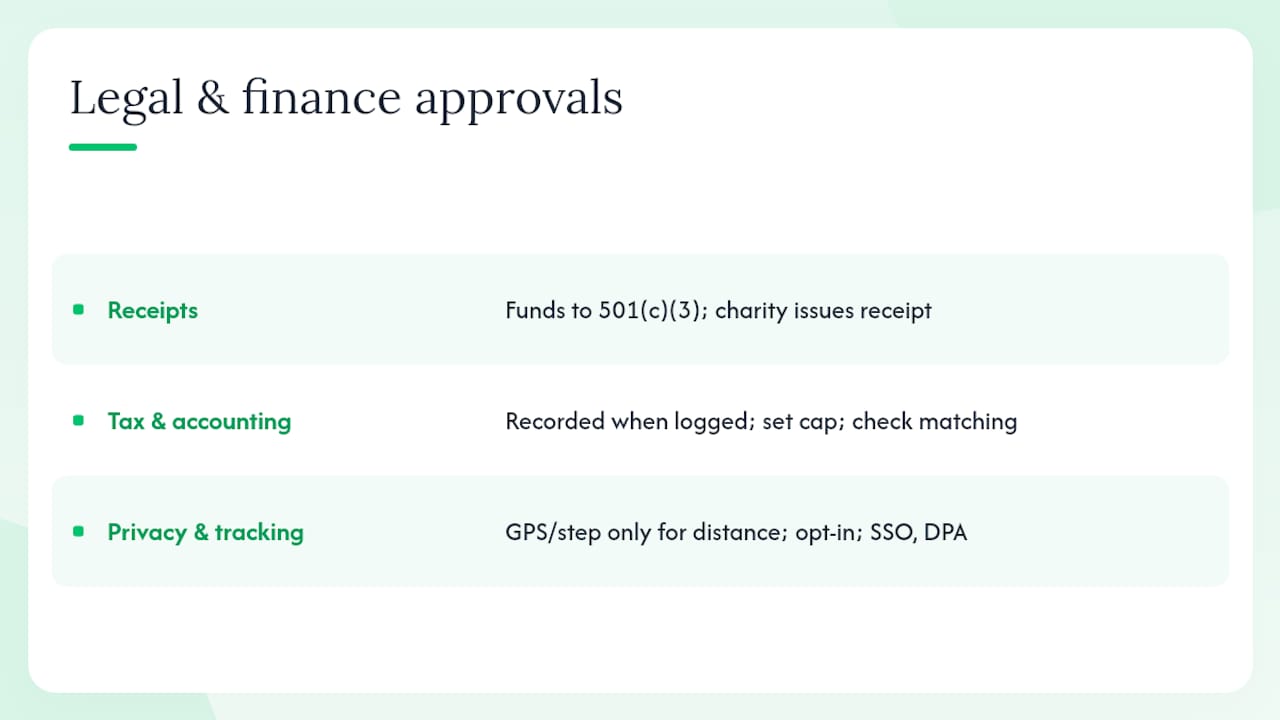
Most approval friction comes from three questions: who issues the tax receipt, how is the sponsorship recorded, and what happens to employee GPS data.
Donation routing and receipts: Charitymiles routes funds to IRS-registered 501©(3) organizations and the receiving charity issues the tax receipt. The company’s sponsorship payment is a charitable contribution for accounting purposes; work with your tax counsel to confirm deductibility under your specific entity structure, as treatment can vary.
Tax and accounting: Per-mile sponsorships are typically recorded as charitable contributions in the period the miles are logged and the payment is triggered. Set the cap before launch so finance can accrue the liability accurately. If your company has a matching gift program, confirm whether Charity Miles miles qualify as a triggering activity.
Privacy and tracking: Charitymiles collects GPS or step data solely to calculate distance. Employees opt in explicitly, and the platform supports data minimization practices. For enterprise deployments, confirm SSO (SAML or OIDC) is configured so employee identity management stays within your existing directory, and request a data processing agreement that specifies retention periods and deletion protocols.
Ready-to-use templates for your pilot launch
Kickoff email outline (send 5 days before launch):
- Subject line: “Your miles are about to do more — [Company] is running for charity.”
- Body: Name the charity, state the per-mile rate, explain how to download and join the private team, and name the team captain.
- CTA: One link to the app store, one link to the team join page.
Six-week comms calendar:
- Pre-launch (Day -5): Kickoff email to all employees.
- Week 1: Slack post with first-day mileage total and a photo from a team captain.
- Week 2: Mid-challenge leaderboard update; introduce the rotating mini-challenge.
- Week 3: Charity spotlight: share the organization’s mission and how donations are used.
- Week 4: Halfway milestone post; celebrate the team’s cumulative donation total.
- Week 6: Final push email; announce the closing date and the last chance to log miles.
- Week 8: Results announcement with total donated, top participants, and next-steps teaser.
Pilot checklist:
- Legal/finance sign-off on sponsorship rate, cap, and donation routing.
- Vendor setup complete: SSO, team created, user list uploaded.
- Team captains recruited and briefed.
- KPIs agreed and dashboard export configured.
- Comms calendar approved and scheduled.
Key Takeaways
An app-based movement-for-charity program works because it ties physical wellbeing to verified charitable impact, and that combination drives employee engagement beyond what either benefit produces alone.
| Point | Details |
|---|---|
| Pilot fast, measure five KPIs | Track participation rate, miles, dollars donated, NPS change, and sponsor fulfillment in your first 6–8 weeks. |
| CSR perception drives engagement | Research shows wellness programs perceived as CSR fully mediate the wellness-to-engagement relationship. |
| Evolving challenges prevent drop-off | Rotate team challenge themes every two weeks; static goals lose participation after week three. |
| Handle legal and finance first | Confirm donation routing, tax treatment, and privacy terms before launch to avoid approval delays. |
| Charitymiles is the platform | HARMAN’s team generated 1,200+ participants and $120,000+ for charity; request a pilot brief to replicate those results. |
What most programs get wrong about sustaining momentum
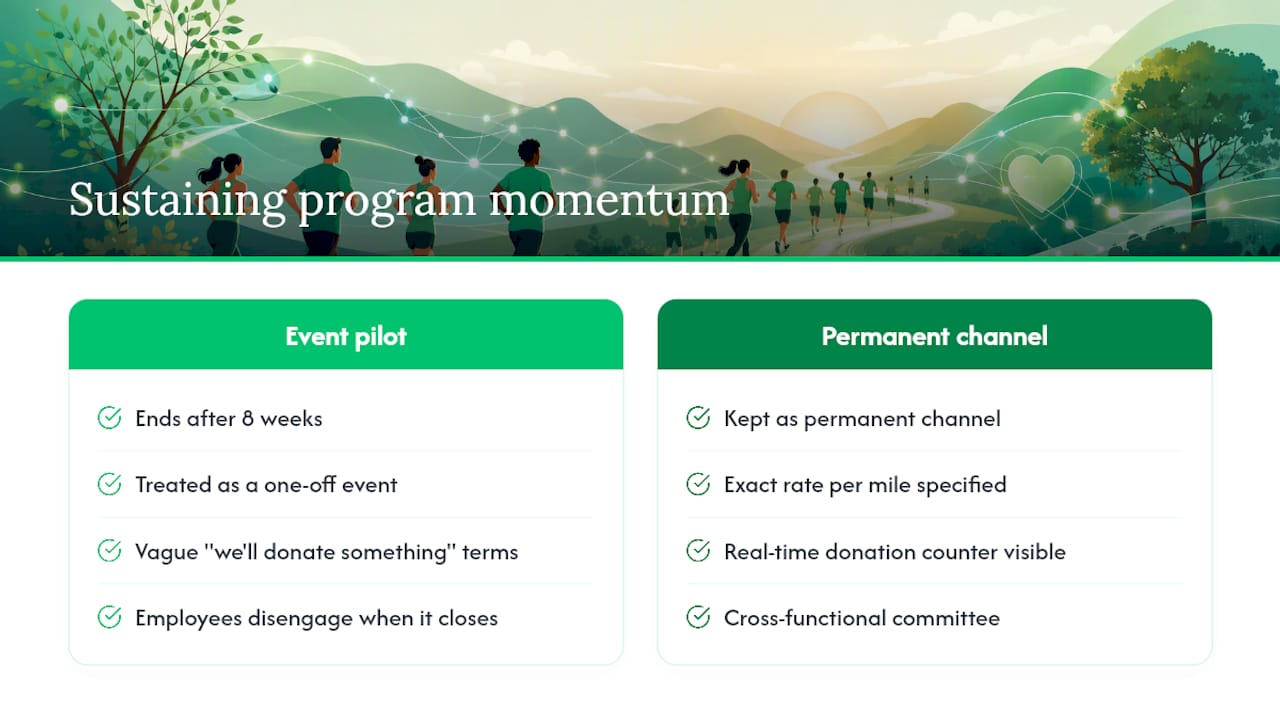
The programs that stall after eight weeks share a common pattern: the pilot was treated as an event rather than infrastructure. A single challenge with a hard end date trains employees to disengage the moment it closes. The companies that see year-over-year participation growth treat the platform as a permanent channel, not a campaign.
The other underestimated variable is sponsorship clarity. Vague terms (“we’ll donate something”) produce vague participation. When employees know the exact rate per mile and can watch the donation counter move in real time, their behavior changes. That specificity is what turned HARMAN’s program into an 11x participation increase rather than a modest pilot result.
My practical advice: form a cross-functional steering committee (HR, CSR, communications, and one employee champion from each major office) that meets quarterly to refresh the challenge calendar, review the charity roster, and celebrate wins publicly. Quarterly refreshes keep the program feeling current without requiring a full relaunch. And celebrate publicly: a Slack post showing “$47,000 donated this quarter by your colleagues” does more for culture than any internal award ceremony.
Charitymiles turns daily movement into measurable CSR impact
Charitymiles’s Employee Empowerment Program gives mid-size and enterprise HR teams a ready-built platform that converts walking, running, and cycling into verified charitable donations, with no cost to employees and full company control over sponsorship terms. The platform has been operating since 2012, has generated tens of millions of dollars for charity, and supports enterprise integrations including SSO, bulk user provisioning, and exportable reporting for ESG disclosure.
HARMAN’s result, 1,200+ employees and $120,000+ generated since 2021, is the benchmark. Your team can reach comparable numbers with the right pilot structure, and Charitymiles provides the program design support to get there. If you are evaluating employee engagement software that also delivers measurable CSR outcomes, this is the category to prioritize. Contact the Charitymiles enterprise team to request a pilot brief and a custom sponsorship proposal for your organization.
Useful sources
- Boosting Engagement: Effects of Wellness Programs in Hospitality Workplaces
- The Sustainability of a Workplace Wellness Program That Incorporates Gamification Principles: Participant Engagement and Health Benefits After 2 Years
- Gamification and digital tools impact employee well-being during company health events
- Employee Wellness Statistics 2026. What the Data Really Says About Engagement | Chanty
- 150+ Corporate Wellness Statistics: 2026 Verified Report
- Charity Miles