

The best remote team wellness challenge is simple to join, counts every kind of movement, gives people a shared purpose, and lets them take part from wherever they work. A walking, running, and biking challenge that turns each mile into a donation meets all four. That is why our Employee Empowerment program builds private company teams around miles that fund a cause. This guide covers the formats that work, the design choices behind them, how to keep participation voluntary and fair, and how to tell whether the challenge worked.
TL;DR
- Remote workers report strong engagement but weaker well-being, so a challenge that adds movement and connection targets a real gap.
- Keep the entry bar low: any movement counts, tracking is automatic or nearly so, and weekends are optional.
- Combine individual goals with a shared team goal. In one randomized trial, only the combined approach beat the control group.
- Add a purpose beyond the leaderboard. Miles that become donations give people a reason to log them.
- Measure participation and well-being separately, and look at reach across the whole company, not only at the people who joined.
Table of Contents
- Why remote teams need wellness challenges
- Five remote team wellness challenge formats that work
- Designing a challenge people can join and sustain
- Keep it inclusive, voluntary and fair
- Add charitable giving to the challenge
- How to launch a remote challenge in six steps
- Measure whether it worked
- Where we land on remote wellness challenges
- Start a private team for your company
- FAQ
- Sources
Why remote teams need wellness challenges
Remote work removes the commute, the walk to a meeting room and the lunch with a coworker. It also removes many of the small moments that built connection without anyone planning them.
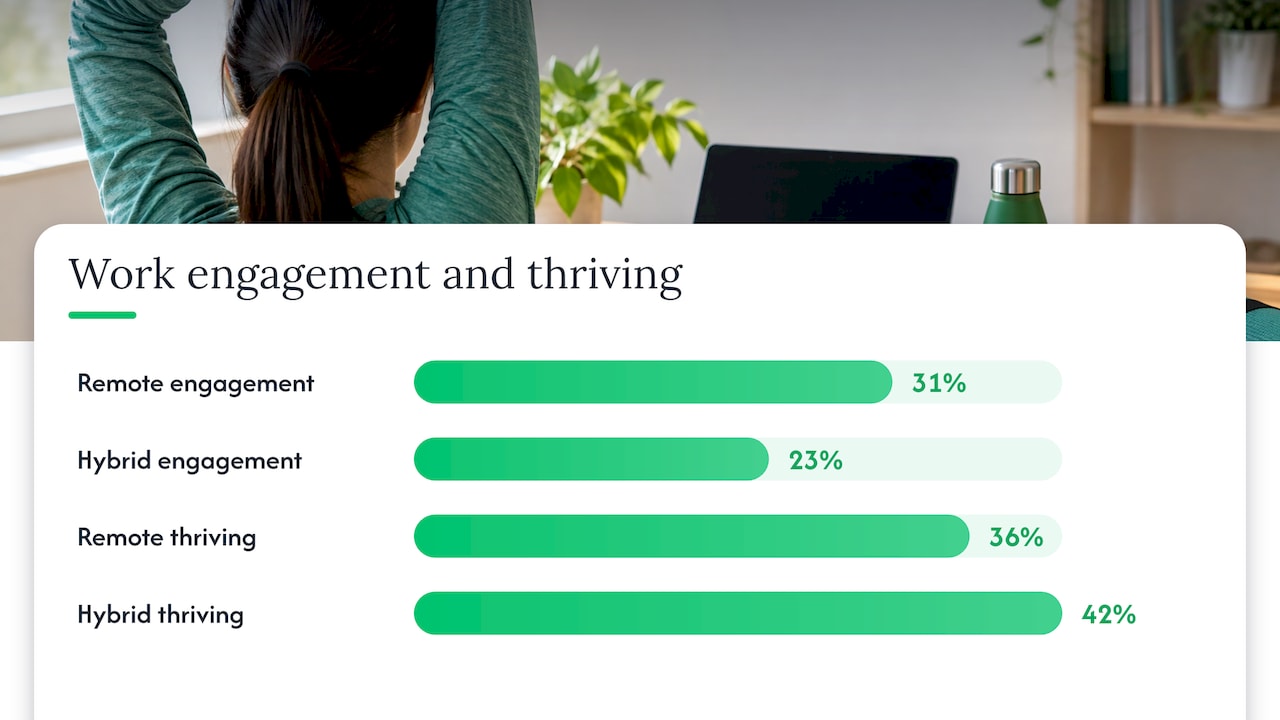
Gallup’s 2025 State of the Global Workplace data shows the tension. Globally, fully remote workers are the most likely to be engaged at work (31%), compared with 23% of hybrid workers. The same report finds they are less likely to be thriving in their lives overall (36%) than hybrid workers (42%). Engaged at work, but struggling outside it: that is the gap a wellness challenge can address.
A peer-reviewed study on virtual and hybrid teams found that structured opportunities for informal interaction can foster connection, rapport, psychological safety and engagement. Check-ins, social rituals and informal conversations were named as practical ways to build those relationships. A team challenge is all three at once: a recurring check-in (the leaderboard), a ritual (the weekly push) and a reason to talk about something other than work.
Five remote team wellness challenge formats that work
Most lists of remote wellness ideas run to ten or twenty items, from desk stretches to wellness webinars. Most teams do better with one clear challenge than with a menu. These are the formats worth considering, with where each fits.
1. A distance challenge (walk, run, bike)
Everyone logs miles, and the team adds them up. It works across time zones because nobody has to be online at the same moment. A lunchtime walk, a bike commute to a co-working space and a Saturday run all count the same way. If you want a deeper look at this format, our guide to a virtual walking challenge covers setup in detail.
The Texas A&M AgriLife Extension’s Howdy Health guide describes virtual team mileage routes, with individual and team mileage goals and friendly competition for participants of varied ages and abilities. The structure is old and proven. Remote teams only need the tracking to be digital.
2. A movement-break challenge
The goal is a short break every day: stand, stretch, step outside for ten minutes. It suits people with desk-bound days and packed calendars. Pair it with a team channel where people post what they did.
3. A sleep or hydration routine challenge
These are self-reported and private by nature. They work as a side track for people who prefer not to track activity, but they are harder to verify and make less satisfying team totals.
4. A mindfulness or check-in challenge
A daily two-minute practice, shared in a thread or a weekly call. It supports the social side of well-being directly. Keep it optional and low-key.
5. A cause-driven challenge
Here the movement itself produces something beyond personal health. Each mile raises money for a charity, so the team can see its effort turn into impact. This is the format we build, and it is the one that most naturally solves the question remote managers ask most: why would anyone keep logging after week two?
| Format | Best for | Tracking effort | Team feeling |
|---|---|---|---|
| Cause-driven distance challenge | Mixed fitness levels, multiple time zones | Low (GPS and pedometer) | Strong shared purpose |
| Distance challenge (steps or miles only) | Competitive teams | Low | Moderate |
| Movement breaks | Desk-heavy roles | Self-reported | Moderate |
| Sleep or hydration | Individual habits | Self-reported | Weak |
| Mindfulness check-ins | Stress and isolation | Self-reported | Moderate |
Designing a challenge people can join and sustain
Retention is where most challenges fail. The design choices below decide whether week four looks like week one.
Lower the tracking burden
A worksite team challenge evaluated in the United States set a target of 50,000 steps per week for five of six weeks and did not require weekend logging. That is a good model: a clear weekly goal, with room for people whose weekends belong to family or rest.
For a remote team, the lesson is to avoid manual entry wherever you can. A tracked mile logged by GPS asks nothing of the participant beyond opening the app and moving.
Mix individual and team goals
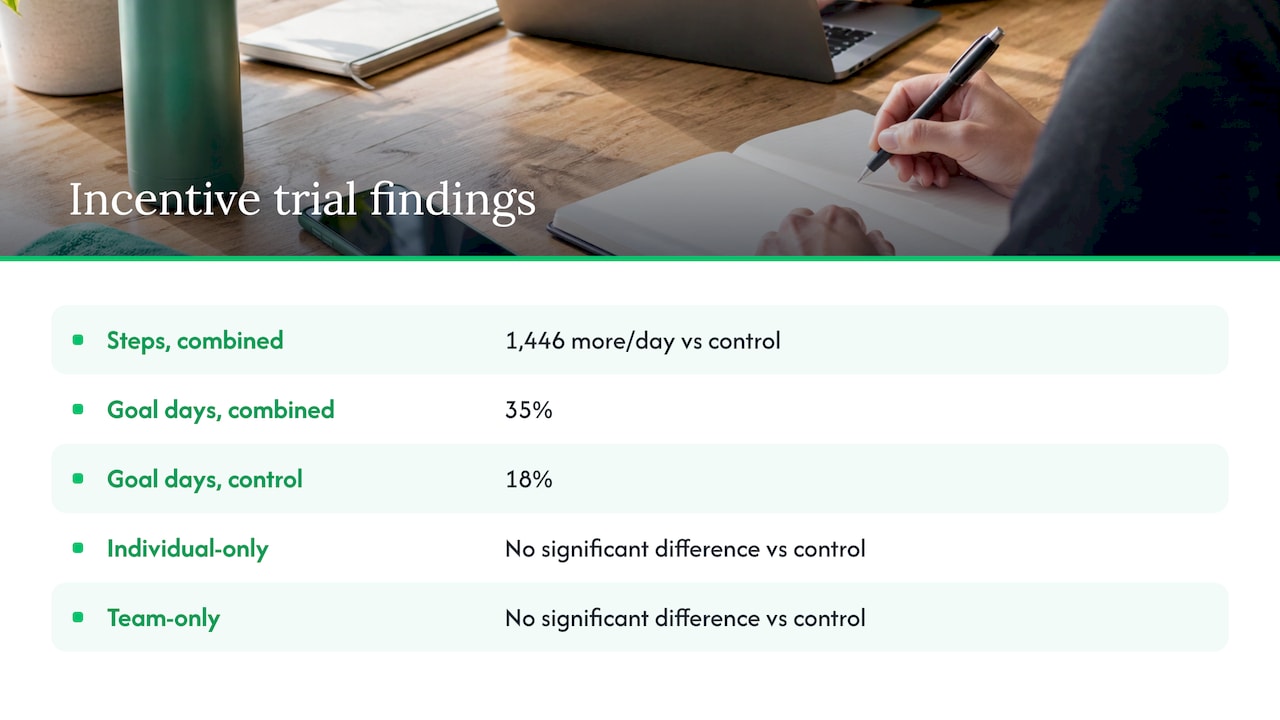
A 2016 randomized exercise trial with 304 employees in Philadelphia found that combining individual and team incentives produced 1,446 more steps per day than the control group, while individual-only and team-only incentives were not significantly different from control. The combined group also met its step goals on 35% of days versus 18% for control.
In practice: give each person a personal target they set for themselves, and give the team one shared total to chase. Recognize both.
Let people choose how to move
A marathoner and a person who walks the dog twice a day should both be able to contribute. A challenge that counts only running or only a step threshold quietly tells half the company it is not for them. Any-movement counting is a design decision, not a bonus.
Give it a rhythm
Six weeks is a workable length for a first run. It is long enough to build a habit and short enough to keep energy high. Open with a kickoff call, post a short weekly recap, and close with a results moment that names the total and the cause.
Keep it inclusive, voluntary and fair
A wellness challenge can backfire if it feels like surveillance or a contest the same three people always win. Two ideas from the research help.
A 2021 study of workplace gamification identified fairness across employees with different personal goals, and privacy, as important design challenges. In the study, personalized goals and privacy-protected social competition were tested over five months with 53 employees at a Dutch university, and about half improved their lifestyles.
What that means for your rules:
- Make joining optional. Invite, do not assign. Never tie participation to performance reviews.
- Show team totals more than individual rankings. Celebrate the combined miles and let people share their own numbers if they wish.
- Count all movement. Include walking, wheelchair pushes where the tracker supports it, cycling and running, and give people the choice of how to contribute.
- Offer a non-tracking way in. Someone who prefers not to share location data can still join the team conversation, cheer others on, or help pick the charity.
- Rotate recognition. Highlight the most consistent team, the biggest weekly improvement, or the person who brought a colleague along, not only the longest distance.
A short note on health: encourage people to move at a pace that suits them, and invite anyone with a medical condition or a question about starting an exercise routine to check with their own doctor first.
Add charitable giving to the challenge
A leaderboard alone motivates people who already like leaderboards. A purpose reaches everyone else. When each mile becomes a donation, the person who walks two miles on a hard day sees that it mattered.
Here is how it works with Charity Miles. Members walk, run or bike, and the app tracks distance via GPS and pedometer. Money is donated to the member’s chosen charity for every mile logged. The app is free for members and free for charities. Companies create private teams for their employees and can optionally sponsor those miles on their own terms: they choose the rate per mile, the total sponsorship cap, and whether donations go to each employee’s chosen charity or to a company-selected cause.
What participants should know:
- Individuals do not pay anything to log miles.
- When a company sponsors a team, the company sets the rate and the cap, so you can budget the total before you launch.
- Employees can see which charity their miles support. The company can choose one shared cause or let people pick their own.
- Charities can have their own sponsors in the app, and the details of those arrangements are in our FAQ.
For a remote example, see how LuxGive connected remote employees with a charity challenge. For results at scale, HARMAN launched its Charity Miles team in 2021 and saw an 11x increase in employee participation, with more than 1,200 employees generating over $120,000 for charity. The full story is in our HARMAN pilot playbook.
How to launch a remote challenge in six steps
- Pick the goal. Decide whether you want more movement, more connection, more CSR participation, or all three. A cause-driven distance challenge covers all three.
- Set the length and rhythm. Six weeks with a weekly recap is a solid starting point.
- Choose the cause. Decide whether the team shares one cause or each person picks. Sponsored teams can do either.
- Set the rules. Voluntary, any movement counts, weekends optional, team totals front and center.
- Create the private team. In our program, the company creates a private team for its employees, so the challenge stays inside your organization. Employee Empowerment for teams shows how this looks for a team lead.
- Communicate and kick off. Announce it in the channels people already read, ask a senior leader to log the first mile, and share the weekly total.
If you are choosing between options, our corporate wellness ideas guide shows where movement challenges sit among other engagement tools.
Measure whether it worked
Track participation and activity separately from health outcomes. A Canadian evaluation of a gamified workplace wellness program defined online challenge participation as entering at least one day of required information, used tracked days as an engagement measure and treated health measures as secondary. Participation across four team challenges ranged from 33% to 68%, and participants tracked activity on at least half of days at rates of 76% to 86%.
For your own challenge, a practical scorecard looks like this:
| Measure | What it tells you | How to get it |
|---|---|---|
| Join rate | Reach across the company | Participants divided by invited employees |
| Active weeks | Whether the habit stuck | Share of participants who logged in each week |
| Total miles and donations | Collective effort and impact | Team totals from the app |
| Pulse survey | Connection and energy | Two or three optional questions before and after |
| Repeat sign-up | Whether people would do it again | Interest in the next round |
One caution from the research: in the U.S. worksite study, team participants recorded 1,922 more steps per day than people tracking individually, yet institution-wide completion did not increase. A good experience for joiners does not guarantee broad reach. Watch your join rate, not only the average of those who showed up, and use the next round to invite the people who sat out.
Where we land on remote wellness challenges
Remote teams do not lack wellness ideas. They lack a reason to keep going once the novelty fades.
We built Charity Miles on a simple belief: movement means more when it helps someone else. A mile on a lunch break is a small thing. A mile that becomes a donation, counted alongside a colleague’s miles in another time zone, is a shared effort. That is what we hear teams value: they feel good about themselves and their company with every mile.
We also think inclusion is a design choice. Because any movement counts, the program is open to every fitness level, not only athletes. And because companies set the rate per mile, the cap and where donations go, leaders keep control of the budget and the message.
A step challenge is a one-off event. Our Employee Empowerment Program is meant to be part of company culture: private teams, friendly challenges between groups, and sponsorship on the company’s terms.
Gene
Start a private team for your company
If you are an HR, CSR or wellness leader planning a remote challenge, the Employee Empowerment program gives you private team challenges, configurable sponsorship (rate per mile, total cap and donation destination) and reporting for enterprise clients. Employees use the free app on iOS or Android. If you want to see how a sponsor can support a wider community, read about corporate sponsorship opportunities.
Individuals can download the app today and choose a charity to support with their next walk, run or ride.
FAQ
What is a remote team wellness challenge?
It is a time-limited, voluntary activity that a distributed team does together, such as logging miles, taking movement breaks or practicing a daily check-in. The goal is better well-being and stronger connection among people who rarely share a room. Distance and step challenges are the most common because they work across time zones.
How long should a remote wellness challenge run?
Six weeks works well for a first round. It is long enough to build a routine and short enough to hold attention. Studies of worksite challenges have used similar windows, such as a target met in five of six weeks, so people have room to miss a week without dropping out.
How do you keep a wellness challenge from becoming too competitive?
Focus the recognition on team totals, offer personal goals alongside shared ones, and make participation optional. Research on workplace gamification points to fairness across different goals and to privacy as key design concerns. Celebrate consistency and improvement as well as distance.
Can employees choose which charity their miles support?
Yes. In our program, a company that sponsors miles can send donations to each employee’s chosen charity or to a company-selected cause. The company also sets the rate per mile and the total sponsorship cap.
Does it cost employees anything to take part?
No. The Charity Miles app is free for members and free for charities. Any donations come from company sponsorship, which the company configures.
Sources
- The Remote Work Paradox: Higher Engagement, Lower Wellbeing (Gallup)
- Advancing virtual and hybrid team well-being (PMC)
- Howdy Health Team-Based Physical Activity Programs implementation guide (Texas A&M AgriLife Extension)
- Evaluation of a Worksite-Based Small Group Team Challenge (PMC)
- Promoting Occupational Health through Gamification (PMC)
- What incentives work best to get a team to exercise more? (ScienceDaily)
- The Sustainability of a Workplace Wellness Program (McGill)