
The most effective way to improve remote team engagement is to combine manager-led rhythms, inclusive social rituals, and measurable programs. Start with weekly meaningful check-ins, one structured social ritual, and a 4-week inclusive challenge. Each lever reinforces the others, and together they give you a pilot you can launch this quarter and measure within 90 days.
TL;DR:
- Structured activities like weekly check-ins, social rituals, and measurable challenges can significantly boost remote team engagement within 90 days.
- Manager support, clear communication, and deliberate relationship-building are critical to maintaining psychological safety and inclusion across different time zones.
- Activities should focus on connection, recognition, growth, wellbeing, and purpose, with each category supported by specific, easy-to-implement ideas.
- Measurement through quick pulse surveys and participation tracking helps identify what works early and guide scaling or adjustments.
- Charitable movement challenges like Charity Miles can enhance engagement by combining wellbeing with purpose, scalable for teams of various sizes.
Table of Contents
- Why remote engagement matters and what makes programs succeed
- Remote engagement ideas organized by what they build
- Manager practices that sustain engagement and safety
- A 30 to 90 day remote onboarding playbook
- How to measure engagement without drowning in dashboards
- A real-world template: the Charity Miles Employee Empowerment Program
- A six-step rollout plan you can run this quarter
- How Charity Miles fits into a remote engagement program
- Sources
- FAQ
Why remote engagement matters and what makes programs succeed
Distance does not have to weaken engagement, but it punishes neglect faster than an office does. There is no hallway conversation to catch a disengaged employee before they quietly check out, so the systems you build have to do that work on purpose.
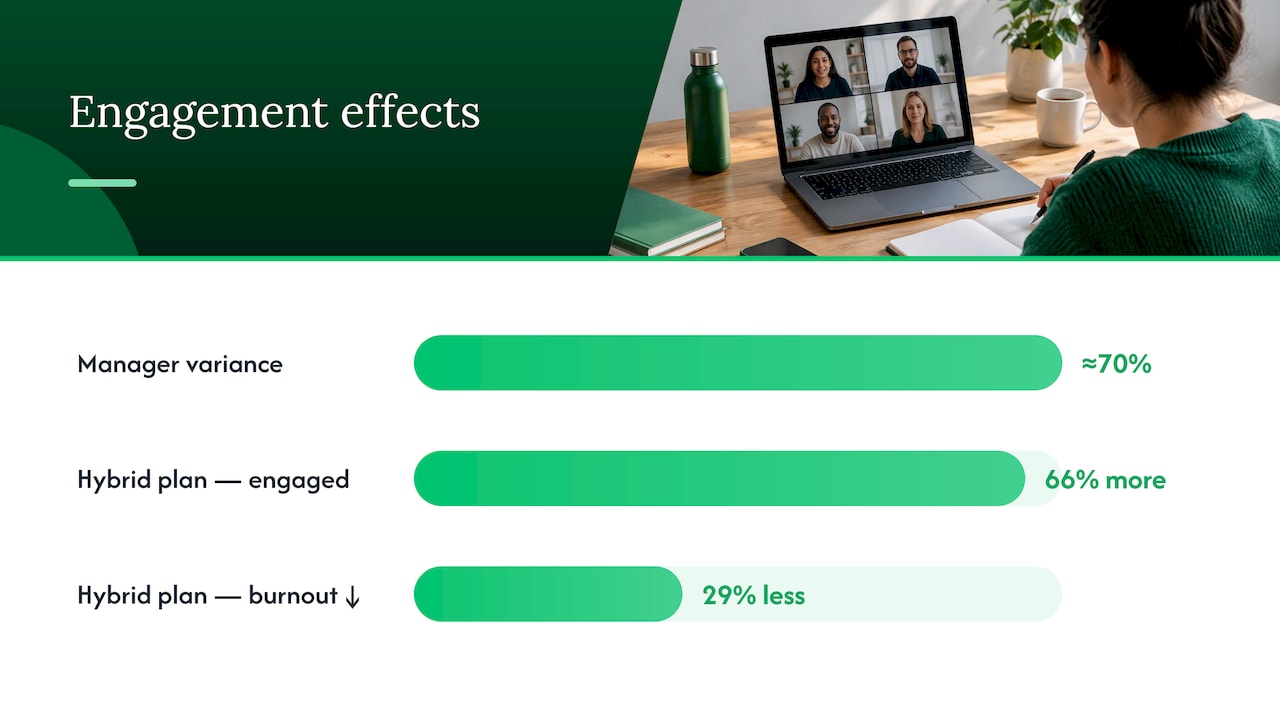
Managers carry most of the weight here. Gallup’s analysis of remote and hybrid teams finds that managers account for roughly 70% of the variance in team-level engagement, meaning the quality of a direct manager matters more than where someone sits. The same research shows that teams with a defined hybrid collaboration plan are 66% more likely to be engaged and 29% less likely to be burned out, which tells you structure, not location, drives the outcome.
A systematic review of telework leadership competencies points to the same conclusion from a different angle: supervisor support, clear digital communication, goal management, and participative leadership are the competencies that protect wellbeing and engagement when teams work apart. Four design principles follow from this evidence.
- Outcome-focus: judge activities by what changes in behavior or sentiment, not by attendance alone.
- Deliberate relationship-building: replace spontaneous office contact with scheduled, repeatable rituals.
- Psychological safety: build channels where people can speak up without fear, since remote settings do not generate this automatically.
- Inclusion: design for every time zone, role, and ability level, not just the loudest participants.
Before you adopt any activity, run it through a short manager checklist: does it build a real connection, can everyone participate regardless of schedule, does it produce a signal you can measure, and does it tie back to something the team already cares about. Activities that fail two or more of these tests rarely survive past the second quarter.
Remote engagement ideas organized by what they build
Once the principles are set, the question becomes which activities to run and how to run them without turning engagement into another task on an already full calendar. The ideas below are grouped by the outcome they target, so you can pick a mix rather than one-off novelty events.
Connection and social rituals
- Virtual coffee pairings: randomly pair two employees for a 15-minute unstructured call each week; track opt-in rate as your signal.
- Small cohort lunch groups: group six to eight people across departments for a recurring monthly video lunch, which works better than company-wide calls because everyone gets airtime.
- Home tours or “show and tell”: open meetings occasionally with a 60-second personal share, useful for new hires who have not met anyone in person.
- Buddy systems: pair every employee with a peer outside their immediate team for ongoing informal support.
Recognition and celebration
- Shout-out channels: a dedicated chat space where anyone can publicly thank a colleague, reviewed weekly by managers for patterns of overlooked contributors.
- Micro-bonuses: small, fast monetary or gift-card recognition tied to specific behaviors rather than only annual reviews.
- Public leader recognition: a short segment in all-hands meetings where leadership names specific wins, by name, with detail.
Development and career growth
Remote employees often worry they are invisible when promotion decisions happen. Counter that directly with virtual mentoring programs that pair junior staff with senior leaders across departments, short skills workshops run monthly on rotating topics, and a modest learning stipend employees can spend on courses or certifications of their choice. The combination signals that growth is not reserved for people who happen to be near the decision-makers.
Wellbeing and inclusive movement
Movement-based activities work especially well remotely because they do not require anyone to be online at the same time. A walking or step challenge gives people a shared, low-barrier goal; mindfulness breaks scheduled into the calendar protect against back-to-back video fatigue; and charitable movement challenges, modeled on the Charity Miles approach to inclusive virtual fitness challenges, turn ordinary activity like a lunchtime walk or a bike commute into a donation for a cause employees choose. Because any movement counts rather than only competitive running times, these challenges include people who would never sign up for a 5K leaderboard.
Purpose and CSR
Team volunteering days, whether virtual or local to each employee’s region, connect work to something larger than the quarterly roadmap. Company match days, where the organization matches employee charitable contributions for a set period, and visible impact milestones, such as announcing a collective total raised or hours volunteered, give CSR programs the same visibility that sales targets get. Charity Miles has published practical formats for team fitness and giving challenges that HR teams can adapt directly.
Onboarding and inclusion activities
New hires need structured intro sessions in their first week, a buddy schedule that extends past day one, and early visibility assignments, meaning a small project or presentation that gets a new employee seen by people outside their immediate team within the first month. Skipping this step is the most common reason remote new hires report feeling disconnected well into their second quarter.
Pro Tip: Pick one activity from each group rather than five from one group. A single category, however well executed, will not cover connection, recognition, growth, wellbeing, and purpose at once.
Manager practices that sustain engagement and safety
Activities create moments. Managers create the conditions that make those moments matter, week after week.
Weekly 1:1s are the single highest-leverage habit a remote manager has, but only when they go beyond status updates. A strengths-based coaching script works better than a task review: ask what went well, what felt hard, and what the employee wants more or less of next week. That last question alone surfaces disengagement before it shows up in exit interviews.
Vulnerability has to start with the manager. When a manager shares a mistake, a scheduling conflict, or an honest “I don’t know yet” in a team meeting, it gives everyone else permission to do the same. A qualitative study of supervisors leading psychological safety in remote settings found that remote psychological safety takes more deliberate time and more designated channels than in-person leadership, because the casual cues that build trust in an office simply do not exist online by default.
That means you need to manufacture the channels on purpose.
- Create a dedicated, low-stakes chat channel for non-work talk, with light norms so it does not turn into noise.
- Rotate who leads meeting openers so airtime and visibility are not concentrated in the same two or three people.
- Schedule feedback and development conversations on a fixed cadence for every employee, not just the ones who ask.
- Watch for silence in meetings or a drop in chat activity as early signals, since research on hybrid teams using Slack suggests psychological safety shows up differently in text channels than it does face to face.
Equal access matters as much as any single ritual. Remote staff in different time zones or with less synchronous overlap with leadership can quietly fall behind on feedback and promotion visibility. Rotate meeting times across zones, record key sessions, and track who gets stretch assignments to make sure access is not accidentally concentrated near headquarters.
A 30 to 90 day remote onboarding playbook
New remote hires form their first impression of the company inside the first month, and that impression is hard to undo later. A staged playbook keeps that impression intentional rather than accidental.
- Days 0 to 30: send a welcome kit before the start date, assign a paired buddy, set a recurring 1:1 schedule with the manager, and give the new hire one small, visible task that puts their work in front of people outside their immediate team.
- Days 31 to 60: hold a development check to confirm the role is matching expectations, arrange two or three cross-functional introductions, and deliver the first piece of specific recognition for a completed piece of work.
- Days 61 to 90: have a real career conversation about growth paths, close the loop on feedback the new hire has given about their onboarding experience, and run an inclusion check to confirm they feel part of team rituals, not just aware of them.
Time zones change the mechanics without changing the goals. Stagger 1:1s so the new hire is never meeting their manager at the edge of their workday, and for hybrid teams, make sure in-office rituals have a recorded or asynchronous equivalent so remote hires are not building a second-class version of the same relationships.
How to measure engagement without drowning in dashboards
Measurement only works when it is simple enough to repeat. A short pulse survey, run monthly rather than quarterly, catches problems while they are still fixable. Pair it with participation rates on the activities you run, manager conversation coverage, meaning the percentage of employees who had a real 1:1 in a given month, and the slower-moving indicators of voluntary attrition and internal mobility.
- Run a short pulse survey monthly, not just in an annual engagement cycle.
- Track participation rates separately from sentiment: a well-attended event with flat sentiment scores is a warning sign.
- Monitor manager conversation coverage so no employee goes quiet for more than two weeks.
- Watch voluntary attrition and internal mobility as the long-term scoreboard behind the short-term signals.
Companies with engaged employees tend to be more profitable than those without, according to Gallup research cited by Charity Miles, which is the business case HR teams can bring into a budget conversation, not just a culture one.
Gallup’s guidance on hybrid and remote teams recommends measuring both participation and sentiment together, because high turnout at an event can mask low psychological safety if people show up but never speak. Treat the first 30 days of any pilot as a short-term read on participation, and wait at least one full quarter before drawing conclusions about attrition or mobility, since those metrics move slowly even when the underlying culture is improving.
A simple pilot-versus-control structure works well here: run a new ritual with two or three teams, leave a few comparable teams unchanged, and compare pulse scores and participation after 60 days. That comparison tells you far more than a single team’s before-and-after numbers ever could.
A real-world template: the Charity Miles Employee Empowerment Program
Charity Miles built its Employee Empowerment Program around the principle that engagement sticks when it is tied to something employees care about. Companies can set up private teams inside the app, run friendly internal challenges, and choose their own sponsorship terms, including per-mile rates, spending caps, and donation allocations. Because various types of movement all count, the program includes employees who might skip a traditional fitness competition.
After launching a Charity Miles team, some companies have seen significant increases in employee participation and charitable donations, demonstrating the impact of a sustained, purpose-driven challenge.
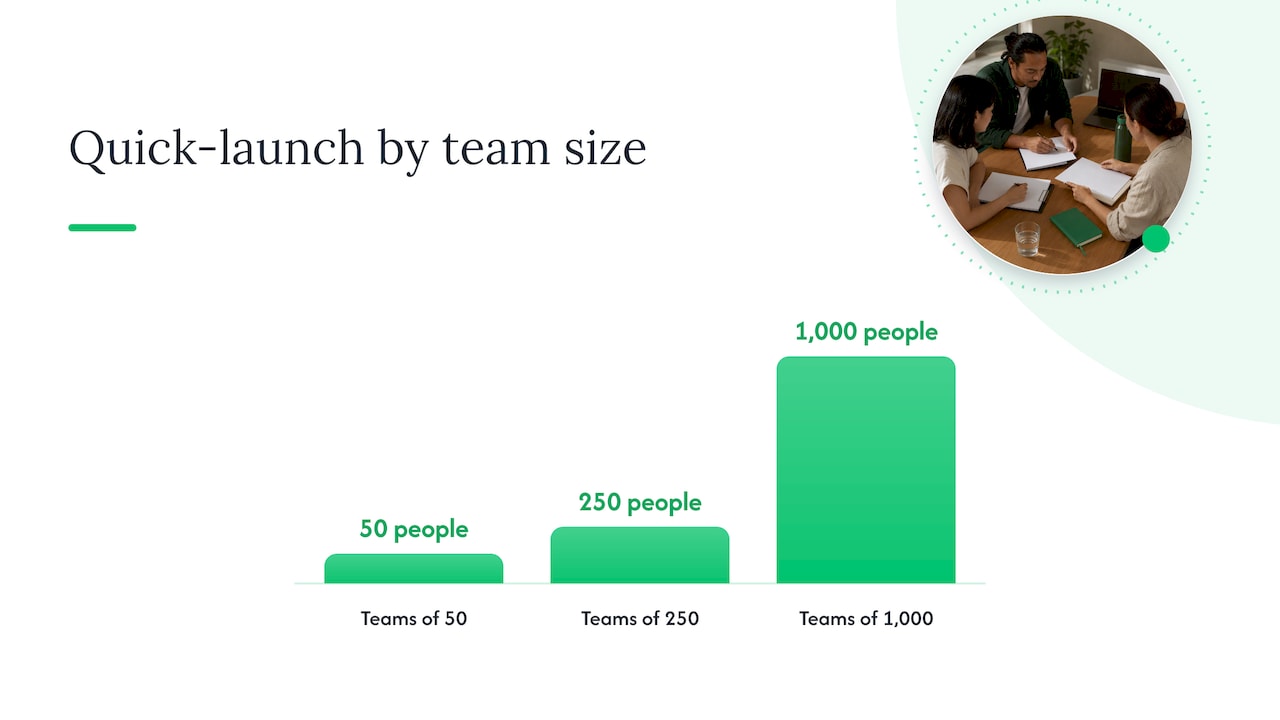
A quick-launch version scales with team size:
- Teams of 50: run a single 4-week challenge with one shared charity, light leaderboard visibility and a modest per-mile sponsorship cap.
- Teams of 250: split into department-level sub-teams, let each choose its own charity, and add monthly milestone recognition.
- Teams of 1,000: run rolling quarterly challenges with a mix of company-selected and employee-selected charities, paired with internal communications that highlight cumulative impact.
Pro Tip: Launch with a 4-week pilot before committing to a quarter-long program. A short window gives you a clean read on participation without asking employees for an open-ended commitment.
A six-step rollout plan you can run this quarter
Most engagement failures are not caused by bad ideas. They are caused by skipping the sequencing that makes an idea stick.
- Baseline assessment: run a short pulse survey and review existing attrition and participation data before changing anything.
- Pick one lever from each category: one manager habit, one social ritual, and one measurable program, rather than a long list of untested activities.
- Assign owners: name a program owner in HR and a champion on each participating team, since ownership without a name rarely survives past week two.
- Launch a 4-week pilot: keep the scope small enough to measure cleanly, and communicate it with a short manager script that explains the why, not just the what.
- Measure at 30 days: compare participation and sentiment against your baseline, and against any control teams you held back.
- Scale what worked: expand the pilot to more teams, retire what did not move the numbers, and fold the surviving rituals into your regular calendar.
A realistic resourcing estimate for a mid-size pilot includes a part-time program owner, a small discretionary budget for recognition or sponsorship, and a one-page communications plan covering the launch announcement, a mid-pilot reminder, and a results recap. Teams that treat remote coordination as an ongoing operating discipline, the kind of structured approach outlined by CentriOps on remote team operations, tend to keep momentum past the first pilot instead of letting it fade once the novelty wears off.
How Charity Miles fits into a remote engagement program
If your pilot includes a wellbeing or CSR lever, Charity Miles gives you a way to combine both without adding a second vendor relationship or a second line item for employees to track. The Charity Miles app is free for every employee who uses it, and it counts a lunchtime walk the same way it counts a long weekend ride, so participation is not limited to people who already consider themselves athletes.
For HR and CSR leaders running the kind of pilot described above, the Employee Empowerment program lets you set up a private team, choose your sponsorship structure, and decide whether donations flow to employees’ own charities or a cause the company selects. A good starting configuration mirrors the rollout plan: a 4-week pilot, a single shared or small set of charities, and a modest sponsorship cap you can measure against participation and pulse survey results. Companies that want to extend the program beyond their own employees can also look at Corporate Sponsorship Opportunities to involve broader communities in the same giving structure.
Check how the Employee Empowerment program works and set up a pilot team before your next engagement survey cycle.
Sources
The recommendations above draw on Gallup’s research on managing remote and hybrid teams, a systematic review of telework leadership competencies, and a qualitative study on remote psychological safety. HR teams building a longer reading list can also review research on psychological safety signals in hybrid chat tools and HBS Online’s practical engagement ideas for additional framing.
- A Strategic Guide for Managing Hybrid and Remote Teams – Gallup
- I Was Given Three Marks and Told to Buy a Porsche—Supervisors’ Experiences of Leading Psychosocial Safety Climate and Team Psychological Safety in a Remote Academic Setting
- Wellbeing in telework: a systematic review of leadership competencies
FAQ
How do you engage your team when working remotely?
Combine manager-led weekly check-ins with at least one structured social ritual and one measurable program, such as a short wellbeing or CSR challenge. Gallup’s research shows manager quality drives most of the variance in team engagement, so start there before adding activities.
How does remote work affect employee engagement?
Remote work itself does not lower engagement, but it removes the informal contact that used to build connection automatically. Teams with a defined hybrid collaboration plan are 66% more likely to be engaged and 29% less likely to be burned out, according to Gallup, which points to structure as the deciding factor rather than location.
How do you bring a team together when working remotely?
Pair a recurring social ritual, like small cohort lunches or virtual coffee pairings, with a shared goal everyone can take part in regardless of time zone or fitness level. A charitable movement challenge works well for this because any walk, run, or bike ride counts toward the shared result.
What does Charity Miles offer for corporate engagement programs?
Charity Miles’ Employee Empowerment program lets companies set up private team challenges where employees’ everyday movement generates charitable donations, with the company choosing the sponsorship rate and spending cap. Pricing details are available directly from Charity Miles on request through the Employee Empowerment program page.
— Gene