
For HR and CSR leaders evaluating Limeade alternatives, Charitymiles is our top recommendation for teams that need measurable social impact woven into daily physical wellbeing. HARMAN’s results tell the story clearly: an 11x increase in employee participation with 1,200+ employees raising over $120,000 for charity after launching their Charitymiles program in 2021.
The strongest shortlist of Limeade alternatives, depending on your primary need:
- Charitymiles — activity-to-charity model combining physical wellbeing, CSR, and team challenges
- Virgin Pulse — population-health and clinical wellbeing at enterprise scale
- LifeWorks — EAP, mental health, and benefits navigation
- Wellable — flexible challenge builder for HR teams that want quick program launches
- Achievers — recognition-first engagement with strong rewards workflows
Table of Contents
- How do the top Limeade alternatives compare?
- What is Limeade, and where does it fit?
- Why Charitymiles is the recommended Limeade alternative
- Virgin Pulse — population-health and broad wellbeing platform
- LifeWorks — EAP, wellbeing content, and benefits integration
- Wellable — flexible wellness challenges for engagement-focused HR teams
- Achievers — recognition-first engagement platform
- How do you choose the right Limeade alternative for your company?
- What does implementation cost and how long does it take?
- HARMAN’s Charitymiles results: what enterprise proof looks like
- Key Takeaways
- Why we position Charitymiles this way
- Charitymiles: the employee engagement program built around purpose
- Useful sources and next steps for your vendor research
How do the top Limeade alternatives compare?
The table below maps each platform across the axes that matter most for HR and CSR procurement. Use it alongside the employee engagement platform buyer’s guide to match platform depth to your workforce type.
| Platform | Best for | Core features | CSR / giving | Mobile app | Integrations | Analytics | Pricing model | Implementation |
|---|---|---|---|---|---|---|---|---|
| Charitymiles | CSR + daily activity | Team challenges, sponsorships, reporting | Native: activity-to-charity, configurable sponsorships | iOS & Android, GPS + pedometer | HRIS, SSO | Participation, funds raised, CSR impact | Per-program / sponsorship | Weeks |
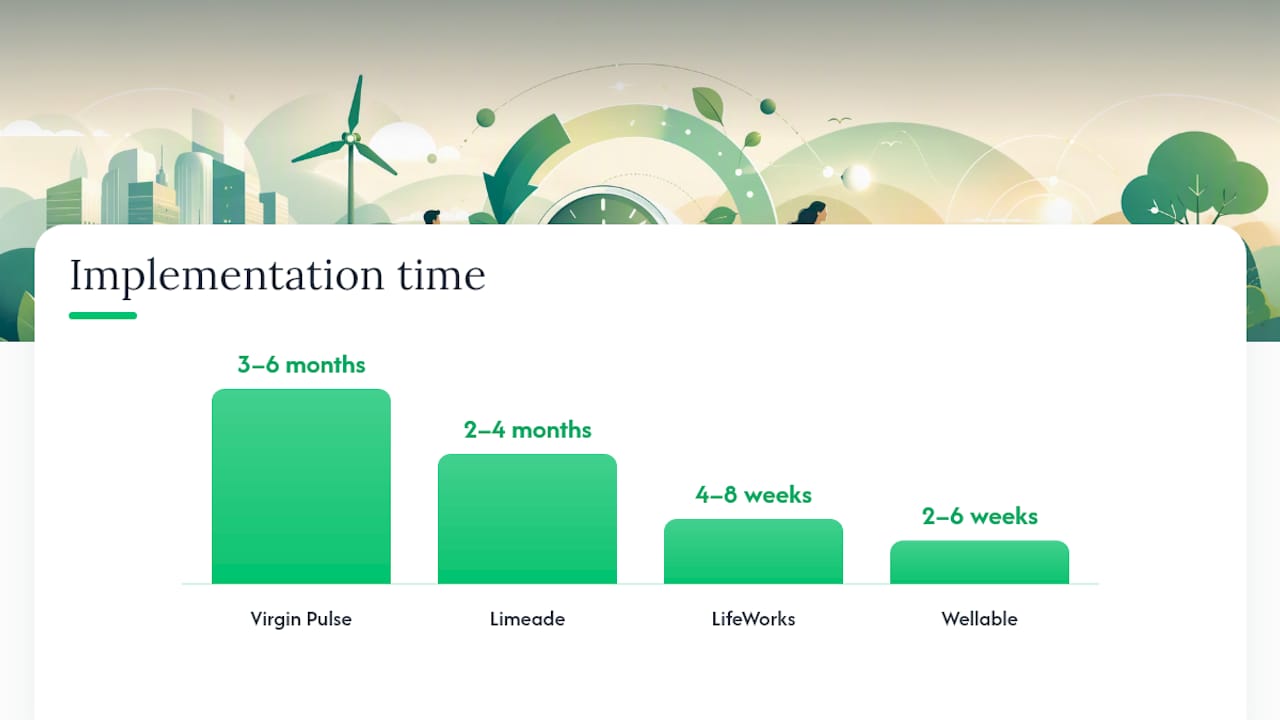
| Limeade | Broad wellbeing suite | Wellbeing modules, surveys, coaching | Limited; no native giving model | Yes | Deep HRIS/SSO | Population health, eNPS | Enterprise subscription | 2–4 months |
| Virgin Pulse | Clinical wellbeing at scale | Health programs, chronic-condition support | Minimal native CSR | Yes | Deep clinical + HRIS | Population health dashboards | Enterprise subscription | 3–6 months |
| LifeWorks | Mental health + EAP | EAP, wellbeing content, benefits nav | Minimal | Yes | Benefits/HRIS | Manager-facing reports | Per-user/month | 4–8 weeks |
| Wellable | Flexible challenge design | Challenges, rewards, content library | Via integrations | Yes | Wearables, HRIS | Program analytics | Per-user/month | 2–6 weeks |
| Achievers | Recognition + culture | Points, rewards, manager tools | Minimal native CSR | Yes | HRIS, SSO | Recognition analytics | Enterprise subscription | 4–8 weeks |
Pro Tip: In vendor demos, ask each platform to show you a live data export and a real SSO handoff. Platforms that cannot demo both in under 10 minutes often have integration gaps that surface only after contract signing.
Pro Tip: If a vendor cannot show you participation rates from a comparable pilot within 60 days of launch, treat that as an adoption red flag — not a negotiation point.
What is Limeade, and where does it fit?
Limeade is an enterprise wellbeing platform focused on the full employee experience: wellbeing surveys, coaching, activity challenges, and population-health reporting. Its typical buyer is a large employer that wants a single suite covering physical, mental, financial, and social wellbeing with deep HRIS and SSO integration. The platform is well-regarded for its breadth of wellbeing modules and its ability to surface population-level health trends.
Strengths:
- Broad wellbeing module library covering multiple dimensions of health
- Population-health analytics and eNPS-style reporting
- Deep enterprise integrations (HRIS, SSO, wearables)
Limitations for CSR-first buyers:
- No native charitable-giving or activity-to-donation model
- CSR activation requires custom configuration or third-party tools
- Enterprise pricing and longer implementation timelines can strain a mid-market CSR budget allocation
Limeade’s pricing is not publicly listed and typically involves an enterprise subscription negotiated per headcount. Implementation commonly runs 2–4 months for full rollout.
Why Charitymiles is the recommended Limeade alternative
Charitymiles runs on a simple, powerful premise: every mile an employee walks, runs, or bikes generates a charitable donation. The Employee Empowerment Program gives companies a private team environment where employees log activity via GPS on iOS or Android, compete in friendly challenges, and watch their collective movement translate into real dollars for causes they care about.
Core capabilities:
- Private team challenges with configurable sponsorship rates and donation caps
- Company choice: direct funds to a strategic charity partner or let employees pick their own cause
- Enterprise reporting on participation, miles logged, and funds raised
- SSO and HRIS integration options for enterprise clients
- Free for individual employees — no app cost passed to your workforce
Pro Tip: When pricing your Charitymiles program, model two scenarios: a per-user license versus a sponsorship-per-mile structure. For companies with high-activity employees, the sponsorship model often delivers better ROI because participation drives the donation total rather than headcount alone.
The program has been used by hundreds of companies since Charitymiles launched in 2012, with tens of millions of dollars generated for charity across the platform’s lifetime.
Virgin Pulse — population-health and broad wellbeing platform
Virgin Pulse is built for large employers that need clinical-grade wellbeing programs: chronic-condition management, biometric screening integrations, and health coaching at scale. Its population-health dashboards give benefits teams visibility into workforce health trends across thousands of employees, and its clinical partnerships extend the platform beyond engagement into genuine health outcomes.
Strengths:
- Clinical wellbeing programs and chronic-condition support
- Deep population-health analytics for benefits and HR teams
- Enterprise-grade integrations with health plan data
Limitations for CSR-focused buyers:
- Minimal native CSR or charitable-giving functionality
- Implementation timelines of 3–6 months and enterprise pricing make it a heavy lift for teams with a tight CSR program cost target
- Complexity can reduce frontline adoption without a dedicated change-management effort
LifeWorks — EAP, wellbeing content, and benefits integration
LifeWorks positions itself at the intersection of employee assistance, mental health support, and benefits navigation. Its EAP coverage is a primary draw for HR teams that need confidential counseling access, crisis support, and financial wellness content alongside a broader wellbeing platform. Manager-facing dashboards give people leaders aggregate data on team wellbeing without exposing individual responses.
Strengths:
- Comprehensive EAP and mental-health program coverage
- Benefits navigation and financial wellbeing content
- Manager-facing analytics for team health trends
Limitations:
- Limited CSR or charitable-giving activation
- Analytics can feel more descriptive than prescriptive for HR teams that want clear action loops from data to manager behavior
Wellable — flexible wellness challenges for engagement-focused HR teams
Wellable gives HR teams a configurable challenge platform with a strong content library and flexible reward structures. Programs launch quickly, and the admin controls let you customize challenge types, point systems, and reward redemption without heavy IT involvement. For teams that want to run a step challenge or a themed wellness campaign in weeks rather than months, Wellable is a practical option.
Strengths:
- Fast program launch with minimal IT dependency
- Flexible challenge and reward configuration
- Wearable and HRIS integrations
Limitations:
- CSR and charitable-giving capabilities typically require third-party integrations or custom campaign setup
- Less suited to organizations where measurable social impact is a primary program goal
Achievers — recognition-first engagement platform
Achievers centers its platform on employee recognition: points-based rewards, manager-to-employee appreciation workflows, and cultural moment tools. Its strength is making recognition frequent, visible, and tied to company values. For organizations where low recognition scores are driving disengagement, Achievers addresses that directly.
Strengths:
- Strong points and rewards engine with manager-centric workflows
- Cultural recognition tied to company values
- HRIS and SSO integrations
Limitations:
- Minimal native CSR or wellbeing programming
- Recognition platforms often work best alongside a wellbeing or CSR tool rather than replacing one; combining Achievers with a platform like Charitymiles covers both recognition and social impact without overlap
How do you choose the right Limeade alternative for your company?
A strong evaluation framework prioritizes outcomes over feature checklists. Before you shortlist vendors, align on these criteria:
Evaluation criteria:
- Trust and data privacy: SOC 2 certification, named data ownership, and clear data-export rights
- Action loops: can insights drive manager behavior, not just HR dashboards?
- Integration reality: live SSO and HRIS demo, not a slide deck
- CSR mechanics: is charitable giving native or bolted on via a third-party?
- Measurability: participation rates, funds raised, and eNPS improvement within a defined pilot window
Questions to ask in vendor demos:
- Show us a live SSO handoff and a real HRIS data sync.
- What does a 60-day pilot participation report look like for a comparable client?
- How is data ownership defined in the contract, and what are our export rights?
- What security certifications does the platform hold (SOC 2, ISO 27001)?
- How does your platform connect employee activity data to manager coaching actions?
Red flags to watch for:
- No SSO or HRIS integration in the demo environment
- Opaque pricing with no pilot or proof-of-concept option
- No named owner for insights-to-action workflows (what one buying framework calls a “digital junk drawer” risk)
- Participation benchmarks unavailable or unverifiable
Run a 6–8 week pilot before full contract commitment. Measure participation rate, activity volume, and, for CSR-enabled platforms, funds generated. Those three numbers tell you more than any demo.
What does implementation cost and how long does it take?
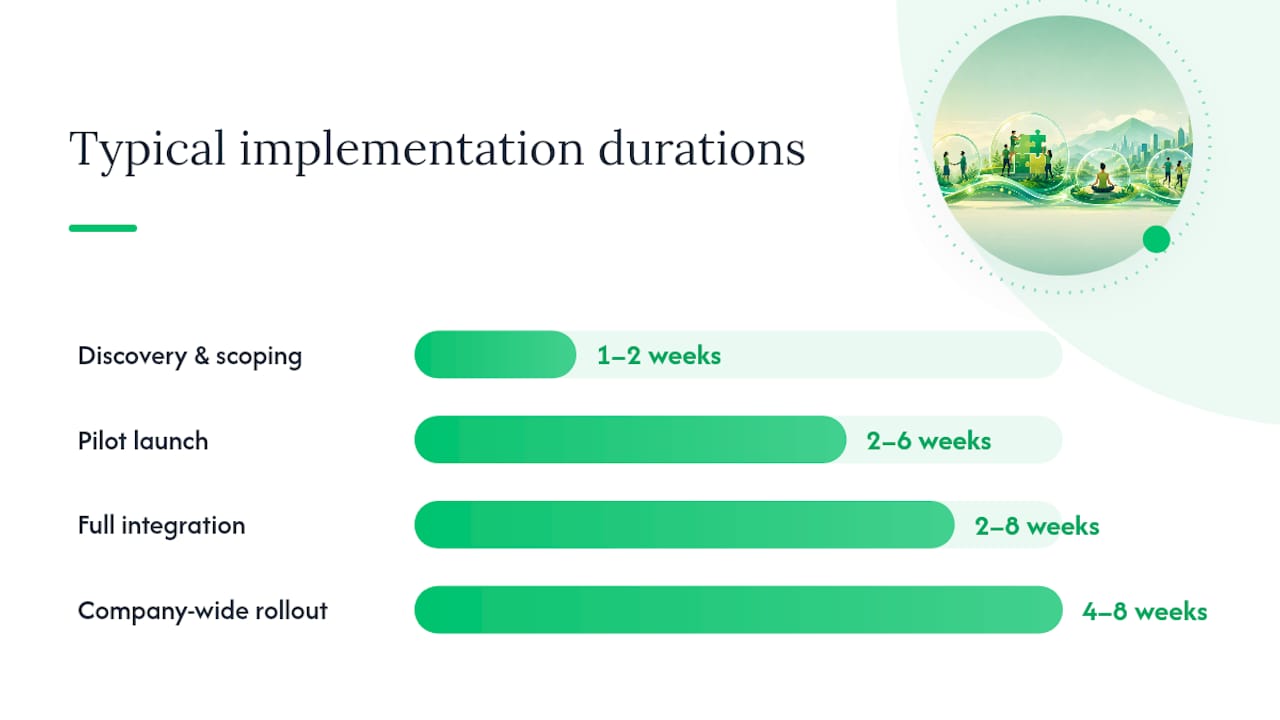
| Phase | Typical duration | Key activities |
|---|---|---|
| Discovery & scoping | 1–2 weeks | Stakeholder alignment, integration audit, pilot design |
| Pilot launch | 2–6 weeks | SSO/HRIS setup, team onboarding, first challenge |
| Full integration | 2–8 weeks | HRIS sync, reporting configuration, manager training |
| Company-wide rollout | 4–8 weeks | Communications plan, challenge calendar, adoption tracking |
| Measurement & optimization | Ongoing | Participation reports, CSR impact data, program iteration |
Pricing models across the shortlist:
- Per-user per-month subscription (most platforms)
- Sponsorship or campaign fee model (Charitymiles: company sets rate per mile and total cap)
- Implementation professional services fees (common for enterprise HRIS integrations)
- Multi-year contract discounts (typically 10–20% off annual rate; negotiate before signing)
Pro Tip: When building your CSR budget allocation, model the sponsorship cost separately from the platform license. A Charitymiles sponsorship is a direct charitable contribution, which may qualify for different budget treatment than a SaaS subscription — confirm with your finance team.
HARMAN’s Charitymiles results: what enterprise proof looks like
HARMAN launched its Charitymiles Employee Empowerment Program in 2021. The results are specific and verifiable:
Implementation engaged HR, internal communications, and CSR stakeholders from day one. The program used private team challenges to create friendly competition across business units, with the company sponsoring miles at a configurable rate. Employees chose their own charities, which drove personal investment in the program.
What to replicate in your pilot:
- Assign a named internal owner for the program (HR or CSR lead)
- Set a sponsorship rate and cap before launch so employees see the impact math clearly
- Run a 6–8 week challenge with a visible leaderboard and a mid-point communications push
- Report participation and funds raised to leadership at the 30-day mark
Key Takeaways
Charitymiles is the strongest Limeade alternative for HR and CSR leaders who need measurable social impact and physical wellbeing engagement in a single, employee-friendly program.
| Point | Details |
|---|---|
| Recommended pick | Charitymiles combines CSR, physical wellbeing, and team challenges with a native activity-to-charity model. |
| Enterprise proof | HARMAN achieved an 11x participation increase and raised over $120,000 for charity through Charitymiles. |
| Evaluation priority | Ask every vendor for a live SSO demo and 60-day pilot participation data before signing. |
| Red flag to avoid | No named data owner and no pilot metrics are the two clearest signs a platform will underdeliver. |
| Charitymiles next step | Run a 6–8 week pilot measuring participation rate and funds raised to validate ROI before full rollout. |
Why we position Charitymiles this way
This article is published by Charitymiles. We are not a neutral third party — we are the platform we recommend. We believe that transparency about that relationship makes this comparison more useful, not less.
The recommendation is grounded in a specific gap we see consistently: most wellbeing platforms treat CSR as an add-on, not a core mechanic. Limeade and its closest competitors are built around health behavior change and population analytics. Those are real needs. But for HR and CSR leaders who want employees to feel personally connected to their company’s social impact every day, a platform where activity directly generates charitable donations is a structurally different proposition.
The HARMAN results are real and verifiable. We encourage you to ask us for comparable client data during a pilot conversation, and to hold us to the same evaluation criteria we outlined above: participation rates, funds raised, and integration performance within a defined timeframe. If those numbers do not hold up in your pilot, you will know before you commit to a full contract.
Charitymiles: the employee engagement program built around purpose
Charitymiles offers something the other platforms on this list do not: a program where every employee’s daily movement generates a real charitable donation, at no cost to the employee. The Employee Empowerment Program gives your company private team challenges, configurable sponsorships, enterprise reporting, and SSO/HRIS integration — all wrapped in a free mobile app your employees will actually use.
For HR and CSR leaders who want to move beyond a checkbox wellbeing program, Charitymiles connects physical activity to social impact in a way that employees feel every time they lace up their shoes. Hundreds of companies have used it to improve participation, strengthen culture, and make their CSR budget work harder. See the full program details and request a demo to get started.
Useful sources and next steps for your vendor research
- Employee Engagement Platform Buyer’s Guide for 2026
- Employee Engagement Platform Evaluation: A Buying Framework
- How to Evaluate Employee Engagement Software (2026)
- Employee Engagement Software Options 2026
- Charity Miles