
The fastest way to integrate charities into wellness is to launch a team-based movement challenge that turns everyday steps, miles, or rides into charitable donations, with your company sponsoring or matching the total. It works because participation is easy for every fitness level, teammates build social connection through shared goals, and the donation total gives leadership a number to point to. An Employee Empowerment program is available to run this model without months of setup.
TL;DR:
- Most programs benefit from small teams and inclusive activities that consider employees with disabilities, shifts, or remote work to maximize participation.
- Tracking both participation metrics and charitable outputs helps demonstrate the program’s impact on wellness and CSR goals from the start.
- Running a short pilot with clear KPIs and leadership involvement builds the case for broader adoption and sustained funding.
- Using a platform like Charity Miles’ Employee Empowerment simplifies setup, management, and reporting, enabling quick launch and scalability.
Table of Contents
- Quick Checklist: Decisions To Make Before Launch
- Program Models That Blend Charity And Wellness
- How Do You Keep Charitable Wellness Programs Inclusive?
- What Metrics Prove A Charitable Wellness Program Works?
- A 6-Step Playbook To Pilot And Scale Your Program
- What Does The Research Say About Charity-Linked Wellness?
- Why This Approach Pays Off Beyond The Pilot
- Run Your Program On Charity Miles’ Employee Empowerment Platform
- Sources
- FAQ
Quick Checklist: Decisions To Make Before Launch
Before you announce anything, nail down five decisions. Skipping any of them is how pilots stall in week two.
- KPIs and cohort size: Pick one or two metrics (participation rate, donation total) and decide if you’re piloting with one department or the whole company.
- Program model: Choose between a movement challenge, a volunteer day, a donation match, or a hybrid of the two.
- Sponsorship rules: Decide the rate per mile or step, a spending cap, and whether donations go to employee-chosen charities or a company cause.
- Inclusion and privacy guardrails: Confirm the program counts walking, wheelchair movement, and adaptive exercise, and clarify what activity data you collect.
- Timeline and communication cadence: Set a launch date, a midpoint check-in, and a closing announcement.
Pro Tip: Lock your sponsorship cap before you announce the challenge, not after. Nothing kills momentum faster than telling employees their miles counted for less than they thought.
Program Models That Blend Charity And Wellness
You don’t need to invent a format. Four models already work, and most companies land on a hybrid within the first year.
- Fitness-for-charity team challenges. Employees log walks, runs, or bike rides, and the company sponsors a set amount per mile. Every activity level counts, so the person taking a daily lunchtime walk contributes as much as the office runner.
- Volunteer events tied to wellbeing. A one-off community service day, or a recurring monthly shift, gives employees a physical and social outlet that doubles as CSR output.
- Donation matches tied to milestones. Instead of paying per mile, the company matches funds once a team hits a step or activity goal, which rewards collective effort rather than individual output.
- Hybrid, ongoing models. The strongest programs combine a challenge with a standing match, so giving doesn’t stop when the campaign banner comes down. Some wellness challenges that give back run this way year-round instead of as a quarterly event.
Charitable fitness formats tend to work best when they’re framed around community engagement and inclusivity rather than pure athletic performance.
How Do You Keep Charitable Wellness Programs Inclusive?
Reach matters more than intensity. A program that only rewards fast runners will lose half your workforce before it starts.
- Build small teams of eight to twelve people rather than one giant company-wide leaderboard. Smaller cohorts increase accountability and a sense of belonging.
- Count every form of movement: walking, wheelchair activity, yoga, and volunteering, not just running and cycling.
- Use gamification sparingly, recognition regularly, and get a leader to visibly participate in week one.
- Plan communication in three waves: a kickoff message, a midpoint nudge with a quick story or stat, and a closing recap.
- Account for shift workers, remote staff, and employees with disabilities when you set challenge hours and activity types.
Structured, cohort-based programs support accountability better than open-ended, individual efforts. Pro Tip: Assign a named point person, not just a department, to check in with each team weekly. A face attached to the program drives far more consistent participation than a company-wide email blast.
What Metrics Prove A Charitable Wellness Program Works?
You need numbers that speak two languages: wellness and CSR. Track both from day one, or you’ll be reconstructing data at reporting time.
- Participation and retention: active users, completion rate, and how many people return for a second challenge.
- Wellbeing indicators: pulse survey shifts, self-reported energy levels, and any change in reported burnout.
- CSR outputs: total dollars donated, volunteer hours logged, and the number of charity partners reached.
- Business outcomes: tie engagement lift to retention and productivity, since engaged employees are measurably more profitable according to federal workplace well-being guidance.
For reporting cadence, a monthly dashboard covering participation rate, donation total, and one wellbeing metric gives leadership enough to track trend lines without drowning them in data. Federal guidance on workplace well-being points toward organizational-level strategies, not just individual interventions, as the more durable lever for improving employee health.
A 6-Step Playbook To Pilot And Scale Your Program
Run this as an eight to twelve week pilot before you commit to a company-wide rollout.
- Secure objectives, budget, and a sponsor. Get one executive to back the pilot publicly, and set a dollar cap for sponsorship.
- Select the model and charity partners. Decide whether employees pick their own charity or the company names one, and finalize participation rules.
- Handle technical setup and approvals. Confirm data privacy terms, get legal sign-off on any fundraising language, and set up private teams in your chosen app.
- Launch with visible leadership. Have a senior leader join the first challenge and announce it themselves rather than routing it through a memo.
- Monitor and nudge mid-campaign. Run a quick leaderboard update or mini-competition around the halfway mark to re-engage stragglers.
- Evaluate, share stories, and iterate. Pull your metrics, collect two or three participant stories, and present both numbers and narrative to leadership before deciding on scale-up.
Pro Tip: Treat the pilot’s final week as a storytelling opportunity, not just a data pull. A short video of your volunteer day or a screenshot of the donation total does more for next year’s budget request than a spreadsheet ever will. Longer behavior-change programs, similar to structured group health curricula, often build in maintenance phases after the initial push to keep habits from fading.
What Does The Research Say About Charity-Linked Wellness?
The evidence lines up cleanly with the team-based model. Individual wellness challenges tend to plateau because there’s no shared accountability holding people in.
Collective approaches to wellbeing build stronger social cohesion and better program performance than individual-only interventions, because shared goals create the kind of accountability that solo habit tracking rarely does.
That finding from George Mason University’s Well-Being program matches what Northwestern’s community health researchers have found: framing wellness around charitable, community-oriented goals reduces stigma and reframes participation as resilience-building rather than crisis management. The YMCA’s Community as Medicine program applies the same logic in a 12-week cohort format, pairing guided movement with facilitated conversation to sustain habit change.
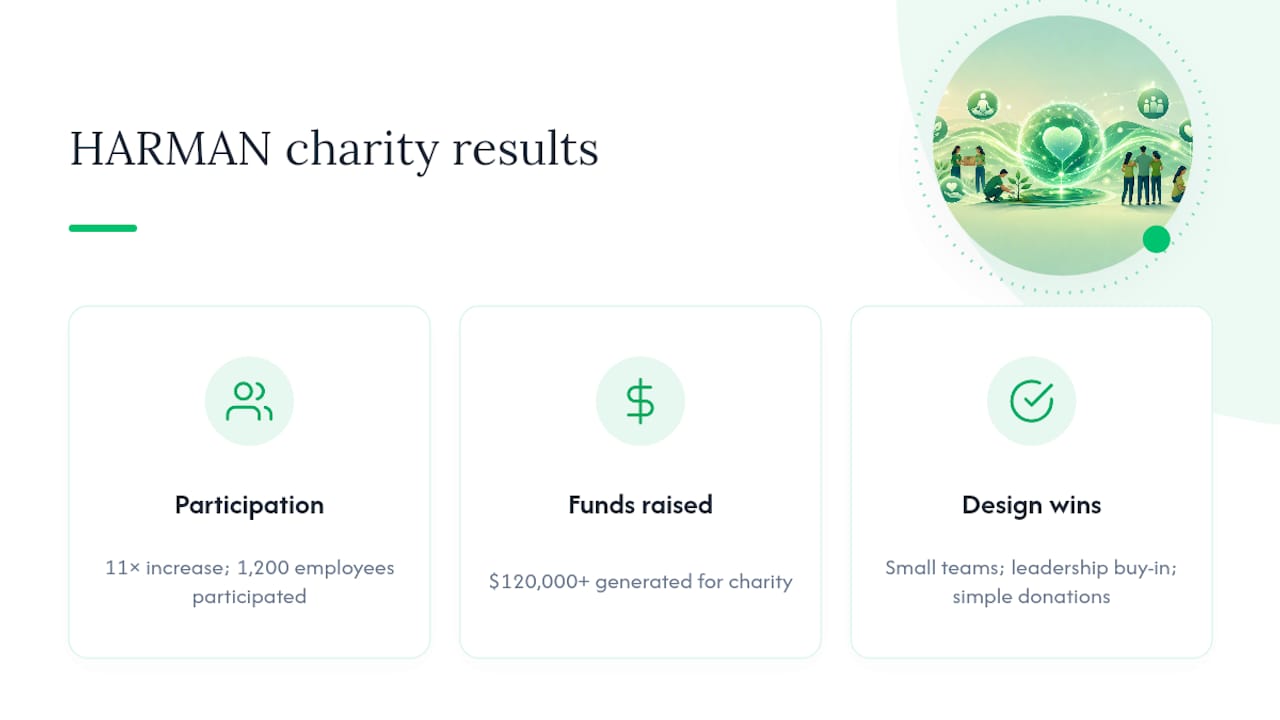
The clearest corporate proof point comes from HARMAN, which saw an 11x increase in employee participation and generated over $120,000 for charity after launching a Charity Miles team in 2021, with more than 1,200 employees taking part. The design choices worth copying: small teams, visible leadership buy-in, and a donation mechanism simple enough that nobody needs a manual to understand it.
Why This Approach Pays Off Beyond The Pilot
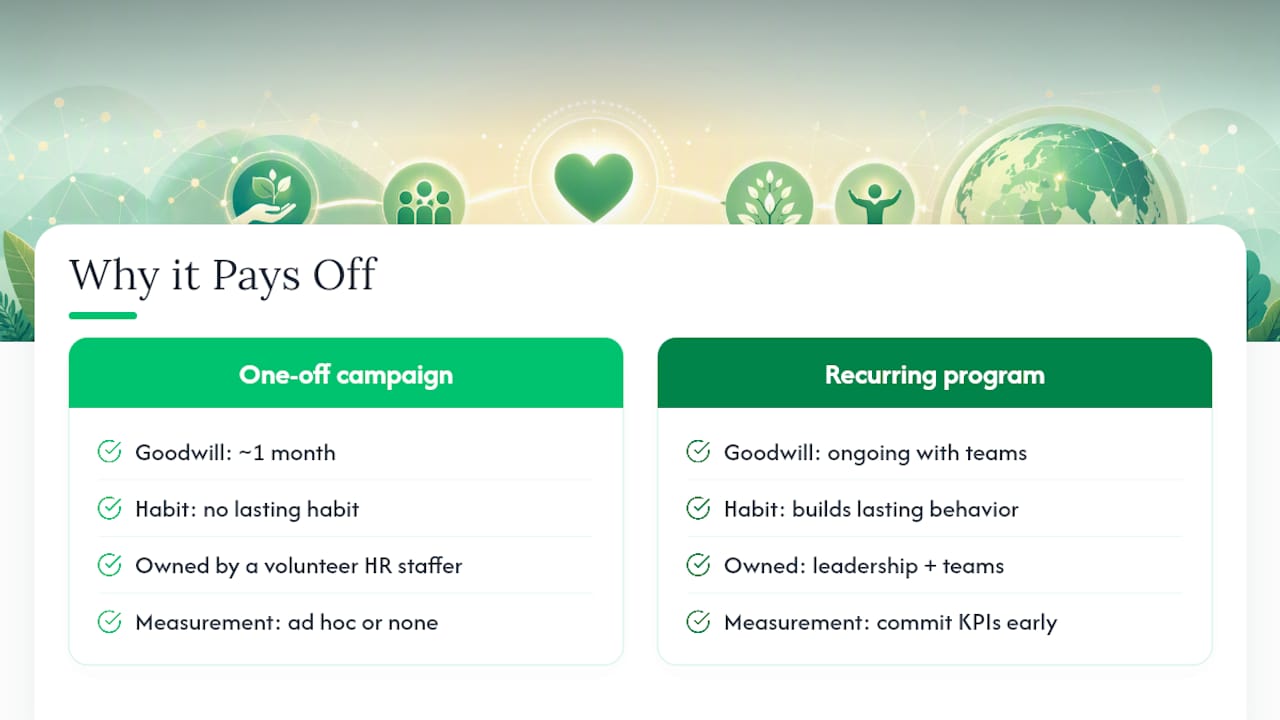
The programs that stick are the ones that stop feeling like a campaign and start feeling like how the company operates. A single charity walk generates goodwill for a month; a recurring, team-based structure builds a habit that outlasts the calendar reminder. That shift only happens when leadership treats it as a real budget line and a shared metric, not a side project owned by whichever HR staffer volunteered first.
The trade-off worth making is committing to measurement early, even when the first cohort is small, because the data from a modest pilot is what earns you the budget for a company-wide rollout. Start with clear KPIs, not just good intentions, and you’ll have an easier case to make in six months.
— Gene
Run Your Program On Charity Miles’ Employee Empowerment Platform
Everything in this playbook, from private team challenges to sponsorship math to donation tracking, is what Charity Miles’ Employee Empowerment program already runs for companies today. Instead of building a challenge structure and a donation-tracking system from scratch, you set your sponsorship terms once, and the platform handles the rest.
Companies create private teams, let every employee’s walk, run, or bike ride convert into miles, and decide whether donations flow to each person’s chosen charity or a single company cause. Coverage for HR and CSR reporting comes built in, so you’re not stitching together spreadsheets to show leadership the participation lift. The Charity Miles app is free for individual employees and free for the charities they support, and companies control the entire sponsorship structure, from rate per mile to total spending cap. If you’re ready to move past the planning stage, visit the Employee Empowerment program page to see how quickly a private team can go live.
Sources
- Collective well‑being: Looking beyond yourself — George Mason University Well‑Being
- Community-driven health initiatives reduce stigma — Northwestern NNSI
- Surgeon General: workplace well-being priorities — HHS
- Community as Medicine — YMCA of Greater San Francisco
FAQ
What Is The 5-3-1 Rule For Wellness?
The 5-3-1 rule is a simple activity guideline suggesting five servings of fruits and vegetables, three sessions of exercise, and one hour of screen-free time daily. It’s often used as a shorthand goal inside broader wellness programs rather than a formal clinical standard.
What Are Some Examples Of Charitable Wellness Initiatives?
Common examples include team walking or running challenges with per-mile sponsorship, company-sponsored volunteer days, and donation matches tied to activity milestones. Some programs support several of these formats through configurable, company-sponsored team challenges.
Can A Wellness Center Operate As A Nonprofit?
Yes, wellness centers can register and operate as nonprofit organizations, particularly when their mission centers on community health access rather than commercial fitness services. The YMCA is a well-known example, running programs like Community as Medicine as a nonprofit health initiative.
What Are The Core Principles Of Workplace Wellness?
Definitions vary, but most workplace wellness frameworks emphasize physical activity, mental health support, social connection, nutrition, and preventive care. Federal guidance on workplace well-being stresses organizational-level strategies and social supports over individual-only programs.
How Much Does Charity Miles Cost For Companies?
Pricing for the Employee Empowerment program isn’t published. Current details are available directly through the Employee Empowerment program page.