
This article gives you a working menu of fitness fundraising ideas, from jog-a-thons to corporate step challenges, plus the planning checklist that decides whether an event actually converts sweat into dollars. Inclusive, low-barrier formats reliably attract more participants and raise more money, and platforms like Charity Miles show what happens when pledges get organized instead of chased down after the fact.
TL;DR:
- The most effective fundraising formats depend on audience size, volunteer capacity, and venue constraints, not on novelty or excitement.
- Virtual challenges and low-cost add-ons like shoe drives or merchandise sales can significantly increase net revenue with minimal upfront investment.
- Proper planning, clear communication, and timely follow-up are crucial to maximize participation, pledges, and post-event impact measurement.
- Using structured platforms like Charity Miles can boost employee engagement, track contributions accurately, and streamline sponsor involvement.
- Ensuring legal, tax, and safety compliance—such as proper permits, waivers, and insurance—is essential to avoid liabilities and secure donation deductibility.
Table of Contents
- Fitness Fundraiser Ideas Worth Copying This Year
- How to Pick the Right Format for Your Group
- Building Your Promotion and Event-Day Timeline
- What a Structured Platform Can Do for Participation
- Legal and Tax Considerations Before You Launch
- Measuring Whether Your Fundraiser Actually Worked
- Keeping Costs Under Control Without Cutting Corners
- Keeping Participants Motivated From Sign-Up to Finish Line
- Themes and Add-Ons That Push Donations Higher
- Turning One Good Event Into a Recurring Program
- Run Your Next Fitness Fundraiser on Charity Miles
- Sources
Fitness Fundraiser Ideas Worth Copying This Year
Every format below solves a different problem: some are built for mass participation, others for high per-person yield, and a few work best bolted onto something you’re already running. Pick based on your audience size and volunteer bandwidth, not on which idea sounds the most exciting.
- 5K or fun run. The default choice for a reason. Best for community-wide audiences with a few months of lead time. Runners register for a flat fee, then collect pledges on top; a route with a scenic finish line boosts same-day sign-ups.
- Jog-a-thon or walk-a-thon. Ideal for schools and youth groups. Kids collect per-lap pledges, and running it online can let organizers keep 95 to 97 percent of funds raised, since there’s no product to buy or ship.
- Pledge-per-rep challenge. Push-ups, burpees, or squats counted against a sponsor pledge. Works well for small teams or classroom fundraisers; typical pledges run for a range of small amounts per rep, so cap the total per sponsor to avoid sticker shock.
- Obstacle or Ninja-style course. Great for teens and thrill-seeking adults. Track completion per station rather than counting reps, since binary station tracking cuts volunteer scoring errors and simplifies sponsor math.
- Dance-a-thon or Zumbathon. A high-energy pick for community centers and gyms. Charge a door fee, then layer in a per-hour pledge for anyone who dances the full session.
- Charity bike ride. Fits cycling clubs and longer-distance fundraising goals. Offer mileage tiers so casual riders and serious cyclists both have a reason to register.
- Swim-a-thon. A natural fit for aquatic centers and swim teams. Pledge per lap works cleanly here since laps are easy to count and verify.
- Virtual step or mileage challenge. No venue needed, which makes it the lowest-cost format on this list. Participants log steps or miles from anywhere, and a shared leaderboard helps maintain momentum over time.
- Corporate step challenge. Built for workplace teams competing department against department. Employers often add a per-mile match, which is where a structured step challenge framework earns its keep.
- Themed fun run (color, superhero, mud). Costumes and color stations drive social sharing, which matters more than most organizers assume for late registrations. Photo-worthy moments are what participants actually post.
- Group fitness class fundraiser. Partner with a local yoga or spin studio for a one-time donation class. Low setup cost, and it introduces your cause to a fitness studio’s existing audience.
- Shoe drive add-on. Collect used athletic shoes alongside any run or walk. It requires almost no upfront cost and can run in parallel with registration without competing for volunteer time.
- Raffle or vendor booth add-on. Pair a finish-line festival with raffle tickets and local vendor tables. This is where net revenue jumps without raising the entry fee.
- Hybrid festival format. Combine a timed run, a kids’ fun run, and a post-race expo into one event day. It takes more coordination but multiplies the reasons for someone to show up and give.
- Corporate matching mile challenge. Employees log miles individually or as a team, and the employer sponsors a rate per mile up to a cap. It’s less an event than an ongoing campaign, and it tends to outlast a single-day fundraiser by weeks or months.
How to Pick the Right Format for Your Group
The best fitness fundraising ideas on paper aren’t always the best fit for your specific group. Match the format to what you actually have available before you fall in love with a concept.
Run through this checklist first:
- Audience: Do participants skew toward families, athletes, employees, or students?
- Space: Do you need a permitted route, a gym, a pool, or nothing at all?
- Budget: Can you cover venue, insurance, and staffing costs upfront, or does the format need to be near zero-cost?
- Volunteer bandwidth: Do you have enough hands for course marshals, timing, and payment collection?
- Timeline: Is this a six-week sprint or a full-season campaign?
- Fundraising target: Are you aiming for a few hundred dollars from a small group or a five-figure goal from a whole community?
Ask about venue permits, event insurance, and whether your payment processor supports mobile giving before you commit to a date. If a corporate sponsor is involved, confirm whether they offer a matching program early, since that detail changes your pledge messaging.
Watch for red flags: complicated per-rep math that volunteers will get wrong, big upfront venue costs with no guaranteed turnout, or a plan with no online payment option at all.
Pro Tip: When setting sponsor pledges, offer both a flat-rate and a per-mile or per-station option. Some sponsors want predictability, others want to feel connected to the effort, and giving them a choice raises your average pledge.
Building Your Promotion and Event-Day Timeline
A six to eight week runway is enough for most fitness fundraisers, and following a structured timeline correlates with higher average revenue per participant than ad-hoc planning.
- Weeks 1 to 2: Confirm format, venue, insurance, and set your fundraising target.
- Weeks 3 to 4: Launch registration and personal pledge pages; distribute QR codes for social sharing.
- Weeks 5 to 6: Push peer-to-peer fundraising reminders, pitch local press, and confirm any corporate match.
- Week 7: Final headcount, volunteer assignments, and safety walkthrough.
- Event day: Run the event, then collect and reconcile totals before anyone goes home.
- Within 24 to 72 hours: Send participant totals and one-click payment invoices while the finish-line energy is still fresh.
Cover these basics before race day:
- Signed waivers for every participant, including minors’ guardians
- A visible medical plan or first-aid station
- Age-appropriate stations or distances for youth events
- Clearly assigned volunteer roles at every checkpoint
Sending pledge reminders and invoices fast isn’t optional. Delayed follow-up emails collect at a noticeably lower rate than totals sent within a few days of the event, so build that step into your plan now rather than improvising it afterward.
What a Structured Platform Can Do for Participation
Charity Miles runs on a simple mechanic: members walk, run, or bike, the app tracks distance, and sponsors donate per mile to a cause of the member’s choice. For organizers, the more relevant piece is the Employee Empowerment Program, which lets a company set up private team challenges and choose its own sponsorship rate, cap, and charity destination.
The results speak for themselves at scale.
Since launching its Charity Miles team in 2021, HARMAN saw an 11x increase in employee participation. More than 1,200 employees generated over $120,000 for charity, all from a private team challenge with a company-set mileage rate.
For organizers weighing a DIY spreadsheet against a platform, the takeaways are practical: private teams isolate your group’s activity, configurable sponsorship rates let a company control its own budget, and built-in reporting gives sponsors proof of impact without manual tallying.
Legal and Tax Considerations Before You Launch
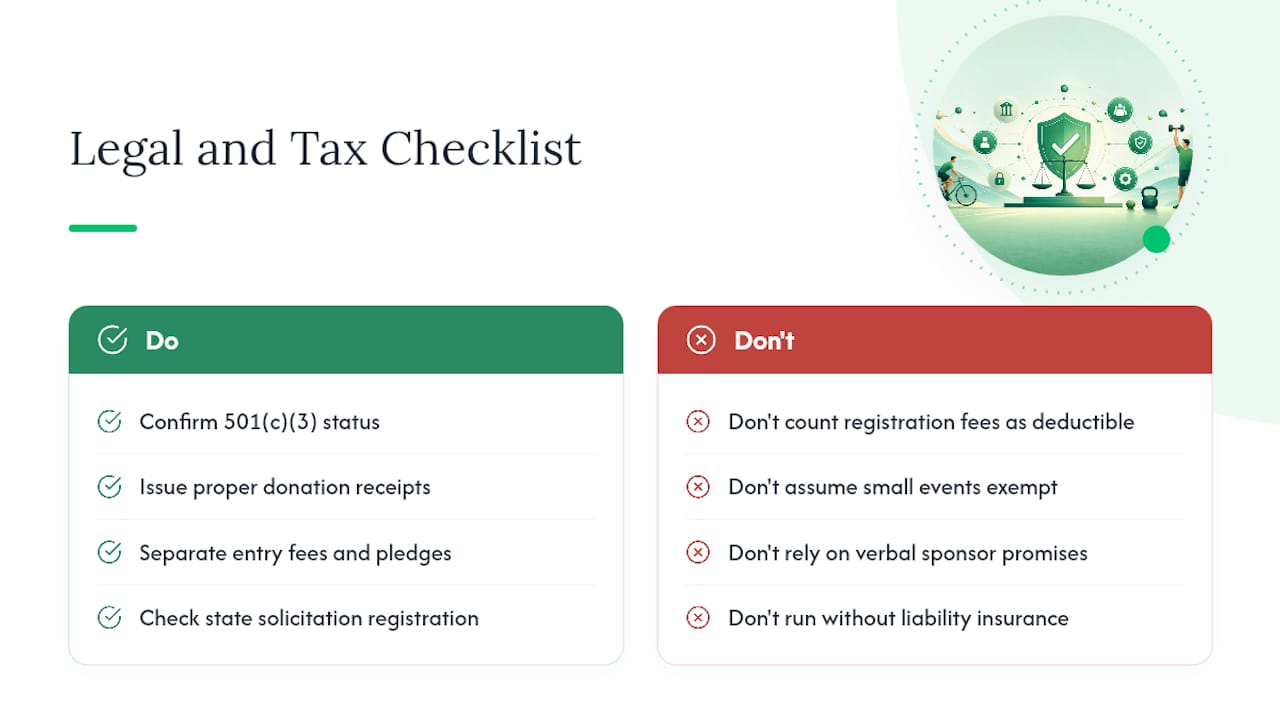
Fitness fundraisers that funnel money to a registered nonprofit generally qualify donations for tax deductibility in the United States, but only if the organization holds active 501©(3) status and issues proper donation receipts. Registration fees and event merchandise typically don’t count as tax-deductible, since participants receive something of value in return. Only the pledge or donation portion above that value usually qualifies.
If your event charges an entry fee and solicits separate pledges, keep the two revenue streams clearly separated in your bookkeeping. Sponsors and the IRS both need that distinction at tax time.
Most states also require some form of charitable solicitation registration if you’re raising funds publicly, especially if you’re collecting online across state lines. Requirements vary significantly, so check your state’s attorney general or secretary of state office rather than assuming your event is exempt because it’s small or informal.
If a corporate sponsor is matching donations, get the match terms in writing before the event, including any cap, deadline, or eligible-employee restrictions. Verbal commitments from a well-meaning HR contact don’t hold up when finance departments start asking questions in January.
Insurance is a legal consideration too, not just a safety one. Many venues and municipalities require proof of event liability coverage before granting a permit, and a single-day policy is often inexpensive relative to what it protects you against. If your fundraiser involves minors, confirm your waiver language covers both the physical activity and any photo or media release you plan to use for promotion afterward.
Measuring Whether Your Fundraiser Actually Worked
Total dollars raised is the obvious metric, but it’s not the only one that matters. Cost-per-dollar-raised tells you whether the event was actually efficient. If you spent $2,000 on venue and insurance to raise $2,500, that’s a fundraiser worth rethinking next year, even though the top-line number looks fine.
Track participation rate against your registered list, not just final headcount. A 60 percent show-up rate signals a promotion or timing problem worth fixing before your next event. Average pledge per participant is another useful number. It tells you whether your sponsor-ask messaging is working or whether people are defaulting to the smallest suggested amount because your pledge tiers weren’t compelling.
Compare year over year once you have more than one event to look at. A fundraiser that grows participation by 15 percent but keeps revenue flat is telling you something about your pledge structure, not your turnout. Volunteer hours per dollar raised matters too, especially for small teams deciding whether a format is sustainable to repeat.
Share these numbers with your sponsors and your participants afterward. A short recap showing dollars raised, participants involved, and the tangible outcome funded builds the case for next year’s event before you’ve even started planning it. Donors and sponsors who see clear before-and-after numbers are far more likely to say yes again.
Keeping Costs Under Control Without Cutting Corners
Every fitness fundraiser has three cost categories: venue and permits, safety and insurance, and materials. Venue costs vary the most, and it’s often the line item organizers underestimate, especially when a “free” public park requires a paid permit or a police detail for road closures.
Build your budget backward from your fundraising target. If you’re hoping to net $10,000, and you estimate $1,500 in fixed costs, your event needs to gross at least $11,500 before those costs eat into donor dollars. Padding that estimate by another 10 to 15 percent for unexpected expenses is a smart habit, not overcaution.
Materials are where costs balloon fastest. T-shirts, medals, and printed bibs feel obligatory but add up quickly per participant, and they’re the easiest place to trim without hurting turnout. A digital finisher certificate or a simple race-day photo op often satisfies the same impulse at a fraction of the cost.
Volunteer labor is technically free, but it isn’t costless. Underestimating how many volunteers you need leads to bottlenecks at registration or the finish line, which frustrates participants and slows collection. A rough rule of thumb: one volunteer for every 20 to 25 participants, more if the event involves timed stations or complex tracking.
Add-ons like a shoe drive or a raffle table cost almost nothing to run and can offset a meaningful share of your fixed costs, which is exactly why they show up so often on the ideas list above.
Keeping Participants Motivated From Sign-Up to Finish Line
The gap between someone registering and someone actually showing up, sweating, and collecting pledges is where most fundraisers lose momentum. Motivation isn’t a one-time push at launch. It needs reinforcement at several points along the way.
Send short progress updates during the fundraising window, not just at the start and the end. A quick note showing the group’s combined total climbing toward the goal taps into intrinsic motivation better than a generic reminder email, because it shows participants their individual effort is part of something visibly growing.
Team-based formats consistently outperform solo fundraising on engagement. Friendly competition between departments, classrooms, or friend groups adds a layer of accountability that a solo pledge page doesn’t create on its own. A leaderboard, even an informal one, gives people a reason to check back in during the weeks before the event.
Small milestone incentives work better than one giant grand prize. A shout-out for the first participant to hit their goal, or a small reward for anyone who recruits three donors, keeps the energy up throughout the campaign instead of concentrating it all at the finish line.
During the event itself, visible progress trackers, whether that’s a whiteboard tally at an obstacle course or a live leaderboard for a virtual mileage challenge, keep people engaged mid-event rather than checking out once the initial excitement fades.
Themes and Add-Ons That Push Donations Higher
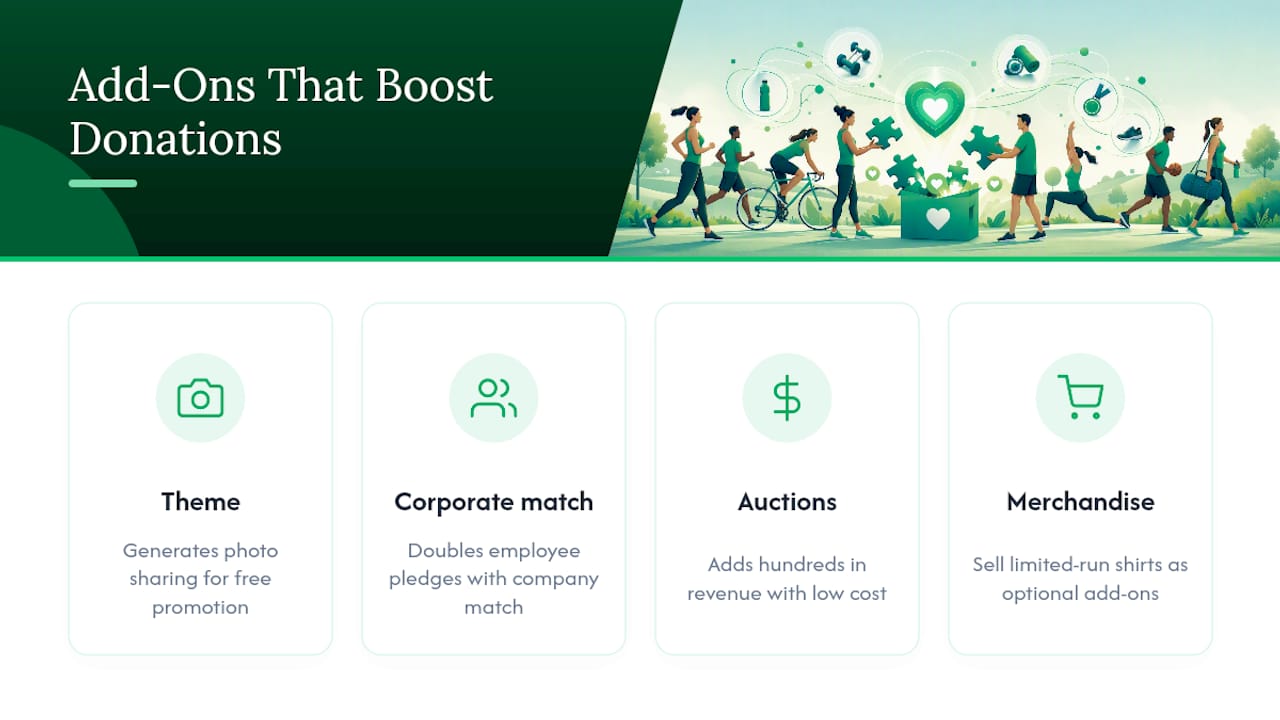
A theme gives people a reason to talk about your event before it happens, and that conversation is often worth more than any single flyer or email blast. Color runs, costume-themed fun runs, and decade-themed dance-a-thons all generate the kind of photo sharing that functions as free promotion.
Corporate matching is one of the highest-leverage additions available, and it’s frequently underused. A company willing to match employee pledges dollar-for-dollar, even with a modest per-person cap, can double the impact of a workplace team’s fundraising without asking participants for more money. If you’re organizing inside a company, this is worth raising with leadership before the campaign launches, not after.
Auctions paired with a fitness event work particularly well for evening kickoff events or post-race festivals, where participants are already gathered and in a giving mindset. A silent auction table with a handful of donated items from local businesses can add hundreds of dollars with almost no cost to run.
Merchandise, done carefully, can be a moneymaker rather than a cost center if you price it as an add-on rather than a giveaway. A limited-run event shirt sold separately from registration, rather than bundled into the entry fee, lets enthusiastic participants opt in without raising the baseline cost for everyone else.
The common thread across all of these: pairing a peer-to-peer event with a high-margin add-on reliably raises net revenue, and none of it requires a bigger event footprint.
Turning One Good Event Into a Recurring Program
The fundraisers that grow year over year treat inclusivity and simple tracking as permanent features, not one-time decisions, and they protect margin with a low-cost add-on instead of chasing a bigger venue every season. Track your numbers annually and hand sponsors a real before-and-after picture. That’s what earns you a bigger ask next year.
— Gene
Run Your Next Fitness Fundraiser on Charity Miles
If you’re organizing across a workplace instead of a single event day, Charity Miles gives you the infrastructure the ideas above still need: private team challenges, a sponsorship rate your company controls, and reporting that shows exactly what your employees generated.

It suits organizers running team-wide challenges, managing large virtual mileage events, and charities seeking ongoing engagement instead of a single fundraising day. Rather than building pledge pages and tracking spreadsheets from scratch, teams set a mileage rate, a spending cap, and let participants log their own activity toward it.
If you’re weighing this against building your own tracking system, start with the team-building fitness challenge ideas page to see how other companies structured their first challenge, then check current program options at Charitymiles.
Sources
- 12 Fitness Fundraiser Ideas For Your Nonprofit
- Fitness Challenge Fundraiser: How to Turn Workouts Into Donations | HometownLift
- Jog-a-Thon Fundraiser: The Complete Guide – Get Movin’ Fundraising
- 25 Walkathon Fundraiser Ideas to Boost Your Cause in 2026 🚶♂️💰 – Walkathon Benefits™