
The fairest fitness challenges use points-based scoring instead of raw totals, normalize different activities against each other, cap daily and weekly gains, and build in clear inclusion rules from day one. Get those four pieces right and you remove most of the complaints that sink workplace wellness programs. Below, we walk through the scoring templates, team formulas, and safety rules that make it work, backed by research on workplace step interventions and inclusive program design.
TL;DR:
- Points-based scoring models that reward effort and consistency, with daily and weekly caps, significantly improve fairness and motivation in workplace challenges.
- Using a top-N contributor approach for teams prevents inactive members from negatively skewing results, encouraging broader participation across all members.
- Normalizing activities through published conversion tables or points per minute helps ensure different exercise types are compared fairly without bias toward more intense activities.
- Incorporating percentage-based weight-loss metrics and privacy safeguards for body measurements increases fairness and protects employee privacy.
- Designing inclusive rules, providing accessible materials, and offering private reporting options ensure participation for employees with disabilities without additional cost.
Table of Contents
- 1. Scoring models that produce fair outcomes
- 2. How should teams combine individual scores fairly?
- 3. Measuring different activities and normalization
- 4. Fair weight-loss and body-change formats
- 5. Making the challenge equitable for people with disabilities
- 6. Safety guardrails and preventing unhealthy competition
- 7. Practical rules and ready-to-copy templates organizers can use
- 8. Evidence and research that support these rules
- 9. Addressing socioeconomic and resource disparities among participants
- 10. Strategies for transparent and unbiased judging or monitoring
- 11. Handling disputes or appeals related to challenge fairness
- 12. Ensuring privacy and data protection in tracking activities
- 13. Why well-designed fairness upholds engagement and CSR
- How Charity Miles supports fair, inclusive team challenges
- Sources
- FAQ
1. Scoring models that produce fair outcomes
Raw totals feel simple, but they quietly reward the people who were already fit before the challenge started. A marathon runner logging 10 miles a day will beat a beginner walking 2 miles every single time, no matter how much the beginner improves. That is not competition, it is a foregone conclusion, and it drives your least athletic employees to disengage within the first week.
A points-based model fixes this by assigning value to effort and consistency rather than volume alone. A common setup: 1 point per 1,000 steps, 5 points for completing any activity that day, and a 10-point weekly bonus for hitting a personal (not universal) minimum. Consistency-based models go further, rewarding streaks: log activity 4 out of 5 workdays and earn a bonus, regardless of how far you moved. Milestone-based models award flat points for reaching checkpoints, so someone walking to a 50-mile milestone earns the same recognition as someone cycling to it, just on their own timeline.
Daily and weekly caps matter just as much as the scoring formula itself. Without a cap, one person having an unusually active weekend can lock up first place by Tuesday. Capping daily points (say, at 30) and adding a separate streak bonus keeps the leaderboard competitive longer and gives steady participants a real shot.
- Points-based scoring rewards effort in small, repeatable increments rather than one big push.
- Consistency bonuses reward showing up on 4 out of 5 workdays over any single high-volume day.
- Milestone rewards give every participant the same recognition for reaching a checkpoint, on their own schedule.
- Daily caps stop one exceptional day from deciding the whole challenge.
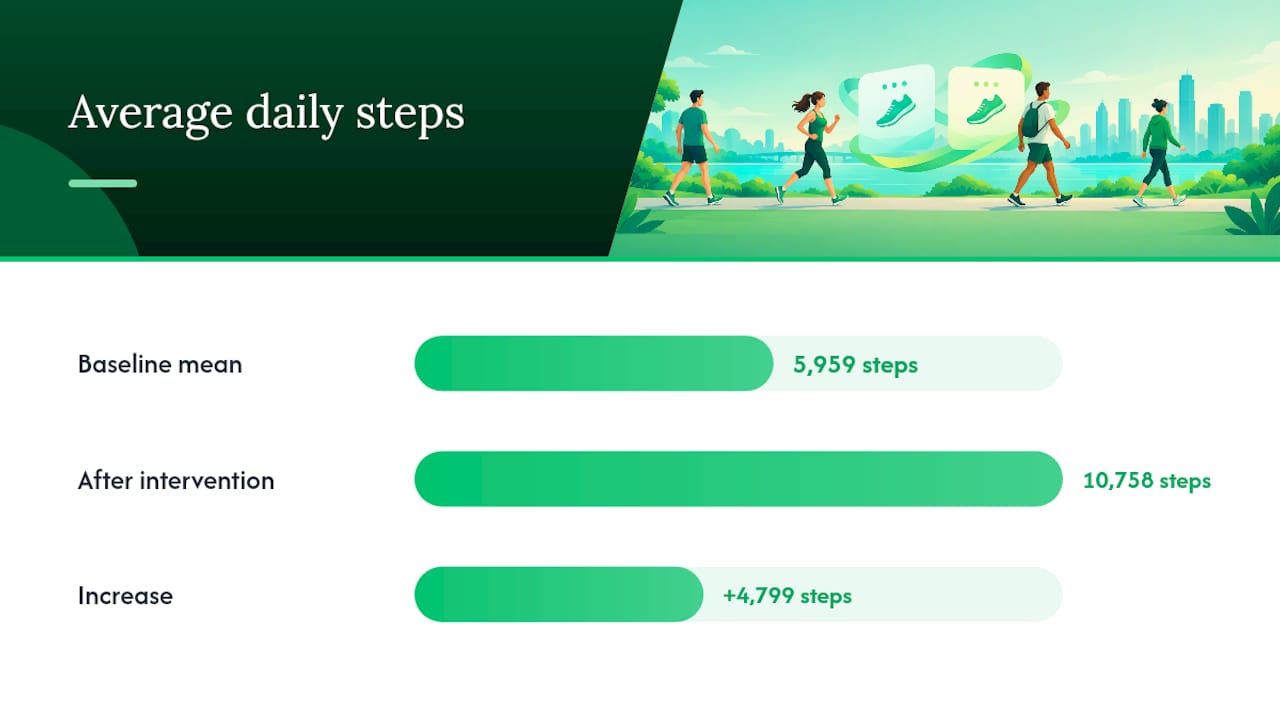
Team-based, points-style incentives work. A workplace intervention among university employees found daily steps rose from a baseline mean of 5,959 to 10,758 once team incentives and point-style scoring were introduced, an increase of roughly 4,799 steps per participant. That is the kind of lift a well-designed scoring model can produce when it rewards participation, not just raw performance.
2. How should teams combine individual scores fairly?
Once you move to teams, a new fairness problem appears: how do you combine everyone’s numbers without letting one star player carry, or one inactive member drag the whole group down?
Team totals (simply adding everyone’s points) favor large teams and let one highly active person dominate the result. Team averages solve the size problem but create a different one: a single inactive member can tank an otherwise strong team’s average, which discourages managers from including anyone who might not participate fully.
A top-N contributor model splits the difference. If a team has 10 members, count only the top 7 scores toward the team total. This keeps the incentive to participate (you want to be in the top 7) without punishing a team for having a couple of members who are traveling, sick, or simply less active that week.
- Team totals reward size and top performers but can make one person’s effort look like the whole team’s.
- Team averages reward balance but penalize teams for a single inactive member.
- Top-N contributor models count only the highest scores from a set number of members, reducing the effect of both outliers and stragglers.
- Participation bonuses (such as a 15% boost when 70% of the team logs activity) reward breadth of engagement, not just peak performance.
Worked example: a 10-person team where the top 7 scores average 45 points each produces a team score of 315, plus a 15% participation bonus if 8 of the 10 members were active that week, for a final score of 362.
3. Measuring different activities and normalization
Walking, running, cycling, and adapted activities like wheelchair rolling all move at different speeds and burn different amounts of effort per minute, so counting them at face value skews things toward whichever activity produces the biggest numbers fastest. A cyclist covering 15 miles in an hour is not necessarily working harder than a walker covering 3, so treating a mile as a mile across activities is not neutral, it is a hidden bias toward cyclists and runners.
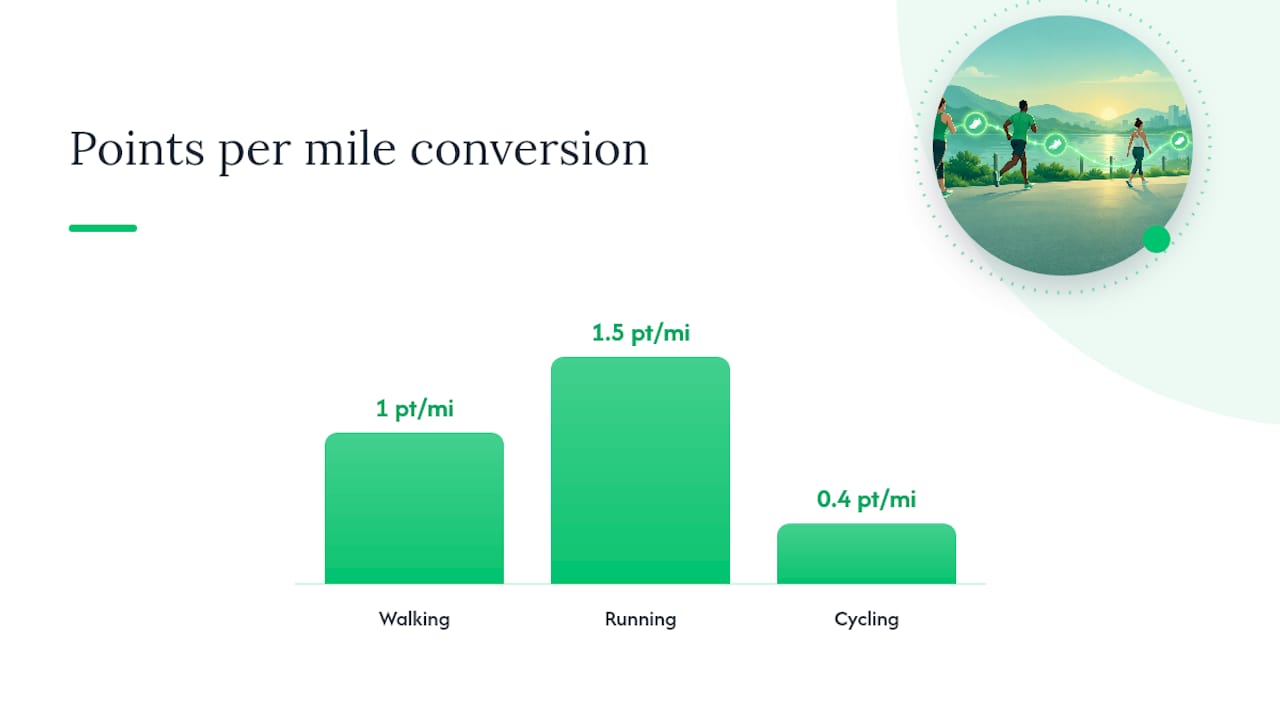
The fix is a published conversion table. A simple version: 1 walking mile equals 1 point, 1 running mile equals 1.5 points (it burns more per mile in less time), and 1 cycling mile equals 0.4 points (lower effort per mile covered). An even simpler alternative, especially for mixed-ability groups, is points per minute of activity rather than points per mile, since time-based effort is easier to normalize across activity types.
- Published conversion rates turn different activities into one shared point currency instead of comparing apples to oranges.
- Points-per-minute scoring sidesteps the conversion problem entirely by rewarding time spent moving.
- Manual-entry verification, such as periodic spot checks or requiring a screenshot for non-GPS activities, protects trust without demanding constant surveillance.
Pro Tip: Publish your conversion table before the challenge starts, not after someone complains about it.
4. Fair weight-loss and body-change formats
Weight-loss challenges are the fastest way to turn a wellness program into a liability if they are not built carefully. Comparing absolute pounds lost is unfair on its face: someone starting at 250 pounds and losing 10 pounds has changed their body far less proportionally than someone starting at 140 pounds and losing the same 10. A percentage-based format solves this instantly. Losing 10 pounds from 250 is a 4% change; losing 10 pounds from 140 is a 7.1% change, a meaningfully bigger shift on the same scale.
Where possible, body-fat percentage or waist circumference can be fairer still, since they separate fat loss from muscle gain, though they require access to equipment or trained measurement that not every workplace has.
- Use percentage change, never absolute pounds, as the primary fairness metric.
- Offer body-fat or circumference tracking as an alternative when equipment and trained staff are available.
- Require a minimum multi-week timeframe and keep all body data private and self-reported to a single trusted admin, never posted on a public leaderboard.
5. Making the challenge equitable for people with disabilities
A fitness challenge that only counts steps automatically excludes employees who use wheelchairs, have chronic conditions, or move in ways a pedometer cannot register. Building inclusion in from the start, rather than patching it in later, keeps the challenge from becoming something only some employees can join.
The NiCIP inclusive implementation framework outlines a practical process: assess physical and digital accessibility before launch, gather input from employees with disabilities on what would make participation realistic, and train staff running the challenge on adapted activity rules. None of this requires a large budget, and the framework’s pilot implementations showed real gains in participation once these steps were followed.
- Publish adapted-activity conversion rules up front, such as counting wheelchair rolling on the same points-per-minute basis as walking.
- Offer private reporting options so employees are not required to disclose a condition to participate fairly.
- Provide accessible materials, meaning screen-reader-friendly rules and sign-up forms, not just an accessible app.
Pro Tip: Ask two or three employees with disabilities to review your rules before launch. It costs nothing and catches problems no spreadsheet will.
6. Safety guardrails and preventing unhealthy competition
A fairness system that ignores safety just creates a different problem: people overtraining, under-eating, or fudging entries to chase points. Daily and weekly caps do double duty here. They flatten the competitive advantage of extreme effort, and they discourage the kind of all-day activity binges that lead to injury or burnout.
Counting only one qualifying activity per day, rather than stacking a morning run, a lunchtime walk, and an evening bike ride into separate entries, keeps the incentive structure from rewarding overexertion. Consider adding rest-day points, a small bonus for a planned recovery day, so the system does not implicitly punish people for resting.
- Cap points per day and per week to remove the reward for extreme, unsustainable effort.
- Count one qualifying activity per day instead of stacking multiple sessions into extra points.
- Award small rest-day bonuses so recovery is not treated as falling behind.
- Set minimum timeframes for any weight-change format, and run periodic audit sampling on top entries with a clear, published appeals process.
7. Practical rules and ready-to-copy templates organizers can use
Two ready templates cover most workplace needs.
- Inclusive Consistency Challenge: 1 point per 1,000 steps or equivalent minutes of activity (capped at 30 points/day), 10-point bonus for 4+ active days per week, 15% team bonus when 70% of members participate weekly.
- Performance Ladder: milestone points (50, 100, 150 miles) worth 25 points each regardless of activity type, top-7-of-10 team scoring, weekly leaderboard capped so no single day counts for more than 20% of a week’s total.
A short launch checklist keeps rollout smooth: communicate the scoring rules and conversion table before day one, confirm accommodation options are documented and easy to request, decide who verifies manual entries, and set a clear privacy policy for any body-metric data.
8. Evidence and research that support these rules
The core recommendations here are not guesswork. Team-based, point-style incentives measurably increased activity in a peer-reviewed workplace step study, and formal inclusion frameworks like NiCIP show that structured accessibility steps improve participation without large budgets. On the judging side, rescaling methodology using population mean and standard deviation offers a straightforward way to remove scorer bias when human judgment is involved anywhere in the process.
| Evidence source | Finding |
|---|---|
| University workplace step intervention | Steps rose from a baseline mean of 5,959 to 10,758 with team incentives |
| NiCIP inclusive implementation framework | Site assessments and staff training reduced participation barriers |
| Judge-rescaling fairness methodology | Mean and standard deviation rescaling aligns scorer distributions |
9. Addressing socioeconomic and resource disparities among participants
Not every employee has the same access to a smartwatch, a gym membership, or a safe neighborhood to walk in after dark, and a scoring system that assumes otherwise quietly favors employees with more resources. Workplace factors like scheduling and access to facilities have been shown to meaningfully affect participation in worksite wellness programs, so the rules matter as much as the intent.
A few adjustments close most of the gap. Let employees log activity through the free app on their existing phone rather than requiring a wearable device, since GPS and pedometer tracking on a standard smartphone covers walking, running, and cycling without added cost. Offer on-site or virtual options for employees without gym access, and build the schedule around shift patterns rather than assuming everyone works a standard nine-to-five. Where the challenge involves any cost, such as team shirts or equipment, make participation possible without purchasing anything.
- Use free, phone-based tracking instead of requiring a paid wearable device.
- Offer virtual and on-site activity options for employees without gym access.
- Design schedules around shift work, not just standard office hours.
- Keep all optional purchases genuinely optional, never tied to eligibility or scoring.
10. Strategies for transparent and unbiased judging or monitoring
Most fairness complaints in workplace challenges are not about the math, they are about not understanding the math. Publishing the scoring formula, the conversion table, and a worked example before the challenge opens removes most disputes before they start. Small, public examples of how points are calculated build trust faster than any assurance that “the system is fair.”
Where any human judgment enters the process, such as reviewing manual entries or verifying milestone claims, use more than one reviewer and apply the same criteria to every submission. If your challenge uses any subjective scoring at all, rescaling each reviewer’s scores against the group’s mean and standard deviation, the same principle used in judge-rescaling fairness methodology, removes the bias that comes from one reviewer being consistently stricter or looser than another.
- Publish the full scoring formula and a worked example before launch, not after questions arise.
- Use more than one reviewer for any manually verified entries.
- Rescale subjective scores against the group average to remove individual reviewer bias.
- Keep a visible, timestamped record of rule changes so no one suspects the goalposts moved mid-challenge.
11. Handling disputes or appeals related to challenge fairness
Even a well-designed challenge will produce a handful of disputes, usually about a missed entry, a disputed milestone, or a conversion question. What separates a minor hiccup from a morale problem is whether there is a clear, known process for raising it.
A simple appeals process works: designate one person or a small committee as the point of contact, require appeals to be submitted within a set window (48 hours is common), and commit to a response within a few business days. Keep the criteria for resolving disputes the same ones used to score everyone else, rather than making case-by-case exceptions that other employees never hear about. Audit sampling, spot-checking a portion of top entries rather than every entry, catches most issues without turning the challenge into a policing exercise.
- Name a specific appeals contact so employees know exactly where to raise a concern.
- Set a clear appeal window and response time to avoid disputes dragging past the challenge’s end.
- Apply the same published rules to every appeal, with no undisclosed exceptions.
- Use periodic audit sampling on top scores instead of reviewing every single entry.
12. Ensuring privacy and data protection in tracking activities
Fitness challenges collect data employees may reasonably consider sensitive: location history, activity patterns, and in weight-loss formats, body measurements. Treating that data casually is one of the fastest ways to lose trust in an otherwise well-run program.
A few baseline practices matter most. Collect only what the scoring model actually needs, GPS distance and duration for activity challenges, not continuous location tracking outside of logged sessions. Store any body-metric data (weight, body fat, circumference) with a single trusted administrator rather than a shared spreadsheet, and never display it on a public leaderboard. Give employees a private reporting option for any accommodation needs so no one has to disclose a medical condition to a wider group. Be explicit, in writing, about what data is collected, who can see it, and how long it is kept after the challenge ends.
- Collect only the data the scoring model requires, nothing broader.
- Restrict body-metric access to a single trusted administrator, never a shared or public document.
- Offer private accommodation reporting so no one discloses a condition to be included fairly.
- State your data retention policy in writing before the challenge begins.
13. Why well-designed fairness upholds engagement and CSR
Fair scoring is not administrative overhead, it is the reason people keep showing up. When the rules feel rigged toward the fittest few, participation quietly drops after week one. When effort and consistency are what count, more employees stay in, and tying that movement to a charitable outcome gives the effort a reason beyond the leaderboard. Organizers who treat fairness as strategy, not paperwork, tend to see better retention across the whole program.
— Gene
How Charity Miles supports fair, inclusive team challenges
Charity Miles’ Employee Empowerment program gives organizers a ready foundation for the rules above: activity tracking that covers walking, running, and biking on any phone, so no employee needs a paid wearable to participate fairly.
- Configurable scoring and sponsorship terms let companies set sponsorship parameters and direct donations accordingly.
- Movement of any kind counts, supporting inclusive scoring models.
- Corporate sponsorship options connect participation with charitable contributions, adding purpose to the competition.
See how the tracking and donation mechanics work on the Charity Miles app page, then talk to us about setting up your team’s challenge.
Sources
- Incentivised physical activity intervention promoting daily steps among university employees in the workplace through a team-based competition
- Feasibility of Implementing Disability Inclusive Evidence-Based Health Promotion
- Fairness rescaling methodology (example) — Healthy Aging Challenge
FAQ
What is the 3-3-3 rule for fitness?
The 3-3-3 rule generally refers to structuring activity in short, repeatable blocks, such as three sessions of a set duration across the week, though exact definitions vary by source. It is not a formal fairness standard for workplace challenges, so organizers should rely on published scoring and caps instead.
Can you give an example of a fair workplace fitness challenge?
An inclusive consistency challenge awards 1 point per 1,000 steps or equivalent minutes, capped at 30 points per day, plus a 10-point bonus for staying active 4 or more days a week.
What is the most fair way to run a weight-loss competition?
Percentage-based weight change is fairer than tracking absolute pounds, since it accounts for different starting body sizes rather than rewarding whoever has the most weight to lose. Keeping all body data private, requiring a minimum multi-week timeframe, and avoiding public weight leaderboards protect both fairness and employee well-being.
How can organizers make a fitness challenge accessible to employees with disabilities?
Publishing conversion rules for adapted activities, such as counting wheelchair rolling on the same basis as walking, and offering private reporting for accommodation needs are two of the most direct steps. The NiCIP framework also recommends site assessments and staff training before launch to reduce participation barriers.
How do you keep team scoring fair when some members are less active?
A top-N contributor model, counting only the highest scores from a set number of team members, prevents one inactive person from dragging down an otherwise strong team’s average. Pairing this with a participation bonus for teams where most members log some activity rewards breadth of engagement alongside peak performance.