
CSR is what your company believes; ESG is how the world measures it. Corporate Social Responsibility defines your values, programs, and stakeholder commitments. Environmental, Social, and Governance criteria are the quantified indicators investors, regulators, and analysts use to evaluate whether those commitments produce real outcomes. Understanding the difference between ESG and CSR is not academic — it determines which frameworks you report against, who reads your disclosures, and whether your programs create credible evidence or just good stories.
- CSR speaks to employees, communities, and customers — it builds culture and brand through voluntary programs like employee volunteering, grants, and philanthropy.
- ESG speaks to investors, analysts, and regulators — it demands quantified KPIs, standardized disclosures (GRI, SASB/ISSB, TCFD), and increasingly, SEC-level accountability for US public companies.
- The practical consequence: a company can run excellent CSR programs and still fail ESG scrutiny if those programs generate no measurable data. The pathway from intent to impact requires deliberate instrumentation.
Key Takeaways
CSR defines what your company stands for; ESG measures whether those commitments produce outcomes that investors and regulators can evaluate and compare.
| Point | Details |
|---|---|
| CSR vs. ESG distinction | CSR expresses values through programs; ESG quantifies impact through KPIs and standardized disclosures. |
| Stakeholder alignment | Investors use ESG frameworks (SASB/ISSB, TCFD); employees and communities respond to CSR culture and purpose. |
| Instrument programs early | Design CSR programs with ESG KPIs defined before launch so data is audit-ready, not retrofitted. |
| Framework selection | Use GRI for stakeholder reports, ISSB/SASB for investor disclosures, and TCFD for climate-specific reporting. |
| Charitymiles as S-pillar tool | Charitymiles converts employee activity into participation rates and donation figures that map directly to Social pillar ESG metrics. |
Table of Contents
- How ESG and CSR differ — and why both matter
- ESG vs. CSR: a side-by-side comparison
- Why stakeholders care about each one differently
- Reporting frameworks and US regulatory context you need to know
- Common ESG metrics and how CSR activities generate them
- How to move from CSR intent to measurable ESG impact
- How a Charitymiles program creates measurable S-pillar outcomes
- Criticisms and credibility risks worth knowing
- Why the integration question is the only one worth asking
- Charitymiles turns employee movement into S-pillar evidence
- Sources
How ESG and CSR differ — and why both matter
CSR emerged in the 1950s and 1960s as a philosophical argument that businesses owe something to society beyond profit. By the 1990s, it had evolved into formal programs: corporate philanthropy, community investment, employee volunteering, and supply chain ethics. The term is inherently stakeholder-focused and largely voluntary. A company decides what it cares about, funds programs that reflect those values, and communicates the results to employees and the public.
ESG arrived later. The phrase “Environmental, Social, and Governance” gained traction after the UN-backed “Who Cares Wins” initiative in 2004, which called on financial institutions to integrate non-financial factors into investment analysis. The UN’s sustainability framework provided the global reference point; the investment community provided the demand for comparability. ESG is not a program — it is a lens. Investors use it to assess material risk and long-term value creation across three pillars:
- Environmental: carbon emissions (Scope 1, 2, and 3), energy intensity, water use, waste management, climate risk exposure.
- Social: employee retention, lost-time injury rates, pay equity, community investment, human rights in the supply chain.
- Governance: board independence, executive compensation structure, anti-corruption policies, shareholder rights, audit quality.
A concrete example clarifies the distinction. A company that runs an annual employee volunteer day is practicing CSR. If that same company tracks volunteer hours per employee, reports them under GRI Standard 413, and ties the data to its Social pillar score, it is converting CSR activity into ESG evidence. The program is the same. What changes is the measurement discipline and the audience it serves.
ESG vs. CSR: a side-by-side comparison
The table below maps the seven dimensions professionals most often use when deciding how to position, report, and govern their sustainability work.
| Dimension | CSR | ESG |
|---|---|---|
| Focus / purpose | Values, intent, and stakeholder programs | Measurable performance and investor-facing disclosure |
| Primary drivers | Reputation, brand, employee engagement | Investor demand, regulatory requirements, risk management |
| Audience / stakeholders | Employees, communities, customers, NGOs | Investors, analysts, lenders, regulators |
| Measurability | Qualitative narratives, program descriptions | Quantified KPIs, scored indicators, rated disclosures |
| Scope & accountability | Voluntary; self-defined scope | Increasingly mandatory; third-party assurance expected |
| Examples | Employee volunteering, corporate grants, wellness programs | Scope 1–3 emissions, board diversity %, injury rate |
| Reporting & assurance | CSR reports, sustainability pages, press releases | GRI, SASB/ISSB, TCFD, EcoVadis ratings, SEC filings |
Industry analysis consistently shows ESG moving toward standardized, investor-driven reporting while CSR retains its importance for brand, employee engagement, and community relations. They are not competing frameworks — they operate at different layers of the same strategy.
Pro Tip: When designing a CSR program, name the ESG KPI it will feed before you launch it. A wellness initiative that tracks participation rates and lost-time injury data from day one produces S-pillar evidence automatically. Retrofitting measurement after the fact is far harder and rarely produces audit-ready data.
Why stakeholders care about each one differently
Investors, employees, customers, and regulators each ask a different question when they look at your sustainability work — and CSR and ESG answer different questions.
Investors and analysts want comparability and material risk assessment. They use ESG scores from rating providers like EcoVadis and frameworks like SASB/ISSB to screen portfolios, price risk, and meet their own disclosure obligations under initiatives like the UN Principles for Responsible Investment (UN PRI). A CSR report that describes programs without quantified outcomes does not give them what they need.
Employees respond to purpose and culture. CSR programs that connect daily work to community impact drive intrinsic motivation, reduce burnout, and build loyalty. Gallup research consistently links purpose-driven work to higher engagement and retention — and engaged employees are 21% more profitable for their organizations.
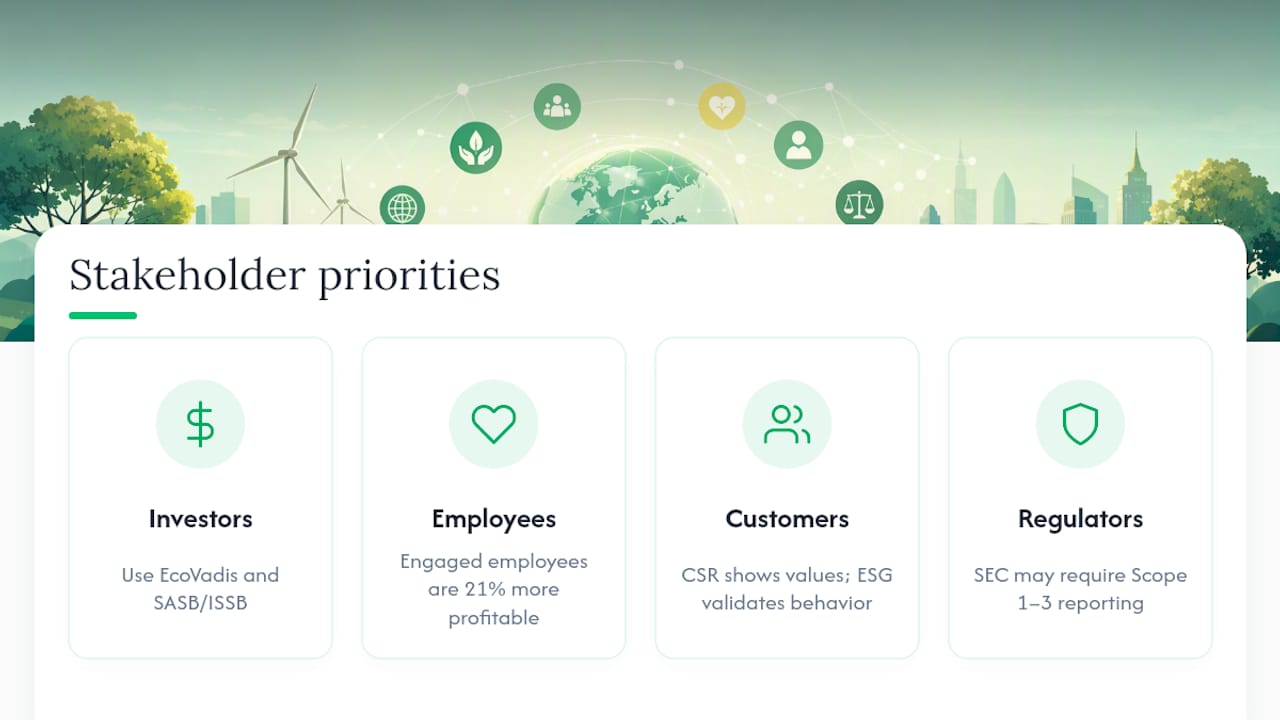
Customers and communities look for evidence that a company’s stated values show up in behavior. CSR programs are the visible expression of those values. ESG scores provide third-party validation that the behavior is real and consistent.
Regulators are increasingly interested in both. The US Securities and Exchange Commission has been developing climate-related disclosure rules that would require public companies to report Scope 1 and Scope 2 emissions and, in some cases, Scope 3 — moving what was once voluntary ESG reporting toward mandatory financial disclosure.
The business case is real. McKinsey’s framework identifies five levers through which a strong ESG proposition creates value: top-line growth, cost reduction, regulatory risk mitigation, improved employee productivity, and better investment decisions. Bain’s analysis with EcoVadis data across a large sample of companies found correlations between robust ESG activities and stronger financial outcomes, including revenue growth and EBITDA margin improvements, though the research stops short of claiming strict causality.
Reporting frameworks and US regulatory context you need to know
Choosing the right framework depends on your primary audience. Here is a practical map:
- GRI (Global Reporting Initiative): The most widely used standard globally. GRI is stakeholder-focused and covers a broad range of economic, environmental, and social topics. Best for companies that want comprehensive, public-facing sustainability reports readable by employees, NGOs, and communities.
- SASB / ISSB (now under the IFRS Foundation): SASB standards are industry-specific and financially material — designed for investor audiences. The International Sustainability Standards Board (ISSB) has consolidated SASB into a global baseline (IFRS S1 and S2) that aligns sustainability disclosures with financial reporting. If your primary audience is capital markets, ISSB/SASB is the right starting point.
- TCFD (Task Force on Climate-related Financial Disclosures): A framework for reporting climate-related risks and opportunities across four categories: governance, strategy, risk management, and metrics/targets. TCFD has been widely adopted by financial institutions and is referenced in SEC climate disclosure proposals.
- UN PRI (Principles for Responsible Investment): A UN-backed investor initiative with over 5,000 signatories. UN PRI signatories commit to integrating ESG factors into investment decisions and stewardship. If your institutional investors are PRI signatories, their expectations will shape what ESG data you need to provide.
- EcoVadis: A commercial ESG rating platform used by procurement teams and supply chain managers. An EcoVadis scorecard covers environment, labor and human rights, ethics, and sustainable procurement. Many large corporations require EcoVadis ratings from suppliers as a condition of doing business.
For US public companies, the SEC’s climate disclosure rulemaking is the most consequential regulatory development. The SEC has proposed rules that would require registrants to disclose material climate-related risks, Scope 1 and 2 emissions, and, for large accelerated filers, Scope 3 emissions if material or if the company has set Scope 3 targets. The rules have faced legal challenges and implementation timelines have shifted, but the direction of travel is clear: voluntary ESG reporting is becoming a compliance function for public companies. Confirm current requirements with SEC.gov or qualified legal counsel, as rules continue to evolve.
Common ESG metrics and how CSR activities generate them
Most ESG KPIs are not exotic. They come from operational data that companies already collect — or could collect with modest effort. The challenge is connecting existing CSR programs to the data streams that produce those KPIs.
Environmental pillar KPIs: Scope 1 direct emissions (company-owned sources), Scope 2 indirect emissions (purchased energy), Scope 3 value chain emissions, energy intensity (kWh per unit of revenue), renewable energy percentage, water withdrawal, and waste diversion rate.
Social pillar KPIs: Employee retention rate, lost-time injury rate (LTIR), total recordable incident rate (TRIR), volunteer hours per employee, community investment as a percentage of pre-tax profit, pay equity ratio, and workforce diversity metrics.
Governance pillar KPIs: Board independence percentage, women on the board, executive pay ratio, anti-corruption training completion rate, and whistleblower policy coverage.
The mapping below shows how three common CSR activities produce Social pillar data directly:
| ESG KPI | CSR activity that generates it | Data source |
|---|---|---|
| Volunteer hours per employee | Structured employee volunteering program | Program tracking platform (hours logged per participant) |
| Community investment ($) | Corporate grant program or matched giving | Finance / philanthropy records |
| Employee participation rate | Wellness or movement challenge (e.g., step challenge) | Activity platform (participants / total eligible employees) |
| Lost-time injury rate | Workplace wellness and safety programs | HR / EHS system |
| Charitable donations generated | Employee activity-to-donation platform | Platform reporting dashboard |
The key insight: CSR programs that track participation at the individual level produce the granular data ESG reporting needs. Programs that only track total spend or aggregate outputs leave gaps that auditors and rating agencies will flag.
How to move from CSR intent to measurable ESG impact
The gap between a well-intentioned CSR program and a credible ESG disclosure is almost always a data governance problem, not a values problem. Here is a practical sequence for closing it.
1. Set strategy and materiality. Use a materiality assessment to identify which ESG topics are most significant to your business and your stakeholders. GRI’s double materiality approach considers both financial impact on the company and the company’s impact on society. ISSB focuses on financial materiality. Choose the lens that matches your primary audience.
2. Select frameworks and KPIs. Map your material topics to the appropriate reporting standard (GRI for stakeholder reports, ISSB/SASB for investor disclosures, TCFD for climate). Define the specific KPIs you will track before the reporting period begins — not after.
3. Instrument your CSR programs to capture data. Every CSR program should have a designated data owner, a defined measurement frequency, and a clear link to at least one ESG KPI. If a program cannot be measured, reconsider whether it belongs in your ESG disclosure.
Pro Tip: Integrate ESG data collection into your existing financial and operational systems rather than building a parallel reporting silo. A peer-reviewed literature review on ESG value creation found that ESG outcomes depend heavily on the credibility and quality of implementation — and siloed data that cannot be audited is one of the most common credibility failures.
4. Integrate ESG into governance and finance. Assign board-level oversight for ESG. Link at least one executive compensation metric to an ESG KPI. This signals to investors that ESG is a management priority, not a communications exercise.
5. Report and seek assurance. Publish your ESG data in a format aligned with your chosen framework. For public companies, consider limited assurance from an independent auditor on your highest-stakes metrics (typically emissions and injury rates). Assurance materially increases credibility with institutional investors.
6. Iterate annually. ESG expectations evolve. Review your materiality assessment each year, update KPIs as frameworks change, and close data gaps identified in the previous reporting cycle.
Common pitfalls to avoid:
- Treating ESG reporting as a separate project rather than an output of operational systems
- Reporting programs without quantified outcomes (the classic CSR-to-ESG gap)
- Setting Scope 3 targets without a credible data collection methodology
- Prioritizing ESG ratings over actual impact, which creates ESG-washing risk
- Failing to align CSR program design with the KPIs your investors actually use
How a Charitymiles program creates measurable S-pillar outcomes
The pathway from CSR intent to ESG evidence becomes concrete when you look at how an employee-engagement program can generate Social pillar data automatically.

Charitymiles converts employee movement into charitable donations: employees walk, run, or bike, and the app tracks distance via GPS and pedometer. Every mile generates a donation to a charity of the employee’s or company’s choice. The platform produces participation data — who is active, how often, and what impact they have generated — in a format that maps directly to S-pillar KPIs.
The metrics a Charitymiles program generates include:
- Employee participation rate (participants as a percentage of eligible employees)
- Total volunteer / activity hours logged across the workforce
- Charitable donations generated (dollar amount, by cause or charity)
- Team challenge completion rates (useful for engagement benchmarking)
- Miles logged per employee (a proxy for physical activity and wellness engagement)
Proof point: Since launching its Charitymiles team in 2021, HARMAN saw an 11x increase in employee participation, with many employees generating substantial donations for charity. That participation rate and donation figure are exactly the kind of quantified S-pillar evidence ESG reporting frameworks ask for.
For CSR managers building an ESG data strategy, the practical takeaway is this: instrument your employee engagement programs to capture individual-level participation data from day one. Aggregate participation rates, hours, and community investment dollars are auditable, comparable across reporting periods, and directly mappable to GRI Standard 413 (Local Communities) and SASB Social Capital standards. A program like Charitymiles makes that data collection automatic rather than manual.
You can see how companies use similar programs to meet CSR goals with measurable outcomes and build the S-pillar evidence their ESG disclosures need.
Criticisms and credibility risks worth knowing
ESG has attracted serious criticism, and professionals who ignore it build programs on shaky ground. A California Management Review analysis argues that ESG risks repeating CSR’s earlier weaknesses if companies fail to improve metrics quality, managerial accountability, and the link between initiatives and measurable social outcomes. That is a fair warning.
The most common credibility risks:
- Measurement inconsistency: ESG rating agencies frequently disagree on scores for the same company because they use different methodologies and weight factors differently. A high EcoVadis score does not guarantee a high MSCI ESG rating.
- Greenwashing and ESG-washing: Prioritizing data collection and optics over actual impact can produce strong ratings while underlying practices remain unchanged. Investors and regulators are increasingly alert to this gap.
- Lack of materiality focus: Reporting on every possible ESG topic dilutes credibility. Stakeholders trust disclosures that focus on what is genuinely material to the business.
- Treating ESG as a PR function: When ESG reporting sits in communications rather than finance or operations, it tends to produce narrative-heavy disclosures with weak data backing.
- Rating divergence: Because no single global standard governs ESG ratings, companies can shop for favorable scores or find their ratings vary widely across providers.
To reduce these risks: seek third-party assurance on your highest-stakes metrics, tie ESG KPIs to financial and operational systems rather than standalone surveys, and publish a clear materiality matrix that explains why you report what you report. When you cannot yet measure something accurately, say so — that transparency builds more credibility than a polished number with a weak methodology behind it.
Why the integration question is the only one worth asking
Most of the ESG vs. CSR debate misses the point. The real question is not which one matters more — it is whether your organization has built the connective tissue between them.
CSR without ESG measurement is a values statement that investors cannot use. ESG without CSR culture is a reporting exercise that employees do not believe in. The companies that get this right treat CSR as the operating system and ESG as the dashboard. They design programs with measurement built in, assign data ownership at the operational level, and report outcomes that are both credible to investors and meaningful to the people who generated them.
The practical implication for HR, CSR, and sustainability leaders is straightforward: every new program you design should answer two questions before it launches. First, which stakeholder does this serve? Second, which ESG KPI will it produce? If you cannot answer both, the program may be worthwhile, but it will not advance your ESG position.
Charitymiles turns employee movement into S-pillar evidence
If you are building a CSR strategy that needs to produce measurable Social pillar outcomes, Charitymiles offers a direct path. The Employee Empowerment Program gives companies a private team platform where employees log walking, running, and biking miles that convert into charitable donations. The program generates participation rates, activity hours, and community investment figures automatically — the exact data points ESG frameworks ask for in the Social pillar.

Unlike a one-off step challenge, Charitymiles runs continuously, so the data compounds across reporting periods. Companies control the sponsorship rate, the charity selection, and the challenge structure. The result is a corporate wellness program that produces audit-ready ESG data while genuinely improving employee well-being. Request a demo at charitymiles.org to see how the program maps to your ESG reporting needs.
Sources
These are the primary sources worth bookmarking as you build or refine your ESG and CSR strategy:
- Is ESG Simply the Old CSR Wine in a New Bottle? | California Management Review
- CSR or ESG? | American University Kogod School of Business