
The single most effective way to raise engagement in hybrid teams is pairing a documented collaboration plan with manager-led weekly meaningful conversations. Gallup’s research backs this combination directly, and a Harvard Business School field experiment confirms the second half: norms only work when teams actually discuss and follow them. Everything below turns that into a step-by-step playbook.
TL;DR:
- Having a documented and discussed collaboration plan increases hybrid team engagement by 66% and reduces burnout by 29%, but only if it is regularly revisited.
- Norm adherence, rather than mere existence, significantly affects feelings of time control and connection among hybrid workers.
- Managers who conduct weekly meaningful conversations and focus on outcomes rather than activities drive the largest engagement gains in hybrid teams.
- Building a simple, actionable team charter and using small rituals for informal exchange can significantly improve remote connection without increasing meeting frequency.
- Implementing inclusive movement-based programs like charity challenges fosters ongoing participation and trust, extending engagement beyond typical wellness initiatives.
Table of Contents
- What Does the Research Say About Engagement in Hybrid Teams?
- Why Does Hybrid Work Change Team Engagement?
- What Manager Habits Drive Engagement in Hybrid Teams?
- How Do You Build a Hybrid Team Collaboration Plan?
- What Tools Keep Hybrid Teams Connected Without More Meetings?
- How Did HARMAN Use Movement to Boost Hybrid Engagement?
- A Manager’s 90-Day Playbook
- How Charitymiles Fits Into an Engagement Plan Built on Trust
- Sources
- FAQ
What Does the Research Say About Engagement in Hybrid Teams?
Teams that write down how they’ll collaborate outperform those that wing it. That’s not a hunch. It’s a measurable pattern that shows up across multiple independent studies, and it should shape how you spend your next quarter of management time.
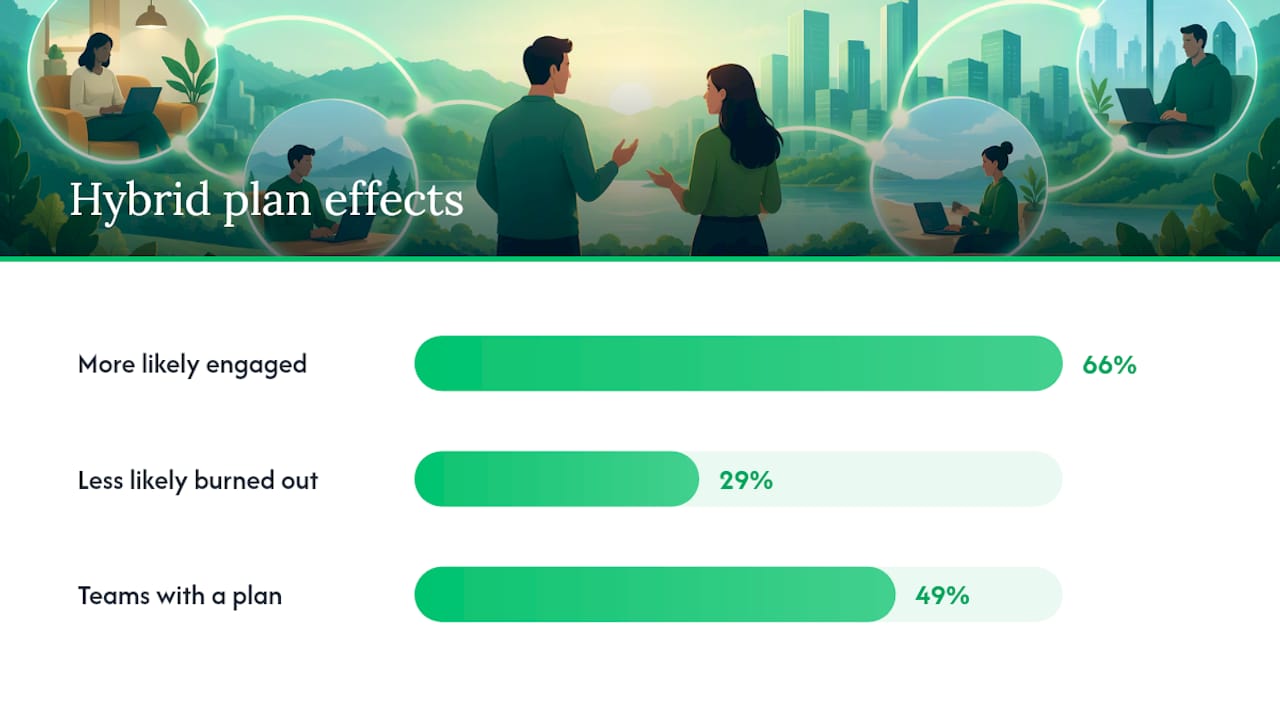
Gallup’s research found that hybrid teams with a formal collaboration plan are 66% more likely to be engaged at work and 29% less likely to report burnout. Yet only about half of hybrid workers say their team has actually sat down and discussed one. That gap between what works and what teams actually do is where most of the missed engagement is hiding.
A pre-registered field experiment run by researchers at Harvard Business School adds an important caveat. The study on team collaboration norms found that interventions like protected focus time and after-hours communication limits improved employees’ sense of time control, and sometimes connection, but the size of the benefit depended almost entirely on whether teams discussed the norms and stuck to them. A plan sitting in a shared drive does nothing. A plan the team revisits and enforces changes outcomes.
Separately, Cisco’s Global Hybrid Work Study found that 92% of employees rate collaboration and community as extremely important to them, but only 49% say their organization gives them consistent tools and processes to work effectively from wherever they are. That’s a tooling and process gap, not a motivation gap.
Three findings worth building your strategy around:
- Teams with a written, discussed collaboration plan are far more likely to be engaged and far less likely to burn out.
- Adherence to norms, not the mere existence of norms, predicts whether hybrid workers feel more time control and connection.
- Most employees value collaboration highly, but organizations frequently fail to give them consistent tools and structure to act on it.
Statistic to remember: Hybrid teams with a documented collaboration plan are 66% more likely to be engaged and 29% less likely to be burned out than teams without one. That single number should justify the hour it takes to run a charter workshop with your team.
Why Does Hybrid Work Change Team Engagement?
Hybrid work doesn’t reduce engagement by design. It reduces the informal moments that used to build trust automatically, and if you don’t replace them intentionally, connection quietly erodes.
A daily-diary study of 219 hybrid employees found that on remote days, workers report meaningfully less informal communication and knowledge sharing than on in-office days. That drop-off directly mediates lower same-day team commitment. Nobody schedules a meeting for the hallway conversation where a junior employee learns how a senior colleague actually handles a tricky client. On a remote day, that conversation just doesn’t happen unless someone builds a substitute for it.
There’s a second mechanism at play: coordination friction. When teams span time zones and schedules, meetings stack up to cover gaps, and “always on” expectations creep in because nobody’s sure when a colleague is actually reachable. That drives stress up, but it’s a design problem, not an inevitability. Clear boundary norms, like defined response windows and core collaboration hours, cut that friction directly.
The flip side matters just as much. Hybrid work can raise autonomy and deepen focus when the structure supports it. Fewer interruptions on remote days, more control over when deep work happens, and less commute fatigue all show up as real gains, but only when the team has been intentional about which days serve which purpose.
Three design levers determine which way hybrid tips for a given team:
- Replace lost informal exchange with structured or lightweight social touchpoints rather than hoping it happens organically.
- Set explicit availability and response-time norms to prevent “always-on” creep.
- Reserve remote days for deep, autonomous work and use in-person time deliberately, rather than defaulting to the same meeting schedule regardless of location.
Pro Tip: Ask your team which specific hallway or coffee-line conversations they miss most on remote days. Then build a five-minute substitute for exactly that exchange, not a generic “virtual coffee” nobody attends.
What Manager Habits Drive Engagement in Hybrid Teams?
Managers explain roughly 70% of the variance in team-level engagement, according to Gallup’s ongoing workplace research, and frequent meaningful feedback correlates with some of the largest engagement gains they’ve measured. That single fact should reorder your priority list. If you’re investing in software, perks, or office redesigns before you’ve fixed manager habits, you’re solving the wrong problem first.
Here are four habits worth building into every manager’s week, whether they lead two people or twenty:
-
Run one weekly meaningful conversation per direct report. Fifteen to twenty minutes, timeboxed, focused on three things: what’s blocking them, what they’re proud of, and one piece of specific feedback. Skip status updates entirely. Those belong in a shared doc, not a conversation slot that’s supposed to build trust.
-
Make accountability outcome-based, not activity-based. Track what got shipped or resolved, not who logged in when. MIT Sloan’s hybrid-work guidance recommends letting the work itself determine which moments need to be in-person, and pairing that with visible, outcome-based accountability so nobody has to guess whether remote work is “real” work.
-
Focus development conversations on individual strengths, not generic competencies. Hybrid setups make it easy for quieter or fully remote employees to fall out of sight during promotion and stretch-assignment conversations. A recurring, individualized development check prevents that drift before it becomes a retention problem.
-
Coach managers on presence, not proximity. Recent research in the Review of Managerial Science frames effective hybrid leadership as responsive engagement, flexibility, and proactive help, not physical visibility. Train your management layer to measure their own effectiveness by responsiveness and follow-through, not by how many hours they’re seen in the office.
Pro Tip: If you manage other managers, audit their calendars for protected one-on-one time before you audit anything else. A manager with zero unbooked slots for direct reports cannot run weekly meaningful conversations, no matter how much you ask them to.
Scaling these habits across a management layer takes more than a memo. Build a short template for the weekly conversation, review adherence in your own one-on-ones with managers, and treat “did this happen consistently” as a metric you track, not an assumption you make.
How Do You Build a Hybrid Team Collaboration Plan?
A collaboration plan works best as a single page your team actually references, not a policy document that lives in an onboarding folder nobody opens twice. Gallup’s own guidance on boosting hybrid team productivity found that giving teams clear guidelines for which activities deserve in-person time increases engagement more reliably than most other hybrid interventions.
Here’s what belongs on that one page:
- Team mission and current priorities — one sentence each, so anyone joining a meeting late understands the “why” fast.
- In-office priorities — the specific work that benefits from being co-located: onboarding, sensitive feedback conversations, complex problem-solving sessions.
- Availability norms — core collaboration hours, expected response windows, and what counts as urgent versus what can wait.
- Communication channels — which tool handles quick questions, which handles decisions, which handles documentation.
- Decision rights — who decides what, and how disagreements get resolved without a meeting.
- Meeting rules — default length, camera expectations, and when a meeting should have been an async update instead.
Build it through a short workshop, not a top-down memo. Draft the fields together, pilot the plan for four to six weeks, then hold a fifteen-minute review to keep what worked and cut what didn’t.
Measuring whether the plan is actually alive matters just as much as writing it. Track a few adherence signals directly:
- How often the team revisits the plan in a recurring meeting, even briefly.
- The percentage of meetings that follow the agreed rules on length and necessity.
- Self-reported time control on your regular engagement survey.
- A specific engagement item asking whether the team has discussed a collaboration plan in the last quarter.
Charitymiles’s engagement plan framework offers a useful complementary structure if you want a more detailed six-step version of this same approach.
What Tools Keep Hybrid Teams Connected Without More Meetings?
The instinct when engagement dips is to add a meeting. Resist it. Most connection problems in hybrid teams are solved with better documentation habits and small rituals, not another calendar invite.
Start with a remote-first documentation default. Every decision, update, and piece of context that used to travel by hallway conversation should land somewhere everyone can find it, whether they were in the office that day or not. A review of hybrid teamwork practices points out that without this default, offices quietly develop a second, invisible information system that remote employees never get access to. Shared task boards and asynchronous written updates close that gap and take pressure off meetings that exist only to relay status.
Knowledge sharing needs different treatment depending on how interdependent the team is. Highly interdependent teams benefit from structured handovers and shared task boards that make dependencies visible. Loosely coupled teams get more value from informal social rituals, like a five-minute optional voice channel at the start of the day, than from formal documentation systems.
A few low-friction practices worth testing:
- Replace one recurring status meeting per week with a written async update.
- Add a fifteen-minute optional pairing session for knowledge transfer between one senior and one junior team member.
- Publish an outcome dashboard visible to the whole team instead of monitoring individual activity or login times.
- Offer occasional optional co-working sessions, virtual or in-person, for employees who want the connection without requiring it.
Pro Tip: Avoid any tool or practice that looks like surveillance, even well-intentioned surveillance. Activity trackers and keystroke monitors erode trust faster than any scheduling problem they claim to solve.
How Did HARMAN Use Movement to Boost Hybrid Engagement?
Charitymiles’s Employee Empowerment Program gives a concrete look at what sustained, inclusive engagement infrastructure looks like in practice, rather than a one-off wellness event. Since HARMAN launched its Charity Miles team in 2021, employee participation increased 11 times over, with more than 1,200 employees generating over $120,000 for charity through everyday walking, running, and biking.
That result tracks with the broader engagement research above. It works because movement is inclusive by design: a lunchtime walk counts exactly as much as a run, so the program doesn’t exclude anyone who isn’t athletic. It also connects personal effort to a visible outcome, which is the same “outcome-based accountability” principle that shows up in hybrid manager guidance, just applied to CSR instead of project work.
Integrating something similar into your own hybrid team requires a few practical decisions:
- Set a recurring team challenge slot, monthly or quarterly, rather than a single annual event.
- Let employees choose their own charity where possible, or align with a company cause when strategic focus matters more.
- Recognize participation publicly, the same way you’d recognize a shipped project.
- Track participation rate and challenge retention over multiple cycles, not just the launch month.
Pair those participation numbers with a couple of survey items on wellbeing and belonging, and you get a direct read on whether the program is doing more than generating donations. Charitymiles’s Employee Empowerment Program page details how companies structure sponsorship and reporting for exactly this kind of ongoing initiative.
A Manager’s 90-Day Playbook
Ninety days is enough time to test this whole framework without waiting for a perfect plan. Treat it as three distinct phases, not one long to-do list.
Month 1: Run the charter workshop, publish the one-page collaboration plan, and launch weekly meaningful conversations with every direct report. Baseline your current engagement numbers before you change anything else, so you have something to compare against later.
Month 2: Pick one collaboration norm to test seriously, something like a response-time window or a meeting-length rule, and run a team challenge alongside it. Track adherence weekly, not just at the end of the month.
Month 3: Review what actually stuck. Scale the norms that showed adherence and drop the ones nobody followed. Refine the charter and your measurement approach based on what the first two months taught you, then repeat the cycle.
— Gene
How Charitymiles Fits Into an Engagement Plan Built on Trust
Most engagement fixes stop at surveys and one-off wellness challenges that fade after a few weeks. A persistent, inclusive program keeps generating participation quarter after quarter, not just during a launch month. Every mile a team member logs, whether it’s a lunchtime walk or a weekend ride, turns into a donation for a cause they care about, which gives the weekly check-ins and collaboration norms above something tangible to rally around.
The Employee Empowerment Program lets you run private team challenges, set your own sponsorship rate and cap, and choose whether donations go to each employee’s charity or a company-selected cause. If you want to see the mechanics before committing, the how it works page walks through the app and sponsorship model step by step, and the corporate sponsorship options page covers how companies structure funding for their programs. Reach out to explore a pilot for your own team this quarter.
Sources
- How to Manage Hybrid and Remote Teams: A Gallup Strategic Guide
- Can Setting Team “Collaboration Norms” Improve the Employee Experience of Hybrid Workers? Results from a Pre-registered Experiment
- Beyond Where We Work: Daily Informal Communication, Knowledge Sharing, and Commitment in Hybrid Teams
- Cisco Global Hybrid Work Study
- Seven essential hybrid-work tips for leaders in 2025
FAQ
What Are the Five C’s of Hybrid Work?
Definitions vary across sources, but common versions center on collaboration, communication, community, connection, and clarity as the pillars organizations need to design for deliberately in hybrid settings. Cisco’s research underscores this directly: 92% of employees rate collaboration and community as extremely important, yet fewer than half feel their organization gives them consistent tools to act on it.
What Are Good Ideas for Remote Team Engagement?
Weekly meaningful one-on-one conversations, a documented team collaboration plan, and recurring inclusive challenges like a movement-based charity program all show measurable engagement benefits. Charitymiles’s engagement challenge ideas page covers additional formats that work across both remote and in-office employees.
What Are the Four Pillars of Hybrid Working?
Most frameworks converge on flexibility, trust, clear communication norms, and outcome-based accountability as the core structural pillars of effective hybrid work. MIT Sloan’s guidance reinforces this by recommending that leaders let the work itself determine which moments genuinely need to be in-person, rather than defaulting to a fixed schedule.
Does a Written Collaboration Plan Actually Improve Engagement in Hybrid Teams?
Yes. Gallup found that hybrid teams with a documented, discussed collaboration plan are 66% more likely to be engaged and 29% less likely to be burned out than teams without one. The plan only works if the team actually revisits and follows it, according to the HBS field experiment on collaboration norms.
How Much Does Charitymiles’ Employee Empowerment Program Cost?
Pricing for the Employee Empowerment Program depends on company size and sponsorship structure, so current details are available directly on the program page. Companies set their own sponsorship rate per mile and total cap, which means cost scales with how the program is configured rather than a fixed price point.