
The CSR approach that most reliably strengthens employer brand is internal, employee-facing CSR that aligns daily employee experience with public claims. The Bentley-Gallup Business in Society Report finds that 43% of Americans trust businesses to act in society’s best interest, well above the 31% who trust the federal government, and that gap is a foundation employers can build on only if the experience matches the message. Charity Miles’ work with HARMAN, where employee participation grew 11 times over after launch, shows what that alignment looks like in practice. The rest of this guide breaks down the evidence, the initiative types that matter most, and how to design and measure a program that holds up.
TL;DR:
- Internal CSR initiatives, like fair pay and safety, have a stronger influence on trust and job pursuit intentions than external philanthropy, especially for already-strong candidates.
- Small, regular CSR touchpoints that employees directly experience increase daily work meaningfulness and engagement more effectively than intermittent large campaigns.
- Credibility depends on honest alignment between internal practices and external messaging; overstated claims can quickly damage employer reputation.
- Designing effective employee-centered CSR requires careful auditing, co-creation with staff, clear framing, set KPIs, and transparency to build and maintain trust.
- The Charity Miles Employee Empowerment program demonstrates how inclusive, employee-driven social responsibility can significantly boost participation and charitable impact with minimal effort.
Table of Contents
- How CSR influences attraction, retention, and engagement
- Which CSR initiatives move the needle for employer brand
- Framework: designing employee-centered CSR that builds employer brand
- How to measure and report CSR’s effect on employer brand
- Case study: Charity Miles’ Employee Empowerment program in action
- Center employees before publicity
- A practical option: Charity Miles Employee Empowerment program
- Sources
- FAQ
How CSR influences attraction, retention, and engagement
The research behind employer brand and CSR points to one underlying mechanism: trust. A 2025 study, Hire Me, I Trust You!, models perceived organizational trustworthiness as the link between a company’s CSR activities and a candidate’s intention to pursue a job there. For candidates who are already a strong fit, internal CSR, meaning fair pay, safety, and development, builds trustworthiness more than external philanthropy does. External CSR still helps, but mainly when fit is uncertain.
A related pathway shows up once someone is already on payroll. A peer-reviewed study on micro-CSR tracked how perceived CSR predicts work meaningfulness, which in turn raises engagement. Small, visible acts of social responsibility, not just headline initiatives, feed that sense of meaning day to day.
A significant portion of Americans trust businesses to act in society’s best interest, more so than the federal government, according to the Bentley-Gallup Business in Society Report. That baseline trust is an asset employers can lose quickly if internal practice contradicts external messaging.
A few patterns worth keeping in mind as you plan:
- Perceived trustworthiness, not the CSR activity itself, is what predicts job pursuit intentions.
- Meaningfulness built through small, regular CSR touchpoints drives engagement more consistently than occasional large campaigns.
- Practitioners surveyed for the ACCP CSR Insights Report report rising pressure to tie programs to measurable business value.
- Claims that outpace lived experience create a credibility gap that can suppress attraction rather than support it.
That last point matters enough to flag on its own. CSR messaging that overstates reality tends to backfire once employees or candidates notice the mismatch, so credibility has a ceiling that authenticity alone protects.
Which CSR initiatives move the needle for employer brand
Not every CSR initiative carries equal weight with candidates and employees. Internal CSR, the practices employees experience directly such as fair pay, safety standards, and career development, tends to matter most for the people you most want to hire: candidates who already see themselves fitting the role and the culture. For that group, internal CSR builds the perceived trustworthiness that drives job pursuit intentions, as the Hire Me, I Trust You! findings show.
Philanthropic and community programs still add value, particularly for candidates who are less certain of fit, and environmental initiatives can strengthen brand perception when they are communicated with the right framing. But neither substitutes for the lived, internal experience.
Practical initiative types worth prioritizing, roughly in order of employer-brand impact:
- Employee wellbeing programs that are inclusive by design, not limited to elite athletes or top performers.
- Fair pay and transparent development paths that employees can point to as evidence, not just policy.
- Volunteering and giving programs that let employees choose causes rather than having one assigned.
- Environmental initiatives communicated with clear, incremental progress markers rather than one-time pledges.
- Internal grants or matching programs that turn individual employee action into visible company support.
Framework: designing employee-centered CSR that builds employer brand
A credible program follows a sequence, and skipping steps is where most CSR initiatives lose trust.
- Audit the gap first. Compare what your external CSR messaging claims against what employees actually experience day to day, and be honest about where the two diverge.
- Co-design with employees. Involve the people who will participate in choosing causes, formats, and cadence, since autonomy is part of what makes an initiative feel meaningful rather than mandated.
- Match the framing to the initiative. Community-focused programs tend to land better with commitment framing, a clear pledge and follow-through, while environmental initiatives often perform better with progress framing that shows incremental movement.
- Set three to five KPIs before launch. Decide what you will measure, such as participation rate or internal engagement scores, before the first employee signs up, not after.
- Build in transparency controls. Publish timelines, share interim results even when they are modest, and use third-party validation where it is available to avoid the appearance of greenwashing.
Pro Tip: Launch with a small pilot team before a company-wide rollout: it surfaces friction points early and gives you real participation data to cite when you expand.
The ACCP CSR Insights Report notes that CSR teams face growing pressure both to tie their work to business value and to measure that impact, with 56% of practitioners reporting increased measurement pressure. Building measurement into the design phase, rather than retrofitting it later, is what lets a CSR program hold up under that scrutiny.
How to measure and report CSR’s effect on employer brand
Proving CSR’s effect on employer brand starts with picking metrics you can actually track. Useful KPIs include:
- Participation rate in CSR programs, pulled from program dashboards or engagement platforms.
- Internal engagement scores or eNPS, tracked through regular pulse surveys.
- Applicant quality and source, drawn from your ATS.
- Turnover and retention changes among participants versus non-participants, from HRIS data.
- Direct program outputs, such as funds raised or volunteer hours logged.
For attribution, keep it simple: compare participation cohorts against non-participants, track changes before and after a launch, and avoid claiming causation from a single data point. The ACCP CSR Insights Report shows that 51% of practitioners already feel pressure to connect CSR work to business value, which makes disciplined, modest attribution language a safer long-term strategy than overclaiming.
Case study: Charity Miles’ Employee Empowerment program in action
HARMAN’s experience with Charity Miles’ Employee Empowerment Program illustrates the framework in practice. Since launching its team in 2021, HARMAN saw an 11-fold increase in employee participation, with more than 1,200 employees generating over $120,000 for charity.
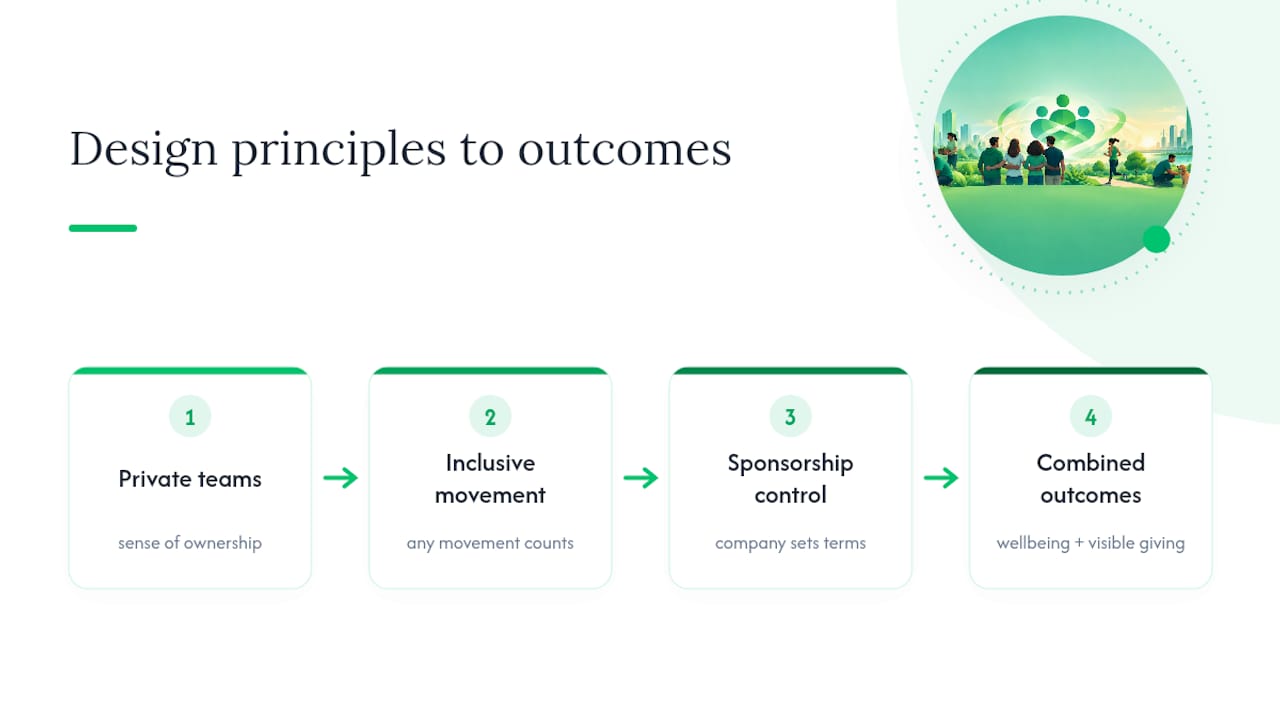
The program’s structure maps directly onto the design principles above: private teams give employees a sense of ownership, any form of movement counts so participation is inclusive rather than limited to top athletes, and companies control sponsorship terms. That combination of employee wellbeing and visible, personal giving is what turns a wellness challenge into a CSR story employees can point to as real.
Center employees before publicity
The strongest employer brands treat CSR as something employees live, not something marketing announces. If a program cannot survive an employee describing it honestly to a friend, it will not survive scrutiny from a candidate either. Shift budget and design time toward internal, employee-driven CSR and toward the measurement discipline that keeps it credible, including incorporating cadeaux d’entreprise as a lever to strengthen engagement. That protects the brand and reduces attraction and retention risk far more reliably than a well-produced campaign.
— Gene
A practical option: Charity Miles Employee Empowerment program
If you are looking for a way to put employee-centered CSR into practice without building a program from scratch, the Employee Empowerment program from Charity Miles turns everyday movement into charitable impact your employees can see and feel.
Companies create private teams, run friendly challenges, and choose their own sponsorship terms, including the rate per mile and whether donations go to an employee’s chosen charity or a company cause. It sits alongside other employee-centered approaches such as volunteering programs and internal grants, offering a lower-effort way to combine wellbeing, giving, and team building in one place.
- Inclusive by design: any walk, run, or bike ride counts, not just competitive performance.
- Notable results: HARMAN’s team saw a large increase in participation and raised a substantial amount for charity.
- Full control: your company sets the sponsorship cap and chooses how donations are allocated.
Explore Corporate Sponsorship Opportunities or see how the Charity Miles app works to decide if it fits your CSR calendar this year.
Sources
- Bentley-Gallup Business in Society Report (2025)
- ACCP CSR Insights Report (2025)
- Perceived CSR to work engagement via meaningfulness (PMC article)
- Hire Me, I Trust You! Perceived organizational trustworthiness and the effect of CSR activities on job pursuit intentions
FAQ
What is CSR branding?
CSR branding is the practice of shaping how a company is perceived based on its social and environmental commitments, both to the public and to its own workforce. When the internal experience matches the external claim, it builds the kind of trust the Bentley-Gallup Business in Society Report links to stronger perceptions of business overall.
What are the four P’s of employer branding?
Definitions vary across practitioners, but a common version covers people, purpose, promise, and proposition, referring respectively to who represents the company, why it exists, what it pledges to employees, and what it offers in return. CSR most directly strengthens the purpose and promise components when programs are employee-driven rather than announced from the top.
What is the best CSR brand?
There is no single ranked “best” CSR brand; credibility depends on whether a company’s internal practices match its public claims, as shown by research on perceived organizational trustworthiness. Programs that involve employees directly, such as inclusive wellness or giving challenges, tend to earn more genuine recognition than campaigns built mainly for external audiences.
What is CSR in employment?
In an employment context, CSR refers to the social and environmental practices an employer builds into daily work life, including fair pay, safety, employee wellbeing, and opportunities to give back. Research on micro-CSR shows these day-to-day practices shape how meaningful employees find their work, which in turn affects engagement.