
A high-impact employee wellbeing strategy embeds wellbeing into work design, not just perks. Appoint an executive sponsor, run a rapid wellbeing scan, set three measurable priorities, and launch a 90-day pilot with a defined cohort before scaling anything.
Your immediate action checklist:
- Appoint a sponsor. Name a C-suite owner who can protect budget and influence work design decisions.
- Run a rapid scan. Deploy a five-question pulse survey and pull absence, benefits utilization, and turnover data within two weeks.
- Set three priorities. Choose the wellbeing elements where risk is highest and manager behavior most influences outcomes.
- Pick your KPIs. Select two leading indicators and two lagging indicators before the pilot starts.
- Define your pilot cohort. Choose a 50–200 person group, set a 90-day window, and agree on success criteria in advance.
The board-level verdict: wellbeing is a workforce strategy, not an HR side project. Govern it, measure it, and fund it accordingly.
Key Takeaways
A durable employee wellbeing strategy requires governance, measurement, and integration into work design, not just a portfolio of programs.
| Point | Details |
|---|---|
| Governance before programs | Appoint an executive sponsor and cross-functional steering group before launching any intervention. |
| Target high-risk populations first | Comprehensive programs can return an estimated $4.90 per $1 spent, with higher ROI for higher-risk participants. |
| Use plausibility metrics | Track assessment completion, enrollment, and 90-day participation before expecting lagging indicators to move. |
| Manager capability is the highest-leverage investment | Managers mediate career, social, and mental health outcomes more directly than any vendor-supplied program. |
| Charitymiles for physical and social wellbeing | The Employee Empowerment Program combines movement, CSR, and team challenges to raise participation across all fitness levels. |
Table of Contents
- Why your employee wellbeing strategy needs a business case first
- What does employee wellbeing actually cover?
- What does the evidence say about wellbeing ROI?
- How should you structure the governance of a wellbeing strategy?
- How do you implement a wellbeing strategy step by step?
- Which interventions actually work across the five wellbeing elements?
- How do you measure employee wellbeing effectively?
- What are the most common pitfalls in wellbeing programs?
- What do real wellbeing programs look like in practice?
- What does a realistic wellbeing budget look like over 12 months?
- What templates and tools should you use to get started?
- What should HR leaders prioritize above everything else?
- How Charitymiles supports your wellbeing strategy with movement and purpose
- Sources
Why your employee wellbeing strategy needs a business case first
A well-designed workplace wellbeing plan delivers three measurable outcomes: lower voluntary turnover, higher productivity per employee, and greater organizational resilience during disruption. The evidence is consistent enough that the question is no longer whether to invest, but where to start and how to measure progress.
The Business Group on Health’s 2026 survey shows employers are moving wellbeing from a benefits add-on into workforce strategy, with mental and physical health as the top priorities and rising expectations for vendor accountability. That shift reflects a broader recognition: programs that sit outside the flow of work rarely sustain participation long enough to produce ROI.
Three priorities consistently yield the strongest early returns: manager capability (because managers mediate most wellbeing outcomes), access to mental health support (where unmet need is high and productivity loss is measurable), and workload design (the structural lever that no app or benefit can replace).
The evidence anchor: Gallup research links career wellbeing to retention and burnout reduction, and an academic evaluation of a comprehensive wellness program found an estimated $4.90 saved for every $1 spent, with higher returns for participants at greater baseline risk.
What does employee wellbeing actually cover?
Employee wellbeing is the sustained experience of thriving across five interconnected elements: career, social, financial, physical, and community. It is not the same as a wellness program. A wellness program is a set of interventions. Wellbeing is the outcome those interventions are trying to influence, and it is shaped far more by daily work conditions than by any single benefit or event.
Gallup’s research identifies career wellbeing as the foundation. When employees find meaning in their work, have clear expectations, and see a path forward, the other four elements are easier to sustain. Organizations that strengthen career wellbeing see lower burnout and higher retention, which is why it belongs at the center of any workplace wellbeing plan.
The five elements, briefly:
- Career wellbeing: Liking what you do each day, having a manager who cares, and seeing a future at the organization.
- Social wellbeing: Having trusted relationships at work and a sense of belonging.
- Financial wellbeing: Managing economic life without chronic stress, including access to emergency savings and retirement planning.
- Physical wellbeing: Having the energy to do your best work, supported by movement, sleep, and preventive care.
- Community wellbeing: Feeling connected to something larger, including the organization’s social purpose.
Scope matters for measurement. A distributed or remote workforce needs digital-first access to every element. Shift workers and frontline employees often face higher physical and financial risk. Segment your workforce by role type, geography, and risk profile before designing interventions, or you will build a program that fits your office population and misses everyone else.
What does the evidence say about wellbeing ROI?
The business case for wellbeing investment is strong, but the ROI profile varies significantly by intervention type. That distinction shapes where you should put your first dollars.
An observational evaluation of a comprehensive workplace wellness program estimated approximately $4.90 saved per $1 invested, with the highest returns concentrated among participants at greater baseline health risk. That finding points to a practical principle: target early investment at high-risk populations where clinical or cost-reduction ROI is most plausible, rather than spreading resources evenly across the workforce.
RAND’s analysis adds an important nuance. Disease-management components often produce larger near-term cost savings than lifestyle-management components. Lifestyle programs still reduce health risks and absenteeism, but their short-term ROI tends to be weaker. This does not mean lifestyle programs are not worth running. It means you should set realistic timelines: expect 12–24 months before lifestyle interventions show up in claims data, and use plausibility metrics in the interim.
Plausibility metrics are the bridge between activity and outcome. Rather than waiting for annual healthcare spend to shift, you track the steps that plausibly produce savings: assessment completion rates, program enrollment, sustained participation at 90 days, and early behavior-change indicators. HERO and PHA recommend measuring across this value chain, from assessment through sustained behavior change, so you can show progress to leadership before lagging indicators move.
Statistic to anchor your business case: An estimated $4.90 saved per $1 spent in a comprehensive wellness program, with higher ROI for higher-risk participants. (Source)
Pro Tip: Focus your first ROI conversation on the two or three interventions where manager behavior directly influences outcomes. Manager-mediated programs show faster participation gains and are easier to attribute than population-wide lifestyle campaigns.
How should you structure the governance of a wellbeing strategy?
Governance is what separates a wellbeing strategy from a collection of wellness events. Without it, programs get cut when budgets tighten and never accumulate enough data to prove their value.
Gartner warns that bolt-on wellness programs tend to show diminishing returns. The more effective path is embedding wellbeing into work design, leadership practices, and operational decisions. That requires cross-functional ownership, not just an HR project plan.
Five core principles for a durable strategy:
- Integrate into work design. Wellbeing decisions belong in workload planning, meeting culture, and job design, not only in the benefits catalog.
- Be evidence-driven. Choose interventions with a plausible mechanism and a measurement plan before launching.
- Design for inclusion. Every intervention should be accessible to remote, frontline, and part-time employees, not just office-based staff.
- Protect privacy. Aggregate data before reporting; never report individual-level health data to managers.
- Align to business priorities. Connect wellbeing metrics to the workforce outcomes finance and operations already track.
Governance structure:
- Executive sponsor: A C-suite leader (CHRO, COO, or CEO) who owns the strategy and protects budget.
- Cross-functional steering group: Representatives from HR, Finance, Operations, and Communications, meeting quarterly.
- Delivery owner: A named HR or People Analytics lead who runs the monthly operational cadence.
- Data owner: Someone accountable for privacy compliance, cohort-size minimums, and reporting integrity.
The Business Group on Health’s 2026 survey confirms that organizations embedding wellbeing into workforce strategy are also increasing vendor accountability and using dashboards to drive decisions. That governance posture, not the program itself, is what keeps wellbeing funded through budget cycles.
Pro Tip: Tie two plausibility metrics directly to the quarterly finance report. When wellbeing data appears alongside headcount cost and turnover figures, it becomes a business metric rather than an HR metric, and it survives budget reviews.
How do you implement a wellbeing strategy step by step?
Implementation follows five stages: assess, prioritize, design, pilot, and scale. Rushing past the first two is the most common reason programs miss their targets.
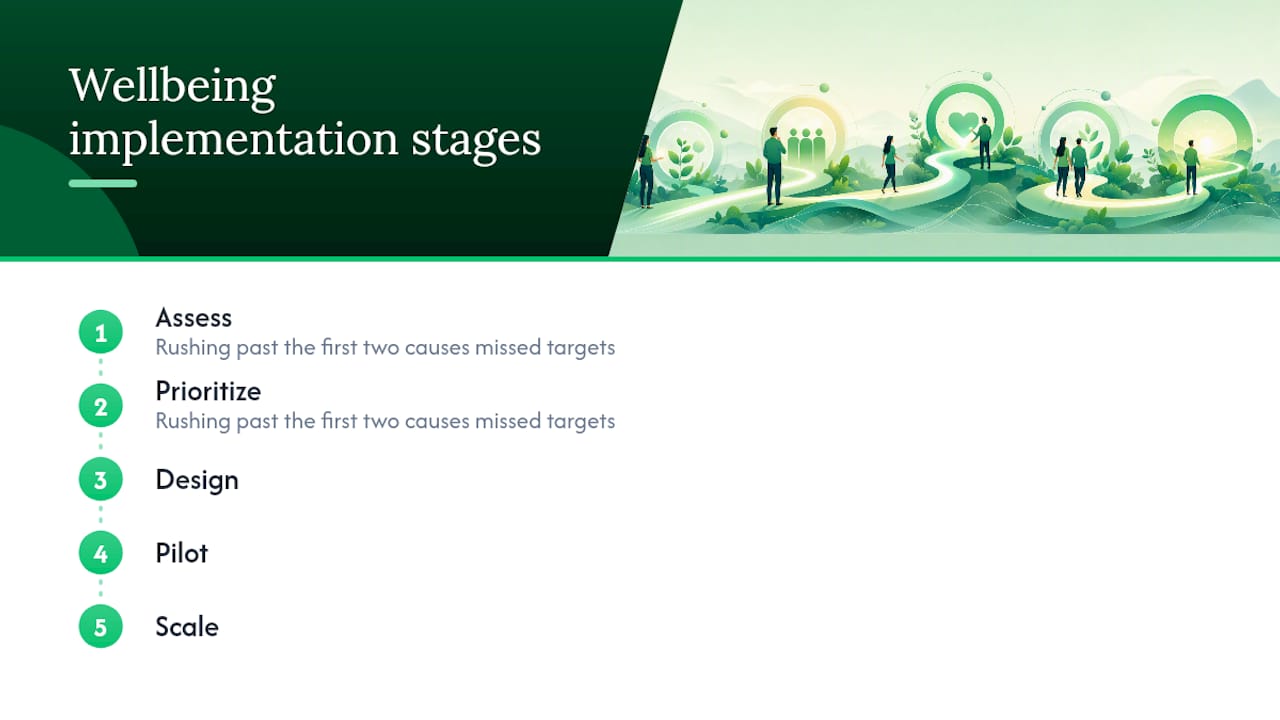
Stage 1: Assess
Collect the minimum data set quickly. A five-question pulse survey, combined with absence rates, benefits utilization by category, and manager feedback from existing engagement surveys, gives you enough signal to act within two to three weeks. You do not need a perfect dataset to start.
Stage 2: Prioritize
Segment your workforce by role type, risk level, and geography. Identify the three wellbeing elements where need is highest and where your organization has the most leverage. Career wellbeing is almost always one of them, because managers influence it directly and it affects every other element.
Stage 3: Design
Mix three intervention types: prevention (reducing risk before it becomes a problem), early support (catching issues before they escalate), and responsive care (accessible help when employees need it). Run an accessibility checklist: Can a remote employee in a different time zone use this? Can a frontline worker access it without a company email?
Stage 4: Pilot
Choose a cohort of 50–200 employees. Where possible, use a staged rollout rather than a simultaneous launch so you have a comparison group. Define success criteria before the pilot starts: what participation rate, what behavior-change indicator, and what manager-reported outcome would tell you the intervention is working? Run the pilot for at least 90 days before evaluating.
Stage 5: Scale
At the 90-day gate, review plausibility metrics against your pre-defined criteria. Scale what is working, iterate what is close, and retire what is not. A 12-month timeline typically looks like this: months 1–2 for assessment and design, months 3–5 for the pilot, month 6 for evaluation, and months 7–12 for phased rollout with quarterly check-ins.
Which interventions actually work across the five wellbeing elements?
The most effective interventions are the ones employees actually use. Accessibility, low friction, and manager endorsement drive participation more reliably than program design alone. Here is a curated set organized by wellbeing element, with effort and cost flags.
Career wellbeing
- Manager coaching and capability training: High impact, medium cost. Managers who hold regular one-on-ones and career conversations reduce burnout risk more than most clinical interventions. This is the highest-leverage investment for most organizations.
- Clarity of expectations: Low cost, high return. Role clarity reduces anxiety and improves focus. Build it into onboarding and performance cycles, not as a separate program.
Mental and physical health
- EAP and telehealth access: Medium cost, broad reach. Ensure employees know the service exists and can access it in under five minutes. Utilization rates below 5% usually signal an awareness or stigma problem, not a program design problem.
- On-demand coaching and mental health apps: Low to medium cost. Useful for employees who will not use an EAP but will engage with a self-directed tool.
- Recovery and rest policies: Low cost, high signal value. Policies that protect recovery time (no-meeting Fridays, minimum PTO usage expectations) signal that leadership means what it says about wellbeing.
Financial wellbeing
- Financial education workshops and digital tools: Low cost. Cover budgeting, debt management, and retirement basics. Pair with access to a financial counselor for employees in acute stress.
- Emergency savings pathways: Medium cost. Employer-facilitated emergency savings accounts reduce financial anxiety and absenteeism among lower-wage employees.
Social and community wellbeing
- Team rituals and connection practices: Low cost. Structured check-ins, peer recognition, and team challenges build social capital without requiring large budgets.
- CSR-linked activity challenges: Low to medium cost, high participation potential. Movement-for-good programs, where employees log walks, runs, or bike rides that generate charitable donations, combine physical activity with social connection and community purpose. These programs tend to attract employees who would not join a traditional fitness challenge, because the motivation is contribution rather than competition. Wellness challenges tied to giving back consistently show higher sustained participation than performance-only challenges.
How do you measure employee wellbeing effectively?
Measurement is where most wellbeing programs lose credibility. Reporting only top-line cost savings after 12 months tells leadership nothing about what is working or why. A layered measurement approach, with leading indicators reported monthly and lagging indicators reviewed quarterly, keeps the program accountable without waiting for annual claims data.
HERO and PHA’s measurement guide recommends tracking the full value chain: assessment completion, program enrollment, sustained participation at 90 days, and behavior-change indicators, before expecting lagging outcomes like reduced absenteeism or lower healthcare spend to appear.
Recommended KPI set:
| Metric | Data source | Cadence | Owner |
|---|---|---|---|
| Pulse survey score (5-item) | Survey platform | Monthly | HR/People Analytics |
| Program enrollment rate | Vendor dashboard | Monthly | Delivery owner |
| 90-day sustained participation | Vendor dashboard | Quarterly | Delivery owner |
| Absenteeism rate by cohort | HRIS | Quarterly | HR Analytics |
| Voluntary turnover (pilot vs. control) | HRIS | Quarterly | HR Analytics |
| Healthcare cost trend | Benefits/Finance | Annually | Finance/Benefits |
| Manager-reported team wellbeing | Manager survey | Monthly | HR Business Partners |
Privacy rules for safe reporting: Never report individual-level health data. Set a minimum cohort size of 10 employees for any aggregate report. Separate health data from performance data at the system level, not just by policy. The OECD’s harmonized wellbeing survey framework recommends multidimensional measurement that includes employee perceptions of job conditions alongside health outcomes, which gives you a richer signal without requiring sensitive clinical data.
Report to managers weekly on team-level flags (pulse dips, absenteeism spikes). Report to HR leadership monthly on program uptake and leading indicators. Report to the executive steering group quarterly on the full KPI set, including lagging indicators and ROI plausibility.
Measurement anchor: HERO and PHA recommend measuring the steps that plausibly produce savings, from assessment through sustained behavior change, rather than reporting only top-line cost outcomes. (Source)
What are the most common pitfalls in wellbeing programs?
Most wellbeing programs fail for the same five reasons. Knowing them in advance is the fastest way to avoid them.
- Bolt-on initiatives with no governance. A yoga app or a step challenge launched without a sponsor, a measurement plan, or manager involvement will plateau within 60 days. Prevention: build governance before you build the program.
- Weak or absent manager involvement. Managers are the primary mediator of career and social wellbeing. A program that bypasses them will not reach the employees who need it most. Prevention: train managers before launch and include manager-reported metrics in your KPI set.
- Privacy missteps. Sharing individual health data with managers, even with good intentions, destroys trust and participation. Prevention: set cohort-size minimums and separate health data from performance systems at the architecture level.
- No segmentation. A single program designed for office-based employees will miss frontline, remote, and part-time workers. Prevention: segment by role type and access profile during the design stage.
- Claiming ROI too early. Reporting cost savings after a 60-day pilot without a control group damages credibility with Finance. Prevention: use plausibility metrics for the first 6–12 months and reserve ROI claims for programs with cohort controls and sufficient follow-up time.
Any one of these warrants a design review before continuing.
What do real wellbeing programs look like in practice?
Three short examples illustrate how the principles above play out, and what each organization would do differently on the next iteration.
A mid-size manufacturer reduces absenteeism through manager training
A 2,400-employee manufacturing company identified high absenteeism and low engagement scores concentrated in three plant locations. Rather than launching a new benefits program, they invested in manager capability training focused on recognition, workload conversations, and early mental health referrals. After six months, the pilot locations showed a measurable reduction in unplanned absence compared to non-pilot sites. The lesson: the intervention that moved the needle was not a new app or vendor. It was manager behavior.
What they would do differently: start the pulse survey two months earlier to establish a cleaner baseline before the training began.
A CSR-linked movement challenge lifts participation across a distributed workforce
A financial services firm with 1,800 employees across 12 states struggled with low participation in traditional wellness programs, particularly among remote workers who felt disconnected from company culture. They launched a movement-for-good challenge where employee miles generated charitable donations to causes employees chose. Participation reached levels the firm had not seen with previous fitness challenges, and post-program survey data showed higher scores on social connection and sense of purpose.

What they would do differently: integrate the challenge data with the existing pulse survey cadence so participation and wellbeing scores could be tracked in the same reporting cycle.
A technology company embeds wellbeing into work design
The gap was not awareness. It was stigma and friction. They redesigned the referral pathway so managers could share the EAP link in a one-click message, added a no-meeting Thursday policy, and introduced a quarterly “workload audit” where teams reviewed task volume with their managers. Pulse scores on workload manageability improved within 90 days.
What they would do differently: pair the workload audit with a financial wellbeing check-in, since financial stress was a secondary driver that the initial assessment underweighted.
What does a realistic wellbeing budget look like over 12 months?
Budget ranges vary widely by workforce size and program scope, but three bands cover most mid-size to enterprise situations.
- Small organizations (under 500 employees): A pilot-focused budget typically covers a pulse survey platform, manager training, and one or two vendor-supported interventions (EAP, a movement challenge, or a financial wellness tool). The priority is governance and measurement infrastructure, not program breadth.
- Mid-size organizations (500–5,000 employees): A phased budget adds segmented programming, a dedicated delivery owner, and vendor contracts with accountability metrics built in. The Business Group on Health’s 2026 survey reflects that employers at this scale are increasing vendor accountability expectations, which means procurement should include outcome reporting requirements, not just service descriptions.
- Enterprise organizations (5,000+ employees): Budget at this scale includes global program adaptation, a technology stack for measurement and personalization, and a formal vendor governance process. AI-assisted personalization is emerging as a tool employers are evaluating. However, governance frameworks for it are still developing.
Phased 12-month timeline:
- Months 1–2: Assessment, governance setup, sponsor appointment, KPI selection.
- Months 3–5: Pilot design and launch with a defined cohort; plausibility metrics tracked weekly.
- Month 6: Pilot evaluation against pre-defined success criteria; scale, iterate, or retire decision.
- Months 7–12: Phased rollout of proven interventions; quarterly steering group reviews; annual ROI report to Finance.
For global workforces, adapt interventions by region rather than translating a US-designed program directly. Financial wellbeing tools, EAP providers, and even movement challenge platforms need local compliance review. Build that review into months 1–2, not as an afterthought at rollout.
What templates and tools should you use to get started?
Three assets will carry most of your first 90 days.
Rapid pulse survey (5 items): Ask about workload manageability, manager support, sense of purpose, access to resources, and overall wellbeing score. Keep it anonymous, report at the team level only, and run it monthly. The OECD’s harmonized wellbeing survey provides a validated multidimensional framework you can adapt for your organization.
Pilot plan template: One page covering cohort definition, intervention description, success criteria, measurement plan, and decision gate. Share it with Finance before the pilot starts so the evaluation criteria are agreed in advance.
KPI dashboard fields: Pulse score trend, program enrollment rate, 90-day sustained participation, absenteeism by cohort, and voluntary turnover. The HERO/PHA measurement guide and MiHCM’s employee wellness metrics guide both provide field definitions and cadence recommendations you can use directly.
First 90 days: suggested owners
- Executive sponsor: owns the strategy narrative and budget protection.
- Delivery owner (HR): runs the pulse survey, coordinates vendors, and reports to the steering group.
- Finance partner: validates the measurement plan and reviews the pilot evaluation.
- Communications lead: manages the launch message and ongoing employee-facing updates.
Communications checklist for launch: Announce the sponsor by name. Explain what you are measuring and why. Commit to a reporting cadence employees can hold you to. Address privacy explicitly. Make participation easy and visible.
Measurement reminder: Programs that report plausibility metrics monthly sustain executive support through budget cycles far more reliably than programs that wait for annual ROI data.
What should HR leaders prioritize above everything else?
Here is my honest recommendation, drawn from the evidence in this guide: fund manager capability and measurement infrastructure before you fund any new program or vendor.
Most wellbeing programs underperform not because the interventions are wrong, but because managers are not equipped to reinforce them and the organization has no way to tell whether anything is working. A manager who holds regular one-on-ones, gives clear expectations, and knows how to make a mental health referral does more for employee wellbeing than any app you could deploy. And a measurement system that reports plausibility metrics monthly keeps the strategy funded and credible through the inevitable budget pressure that follows every new initiative.
The temptation is to launch something visible quickly, a challenge, an app, a new benefit, because it signals action. Resist it. Spend the first 60 days on governance, sponsor appointment, and a clean baseline measurement. Then pilot one or two targeted interventions with a defined cohort and real success criteria. That sequence is slower to start and far more likely to produce outcomes worth reporting.
How Charitymiles supports your wellbeing strategy with movement and purpose
Physical and social wellbeing are two of the five elements most organizations struggle to address at scale, especially for distributed and remote employees. Charitymiles’s Employee Empowerment Program addresses both through a model that is genuinely different from a standard step challenge.
Employees walk, run, or bike, and every mile generates a charitable donation to a cause they choose. Companies create private team challenges, set their own sponsorship rate and cap, and get reporting on participation and impact. Because any movement counts and the motivation is contribution rather than competition, the program reaches employees who would not engage with a performance-focused fitness challenge.
For HR leaders building a wellbeing strategy, Charitymiles fits naturally into the social and community wellbeing elements, and it works as a low-friction, high-visibility pilot intervention. It is inclusive by design, free for individual employees, and configurable for your CSR goals. To see how it fits your program mix, visit the corporate wellness programs page or explore CSR-linked engagement options for your team.
Sources
- Employee Wellbeing: A Practical Guide (Gallup)
- 2026 Employer Well-being Strategy Survey: Executive Summary | Business Group on Health
- Evaluation of a comprehensive workplace wellness program and associated ROI (PMC/academic article)
- Program measurement & evaluation guide: core metrics for employee health management (HERO & PHA)
- Employee wellbeing in the workplace (Gartner)