
Coordinating employee resource groups, mentoring, event programming, and participation data often becomes scattered across multiple systems or manual processes. Many existing tools split features across separate platforms, lack real time analytics, or require enterprise buyers to wait for custom pricing instead of publishing clear options. This comparison covers control, automation, analytics, and pricing transparency across five employee engagement platforms so HR and DEI teams can pick one that fits their scale and reporting needs.
Table of Contents
Charity Miles
At a Glance
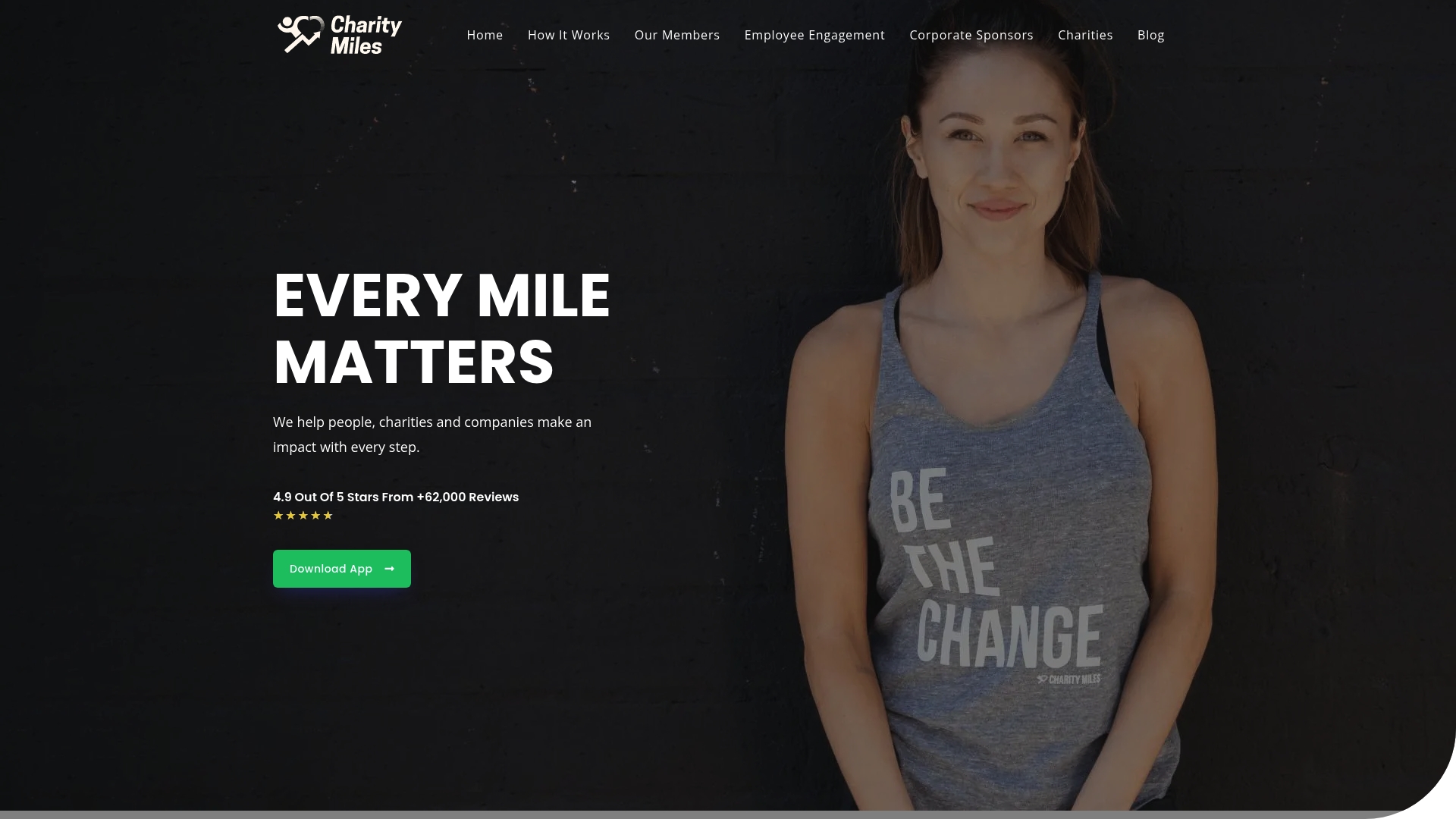
Charity Miles reports that HARMAN saw an 11x increase in employee participation after launching a Charity Miles team in 2021. The app converts walking, running, and biking into donations and is free for members and charities. Companies can create private teams and sponsor employee miles to direct giving.
Core Features
Charity Miles tracks walking, running, biking, and indoor activities using phone sensors and integrates with common fitness platforms. It connects with Apple Health, Google Fit, and Strava, and it accepts manual mileage entries through an honor system. Teams can run company challenges and set sponsorship rules for donated funds.
Key Differentiator
The platform turns everyday movement into charitable donations with minimal setup and broad device connections. Companies choose the sponsorship rate per mile and set a total sponsorship cap. That control lets HR link routine activity directly to CSR goals without new fundraising infrastructure.
Pros
Charity Miles lets members give to causes passively by tracking daily movement. The app supports indoor and outdoor activity types and multiple device syncs, which helps teams with varied fitness habits. It is free for members and for charities, which lowers the bar to join for supporters and teams.
The vendor advertises that Charity Miles has generated tens of millions of dollars for charity since 2012. That reported scale shows how donations accumulate when companies run ongoing challenges rather than single events.
Cons
- Reliance on phone sensors can produce inaccurate readings for indoor biking or elliptical workouts.
Who It’s For
HR and CSR leaders at mid-size and enterprise organizations that want a low-effort way to add measurable giving to wellness programs. The app also fits active employees who want their daily movement to support causes. Charities and fundraising teams can use it to engage supporters through team challenges.
Unique Value Proposition
Companies create private teams, choose a sponsorship rate per mile, and set a sponsorship cap while letting employees pick beneficiary charities or use a company-selected cause. That setup transfers the logistics of giving into ongoing employee behavior rather than a one off event. The result is measurable, recurring donations that tie directly to participation and morale.
Real World Use Case
An HR team launches a private Charity Miles group for a quarterly wellness campaign. The company sponsors every mile at a set rate and posts team leaderboards to internal channels. Employees log walks and bike commutes, the app tallies donations, and the company reports visible CSR impact while the team builds cohesion.
Website: https://charitymiles.org
Chezie
At a Glance
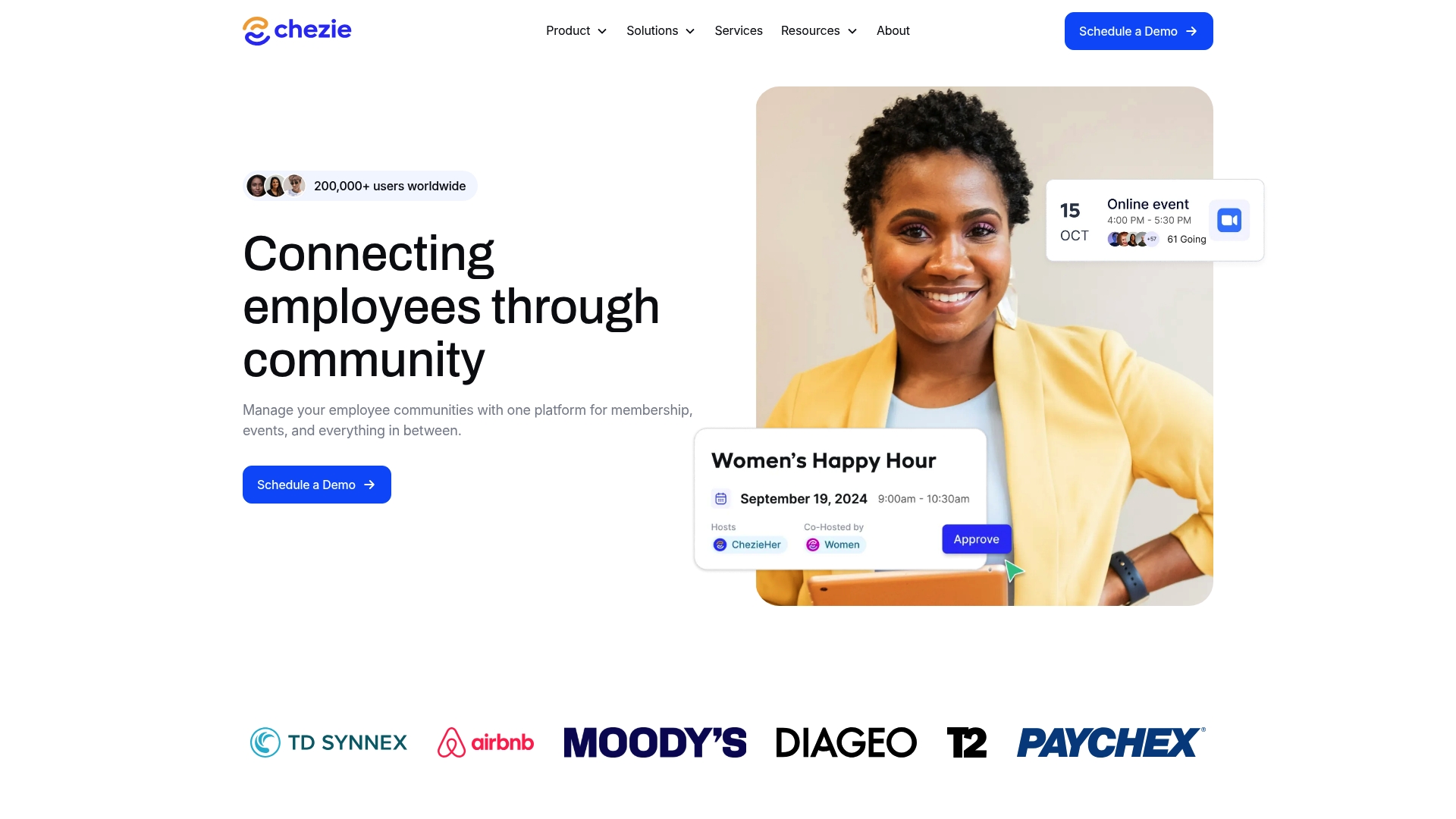
Plans begin at $19/month with higher tiers at $49 and $99 per month, showing a clear tiered model for teams of different sizes. The platform combines membership tools, event planning, analytics, and training services aimed at scaling ERGs and interest groups. That mix targets HR teams and DEI leads who need more than a simple community directory.
Core Features
Chezie includes Membership management, event planning and tracking, and approval workflows for permissions and compliance. The platform delivers Real-time analytics and reporting to measure engagement and identify gaps in participation. Automated communications cover email plus Slack and Teams, so groups keep momentum without manual outreach.
Key Differentiator
Chezie positions itself as an all in one solution that merges community management, analytics, automation, and identity integrations with HR systems. The platform adds training, workshops, and optional consulting to develop ERG leaders and strategy. That combination shifts work from tactical coordination to ongoing leadership development and measurement.
Pros
The product centralizes ERG administration and reporting, which reduces duplicate spreadsheets and meeting overhead. Integrations with collaboration and identity systems let you map membership to company directories and automate event invites. The vendor also offers training and consulting, which helps ERG leaders run programs and use analytics to argue for budgets and executive support.
Cons
-
Limited independent user reviews. User sentiment beyond vendor examples is sparse, so broader reliability and adoption details are not well documented.
-
Can feel complex for small teams. The feature set and consulting options may exceed the needs of a single volunteer-led ERG.
-
Pricing appears premium for small budgets. The tiered fees suggest a heavier cost as you add groups or need advanced services.
When It May Not Fit
Small companies or single-ERG programs that only need a lightweight membership list and occasional events will likely prefer simpler tools. Organizations that cannot allocate time for leader training or change management may not realize the value from the platform components. Buyers who require an off the shelf, no-configuration solution should look elsewhere.
Notable Integrations
- Slack
- Outlook
- Zoom
- Teams
- Google Meet
- Okta
- Azure AD
- Workday
Who It’s For
Large enterprises, HR teams, and DEI professionals managing multiple ERGs or employee communities will get the most from Chezie. The platform fits organizations that want to link membership to identity stores and measure program impact. It also suits teams planning ongoing leader development and formal governance.
Real World Use Case
PagerDuty centralizes ERG programming on Chezie to unify event calendars and membership data. The company uses analytics to identify participation gaps and to prioritize outreach for underrepresented groups. That approach helped move ERG work from ad hoc activities to tracked programs with measurable outputs.
Pricing
The vendor lists starter pricing at $19/month with mid and higher tiers at $49 and $99 per month, indicating a tiered subscription model. Detailed seat counts or feature limits per tier are not publicly listed and require a vendor conversation.
Website: https://chezie.co
Teleskope
At a Glance
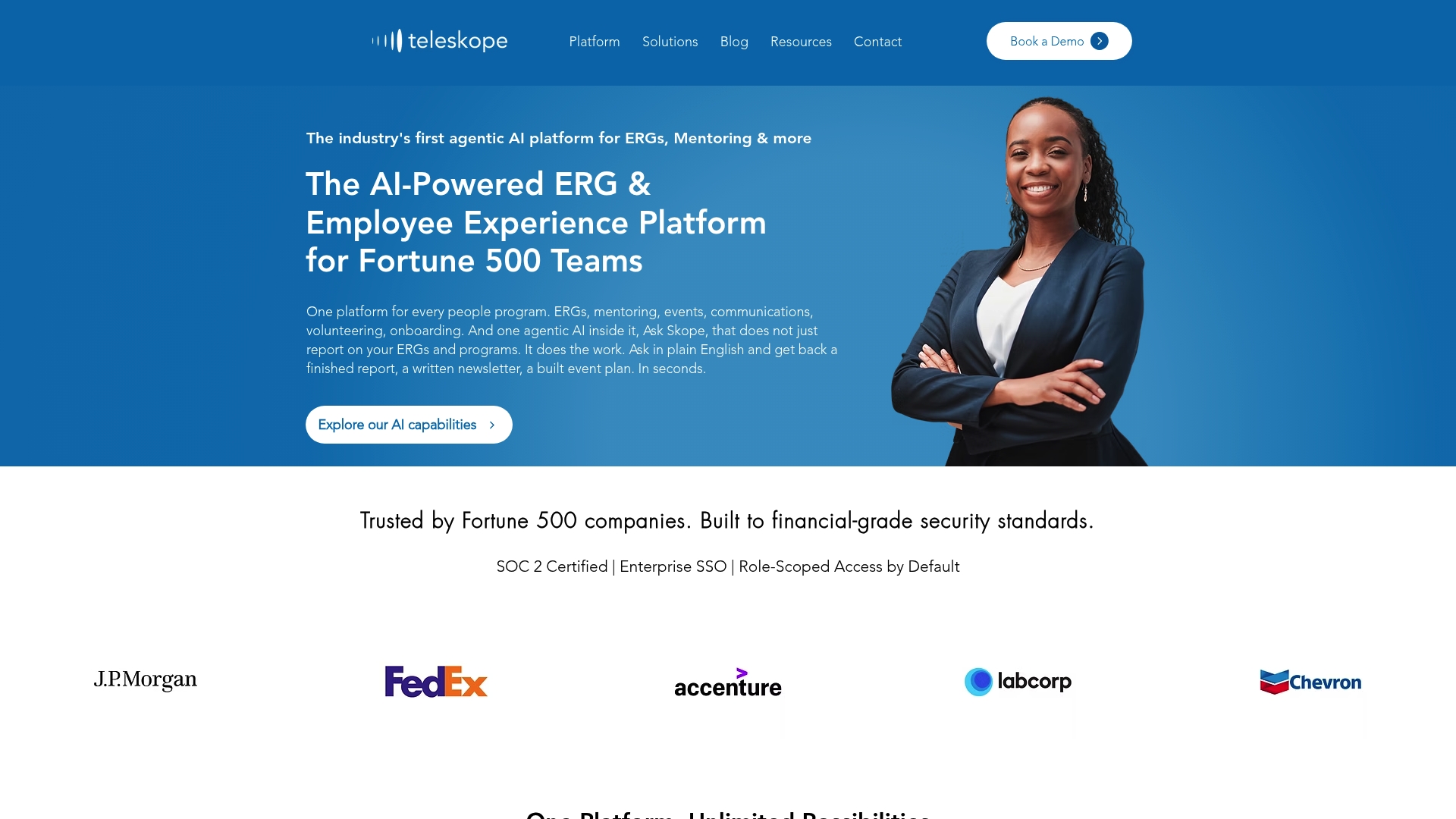
Ask Skope can produce finished reports, newsletters, and event plans from plain English queries. The vendor positions Teleskope for enterprise scale with HRIS connectors and SOC 2 certified security. The platform bundles ERG management, mentoring, onboarding, events, volunteering, and internal communications into a single system.
Core Features
Teleskope combines an all-in-one employee experience system with a built-in agentic AI, Ask Skope, that automates content and operational tasks. The platform manages ERGs, mentoring programs, onboarding flows, volunteer coordination, events, and comms while offering role based governance and enterprise single sign on. It integrates with major HRIS systems and collaboration tools to keep directory and workflow data synchronized.
Key Differentiator
The standout capability is Ask Skope, an agentic AI that returns finished deliverables from natural language prompts. That capability shifts work from drafting to review for program leaders who need frequent reports and event plans. The result is less manual assembly of recurring program artifacts and faster iteration on communications.
Pros
Teleskope groups multiple employee programs into one platform, so ERG leads and HR teams avoid stitching together separate tools. The built-in AI speeds report creation, newsletter drafts, and event outlines, reducing administrative load for program managers. The product emphasizes enterprise security and governance with SOC 2 certified controls and enterprise single sign on, and the vendor reports adoption among Fortune 500 companies.
Cons
-
Limited independent user reviews and public feedback make it hard to assess day to day reliability and adoption.
-
Public documentation and some site pages return 404 errors, which reduces transparency about exact capabilities and rollout details.
-
Pricing and detailed feature matrices are not publicly available, so procurement requires direct vendor engagement.
When It May Not Fit
If your team requires extensive public case studies or crowdsourced user feedback before buying, this will feel thin. Small HR teams with simple ERG needs will likely find Teleskope broader and more complex than necessary. If your procurement process demands fully documented, self serve pricing and feature pages, the limited public information may slow evaluation.
Notable Integrations
Teleskope connects with common enterprise systems to reduce manual sync work. Integrations listed by the vendor include Workday, SAP SuccessFactors, Oracle HR systems, Slack, Microsoft Teams, and Single Sign On providers.
Who It’s For
Large organizations and HR teams running multiple employee programs who need tighter coordination between ERGs, mentoring, onboarding, and comms will gain the most. ERG leaders who want AI assistance to cut drafting time will find the platform relevant. Smaller teams or organizations that require fully transparent public pricing may not match the typical buyer profile.
Real World Use Case
A Fortune 500 company consolidated ERG management, mentoring, and onboarding into Teleskope. Program leads used Ask Skope to generate monthly impact reports and event plans, which cut time spent on administrative work. That combined insight and automation helped the HR team focus on strategy rather than document assembly.
Pricing
Not applicable — informational only. Public pricing is not listed, and the vendor treats enterprise offerings as customized for large organizations. Procurement teams should plan to request a tailored quote and capabilities briefing.
Website: https://teleskope.io
MentorcliQ
At a Glance
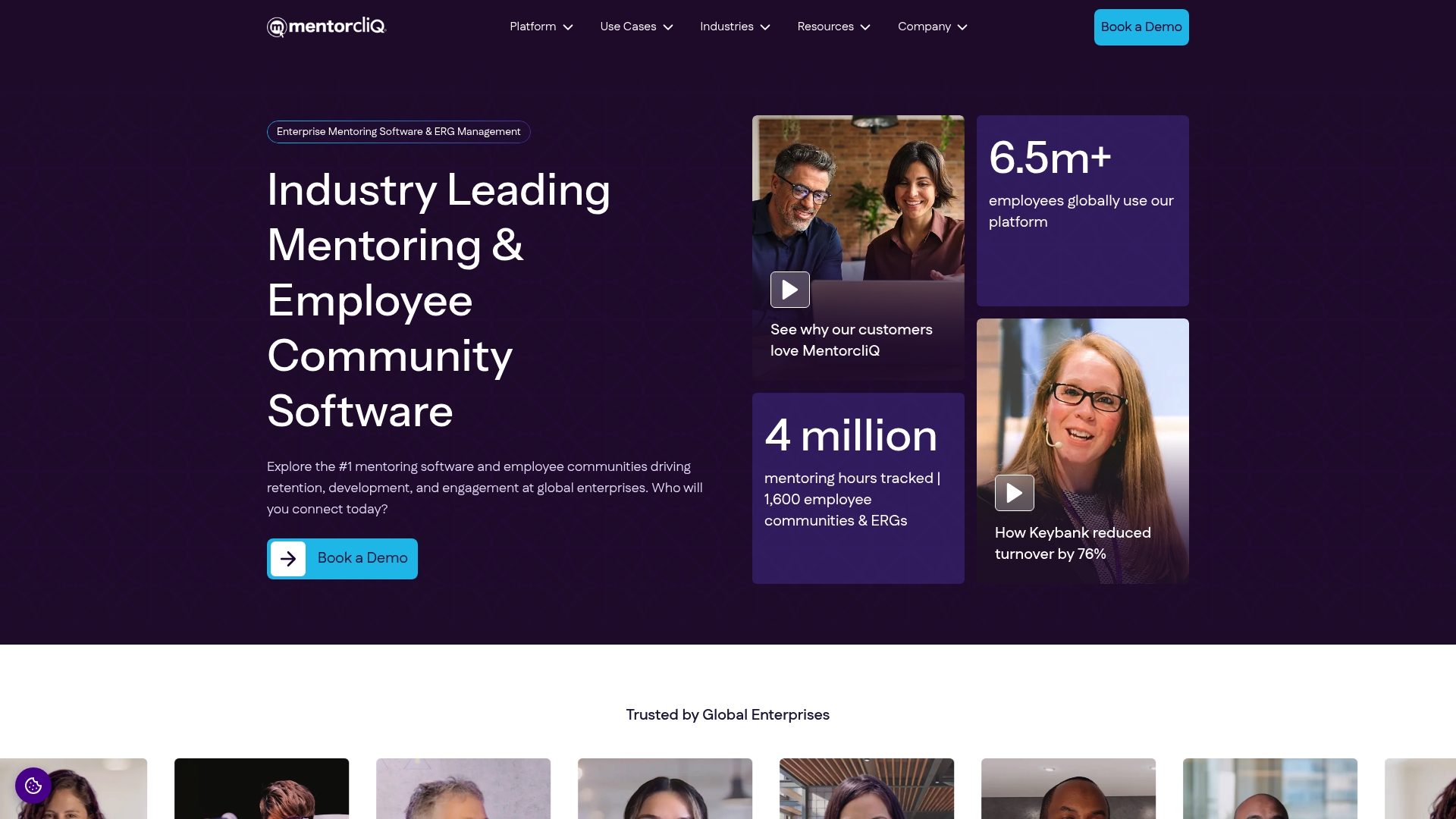
MentorcliQ reports supporting 6.5 million employees worldwide. The platform pairs automated mentor-mentee matching with ERG management tools. That pairing targets HR and talent teams that need to scale mentoring and community programs across regions.
Core Features
MentorcliQ offers a centralized hub for mentoring and employee communities, combining program workflows with participant dashboards. It automates mentor-mentee matching and captures mentoring hours, milestones, and program ROI. The product connects with HRIS and collaboration tools such as Microsoft 365, Slack, and Zoom.
Key Differentiator
MentorcliQ’s main advantage is user-focused automation of matching and routine program tasks. Automated matching reduces manual coordination and shortens program setup time. That approach helps large organizations launch cohorts faster and maintain program cadence with fewer dedicated resources.
Pros
The interface is intuitive, which speeds adoption among employees and managers. Automated matching saves program admin time and simplifies pairings across skill, location, and role criteria. Integrations with common HR and collaboration platforms reduce manual sync work, and the reporting tools give visible metrics for program leaders. Customer support and implementation are described as responsive and straightforward, which helps global rollouts.
Cons
- Reporting tools may feel limited for teams that need deep, custom analytics. This can force exports to external BI tools.
- Customization options might be restricted for organizations with highly specific workflows or unusual matching rules.
- Integration with some HR systems could require more engineering effort than expected.
- Matching criteria can feel rigid for programs that favor manual or hybrid pairing methods.
When It May Not Fit
If your team needs advanced analytics inside the mentoring platform, MentorcliQ’s reporting could frustrate you. Organizations that require heavy customization of matching logic or program flows may find the product restrictive. If your HR ecosystem relies on bespoke or older systems, integration work could add time and cost.
Notable Integrations
- HRIS systems
- Microsoft 365 and Teams
- Slack
- Google Calendar
- Zoom
Who It’s For
Large HR, talent development, and learning teams that must run mentoring and ERG programs at scale will get the most value. The product suits organizations that want automation to reduce administrative overhead. Smaller teams or those needing extreme customization may want a different fit.
Real World Use Case
According to the company, a Fortune 500 customer tracked over 4 million mentoring hours, reduced turnover by 76%, and supported 1,600 employee communities while using MentorcliQ. That case illustrates how the platform can scale mentoring and community programs across a global workforce.
Pricing
Pricing is not publicly listed. The vendor appears to offer custom enterprise quotes based on company size and program complexity. Expect a scoped proposal rather than fixed public tiers.
Website: https://mentorcliq.com
Wavy Culture Operating System
At a Glance
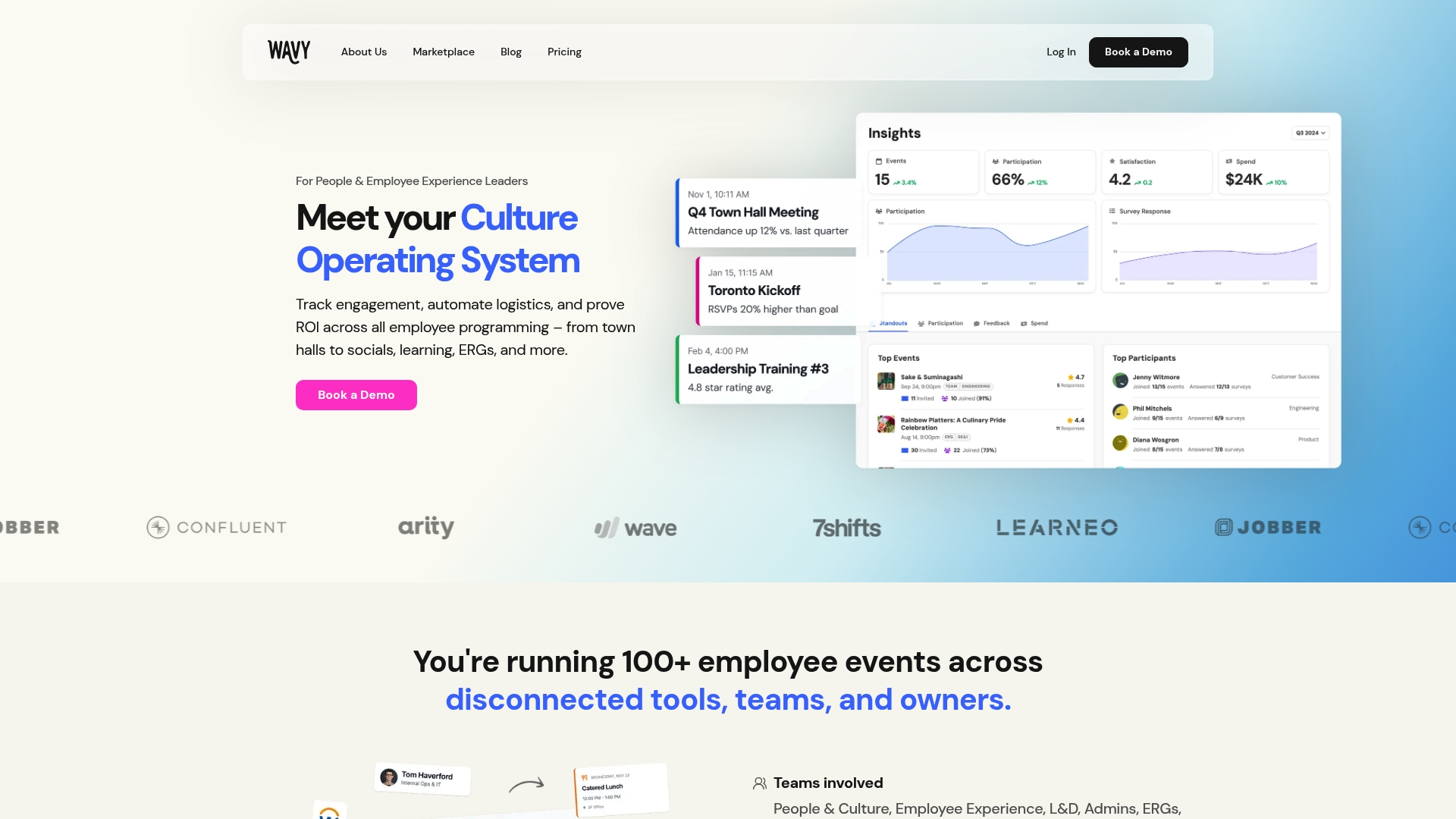
Automations cover invites, RSVPs, reminders, surveys, and reporting for town halls, learning sessions, ERG events, and socials. Wavy centralizes program records so event details and outcomes live in one place. The platform adds AI powered analysis of participation and sentiment to move reporting beyond raw attendance figures.
Core Features
Wavy acts as a single source of truth for employee programming while supporting multiple program types like town halls, offsites, and communities. It automates logistics for invites, RSVPs, reminders, surveys, and reporting, and it surfaces AI powered insights into participation and sentiment. The product also connects to existing tools including Gmail, Slack, Microsoft 365, Zoom, HiBob, and Workday to keep current workflows intact.
Key Differentiator
Wavy combines a unified system of record for culture programs with AI powered analysis that looks past attendance. That focus on participation signals and sentiment makes it easier to build narratives about impact rather than only counting heads at events.
Pros
Wavy centralizes program and participation data so teams can pull reports from one place. Its automations reduce manual steps for invites, reminders, and postevent surveys which saves program managers hours. The platform includes real-time analytics, AI powered insights, and single source of truth capabilities that help translate events into measurable outcomes and evidence for leadership.
Cons
- Some third party reviews report the automation workflow feels complex or inconsistent for early adopters. This can raise the bar for training and setup.
- Public pricing is limited, so total cost and scalability for smaller teams are not clear from available information.
- Compatibility with niche or custom HR tools is not listed, which may require extra integration work.
When It May Not Fit
If you run a very small HR team or manage fewer than 100 employees, the platform may be heavier than needed. Organizations that require firm, public pricing before evaluation will find pricing details lacking. If your ecosystem depends on niche tools not listed, plan for custom integration effort.
Who It’s For
People and Employee Experience Leaders accountable for coordinating programs across regions will get the most from Wavy. The product matches teams managing 100+ employees who need automated logistics and data to demonstrate program ROI. It suits managers who already use Gmail, Slack, Microsoft 365, Zoom, or Workday.
Real World Use Case
A global HR team uses Wavy to coordinate town halls, socials, learning modules, and ERG events across time zones. The team automates invites and reminders, tracks attendance and sentiment, and generates reports that show program impact to senior leaders.
Website: https://joinwavy.com
Comparison of alternatives
Charity Miles stands out for its simplicity in combining employee wellness initiatives with CSR contributions, leveraging physical activities for tangible social impact. Meanwhile, competitors like Chezie and Teleskope cater to organizations seeking more structured management tools for ERGs and mentoring programs.
CSR Engagement vs ERG Depth
Charity Miles uniquely connects individual exercise metrics to direct charitable funding, making it a option for CSR programs. Its simplicity and synchronization with popular fitness platforms make it accessible. On the other hand, Chezie provides extensive tools for managing ERGs, including analytics and specialized training, offering a richer feature set for structured community engagement and governance.
Automation and Mentorship Features
Teleskope emphasizes total operational automation, featuring agentic AI for report generation and communication drafts. These capabilities appeal to enterprises requiring cohesive program integration for ERGs, mentorships, and onboarding processes at scale. Additionally, MentorcliQ is tailored for talent development programs, automating mentor-mentee pairings and simplified matching criteria, facilitating efficient mentorship rollout for large organizations.
Best fit
- CSR leaders aiming to engage employees passively should adopt Charity Miles.
- Large enterprises managing multiple ERGs will find value in Chezie’s training tools and governance options.
- MentorcliQ stands out for organizations focusing on advanced mentoring programs requiring precise pairing and reporting.
- Teams seeking centralized program management for multi-regional operations should explore Wavy Culture Operating System’s data consolidation.
Our pick
Charity Miles provides an accessible and effective option for HR leaders to marry physical activity with social impact in wellness programs. Its low-friction approach leverages everyday fitness data for donations, making it especially suitable for companies aiming to deepen CSR integration. Organizations requiring detailed ERG management or automated mentoring may still benefit from the tailored solutions offered by competitors like Chezie and MentorcliQ.
Organizations seeking software solutions to drive employee participation while aligning with CSR objectives can consider the following options, highlighting key features and unique advantages.
| Product | Best For | Key Differentiator | Pricing | Notable Limitation |
|---|---|---|---|---|
| Charitymiles | CSR and wellness programs | Converts physical activity into charitable donations | Price not published | Phone sensors can misread indoor workouts |
| Chezie | Multi-ERG management | Combines ERG tools with analytics and leadership training | From $19/month | Complexity exceeds needs of small or single groups |
| Teleskope | Enterprise-scaled HR programs | Integrates AI automation for reporting and planning | Price not published | Limited public documentation |
| MentorcliQ | Mentoring and community program scaling | Automatic mentor-mentee matching | Price not published | Limited customization of matching and deep analytics |
| Wavy Culture OS | Coordinating employee programs at scale | AI-powered insights into program participation | Price not published | Setup complexity for smaller or fewer programs |
How Can Employee Resource Group Software Improve Engagement and CSR Impact?
Employee resource group software aims to strengthen community and participation, but many organizations face challenges turning routine involvement into meaningful outcomes. Charitymiles offers a unique approach by turning everyday walking, running, or biking into charitable donations, strengthening employee engagement while advancing corporate social responsibility goals.
Charitymiles empowers HR, CSR, and employee-wellness leaders to increase participation with friendly team challenges that align personal activity with company purpose. Employees enjoy wellness benefits and see their impact grow with every mile, creating a culture of ongoing giving and connection. Learn how to integrate these proven benefits through the Employee Empowerment Program and start seeing measurable results.
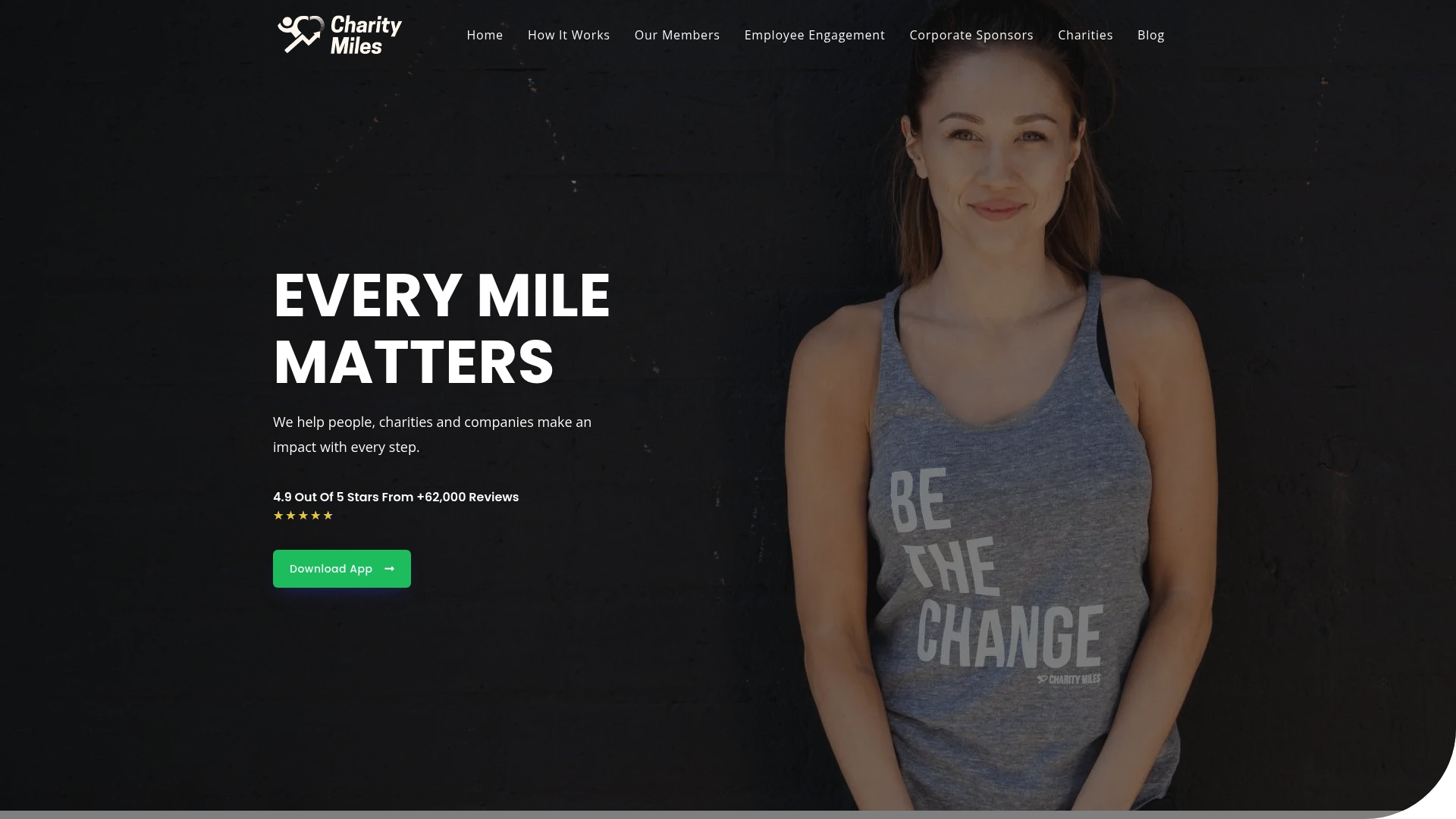
Visit Charitymiles to design your program, set donation sponsorships, and build a stronger, healthier, and more engaged workforce today.
FAQ
How does Charitymiles track employee activity for charitable donations?
Charitymiles tracks walking, running, biking, and indoor activities using phone sensors. The app converts this activity into donations, which allows team members to support their chosen charities through everyday movements. This functionality encourages active participation while contributing to charitable causes.
What is the difference between Charitymiles and Chezie for employee engagement?
Chezie excels in providing membership management and analytics for employee resource groups (ERGs). Charitymiles, on the other hand, translates physical activity into monetary donations, making it ideal for organizations looking to boost charitable efforts through employee wellness activities. This means organizations can choose Charitymiles when their focus is on linking employee activity to direct giving.
Which platform offers the ability to create private teams for employee engagement?
Charitymiles enables companies to create private teams that can participate in challenges while earning donations for charities. This allows organizations to tailor engagement efforts and foster a sense of community among employees, linking their actions to a common cause.
Can I manually enter activity miles with Charitymiles?
Yes, Charitymiles accepts manual mileage entries through an honor system. This flexibility allows participants to log their activity even if they prefer not to use the app’s automatic tracking features, making it accessible for diverse fitness habits.
What are the pricing details for Charitymiles?
Charitymiles is free for both members and charities, making it an appealing choice for organizations looking to engage employees without incurring additional costs. This no-cost model lowers the barriers for companies and teams wanting to participate in charitable giving initiatives.