
We recommend prioritizing five goals this year: raise your team engagement score (tracked through quarterly pulse surveys), lift recognition program participation (tracked by monthly participation rate), reduce burnout indicators (tracked through a wellbeing index), improve role clarity (tracked by OKR completion rate), and strengthen manager coaching cadence (tracked by 1:1 frequency). Each one ties directly to retention, productivity, or wellbeing outcomes that leadership actually cares about.
TL;DR:
- Psychological safety is the top engagement driver and can be tracked with speak-up indices, strongly correlating with greater job satisfaction and lower burnout.
- Setting clear, outcome-based goals in SMART or OKR format, with a designated owner and measurement cadence, is essential for sustained engagement progress.
- Leading indicators like survey participation or manager 1:1 frequency should be prioritized over lagging scores to monitor real-time engagement trends.
- Engagement programs like movement challenges can improve participation, wellbeing, and CSR visibility, with concrete metrics like participation rate and donation totals.
- Avoid mistaking tactics for outcomes by defining specific numbers and deadlines before planning activities, and always involve managers in goal design to ensure effectiveness.
Table of Contents
- What Employee Engagement Goals Are and Why They Matter
- The Drivers Behind Every Strong Engagement Goal
- How to Set Engagement Goals That Stick
- Engagement Goal Templates You Can Copy Today
- Measuring and Tracking Engagement Progress
- A Real-World Case: Movement-Based Engagement Goals
- What HR Practitioners Get Wrong About Engagement Goals
- How Charity Miles Supports Your Engagement Goals
- FAQ
- Sources
What Employee Engagement Goals Are and Why They Matter
An engagement goal is an outcome you want to see change, not an activity you want to run. “Host a wellness challenge” is a tactic. “Raise our engagement score by a measurable margin this quarter” is a goal. The distinction matters because teams often run plenty of activities without moving the numbers that count.
The business case is well documented. Workers who experience higher psychological safety report greater job satisfaction and engagement, along with sharply lower rates of stress and burnout, according to the American Psychological Association’s 2024 Work in America report. Gallup’s State of the Global Workplace research ties engagement to business-unit productivity as well.
Engagement also varies widely by team, largely because of the manager. Two departments in the same building, under the same policies, can post very different scores depending on how well their manager communicates, coaches, and removes obstacles. That is why goals need to live at the team level, not just the company level.
The Drivers Behind Every Strong Engagement Goal
Four drivers show up again and again in engagement research, and each one can be turned into something you measure rather than something you hope for.
Psychological safety means people feel safe raising concerns, admitting mistakes, or disagreeing with a plan without fear of punishment. The APA’s 2024 Work in America report associates higher psychological safety with better job satisfaction and far lower stress and burnout. You can track it with a speak-up index from survey items or self-reported stress levels gathered through pulse checks.
Role clarity is next; practical guidance on keeping distributed field teams aligned can be found in this best practices guide. When employees know what is expected of them and how their work rolls up to team objectives, engagement tends to rise. OKR completion rate is a practical way to measure this.
Manager capability is the lever most organizations underuse. Gallup’s engagement research points to manager-mediated outcomes, meaning coaching cadence and manager effectiveness scores often predict team engagement better than company-wide initiatives.
Recognition and purpose round out the list:
- Recognition rate: the share of employees recognized at least once a month
- Mission-alignment score: survey items asking whether daily work connects to company purpose
- Peer recognition frequency: how often colleagues, not just managers, acknowledge each other
Workers reporting higher psychological safety show measurably better job satisfaction and engagement, along with far lower stress and burnout, according to APA’s 2024 Work in America report. That single driver may be the highest-leverage goal on this list.
How to Set Engagement Goals That Stick
Converting a vague aspiration into a working goal takes a few deliberate steps.
- Write the goal in SMART or OKR format. Instead of “improve engagement,” try: “Increase engagement score among the customer support team by a defined, time-bound margin within the next two quarters.”
- Co-design the goal with the team. Run a short workshop or a round of stay interviews so employees shape the target rather than inherit it.
- Assign an owner. Every goal needs one person accountable for tracking it, usually the team manager.
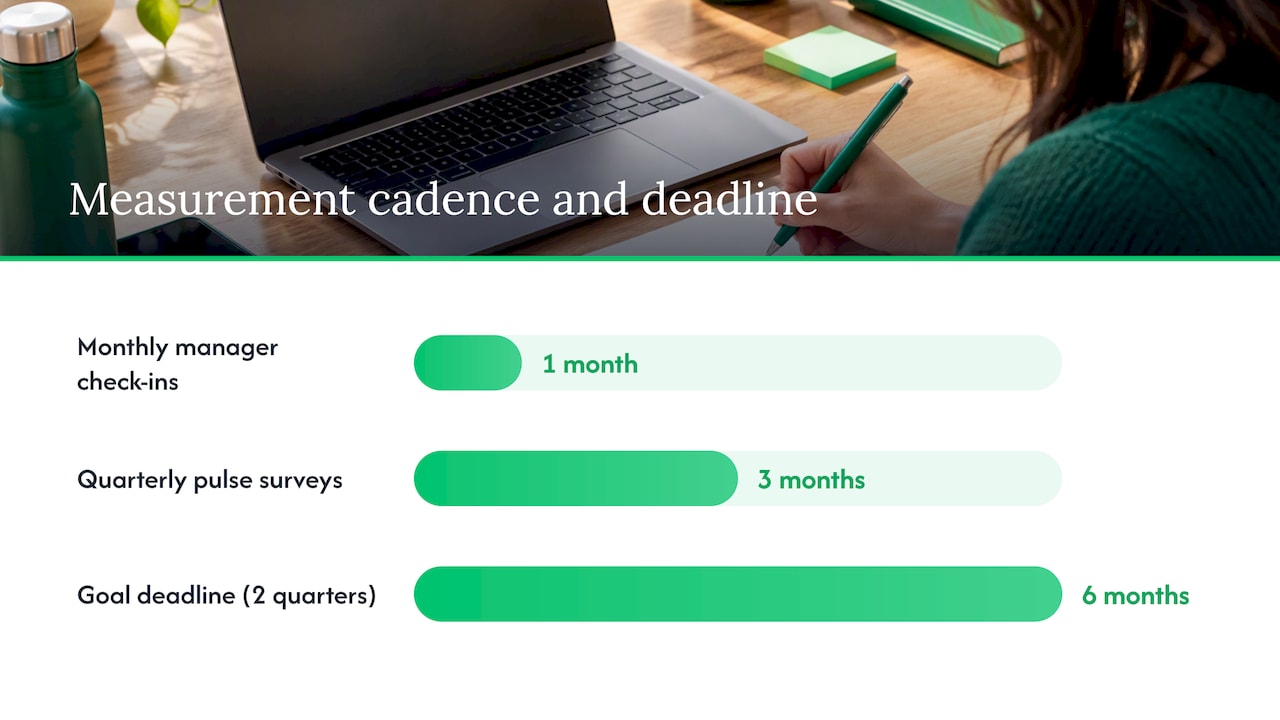
- Set a measurement cadence. Quarterly pulse surveys paired with monthly manager check-ins keep the goal visible instead of forgotten.
- Build a team action plan. Translate survey findings into two or three concrete changes the team commits to trying.
The most common mistake is writing goals around tactics rather than outcomes. “Launch a recognition program” sounds productive, but it says nothing about whether recognition actually increased or whether it changed how people feel at work. Gallup and the APA research both point to the same conclusion: engagement is team-level and manager-mediated, so goals that skip manager involvement rarely hold up past the first quarter.
Pro Tip: Write the goal statement before you pick the initiative. If you cannot state the outcome in one sentence with a number and a deadline, the initiative is not ready yet.
Engagement Goal Templates You Can Copy Today
Ready-made templates speed up adoption because managers do not have to invent the wording from scratch. Here are starting points by level.
Company-level examples:
- “Raise company-wide engagement score from the current baseline to a target set by HR within two survey cycles.”
- “Increase employee Net Promoter Score (eNPS) by a defined point margin by the next annual survey.”
Manager-level examples:
- Lift direct-report engagement scores through a structured weekly or biweekly coaching cadence, measured against the prior quarter’s baseline.
- Hold one meaningful career-development conversation with each direct report per quarter, tracked through a simple completion log.
- Close the loop on every pulse survey within two weeks with a one-page team action plan.
Role-specific examples:
- Customer service: reduce reported burnout on pulse surveys while maintaining response-time targets, reviewed quarterly.
- Sales: increase recognition-program participation among the sales team, tracked monthly against a baseline participation rate.
- Engineering: improve role-clarity scores on the next engagement survey by clarifying sprint ownership and OKR assignments.
Adapt the time-bound portion of each template to your review cycle. A ten-person team can realistically check progress monthly; a five-hundred-person division may need a full quarter between readings to see a meaningful shift.
Measuring and Tracking Engagement Progress
Engagement scores themselves are a lagging indicator: they tell you what already happened. Leading indicators, like survey participation rate, manager 1:1 frequency, and program adoption, tell you what is about to happen. Prioritize the leading signals for weekly or monthly tracking and reserve the lagging engagement score for a quarterly or annual read.
A practical cadence looks like this:
- Quarterly pulse surveys of five to ten short questions
- One annual deep-dive survey covering the full engagement framework
- Monthly tracking of program adoption metrics such as recognition participation or wellness-challenge sign-ups
- Immediate manager follow-up within two weeks of any survey close
Gallup’s engagement research shows employee engagement correlates with business-unit productivity and wellbeing, and its Q12 framework remains a standard reference for building survey questions tied to outcomes. Once results come in, the real work starts: turn findings into a short team action plan, assign an owner, and revisit it at the next check-in. Data without a follow-up plan rarely changes anything.
A Real-World Case: Movement-Based Engagement Goals
Wellness-for-purpose programs offer a repeatable way to frame an engagement goal around participation, inclusivity, and visible impact. Our Employee Empowerment program lets companies create private team challenges where every walk, run, or bike ride logged converts into a donation to a charity of the employee’s choosing, with the company controlling the sponsorship rate and cap.

We point to HARMAN’s experience as a useful illustration: after launching a Charity Miles team in 2021, HARMAN saw an 11x increase in employee participation, with more than 1,200 employees generating over $120,000 for charity, according to our program page.
Programs like this can anchor several engagement goals at once:
- Participation rate: percentage of eligible employees logging activity monthly
- Wellbeing index: self-reported energy or stress levels tracked alongside activity
- CSR visibility: dollars donated and causes supported, reported quarterly to leadership
A short pilot checklist: pick one department, set a 90-day participation target, choose whether donations go to employee-chosen or company-selected charities, and report results against your baseline engagement score.
What HR Practitioners Get Wrong About Engagement Goals
The biggest pitfall we see is mistaking tactics for outcomes: a calendar full of events but no change in the engagement score. The fix is simple. Write the number you want to move before you plan the activity.
The second pitfall is leaving managers out of goal design, even though engagement research consistently ties outcomes back to manager behavior. Build manager coaching cadence into the goal itself.
The third is skipping measurement entirely. A goal without a tracked metric is a wish. Tie every goal to one business outcome and one person who owns it.
— Gene
How Charity Miles Supports Your Engagement Goals
We built our Employee Empowerment program to give HR a low-effort way to hit participation, wellbeing, and CSR-linked goals in one move. Because any kind of movement counts, not just athletic performance, the program stays inclusive across fitness levels while still generating the kind of visible, personal impact that strengthens culture and employer brand.
A typical pilot sets three metrics: monthly participation rate, average monthly active users, and total donations generated for the quarter. From there, we let you choose whether funds go to each employee’s chosen charity or a cause the company selects.
- Participation and wellbeing goals: team challenges that welcome every fitness level
- CSR visibility goals: donation totals reported in real time to leadership
- Retention-linked goals: camaraderie and recognition built into every mile logged
Ready to pilot it with one department? Visit our Employee Empowerment program page to see setup options and sponsorship controls, or check out Corporate Sponsorship Opportunities if you want to structure funding around a cause your company already supports.
FAQ
What are the 5 C’s of employee engagement?
Definitions vary across practitioners, but a common version includes care, connect, coach, contribute, and congratulate: five behaviors managers use to build trust and recognition on their teams. These map closely to the drivers covered above, particularly recognition and manager capability.
What are the 5 SMART goals for employees?
There is no single fixed list, but common SMART engagement goals include raising the team engagement score, increasing recognition participation, improving role-clarity scores, lifting manager coaching cadence, and reducing self-reported burnout. Each should include a baseline, a target, and a deadline rather than a vague direction.
What are 10 examples of goals?
Examples span company, manager, and role levels: raising engagement score, lifting eNPS, increasing recognition participation, improving OKR completion, reducing burnout indicators, raising pulse-survey response rate, growing wellness-program participation like the one described in our Employee Empowerment program, increasing peer recognition frequency, improving psychological-safety scores, and boosting stay-interview completion rates.
Can you give examples of employee goals?
Yes. A support-team goal might be reducing reported burnout while holding response times steady, while a sales-team goal might be lifting recognition-program participation by a set margin over a quarter. Each example should tie to one metric and one review date so progress is easy to check.