
Employee empowerment is the set of structural and psychological conditions that let people make real decisions about their work. Employee engagement is the energized, sustained state of vigor, dedication, and absorption that can follow. Empowerment is an antecedent: it tends to produce engagement when leaders add clear direction, resources, and coaching. Without that support, autonomy alone can leave people anxious rather than motivated.
TL;DR:
- Use Spreitzer’s scale to assess meaning, competence, choice, and impact; measure engagement with UWES or Gallup’s Q12, reporting an overall score plus UWES subscales.
- Establish a baseline, pilot with one or two teams, keep survey questions identical, and compare results with teams whose conditions did not change.
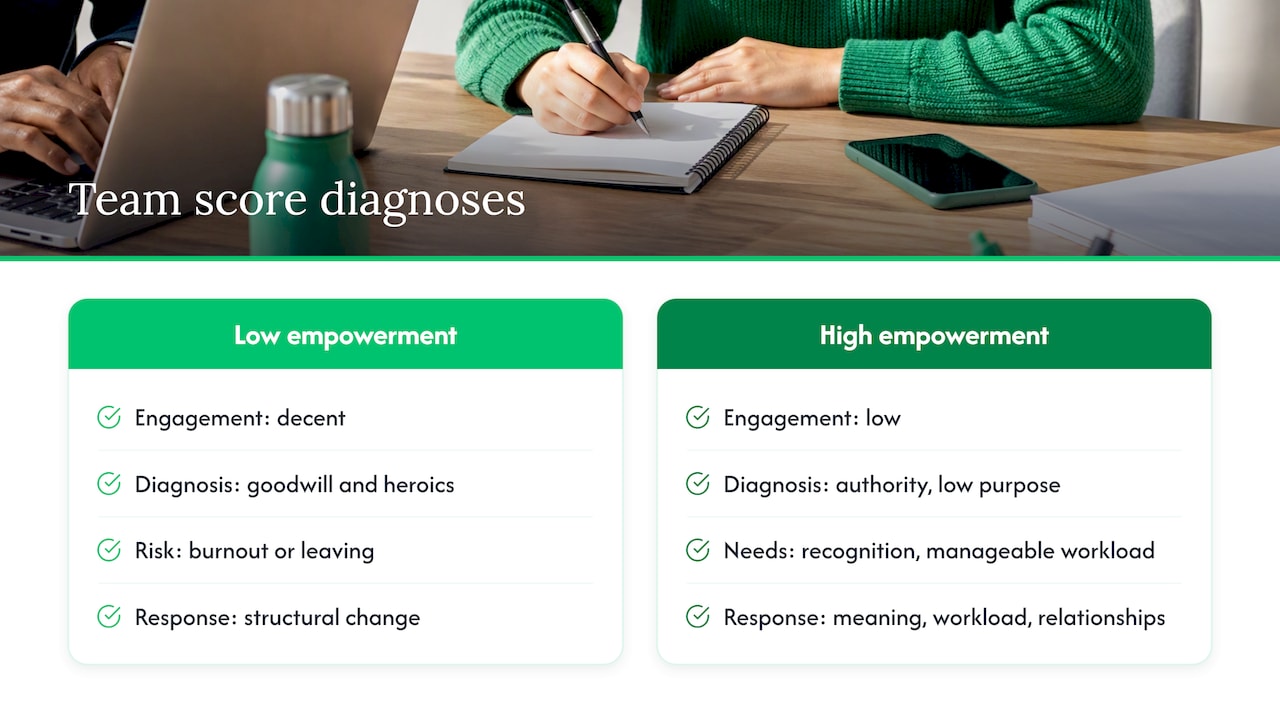
- Teams with low empowerment but decent engagement need structural fixes; teams with authority but low engagement need attention to purpose, recognition, and workload.
- Daily diary findings indicate autonomy support works better when leaders provide development support; authority without direction or resources can create anxiety.
Table of Contents
- What does employee empowerment actually include?
- What is employee engagement, and why track it?
- How do empowerment and engagement differ, and how do they connect?
- What can managers do to build empowerment that drives engagement?
- How do you measure whether it is working?
- What mistakes undermine empowerment efforts?
- Do empowerment and engagement drive different outcomes?
- How do empowerment and engagement connect to CSR programs?
- What does success look like in practice?
- How do team dynamics and social connection fit in?
- Why I would start with one measurable experiment
- How our Employee Empowerment program supports empowerment and engagement
- FAQ
- Sources
What does employee empowerment actually include?
Researchers describe empowerment from two complementary angles, and managers need both. The first is structural: the systems an organization builds. The second is psychological: how an employee experiences those systems. Social-structural perspectives, associated with Kanter and with Conger and Kanungo, describe sharing power through delegation, plus access to opportunity, information, support, and resources. Psychological perspectives, associated with Spreitzer and with Thomas and Velthouse, focus on what employees feel internally.
Structural empowerment is what you can change on Monday morning:
- Delegated authority: who may decide what, without asking permission.
- Access to information: the data, context, and numbers people need to decide well.
- Support and resources: budget, tools, time, and a manager who has their back.
Psychological empowerment is the experience on the other side, usually measured as four cognitions:
- Meaning: the work matters to the person doing it.
- Competence: the person believes they can do it well.
- Self-determination: the person has choice over how the work gets done.
- Impact: the person sees that their work changes outcomes.
Practitioners stress that all four need attention at once. Raising autonomy while ignoring competence or meaning does not add up to a sense of empowerment.
The evidence connecting the two sides is solid. Meta-analytic research confirms that structural conditions such as leadership practices and socio-political support relate strongly to psychological empowerment, which in turn predicts higher job satisfaction and lower turnover intentions.
Evidence snapshot: A meta-analysis of psychological empowerment finds correlations of about .50 with job satisfaction and about .51 with organizational commitment. In plain terms, empowered people tend to like their jobs and stay loyal to their employers.
What is employee engagement, and why track it?
Engagement is a different thing. A common definition, used by the Utrecht Work Engagement Scale (UWES), describes a positive, fulfilling, work-related state of mind with three components:
- Vigor: high energy and mental resilience while working.
- Dedication: a sense of significance, enthusiasm, and pride in the work.
- Absorption: being so immersed in tasks that time passes quickly.
Engagement is state-like. It rises and falls with workload, leadership, and daily events, which is exactly why it is worth watching. Scholarly reviews describe it as a multi-component, relational psychological experience that develops through relational and systemic processes, not through slogans or perks.
Research links these components to higher job satisfaction, organizational commitment, and task performance. For HR leaders, that makes engagement a leading indicator for productivity and retention, not a soft morale metric.
Organizations can use tools such as the UWES, which measures the three components directly, or Gallup’s Q12, which asks about the conditions around the work and can suit organizations that want a short, repeatable pulse.
Researchers still debate whether engagement is one thing or three. A practical answer comes from work showing that UWES data fits a bifactor model: one global engagement score plus vigor, dedication, and absorption as specific factors. For you, that means reporting a global score for the executive dashboard and reading the subscales when a team needs a diagnosis.
How do empowerment and engagement differ, and how do they connect?
The cleanest contrast is about who provides what. Empowerment is something the organization and its leaders create. Engagement is something the employee experiences and chooses to give back. Treating them as identical leaves structural barriers untouched, because a survey can tell you people are disengaged without telling you that they lack information or authority.
| Dimension | Empowerment | Engagement |
|---|---|---|
| Who provides it | Organization and leaders | Employee, in response |
| What it is | Conditions: authority, information, resources, meaning | State: vigor, dedication, absorption |
| What you can change directly | Yes, through policy and delegation | Only indirectly |
| Typical measure | Spreitzer’s four cognitions | UWES or Gallup Q12 |
The research describes a mediated pathway: structural supports and empowering leadership raise psychological empowerment, and psychological empowerment raises engagement. Meta-analytic reviews find that contextual antecedents such as high-performance managerial practices, socio-political support, and leadership are strongly related to psychological empowerment.
Diary-study finding: Daily diary research shows that empowering leadership, meaning autonomy support plus development support, raises daily psychological empowerment and, through it, daily work engagement. Development support strengthens the benefit of autonomy support.
When the pathway is intact, you can reasonably expect:
- Higher job satisfaction and organizational commitment.
- Lower turnover intentions.
- More discretionary effort, meaning the extra mile no one can mandate.
- More room for people to suggest and try new ideas.
What can managers do to build empowerment that drives engagement?
Work through these in order. Each step builds on the one before it.
- Start with clarity. Tell your team the purpose of the work and the boundaries of their decisions. Empowerment is trust paired with direction: you define the what and why, they decide the how.
- Delegate authority with guardrails. Write down who decides what, what needs a quick check, and what needs sign-off. Pair each decision right with accountability so autonomy never turns into ambiguity.
- Provide resources, information, and development support. Give people the data, budget, and time they need, plus coaching and training. Delegating without guidance fails to meet employees’ psychological needs.
- Build trust through recognition and visible impact. Close feedback loops quickly and show people what their decisions changed. This feeds the meaning and impact cognitions directly. Our guide to employee motivation and engagement strategies covers recognition tactics you can adapt.
- Run small experiments. Pilot with one team, measure, adjust, then expand.
Pro Tip: Give one team a real decision they previously escalated, set a clear success metric, and review the results after the pilot. A small, visible win teaches more than a company-wide announcement.
Leadership research adds a caution here: empowering people takes more than granting authority. Leaders also need to provide security, a clear vision, and development support to prevent role ambiguity and anxiety when autonomy grows. If your managers need structured training on leading this way, the leadership curriculum from RELA is one resource worth reviewing.
How do you measure whether it is working?
Pick instruments that match the thing you are measuring. For empowerment, use Spreitzer’s psychological empowerment scale, which covers meaning, competence, self-determination, and impact. For engagement, use the UWES, or Gallup’s Q12 where it fits your organization better. Our overview of effective employee engagement strategies pairs well with these tools.
Why the scales matter: Because the relationship between psychological empowerment and commitment is strong in meta-analytic data, a rise in empowerment scores is a reasonable early signal that engagement and retention will follow.
Surveys capture how people feel. Pair them with operational KPIs that show what people do:
- Participation rates in voluntary programs.
- Retention and turnover by team.
- Discretionary effort indicators, such as improvement suggestions submitted.
- Productivity measures that fit the team’s work.
- CSR participation, where your program includes it.
A simple evaluation plan starts with a baseline before changing anything. Run the pilot with one or two teams, then follow up and compare pilot teams against teams that did not change. Keep the survey questions identical each time so the comparison holds.
What mistakes undermine empowerment efforts?
Most failed efforts share a handful of avoidable errors:
- Autonomy without direction. People handed freedom with no goals become anxious, not energized. Fix: pair every decision right with a clear outcome and a boundary.
- Authority without resources or coaching. Delegating a decision without the information, budget, or skills to make it well sets people up to fail. Fix: bundle training and access with every grant of authority.
- Surveys as a substitute for change. Practitioners note that engagement surveys alone are not enough; improving empowerment means addressing structural barriers such as access to information and resources. Fix: for each low survey score, name one process you will change and tell your team about it.
- Nurturing only one cognition. A team can feel competent yet see no meaning in the work. Fix: check all four dimensions before declaring success.
Do empowerment and engagement drive different outcomes?
They overlap, but they are not interchangeable, and separating them helps you diagnose problems. Empowerment mostly shapes how people work: the quality of their decisions, their sense of ownership, their willingness to act without waiting for approval. Research ties it to commitment, job satisfaction, and lower turnover intentions.
Engagement mostly shapes how people feel while working and how much of themselves they bring. The energy of vigor, the pride of dedication, and the immersion of absorption show up in sustained effort and resilience, which supports well-being as well as performance.
The distinction guides your response. A team with low empowerment scores and decent engagement is usually running on goodwill and heroics, and will burn out or leave when the goodwill runs thin. A team with high empowerment and low engagement often has the authority but lacks purpose, recognition, or manageable workload. Treat the first with structural change and the second with meaning, workload, and relationship work.
Because the pathway runs from empowerment to engagement, fixing the conditions first is usually the more reliable order. Engagement left alone, with no change to the conditions, tends to fade after the next campaign ends.
How do empowerment and engagement connect to CSR programs?
Corporate social responsibility is one of the clearest places to see both ideas at work. A top-down CSR program can feel distant: leadership picks a cause, announces a donation, and employees watch. A participatory program does the opposite. Employees personally generate the impact, choose what matters to them, and see the result.
Those features line up with the four cognitions. Choosing a charity builds self-determination. Supporting a cause people care about builds meaning. Watching miles turn into donations makes impact visible and personal. And because any movement counts, from a lunchtime walk to a bike commute, nearly everyone can feel competent taking part.
That is the design logic behind our Employee Empowerment program. Employees move, the app tracks distance, and money goes to a charity for every mile. Companies set the sponsorship terms: the rate per mile, the total cap, and whether donations follow each employee’s chosen charity or a company-selected cause. The program is woven into company culture rather than staged as a one-off event.
For HR and CSR leaders, the payoff is a program where participation itself becomes the engagement signal. When people join voluntarily and keep logging miles, you are seeing the empowerment-to-engagement pathway in action, and you can measure it with the participation KPIs described above.
What does success look like in practice?
Consider how an employee charity challenge can connect participation with a visible charitable impact. We walk through examples in our guide to employee empowerment examples.
Read the challenge through the framework. The structural pieces were simple: a private company team, a sponsorship the company funded, and a challenge anyone could join. Those conditions supported meaning, because employees picked causes they cared about, and impact, because every mile produced a visible donation. Participation followed because the barrier to entry was low and the reward was personal.
You can borrow the pattern for your own pilot, whether it is a charity challenge, a wellness initiative, or a volunteering drive:
- Let employees choose the cause or the format, which supports self-determination.
- Count every kind of effort, which supports competence for people at all fitness levels.
- Show cumulative results in a shared place, which supports impact.
- Recognize teams, not just top individuals, which keeps casual participants involved.
Our write-up on proven employee engagement strategies collects more program-level ideas to test alongside this pattern.
How do team dynamics and social connection fit in?
Empowerment is often described as an individual experience, but it grows faster inside a team. A challenge that pits teams against each other, or better, has them pursue a shared goal, turns private motivation into public momentum. People who see colleagues taking part feel it is normal and worthwhile to join. Social proof lowers the cost of starting.
Team challenges also supply things that a survey cannot manufacture: a reason to talk to colleagues outside normal reporting lines, shared stories, and a feeling of belonging to something bigger than a task list. That connection feeds dedication, the part of engagement that is about pride and significance, and it builds trust, which makes managers more willing to delegate.
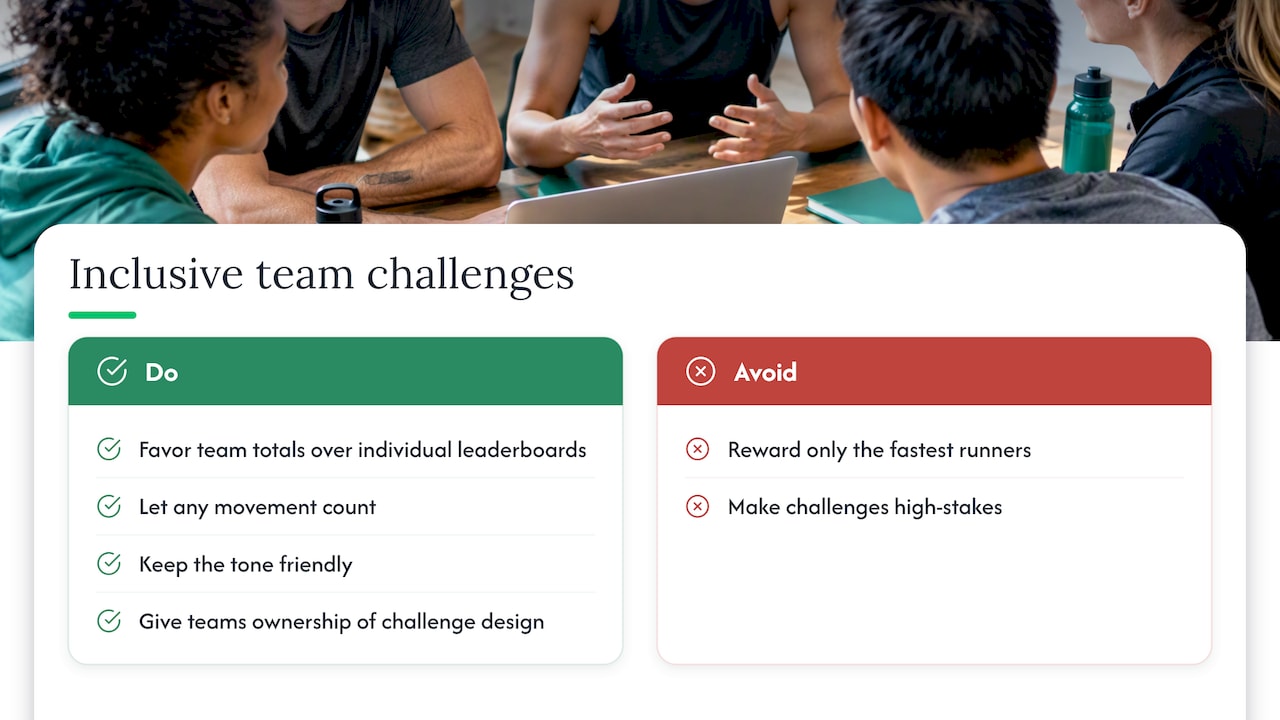
Design matters, though. A competition that rewards only the fastest runners excludes the people you most want to reach. Favor team totals over individual leaderboards, let any movement count, and keep the tone friendly. Group challenges work best when they feel inclusive and a little playful, not high-stakes.
For managers, the lesson is to treat social structure as part of the empowerment toolkit. Give teams ownership of how they run their own challenge: the name, the rhythm, the way they celebrate. That ownership is itself a small dose of self-determination.
Why I would start with one measurable experiment
Here is the practitioner’s version of everything above: stop debating definitions and run one experiment. Pick a single team, give it a decision it used to escalate, clear goals, and the resources to succeed, then watch what happens to both empowerment and engagement scores. Research suggests the pathway runs from conditions to psychological experience to engagement, which means you will learn more from changing one real condition than from another all-hands survey.
Most organizations underestimate how much leaders get in their own way here. The conventional advice is to “engage” people with events and recognition. The evidence points the other direction: fix the structure, then engagement has something to stand on. Tie the pilot to a business metric, such as retention or participation, so the result survives a budget meeting.
— Gene
How our Employee Empowerment program supports empowerment and engagement

If you want an enterprise-ready way to put these ideas to work, our Employee Empowerment program gives you private company teams, friendly intra-company challenges, and sponsorship you control: the rate per mile, the total cap, and where donations go. Employees pick causes they care about, see the impact of every mile, and take part at any fitness level, which supports meaning, impact, and participation together. The same setup supports wellbeing and gives your CSR program a measurable, personal face.
Learn more on our Employee Empowerment program page, see how the app works, or start your first pilot team.
FAQ
What are the three components of employee engagement?
The three components are vigor, dedication, and absorption. Vigor is high energy and resilience, dedication is enthusiasm and pride in the work, and absorption is deep immersion in tasks. Scholarly work supports reporting a global score alongside these subscales.
What does job empowerment mean?
Job empowerment means giving people the authority, information, and resources to make decisions, and the experience of meaning, competence, self-determination, and impact that comes with it. It combines structural conditions an organization provides with the psychological experience an employee has. Research shows structural conditions relate strongly to psychological empowerment.
What are the main types of empowerment?
The two main types are structural and psychological empowerment. Structural empowerment covers delegation, information, support, and resources, while psychological empowerment covers meaning, competence, self-determination, and impact. Many researchers also study team empowerment as a shared version of the same idea.
Does empowerment lead to engagement?
Often, yes, but not automatically. Scholars commonly treat empowerment as an antecedent of engagement, and diary research shows the effect runs through psychological empowerment. Autonomy works best when leaders also provide direction and development support.
Sources
- Pubmed
- Is a Transdisciplinary Theory of Engagement in Organized Settings Possible? A Concept Analysis of the Literature on Employee Engagement, Consumer Engagement and Patient Engagement
- Frontiers | Having the Cake and Eating It Too: First-Order, Second-Order and Bifactor Representations of Work Engagement