
An Employee Resource Group (ERG) is a voluntary, employee-led network within a company that promotes inclusion, professional development, and business results aligned with company values. ERGs are not social clubs. They are structured workplace collectives that connect employees around shared identities or interests while advancing organizational priorities. 90% of Fortune 500 companies operate at least one ERG, typically maintaining 8 to 12 active groups per company. That prevalence reflects a clear consensus: ERGs deliver real value when built and managed with intention. This guide gives HR professionals and corporate leaders a complete picture of what ERGs are, how they work, and how to make them last.
What is the definition of an employee resource group?
An Employee Resource Group is an internal, employer-recognized collective formed and led by employees who share a common identity, experience, or interest. The standard industry term is ERG, though you will also see the terms “affinity group” and “business resource group” used interchangeably in corporate settings. Each label reflects a slightly different emphasis: affinity groups center on shared identity, while business resource groups stress alignment with company strategy. ERGs combine both functions.
The purpose of an ERG is threefold. First, ERGs create a sense of belonging for employees who might otherwise feel isolated in the workplace. Second, they build professional skills and leadership pipelines by giving members real responsibilities. Third, they connect employee experience directly to business outcomes, from product feedback loops to recruiting pipelines. The most effective ERGs refuse to separate human inclusion goals from commercial value creation. That dual mandate is what distinguishes a high-performing ERG from a lunch-and-learn club.

Executive sponsorship is the structural feature that separates ERGs from informal employee networks. A senior leader, typically a vice president or C-suite executive, formally sponsors the group. That sponsor opens doors, secures budget, and connects ERG priorities to leadership conversations. Without that link to power, even the most passionate ERG stalls.
What are the common types of ERGs and how are they structured?
ERGs generally fall into two broad categories: identity-based groups and experience-based groups. Both are legitimate, and most organizations run a mix of both.
Identity-based ERGs form around shared demographic characteristics. Common examples include:
- Women’s networks focused on gender equity and leadership advancement
- LGBTQ+ groups supporting visibility and policy advocacy
- Black, Hispanic, and Asian employee networks addressing racial equity
- Veterans’ groups connecting military-background employees with civilian career paths
- Disability and neurodiversity groups promoting accessibility and accommodation
Experience-based ERGs form around shared life circumstances or career stages. Examples include:
- Early career or new employee networks
- Caregiver networks for employees managing family responsibilities
- Mental health and wellness groups
- Remote and hybrid worker communities
One critical point: identity-based ERGs often include allies and are not exclusive to members of the identity group. That open membership model broadens impact and prevents ERGs from feeling like closed circles, which is a common misconception that limits participation.
Structurally, most ERGs operate with a volunteer leadership team: a chair or co-chairs, a communications lead, a programming lead, and a membership coordinator. An executive sponsor sits above this team and connects the ERG to senior leadership. Formal recognition from HR or a DEI office gives the group legitimacy and access to company resources.
Annual ERG budgets typically range from $2,000 to $7,000 per group. That range is modest, which means many successful ERGs rely on creative, low-cost programming. Budget constraints are real, but they are not a ceiling on impact.
Pro Tip: When launching a new ERG, start with a clear one-page charter that defines the group’s purpose, target membership, leadership structure, and one measurable goal for the first year. Charters prevent scope creep and make it easier to request budget from leadership.
What are the key benefits of employee resource groups for organizations?
ERGs deliver measurable value across four organizational dimensions: retention, engagement, leadership development, and strategic alignment.
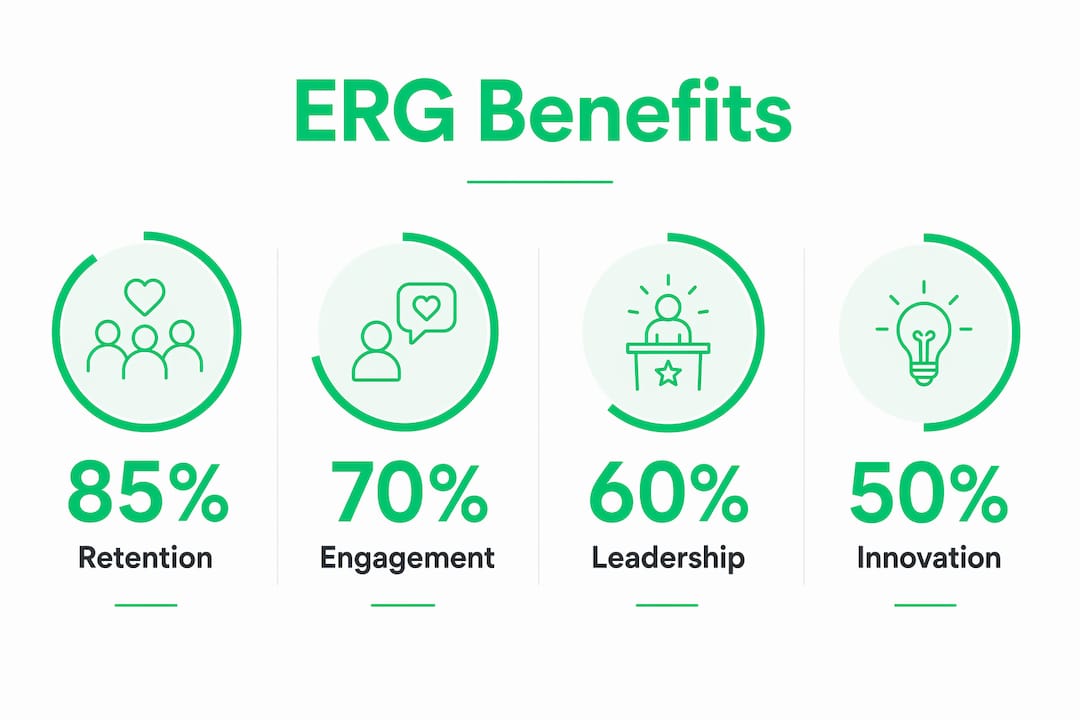
Retention and belonging. Employees who feel seen and supported at work stay longer. ERGs create that sense of belonging by giving employees a community within the larger organization. When ERGs are active and well-resourced, they reduce the isolation that drives voluntary turnover, particularly among underrepresented groups.
Engagement and productivity. Aligning ERGs with business strategy enhances their credibility and transforms them into strategic partners, with impact shown through retention and engagement metrics. Engaged employees are more productive and deliver better customer service. Gallup research shows companies with engaged employees are 21% more profitable. ERGs contribute to that engagement by giving employees purpose beyond their job description.
Leadership development. ERG leadership roles are real management experience. A member who chairs a 200-person women’s network has managed budgets, led teams, run events, and communicated with senior executives. That experience builds the skills companies need in their next generation of managers.
Strategic alignment. The benefits of ERGs extend into business strategy when leaders use them deliberately. ERGs can:
- Provide market insight from employees who reflect customer demographics
- Support recruiting by showcasing company culture to prospective hires
- Inform product development through lived-experience feedback
- Strengthen the company’s employer brand and DEI reporting
Metrics that demonstrate ERG value include retention rates among ERG members versus non-members, promotion rates, engagement survey scores, and event participation numbers. Tracking these consistently gives HR leaders the data they need to secure continued investment.
What challenges do ERGs face and how can organizations sustain them?
ERGs face three persistent challenges: volunteer burnout, operational limits, and perception gaps between leaders and sponsors.
Volunteer burnout is the most common ERG killer. ERG leaders hold full-time jobs. Their ERG work is additional, often uncompensated, and emotionally demanding. The most resilient ERGs manage burnout by pacing advocacy and maintaining clear succession plans. Without succession planning, the departure of one committed leader can collapse an entire group.
Operational ceilings emerge as ERG portfolios grow. Organizations face an operational ceiling when managing more than 15 to 20 ERGs without centralized infrastructure, leading to burnout and inefficiencies. Data silos, inconsistent reporting, and duplicated effort across groups are the symptoms. Centralized program management with a single platform prevents these problems by standardizing workflows and reporting.
Perception gaps between executive sponsors and ERG leaders create a quiet but serious problem. There is a significant gap between executive sponsors’ perception of their support (100% positive) and ERG leaders’ agreement (52%). That 48-point gap means sponsors believe they are helping while ERG leaders feel unsupported. Closing that gap requires structured check-ins, shared goals, and honest feedback channels.
Additional challenges include:
- Lack of formal recognition for volunteer leaders, which signals that ERG work is not valued
- Tension between maintaining grassroots energy and adding formal governance
- Difficulty demonstrating ROI without consistent data collection
Pro Tip: Providing stipends or formal recognition for volunteer ERG leaders is a proven practice for preventing burnout and improving program effectiveness. Even a modest annual stipend signals that the organization values the work.
The FAIR model (Formality, Audience, Identities, Resilience) offers a useful framework for diagnosing ERG health. FAIR model tensions affect ERG effectiveness and evolution. Too much formality stifles the grassroots energy that makes ERGs authentic. Too little structure limits their organizational impact. The goal is balance, and that balance requires active management.
How can HR leaders integrate ERGs into DEI initiatives effectively?
ERGs become strategic assets when HR leaders treat them as partners rather than programs. The shift requires deliberate positioning, data discipline, and executive alignment.
Step 1: Define the ERG’s strategic role. Each ERG should have a documented connection to at least one organizational DEI goal. That connection makes the group’s work legible to leadership and justifies budget requests. Without it, ERGs remain peripheral.
Step 2: Build a data infrastructure. Track ERG membership, event attendance, member retention rates, and promotion rates. Use employee engagement survey questions to measure belonging and inclusion scores among ERG members versus the broader workforce. Data is the language of business cases.
Step 3: Select executive sponsors for influence, not optics. Selecting executive sponsors for their ability to influence and open doors, rather than solely demographic representation, is crucial for effective ERG leadership and resource access. A sponsor who can get a budget approved and a policy changed is more valuable than one who simply attends events.
Step 4: Treat ERGs like a product portfolio. Treating employee programs like a product portfolio with centralized infrastructure, real-time analytics, and structured leader support is key to scaling ERGs successfully. That means standardized reporting templates, shared toolkits, and a central ERG council that coordinates across groups.
Step 5: Communicate ERG impact visibly. ERGs should be treated with discipline equivalent to formal employee engagement programs, including marketing and budgeting. Internal newsletters, leadership town halls, and annual impact reports all signal that ERG work matters.
| Integration area | Key action |
|---|---|
| Strategic alignment | Link each ERG to a documented DEI goal |
| Data and metrics | Track retention, promotion, and engagement scores by ERG membership |
| Executive sponsorship | Select sponsors for influence and resource access |
| Infrastructure | Centralize reporting and workflows across all ERGs |
| Communication | Report ERG impact through formal internal channels |
Key Takeaways
ERGs deliver lasting value only when organizations treat them as strategic programs with real infrastructure, data, and leadership support.
| Point | Details |
|---|---|
| ERG definition | An ERG is a voluntary, employee-led network that advances inclusion, development, and business results. |
| Prevalence | 90% of Fortune 500 companies operate ERGs, typically running 8 to 12 active groups. |
| Burnout prevention | Succession planning, paced advocacy, and stipends for leaders are the most effective burnout safeguards. |
| Perception gap | Executive sponsors rate their support at 100% positive; only 52% of ERG leaders agree. Close this gap with structured feedback. |
| Strategic integration | Treat ERGs like a product portfolio with centralized infrastructure, metrics, and formal executive sponsorship. |
What I’ve learned from watching ERGs succeed and fail
After years of observing how organizations build and break their ERG programs, one pattern stands out clearly. The ERGs that thrive are not the ones with the most passionate members. They are the ones with the most organized infrastructure behind them.
Passion gets an ERG started. Structure keeps it alive. I have watched deeply committed employee leaders burn out within 18 months because their organizations gave them enthusiasm but no budget, no recognition, and no succession plan. The organization then wonders why the group collapsed. The answer is always the same: the company treated volunteer labor as a free resource rather than an investment.
The perception gap between executive sponsors and ERG leaders is the most underappreciated problem in this space. When sponsors believe they are doing a great job and leaders feel abandoned, you get a quiet organizational failure. No one raises the alarm because ERG leaders do not want to seem ungrateful, and sponsors do not ask hard questions. HR leaders need to build formal feedback loops that surface this gap before it becomes a crisis.
The most encouraging shift I have seen recently is organizations connecting ERG participation to employee retention strategies in a measurable way. When you can show that ERG members stay longer and get promoted at higher rates, the conversation with the CFO changes completely. ERGs stop being a DEI line item and start being a talent investment. That reframe is the most powerful thing an HR leader can do for their ERG program.
— Gene
How Charitymiles supports employee engagement beyond ERGs
ERGs build belonging inside the organization. Charitymiles extends that sense of purpose into daily life by turning employee movement into charitable donations. Companies using the Charitymiles Employee Empowerment Program create private teams, run intra-company challenges, and sponsor employee miles for causes that matter to their workforce.
HARMAN launched its Charitymiles team in 2021 and saw an 11x increase in employee participation, with 1,200+ employees generating over $120,000 for charity. That kind of result complements ERG work by giving every employee, regardless of their ERG involvement, a daily way to connect personal values with company mission. Explore the best engagement platforms to find the right fit for your workforce, or see how CSR initiatives can amplify the work your ERGs are already doing.
FAQ
What does “employee resource group” mean?
An Employee Resource Group is a voluntary, employee-led workplace network that promotes inclusion, professional development, and business alignment. ERGs are formally recognized by the employer and typically supported by an executive sponsor.
What are the most common types of ERGs?
The most common ERGs are identity-based groups (women, LGBTQ+, veterans, racial and ethnic communities) and experience-based groups (early career professionals, caregivers, remote workers). Most organizations run a mix of both types.
What is the purpose of an ERG in a company?
The purpose of an ERG is to create belonging, develop employee skills, and connect workforce experience to business strategy. High-performing ERGs serve as strategic partners to HR and DEI leadership, not just social networks.
How many ERGs do most companies operate?
90% of Fortune 500 companies operate at least one ERG, with most maintaining 8 to 12 active groups. Organizations managing more than 15 to 20 ERGs need centralized infrastructure to avoid burnout and inefficiency.
How do you measure the effectiveness of an ERG?
The most reliable ERG metrics are retention rates, promotion rates, and engagement scores among ERG members compared to non-members. Tracking event participation and budget utilization adds operational context to those outcome measures.