
Commuting by bicycle delivers measurable physical and mental health gains, cuts transport costs and CO₂ emissions, and works for far more routine trips than people assume. For most riders, a regular commute alone can supply the World Health Organization’s recommended 150 minutes of weekly moderate activity, no gym membership required. The evidence behind these advantages of cycling to work is stronger than most casual guides let on, and the practical fixes for gear, sweat, and safety are simpler than they sound.
TL;DR:
- Cycling can provide the recommended 150 minutes of weekly moderate activity with typical commutes, improving fitness markers and reducing mortality risk.
- Routine bike commuting lowers all-cause mortality by roughly half and decreases cardiovascular hospitalizations, especially for inactive beginners.
- A short, consistent ride of 20 minutes at a slow pace five days a week offers measurable fitness benefits, rather than occasional longer rides.
- Cycling improves mental alertness and mood both immediately and over months, acting as a stress buffer and enhancing neighborhood awareness.
- Safe routes matter more than gear upgrades, with low-traffic roads and protected lanes significantly reducing collision risks.
Table of Contents
- What Does the Research Say About Cycling Commute Benefits?
- How Commuting by Bike Improves Physical Health
- Can Biking to Work Improve Your Mental Health?
- How Much Money Can You Save Cycling to Work?
- What Gear and Habits Make a Bike Commute Work?
- How Do Employers Benefit When Employees Bike to Work?
- Is Cycling to Work Safe?
- What’s the Realistic Path to Becoming a Bike Commuter?
- Turn Your Commute Miles Into Charitable Impact
- Sources
- FAQ
What Does the Research Say About Cycling Commute Benefits?
Three lines of evidence back up the case for commuting by bike, and they come from different research traditions, which matters when you’re deciding whether to trust the claims.
Harvard’s Nutrition Source points out that bicycling is one of the most time-efficient ways to hit moderate-intensity activity targets, folding exercise into a trip you’d take anyway. A systematic review of active commuting interventions found consistent improvements in fitness markers among people who switched to cycling or walking for their commute. And a long-running cohort tracked in BMJ Public Health linked cycle commuting to notably lower all-cause mortality.
- WHO baseline: 150 minutes of moderate activity weekly is the reference point most cycling research measures against.
- Intervention studies: show gains in VO2max, blood pressure, and waist circumference among new commuter cyclists.
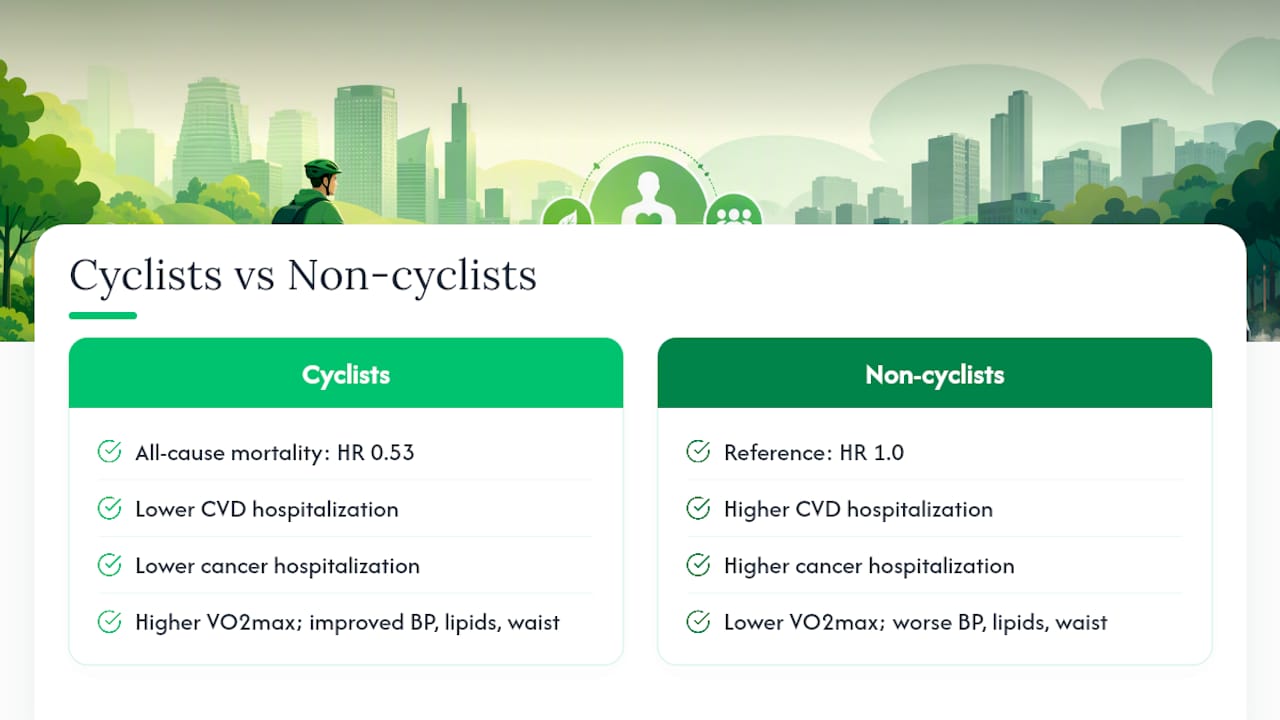
- Cohort data: shows lower mortality and fewer cardiovascular hospitalizations among habitual cyclists, though the studies lean on self-selected, mostly urban populations, and results vary by season and climate.
How Commuting by Bike Improves Physical Health
Cycling to work is moderate-intensity exercise, and moderate intensity is exactly what raises cardiorespiratory fitness over time. The same systematic review found that active commuting produced measurable improvements in VO2max, blood pressure, lipid profiles, and waist circumference, with the biggest gains showing up in people who started out inactive.
Pro Tip: If you’re new to cycling, don’t chase distance. A 20-minute ride at a conversational pace, five days a week, beats one brutal 90-minute ride on Saturday for building the fitness gains researchers actually measured.
One controlled study comparing car and bicycle commuters over short distances found that cyclists showed improved V̇O2peak and microvascular function compared to drivers making the same trip.
The dosing that matters is cumulative, not heroic. That’s the practical version of the health benefits of bike commuting: you don’t need a century ride, you need a routine one.
The BMJ Public Health cohort reinforces the long game, tying regular cycle commuting to a hazard ratio near 0.53 for all-cause mortality relative to non-cyclists, alongside lower risk of cardiovascular and cancer-related hospitalization.
Can Biking to Work Improve Your Mental Health?
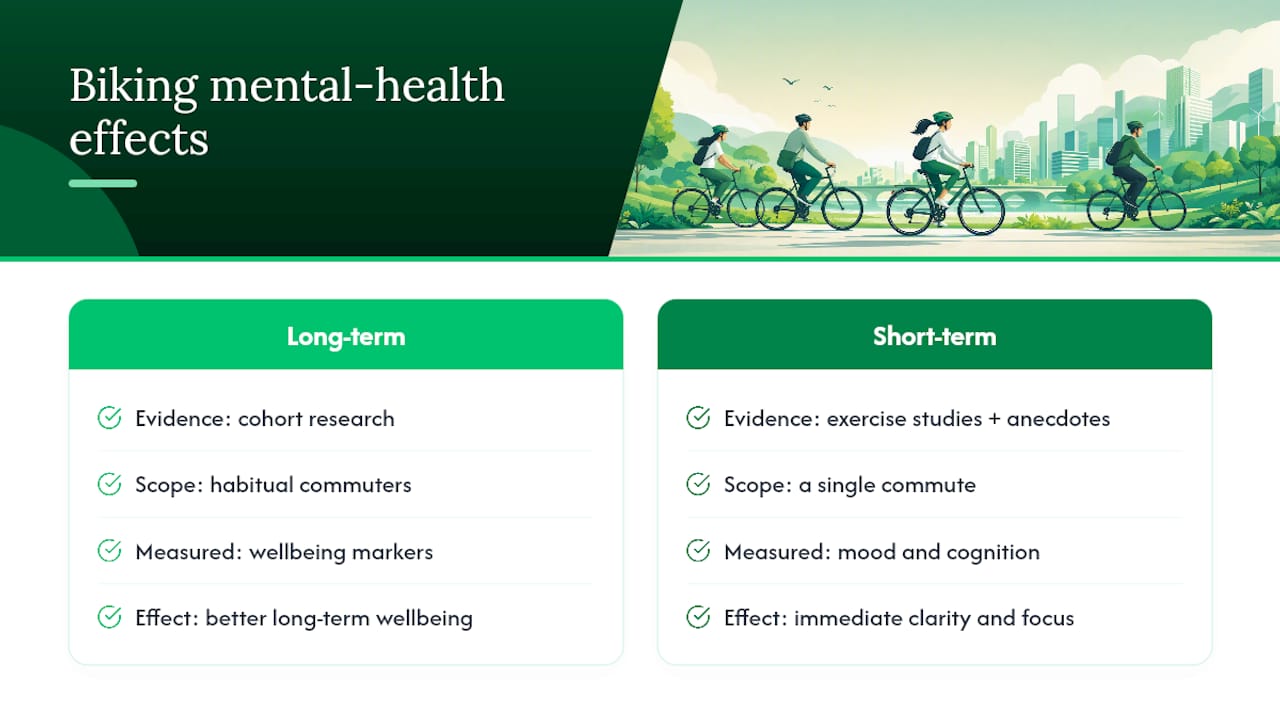
Yes, and the effect shows up in two different ways: over months, and within minutes. Cohort research associates habitual cycle commuting with better long-term wellbeing markers, which tracks with the impact of cycling on mental health seen in broader active-travel research.
The shorter-term effect is the one riders notice first: a bike commute acts as a decompression buffer between home and work, and between work and home. Moderate exercise produces immediate cognitive benefits, sharper focus and steadier mood, that a stalled bus or a jammed highway simply doesn’t offer.
Riders on cycling forums frequently describe an unexpected clarity after a ride, better awareness of their neighborhood, less mental fog at their desk. That’s anecdotal, not clinical, but it lines up with what the exercise science suggests about why cycle to work at all: the payoff isn’t only physical.
How Much Money Can You Save Cycling to Work?
The financial case is the easiest one to run numbers on yourself, and it usually favors the bike once you account for every line item, not just gas.
- Fuel and parking: disappear almost entirely for bike commuters, and downtown parking often costs more per month than a decent bike.
- Insurance and depreciation: a bike carries a fraction of a car’s ownership cost, even with occasional tune-ups and tire replacement.
- Transit fares: get replaced outright, though many riders still keep a transit pass for bad-weather days.
- Time reliability: in congested urban corridors, a bike often beats a car door to door, because it isn’t subject to the same traffic bottlenecks.
An e-bike changes the math slightly, higher upfront cost, but it extends your practical commute range and flattens hills, which matters if terrain or distance was the reason you ruled out cycling before. Secure bike parking at your workplace removes the last real friction point for a lot of would-be commuters.
What Gear and Habits Make a Bike Commute Work?
Sustainability of cycling commutes comes down to removing friction, not buying the perfect setup on day one.
- Test the route before committing. Ride it once on a weekend to find the low-traffic streets and skip the guesswork during rush hour.
- Add cheap upgrades before expensive ones. Fenders, a rear rack, and a decent light set solve more real problems than a lighter frame does.
- Plan for sweat, not around it. Panniers instead of a backpack keep your back dry, and layering clothing lets you dial intensity down on hot days without changing your entire wardrobe.
- Combine modes when the full ride doesn’t work. Bike to a transit stop, fold or rack the bike, and finish the trip by rail or bus.
Pro Tip: Keep a spare set of work clothes and a towel at your desk. It removes the daily decision fatigue that kills most bike-commute attempts in the first two weeks.
How Do Employers Benefit When Employees Bike to Work?
Workplace encouragement measurably increases active-commuting uptake, and that has downstream effects on absenteeism and morale that HR and CSR teams can point to directly.
- Facilities matter: secure bike parking and on-site showers remove the biggest practical objections employees raise.
- Incentives drive habit formation: even small per-mile sponsorships or team challenges turn occasional riders into regular ones.
- CSR gets personal: Charity Miles’s Employee Empowerment Program lets companies sponsor employee miles toward causes employees choose. HARMAN saw an 11x jump in participation after launching its program, with over 1,200 employees generating more than $120,000 for charity, and Pure Storage employees raised $130,000 the same way.
Is Cycling to Work Safe?
The honest answer is that cycling carries real risk, and pretending otherwise does readers a disservice. The BMJ Public Health cohort found cyclist commuters faced a higher relative risk of hospitalization after traffic collisions, even as their overall mortality and disease risk stayed lower than non-cyclists. Collision hospitalizations are a comparatively rare event set against the daily volume of rides, but the risk is not zero.
Route choice does more for perceived safety than most gear purchases. Low-traffic side streets and protected lanes tend to cut risk more than a better helmet or a brighter light alone, though both are still worth having. If your only viable route runs along a high-speed arterial with no shoulder, that’s a legitimate reason to look for a multimodal alternative instead of forcing the ride.
What’s the Realistic Path to Becoming a Bike Commuter?
The people who benefit most from switching are usually the ones who were least active beforehand, and the trips that convert most easily are the short, unglamorous ones: three to five miles, mostly flat, mostly predictable. Nobody needs to go all in on day one. Riding two or three days a week and driving or taking transit the rest is still a legitimate, sustainable pattern, and it’s the one that survives a bad-weather winter. Weigh the payoff against your own streets and your own schedule, not against a stranger’s Strava feed.
— Gene
Turn Your Commute Miles Into Charitable Impact
Every mile you already ride to work can quietly fund a cause you care about, no extra time, no extra effort. Charity Miles tracks your ride by GPS and pedometer and converts that distance into donations to the charity of your choice, at no cost to you.

For HR and CSR leaders, the same mechanism scales into something bigger: a private team challenge where your company can sponsor employee miles on its own terms, setting the rate, the cap, and whether donations flow to individual employee choices or a company-selected cause. It’s the same lever that helped HARMAN multiply participation elevenfold. If you’re weighing how to turn a wellness or CSR budget into something employees actually notice, start with the Employee Empowerment Program for corporations and see what a pilot team challenge could look like for your organization.
Sources
- Harvard T.H. Chan School of Public Health — Bicycling
- Health effects of active commuting to work: The available evidence before GISMO (systematic review)
- WHO — 100 reasons to cycle and walk more (PDF)
- Health effects of pedestrian and cyclist commuting: evidence from a longitudinal study (BMJ Public Health)
FAQ
Is Cycling a Good Way to Commute?
Yes. Research links regular cycle commuting to lower all-cause mortality, better cardiovascular markers, and reduced transport costs compared with driving, especially over short to moderate distances.
What Is the 75% Rule in Cycling?
Definitions of this rule vary across cycling communities, and it isn’t a standard from any of the health agencies or studies cited here, so it’s best treated as informal training advice rather than an established guideline.
Why Are Cyclists Often Described as Happier Commuters?
Cycling combines moderate exercise with a predictable, congestion-resistant commute, and cohort research ties habitual cycling to better long-term wellbeing markers, likely from the combined effect of movement and reduced commute stress.
Can Employers Encourage More Employees to Bike to Work?
Yes. Workplace facilities like secure parking and showers, paired with incentive programs such as Charity Miles’ Employee Empowerment Program, measurably increase active-commuting participation and sustain it over time.