
The best cycling challenge formats for employee engagement right now are the team distance relay, the bike-commute challenge, and a charity bike-build hybrid. Run any of them for 2 to 3 weeks, with 30 days as a common sweet spot, and make participation inclusive by counting indoor rides and letting non-cyclists convert walking or steps into miles.
TL;DR:
- The most effective formats are team distance relays, commute challenges, and charity bike-build hybrids, which should run for 2 to 3 weeks with inclusive participation.
- Tracking should include manual options, minimum ride durations of 10 to 15 minutes, and equal recognition for indoor trainer sessions to ensure fairness.
- Success metrics focus on participation rate, average miles per participant, active days, and funds raised, rather than total miles or top performance.
- Milestone updates, mid-challenge boosters, and recognition for consistency help maintain motivation and prevent drop-off around week three.
- Using private teams, flexible sponsorships, and built-in inclusivity streamlines setup and boosts employee engagement, as demonstrated by HARMAN’s 11x participation increase.
Table of Contents
- Cycling Challenge Ideas HR Teams Can Copy This Quarter
- How to Choose the Right Format and Set KPIs Leadership Cares About
- Setup, Tracking, and Safety: The Logistics Checklist
- Measuring and Reporting Impact to Leadership
- Launching and Sustaining Momentum Without Burning Out Your Team
- Charity Miles’ Employee Empowerment Program and the HARMAN Result
- Keeping Participants Motivated Once the Novelty Wears Off
- Common Problems That Derail Cycling Events and How to Fix Them
- An HR Organizer’s Fast-Win Shortcut
- Run Your Cycling Challenge Without Building It From Scratch
- Sources
Cycling Challenge Ideas HR Teams Can Copy This Quarter
You don’t need to invent a format from scratch. The formats below already work inside companies with hybrid schedules, mixed fitness levels, and leadership that wants a clean report at the end. Pick one, adjust team size and duration to your headcount, and launch.
-
Team distance relay. Split employees into moderately sized teams and set a collective distance goal. Smaller teams of this size consistently boost accountability and cross-department connection, because nobody wants to be the one dragging down a group of five colleagues.
-
Virtual route with milestones. Map a symbolic route (coast to coast, a famous cycling tour, a loop around your company’s office locations) and post updates as the team’s combined miles pass landmarks. The storytelling keeps people checking in even in week three, when motivation typically dips.
-
Bike-commute challenge with sustainability tie-ins. Track actual commute miles and estimate carbon saved versus driving. This works especially well for companies already running sustainability messaging, since it turns an abstract goal into a personal one.
-
Indoor trainer-inclusive challenge. Count smart-trainer sessions the same as outdoor rides. Employees in winter climates or without safe road access shouldn’t be locked out of full participation.
-
Multi-activity conversion challenge. Let non-cyclists log walks or runs and convert them into equivalent miles or points, using something like a cycling-to-steps conversion formula. This single rule change is often what separates a challenge with 30% participation from one with 80%.
-
Charity bike build plus ride combo. Pair a hands-on bike-build event, where teams assemble bicycles that get donated to a local cause, with a logged-mileage challenge afterward, leveraging the best CRM tools for nonprofit coordination to streamline charity partner engagement. Bike builds create a visible, emotionally memorable outcome that a leaderboard alone can’t match.
-
Consistency challenge. Reward most active days rather than total distance. This favors the person who rides 15 minutes every day over the person who does one 40-mile weekend ride and disappears.
-
Pay-per-mile sponsorship model. The company pledges a set dollar amount per mile, up to a capped total, with funds going to employee-chosen or company-selected charities.
-
Office versus office or department leagues. Run seasonal or quarterly leagues between locations or departments to build a recurring cadence rather than a one-off event. A detailed corporate bike challenge playbook can help you structure the logistics for a multi-location league.
How to Choose the Right Format and Set KPIs Leadership Cares About
Match the format to your primary objective before you match it to what looks fun. A distance relay drives engagement and camaraderie. A commute challenge drives sustainability and wellbeing metrics. A bike-build hybrid drives visible CSR storytelling. Trying to make one challenge serve all four goals equally usually waters down the result.
Once you’ve picked a lane, track:
- Participation rate: employees who logged at least one ride versus total eligible employees.
- Average miles per participant: a better engagement signal than total team miles, which top performers can skew.
- Active days per participant: rewards consistency over one-time bursts.
- Funds raised per mile: ties directly to your sponsorship budget and CSR reporting.
- Post-challenge retention: how many participants keep logging activity 30 days after the challenge ends.
Build tiered donation structures, for example $0.10 per mile up to the first 500 miles, then a bonus rate for teams that hit a stretch goal, to keep motivation climbing instead of flattening out mid-challenge.
Pro Tip: Before locking in a vendor or internal tool, ask about device sync reliability, participant privacy, reporting cadence, and how flexible the sponsorship configuration is. Those four questions eliminate most bad fits early.
Setup, Tracking, and Safety: The Logistics Checklist
Getting the rules right up front prevents half the headaches that surface in week two.
- Choose your tracking method. App-plus-wearable syncing is more reliable than manual logging, but always keep a manual entry option for employees without smartphones or GPS watches.
- Set a minimum ride duration. Rides under 10 to 15 minutes shouldn’t count toward totals; this single rule closes most of the loopholes people find when a challenge has a prize attached.
- Decide on indoor rules explicitly. State upfront that smart-trainer and stationary-bike sessions count equally to outdoor miles.
- Build in inclusivity conversions. A short walk might equal a set number of steps toward the mileage goal, and a modest bike-rental subsidy can remove the barrier for employees without a bike.
- Run a safety checklist. Recommend helmets, provide basic group-ride guidance for any in-person rides, confirm your insurance covers organized activity, and have a simple incident-reporting process ready before day one.
Programs that set minimum ride durations and reward consistency over single long efforts see fewer disputes and cleaner final numbers.
Measuring and Reporting Impact to Leadership
The numbers that matter to a CFO aren’t the same ones that motivate a participant, so track both.
- Participation rate (percent of eligible employees who logged activity) and average miles per participant tell the engagement story.
- Total donations generated, broken out by sponsorship tier, tells the CSR story.
- Consistency metrics (active days, streaks) predict whether the habit sticks after the challenge ends.
Pair a short before-and-after survey on energy and stress with two or three participant stories that align with your top metrics. A one-page impact summary with a dashboard screenshot and a three-slide executive recap usually gets read; a 20-page report usually doesn’t.
Launching and Sustaining Momentum Without Burning Out Your Team
Give yourself a 2 to 3 week prelaunch window for registration, executive sign-up, and team formation messaging. A short prelaunch runway with visible leadership buy-in materially increases early registration.
- Send a weekly leaderboard email with team shoutouts, not just numbers.
- Drop a mid-challenge booster, a bonus-mile weekend or a surprise sponsorship bump, right when energy typically sags.
- Close with a finish-line event: award reveal, total donation announcement, and a short post-challenge survey.
Low-cost incentive categories worth including: most improved, most consistent, and best team spirit. These reward effort over raw athleticism, which keeps non-athletes engaged through the finish.
Charity Miles’ Employee Empowerment Program and the HARMAN Result
Charity Miles built its Employee Empowerment Program around exactly these mechanics rather than leaving companies to assemble them from scratch.
- Private teams for intra-company challenges, keeping results internal unless shared.
- Configurable sponsorship rates, including per-mile rate, cap, and donation designation.
- Inclusive tracking that counts any movement to address conversion and non-cyclist participation.
HARMAN launched its Charity Miles team in 2021 and saw an 11x increase in employee participation, with 1,200-plus employees generating over $120,000 for charity. That’s not a hypothetical projection. It’s a real company running the same private-team, configurable-sponsorship model described above.
Keeping Participants Motivated Once the Novelty Wears Off
Week one always looks great. Week three is where challenges quietly die, and it’s rarely because people stopped caring about the cause.
Motivation drops off when the middle of a challenge feels like a grind with no visible progress. Combat that with milestone check-ins tied to your route or distance goal, not just a final tally at the end. Seeing your team pass “mile 200 of 500” feels different from wondering silently whether anyone’s still logging rides.
Recognition matters more than most organizers expect. A public shoutout for the most consistent rider, not just the fastest or farthest, tells the office that steady effort counts as much as athletic ability. This is where the “most improved” and “team spirit” award categories earn their place. They give slower or newer riders something real to chase.
Tie the mission back to the money regularly. A mid-challenge update showing the dollar total climbing does more for morale than a leaderboard of raw mileage, because it reminds people why they started logging rides in the first place. Challenge events that combine team-building with a visible outcome tend to hold participation better than fundraising drives alone.
Finally, watch for the plateau that hits around the halfway mark. A short, low-stakes booster, a bonus-mile weekend, a surprise leaderboard shuffle, a team challenge within the challenge, resets attention without asking people to do more work than they signed up for.
Common Problems That Derail Cycling Events and How to Fix Them
Most cycling challenges don’t fail because of bad ideas. They fail because of predictable logistics gaps that show up every time.
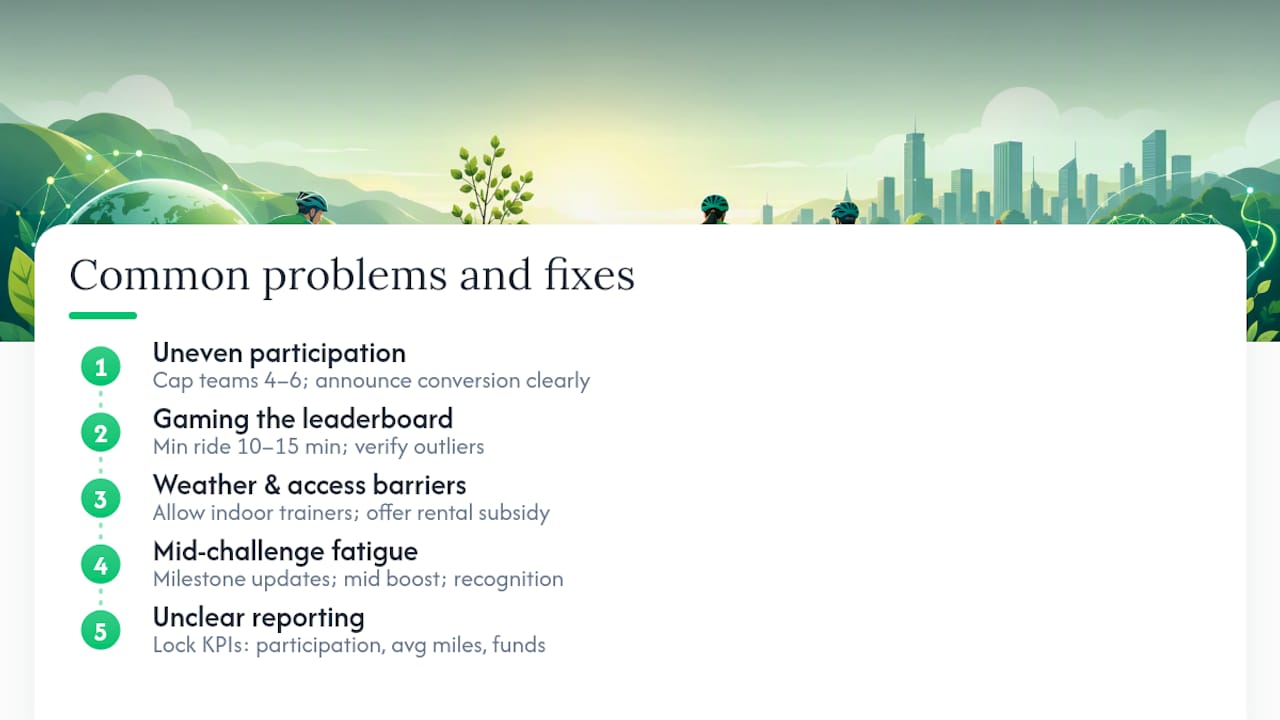
Uneven participation across departments. Some teams dive in; others barely register. The fix is usually structural, not motivational: cap team size at four to six so nobody hides in a crowd, and make sure the inclusivity conversion (steps to miles) is announced loudly, not buried in the rules page.
Gaming the leaderboard. Someone will always try to inflate numbers, whether by logging a five-minute ride as a full session or letting a device auto-track a car trip. A minimum ride duration of 10 to 15 minutes and a light manual-verification step for outlier entries close most of this gap without turning the challenge into an audit.
Weather and access barriers. Not every employee has safe roads or good weather. Counting indoor trainer sessions and offering a modest bike-rental subsidy removes two of the most common excuses for non-participation.
Fatigue by week three. This is the same drop-off covered above, and the fix is the same: milestone updates, a mid-challenge booster, and public recognition for consistency.
Unclear reporting at the end. Teams that don’t decide their KPIs upfront scramble to build a report after the fact. Lock in participation rate, average miles, and funds raised before launch, not after.
An HR Organizer’s Fast-Win Shortcut
Mandate leadership captains who pledge the first miles publicly before launch. It signals the challenge is real and worth joining.
— Gene
Run Your Cycling Challenge Without Building It From Scratch
Every format in this guide, the team relay, the commute tracker, the bike-build hybrid, works better with private teams, flexible sponsorship, and built-in inclusivity already set up, instead of stitched together across spreadsheets and three different apps. The platform offers private team challenges, a sponsorship structure configurable by the company, and reporting that converts activity data into usable leadership metrics.
If you’re weighing your options for a broader employee engagement platform, start with the best employee engagement software comparison, or go straight to the Employee Empowerment Program page to see how to set up your first private team.
Sources
- Cycling Challenges for Employees: How to Boost Wellness and Team Spirit on Two Wheels | Blog | DistantRace
- Charity Bike Builds for Corporate Teams Complete Guide 6 Wish for Wheels
- P3 Charity on the underrated power of challenge events