

CSR storytelling is the practice of turning your company’s community work into true, specific accounts of what happened, to whom, and why it mattered. Done well, it connects a volunteer day or a giving program to the people inside your company and the people outside it. Done badly, it reads like a press release and gets ignored. This guide covers what makes a CSR story credible, how to collect and tell one ethically, which numbers to pair with it, and how to make it a habit instead of a once-a-year report.
TL;DR
- A CSR story works when it is specific: a named contribution, a real outcome, and a person who was there. Vague praise carries little weight.
- Pair every story with a number, and every number with a story. Data shows scale, and stories show meaning.
- Tell stories about the strengths of the people and communities you serve, not their deficits, and get their informed consent.
- Your best storytellers are your employees. Give them an easy way to act first, and the stories follow.
- Be honest about limits. Audiences are skeptical of CSR communication, so claims you cannot back up cost you trust.
Table of Contents
- Why CSR stories matter inside the company first
- What makes a CSR story credible
- Tell stories about strengths, not deficits
- Get informed, time-limited consent
- Collect stories before you need them
- Match the story to the audience
- Which numbers to put next to the story
- Perspective: why we think action comes before the story
- A simple story format you can reuse
- Build a rhythm, not a campaign
- Give your stories something to be about
- FAQ
- Sources
Why CSR stories matter inside the company first
Most advice on CSR storytelling is aimed at the outside world: customers, investors, press. We start with employees, because they are the audience that can verify your story. They know whether the volunteer day was well run, and whether leadership showed up.
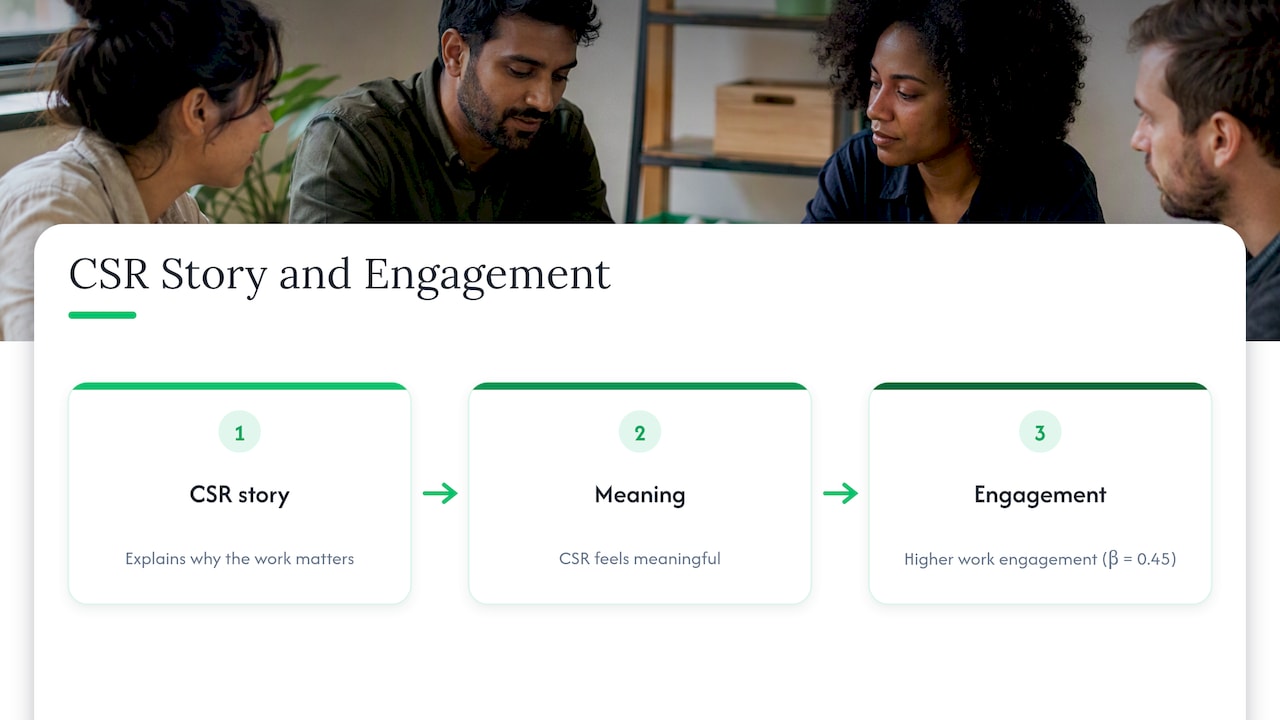
The research points the same way. A study published in 2024 on employees’ perceptions of CSR found that when people see their company’s CSR as meaningful, they report higher work engagement (β = 0.45, p < 0.001). The link runs through meaningfulness: people need to make sense of why the work matters before it shows up in how they feel about their jobs. A story is one of the fastest ways to supply that sense.
Georgetown’s Center for Social Impact Communication, which studies this field, describes effective social impact stories as ones that create emotion and drive action. Action is the point. A story that does not make someone sign up, give, or join a team has entertained them at best.
If you want the wider case for linking CSR and engagement, we cover it in our guide to corporate social responsibility and employee engagement.
What makes a CSR story credible
Credibility comes from four things. Check your draft against them before you publish.
Specificity
Psychologist Isaac Prilleltensky, quoted in guidance from the American Psychological Association, makes a point that applies directly to storytelling: broad praise such as “good job” carries little weight, while recognition that names a person’s specific contribution and its actual impact builds the sense of mattering that drives satisfaction and retention.
Compare two lines:
- “Our employees made a difference in the community this quarter.”
- “Priya from accounting organized the Saturday shift at the food pantry. Twelve colleagues packed boxes, and the pantry told us it covered the weekend gap it had struggled with.”
The second one is a story. The first is a slogan. (The example is illustrative: use real names, with permission, and real outcomes from your own program.)
A human at the center
People remember a person doing something, not an organization achieving an outcome. Put one employee, one volunteer, or one community partner in the frame, and let the larger numbers sit behind them.
Evidence you can show
A story with no data invites the question “Is that typical?” Data with no story invites “So what?” Points of Light’s guide for CSR and employee volunteer program leaders recommends combining impact data with human-centered stories for exactly this reason. Use the story to make one data point feel real, and use the data to show that the story is not a one-off.
Honesty about what you did not do
A 2025 paper in Psychology & Marketing looks at the limits of storytelling in CSR communication and investigates its potential downsides. The lesson we take from it: stories are not automatically persuasive, and an audience that senses spin can push back. Say what worked, say what you are still improving, and do not claim more than your program delivered.
Tell stories about strengths, not deficits
The fastest way to damage a CSR story is to cast the company as a rescuer. Points of Light’s guidance calls out this trap and recommends a shift from deficit framing, which dwells on what a community lacks, to asset framing, which describes people and communities by their strengths and aspirations. The same guide ties this to avoiding savior tropes and “us versus them” dynamics.
In practice, that changes how you write:
| Deficit framing | Asset framing |
|---|---|
| “Our volunteers rescued a struggling neighborhood.” | “Neighbors who had been organizing a cleanup for years invited our team to work alongside them.” |
| “Families with nothing received donations.” | “The pantry’s volunteers, many of them former clients, ran the sorting line, and our team followed their lead.” |
| “Thanks to us, kids have a future.” | “The youth program set the goal. Our employees helped fund and staff it.” |
The test is simple. Ask whether the people in the story would be comfortable reading it aloud to their own community. If not, rewrite it.
Get informed, time-limited consent
If your story features someone outside your company, a beneficiary or a partner staff member, treat it as a collaboration. Points of Light recommends what it calls informed, time-limited consent: go beyond basic paperwork so the person understands how their story will be shared and for how long, and let them review the final narrative to confirm it reflects their perspective. That moves the relationship from extraction to collaboration.
A workable checklist:
- Explain where the story will appear (website, report, internal channel, social media).
- Say how long you will use it, and when you will review or remove it.
- Show the finished draft before it goes live.
- Offer a way to withdraw, and honor it.
- Check your partner organization’s own rules before you contact anyone it serves.
This takes extra days. It also protects the people in the story and the trust you are building.
Collect stories before you need them
Most companies scramble for stories the week the annual report is due. A better approach is to build collection into the program itself.
Ask three questions after every activity
Send a short follow-up after each volunteer shift, giving campaign, or team challenge:
- What did you do, specifically?
- What did you notice or learn?
- What would you tell a colleague who has not tried it?
Three answers are enough to find a story. Follow up by phone or chat with the two or three that stand out.
Start in pairs, then widen the circle
If you run storytelling workshops for employees, a useful structure comes from a 2026 evidence-based practice initiative in healthcare. It draws on a body of evidence for narrative-based interventions such as storytelling workshops and guided writing to strengthen well-being and human connection. The setting is clinical, so adapt with care, but the principle travels: let people share a personal experience tied to a company value in pairs first, and open up to the larger group afterward. Pairs feel safer, which makes the group sharing more honest.
Keep a simple story bank
A shared document with five columns is enough: who, what happened, the measurable result, consent status, and where it has been used. When a request comes from HR, marketing, or the sustainability team, you can answer in minutes, and you avoid telling the same story three times.
Match the story to the audience
One experience can become several pieces. What changes is the emphasis.
| Audience | What they want to know | Best format |
|---|---|---|
| Employees | Did this matter, and how can I join? | Short internal post with a name, a photo, and a sign-up link |
| Executives | Is this worth funding and what changed? | One-page summary with one story and three metrics |
| Nonprofit partners | Did you respect our work and our community? | Co-written update they approve first |
| Customers and the public | Does this company mean it? | A specific account with proof, not a slogan |
| Candidates | What is it like to work here? | Employee-voiced stories on the careers page |
Notice that employees come first on the list. Stories told internally build the participation that gives you stories to tell externally. Our piece on how employee-centered CSR builds employer brand walks through that loop.
Which numbers to put next to the story
Pick metrics that match what the story claims. Three groups work for most programs:
- Participation: how many employees took part, and what share of the workforce that represents.
- Activity: hours volunteered, miles logged, dollars raised or donated.
- Outcome: what the partner organization says changed, in its words.
The third group is the hardest and the most credible. If you cannot measure an outcome, say so, and report what you can verify. Never attach a community outcome to an activity that did not cause it.
A real example from our own work shows how the pieces fit. After launching a Charity Miles team in 2021, HARMAN saw an 11x increase in employee participation, with more than 1,200 employees generating over $120,000 for charity. The number alone is impressive, but the story people tell internally is about colleagues walking at lunch and teams cheering each other on. Both belong in the write-up.
Perspective: why we think action comes before the story
We talk with HR, CSR, and wellness leaders who want better stories. Usually the problem is not the writing. It is that too few employees have done anything worth writing about, or that taking part was too hard.
Our view is that the story is a product of the program, so design the program to produce stories. That means three things.
Make the first step small. At Charity Miles, any movement counts: a lunchtime walk, a bike commute, a run. Because it is not limited to athletes, people who would never join a fitness challenge still take part, and each of them has a reason for doing it. That variety is what you want in your story bank.
Let people choose the cause. When employees pick the charity their miles support, or when the company selects one cause on purpose, the connection between action and meaning is built in. Employees tell a different story when the cause is theirs.
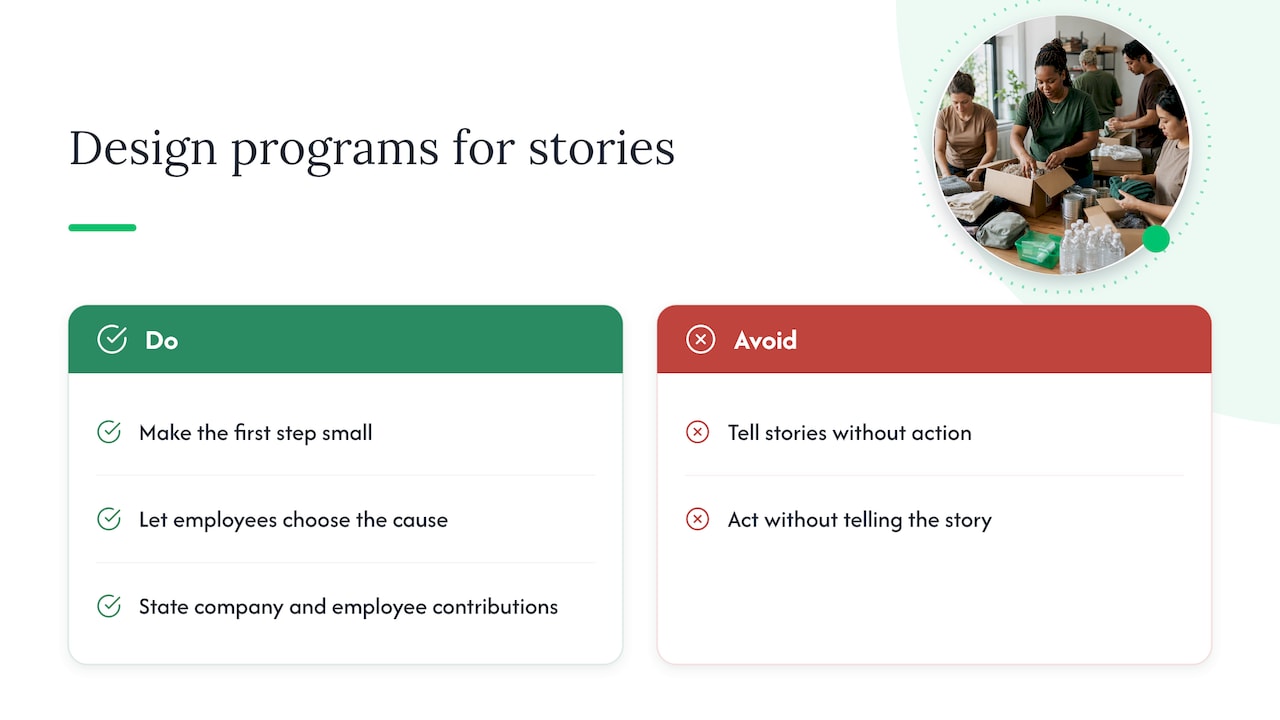
Keep the company’s role honest. Companies can sponsor employees’ miles on their own terms: the rate per mile, the total cap, and whether donations go to each employee’s charity or to a company-selected cause. We think the best stories say plainly what the company contributed and what employees contributed, and do not blur the two.
Storytelling that skips the doing reads as marketing. Doing that skips the telling gets forgotten. The two work as a pair.
— Gene
A simple story format you can reuse
When you sit down to write, a five-part structure keeps you honest and short:
- The situation. What need or goal existed, in the words of the people closest to it.
- The action. What your employees did, with names, dates, and numbers.
- The partnership. Who led, who supported, and how the community or nonprofit shaped the work.
- The result. What changed, measured or reported by the partner, with the limits stated.
- The invitation. One clear next step for the reader: join the next event, form a team, or give.
Keep most stories under 300 words. Lead with the person, not the company logo. Use the invitation every time, because a story without a next step wastes the attention it earned.
Common mistakes to avoid
- Writing in the passive voice. “Donations were made” hides the people who made them.
- Using stock imagery. Real photos of your own people, with permission, beat polished generic ones.
- Recycling one hero story. If the same employee features every quarter, others will conclude the program is for a select few.
- Skipping the quiet contributors. The person who handled logistics often has the most useful story.
- Overclaiming. If your company funded part of a project, do not describe it as the whole project.
Build a rhythm, not a campaign
Stories land best when they arrive regularly. A rhythm that works for many teams:
- Weekly: a short internal shout-out naming one person and one specific contribution.
- Monthly: one fuller story with a photo and a metric, shared with the whole company.
- Quarterly: a leadership summary with participation and outcome data, plus the strongest story.
- Annually: the CSR or impact report, built from stories you already collected and cleared.
The weekly shout-out connects to the APA guidance above: specific, detailed recognition is what fuels the sense of mattering. It also costs almost nothing, and it gives employees a reason to take part again.
For program ideas that generate material across the year, see our list of employee engagement ideas, from charity miles to volunteer days, and our overview of what employee volunteer programs actually deliver.
Give your stories something to be about
If your CSR program is hard to join, your stories will be thin. Our Employee Empowerment program is designed to solve that. Companies create private teams for their employees, run friendly challenges inside the company, and can sponsor employees’ miles on their own terms. Employees walk, run, or bike, and the app tracks distance by GPS and pedometer, so there is no manual reporting. The app is free for members and free for charities, and companies can see participation and activity data to feed the numbers half of their story. If you are also exploring brand-level involvement, our corporate sponsorship opportunities show how companies activate their communities around giving.
FAQ
What is CSR storytelling?
CSR storytelling is communicating a company’s social and environmental work through specific, human accounts instead of general claims. A good story names who acted, what they did, and what changed, and it is backed by data. It can be aimed at employees, customers, investors, or nonprofit partners.
How is social impact storytelling different from marketing?
Marketing aims to sell, while social impact storytelling aims to show what your work contributed and to invite others to take part. The overlap is risky, because audiences are wary of CSR messaging, and research has examined the downsides of storytelling in CSR communication. Keep claims modest, verifiable, and shared with the people featured.
How do I avoid sounding like we are rescuing a community?
Use asset framing: describe people and communities by their strengths and goals, and show your company as a partner following their lead. Points of Light’s guidance explains how this avoids savior tropes. Before publishing, ask the people in the story to review it.
Do employees really care about CSR stories?
The evidence suggests they do when the work feels meaningful and genuine. A study of employees’ perceptions found that perceived CSR meaningfulness predicted higher work engagement. The stories matter most when employees can see themselves in them and know how to join.
How often should we publish CSR stories?
A steady cadence beats a big annual push. Many teams share a short internal recognition weekly, one fuller story monthly, and a data-backed summary quarterly. Adjust to how much activity your program generates, and never invent a story to fill a calendar slot.
Sources
- Beyond Numbers and Basic Narratives: A Guide for CSR and Employee Volunteer Program Leaders (Points of Light)
- Bridging Employees’ Perceptions of Corporate Social Responsibility, Sense-Making for Meaningfulness, and Work Engagement (PMC)
- Employees really value making a difference at work (American Psychological Association)
- Strategic Storytelling (Georgetown Center for Social Impact Communication)
- I Do Not Buy Your Story! Understanding the Limits of Storytelling in CSR Communication
- Our Stories, Our Strength: Enhancing Healthcare Culture Through Storytelling