
The typical employee participation rate in corporate CSR programs sits at a median of 25.6%, and it’s been climbing steadily across companies that report consistently year after year. That figure varies widely by company size and industry, with smaller organizations often doubling the participation rates of large enterprises. The benchmarks come primarily from the Volunteering Quotient 2026 report, Blackbaud’s YourCause CSR Industry Review, and CECP-derived data cited by Groundswell.
TL;DR:
- Smaller companies consistently report participation rates around 48%, nearly triple those of large enterprises with over 50,000 employees, which hover around 16%.
- Building participation requires removing friction, such as offering micro-opportunities, embedding programs in onboarding, and consolidating platforms, rather than increasing budgets.
- Engaging managers in team challenges and incentivizing participation through layered rewards significantly boosts involvement quickly.
- Movement-based CSR programs like Charity Miles can increase participation elevenfold by making involvement easy, visible, and inclusive across fitness levels.
- Benchmarking results should be region-specific, as cultural differences and local norms heavily influence participation rates and program design.
Table of Contents
- What Are Current CSR Participation Rates and Trends?
- How Do You Measure CSR Participation Correctly?
- What Drives or Blocks Employee Participation in CSR?
- How Do Participation Rates Vary by Company Size and Industry?
- What Tactics Actually Raise CSR Participation?
- How Charity Miles Boosted Participation for HARMAN
- Do CSR Participation Rates Vary by Region or Culture?
- Practitioner Perspective: Framing Participation for Leadership
- How Charity Miles Helps HR Teams Raise Participation Fast
- Sources
What Are Current CSR Participation Rates and Trends?
Twenty-five percent used to be a stretch goal for CSR teams. Now it’s the midpoint. The Volunteering Quotient 2026 report surveyed 240 companies and found a median workforce participation rate of 25.6%, up from 20.1% just two years earlier.
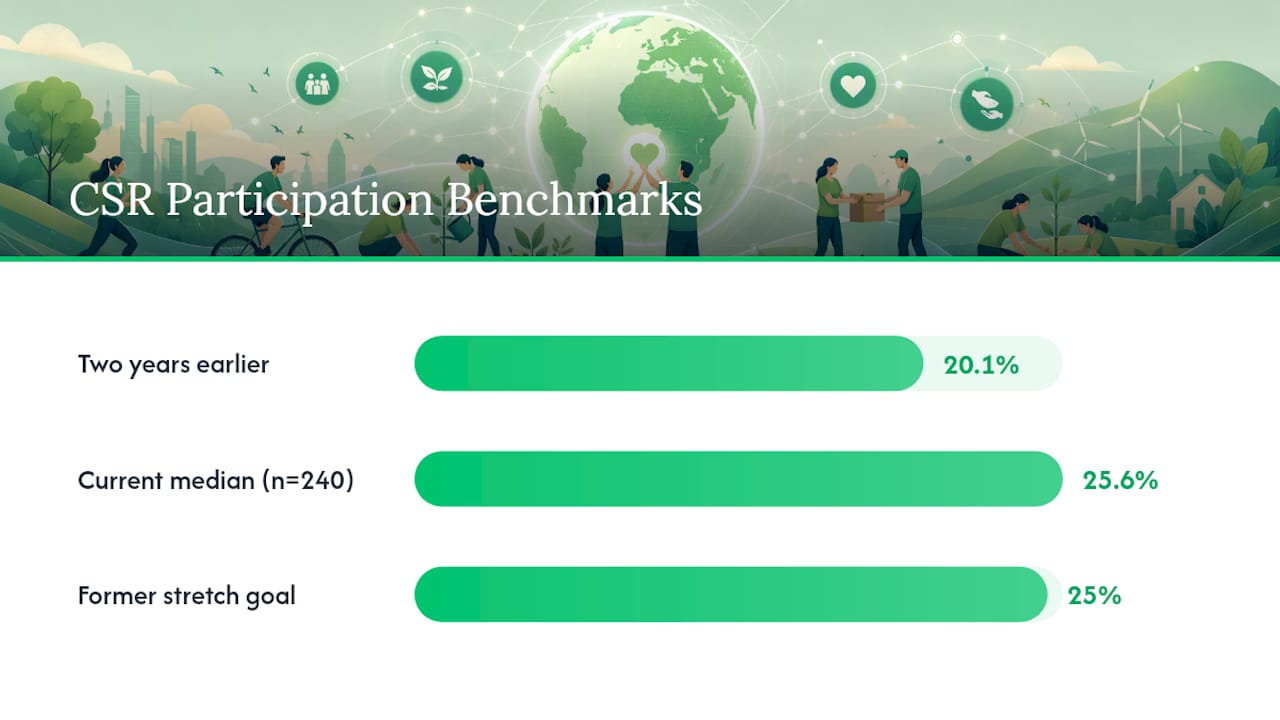
That trend line matters more than the single-year snapshot. It tells you participation isn’t a fixed ceiling, it’s a moving target that rewards programs with staying power. Blackbaud’s 14th Annual YourCause CSR Industry Review backs this up, reporting rising volunteering participation year-over-year alongside growing adoption of shorter, more flexible volunteer formats.
Participation looks different depending on what you’re measuring. Volunteering, giving, and matching each have their own adoption curve:
- Volunteer program participation: roughly 25% among companies tracked by CECP, per Groundswell’s synthesis of the data.
- Matching gift participation: closer to 21%, though 65% of Fortune 500 companies now offer a matching program in the first place.
- Volunteer grant (dollars-for-doers) adoption: offered by about 40% of large employers, though actual redemption trails offer rates significantly.
- Flexible-scheduling programs: participation jumps to roughly 43% when employees can volunteer during work hours without a formal request process.
Statistic Callout: Companies reporting consistently across multiple years saw participation climb from 22.0% to 28.6%, a 19.7% compound annual growth rate, suggesting mature programs compound their gains rather than plateauing.
One caveat worth flagging before you benchmark your own numbers against these: sample sizes and reporting frames differ across studies. The Volunteering Quotient draws from 240 companies with standardized reporting; Blackbaud’s data comes from its YourCause platform users, which skews toward organizations already running structured CSR technology. Neither is a perfect cross-section of the American workforce, so treat these as directional benchmarks, not universal law.
How Do You Measure CSR Participation Correctly?
Most confusion around participation rates comes down to sloppy math, not sloppy programs. Get the formula right and everything downstream, goal-setting, board reporting, budget requests, gets easier.
The core calculation is simple: participation rate = employees who engaged at least once ÷ total eligible workforce, expressed as a percentage. “Engaged” should mean a specific, countable action, not vague awareness of the program.
Beyond that headline number, four supporting metrics round out a credible measurement framework:
- Volunteer hours per volunteer — total hours logged divided by the number of participating employees, which shows depth of engagement, not just breadth.
- VTO (volunteer time off) uptake — the share of eligible employees who actually use their paid volunteer hours, often far lower than awareness of the benefit.
- Match redemption rate — the percentage of employees who make a donation and actually submit it for employer matching, frequently the weakest link in giving programs.
- Dollars-for-doers participation — the share of volunteers who convert their hours into a grant request, which tends to lag far behind actual volunteering.
Pick an annual reporting window if you want year-over-year trend data, or a campaign window (a giving season, a quarterly challenge) if you’re testing a specific tactic. Mixing the two inside one report is the single most common measurement mistake.
Pro Tip: Report participation rate and volunteer hours per volunteer side by side. A rising participation rate paired with falling hours per person usually means your program is getting more inclusive, not less serious, and that’s a good thing.
What Drives or Blocks Employee Participation in CSR?
Virtual volunteering, micro-opportunities that take 20 minutes instead of a full Saturday, and flexible scheduling all remove the friction that keeps busy employees on the sidelines.
Incentive structure matters just as much as access. VTO, matching gifts, and sponsored-per-action campaigns, where a company donates per mile walked or per hour logged, turn passive good intentions into logged actions. Organizational habits reinforce or undercut all of it: whether CSR gets introduced during onboarding, whether a manager visibly participates, and whether communications repeat the invitation instead of sending it once and moving on.
Common barriers show up in nearly every employee survey on the topic:
- Time constraints, especially for shift workers and remote teams without built-in flexibility.
- Poor fit between available opportunities and employee interests or skills.
- Unclear purpose, where employees don’t understand how their action connects to a larger goal.
- One-time promotion instead of ongoing visibility, so the program fades from memory within weeks.
Fix the friction and the incentive structure together, and participation tends to move fast. Fix only one, and you’ll plateau below your potential.
How Do Participation Rates Vary by Company Size and Industry?
Company size is the single strongest predictor of participation rate, and the relationship runs opposite to what most leaders expect. Smaller organizations consistently out-participate giants, not because their employees care more, but because communication travels faster and leadership visibility is higher.
The Volunteering Quotient 2026 data breaks this down cleanly by workforce size:
- Under 5,000 employees: median participation of 48.0%, the highest band in the report.
- 5,000 to 10,000 employees: participation drops into the 30% range as coordination gets harder.
- 10,000 to 50,000 employees: participation continues sliding as programs rely more on opt-in communication than direct manager contact.
- 50,000+ employees: median participation of just 16.4%, roughly a third of the smallest band.
Context changes what “good” looks like.
Industry medians tell a similar story of variation. Financial sector companies tend to have higher median participation rates compared to healthcare and technology sectors. The pattern suggests industries with more structured internal communication, like financial services, translate that infrastructure directly into higher CSR engagement.
What Tactics Actually Raise CSR Participation?
Raising participation rarely requires a bigger budget. It requires removing steps between “wants to help” and “did the thing.” The tactics below are ranked by how quickly they typically move the needle.
- Shrink the time commitment. Offer 20 to 60 minute micro-opportunities alongside full-day options. Shorter, flexible formats are seeing rising adoption precisely because they fit into a lunch break instead of requiring a day off.
- Build manager-led team challenges. Peer visibility and light competition consistently outperform top-down mandates, especially when a manager visibly participates instead of just announcing the program.
- Activate during onboarding. Employees who hear about CSR in their first two weeks form the habit early; employees who discover it a year in rarely catch up.
- Layer incentive structures. Combine VTO with a matching gift program and, where budget allows, a sponsored-per-action campaign that donates based on logged activity rather than requiring a separate ask.
- Consolidate onto one low-friction platform. Platform consolidation is a genuine accelerator for participation, since employees who need three logins and a spreadsheet request rarely finish the process.
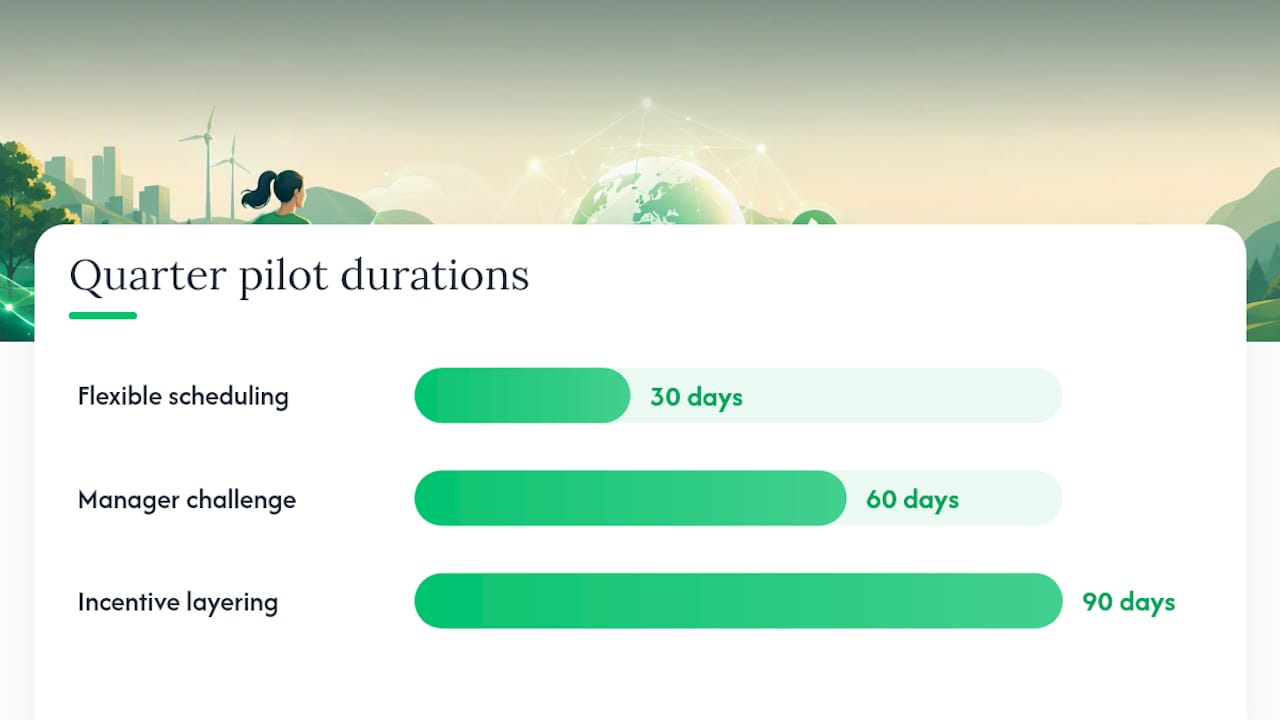
For teams that want to test before committing budget, three pilots fit inside a single quarter. A 30-day flexible-scheduling pilot in one department, measured by uptake against a matched control group. A 60-day manager-challenge pilot measured by participation rate and repeat engagement. A 90-day incentive-layering pilot that adds a match or sponsorship on top of an existing volunteer program, measured by dollars generated per participant.
Pro Tip: Momentum dies fastest right after a launch spike. Schedule a second, smaller push at the 45-day mark, a reminder, a leaderboard update, a new opportunity, so participation doesn’t collapse the moment the initial announcement fades from memory.
Explore corporate volunteering ideas built specifically to lower the time barrier that keeps otherwise willing employees from ever logging their first hour.
How Charity Miles Boosted Participation for HARMAN
Movement-based CSR sidesteps a lot of the friction that sinks traditional volunteer programs, because walking, running, or biking is something almost every employee already does. After adopting a Charity Miles team, HARMAN saw an 11 times increase in employee participation, with more than 1,200 employees generating over $120,000 for charity since the program launched in 2021.
What likely drove that jump:
- Daily visibility replaced a once-a-year volunteer event, keeping the program top of mind.
- Any fitness level could contribute, removing the “I’m not athletic enough” barrier entirely.
- Team-based challenges added light competition without requiring a big time commitment.
- HARMAN controlled its own sponsorship terms, setting the rate per mile and total budget.
Teams considering a similar pilot should track participation rate and dollars generated per employee as their two core success metrics before scaling company-wide.
Do CSR Participation Rates Vary by Region or Culture?
Participation benchmarks built primarily from American and European reporting don’t transfer cleanly to every market, and leaders running global teams need to account for that before setting a single company-wide target.
Cultural attitudes toward volunteering as an individual act versus a collective, employer-organized one shift the baseline considerably. In some regions, volunteering carries strong religious or community-organization roots and happens largely outside employer channels, which can make workplace participation numbers look artificially low even when overall civic engagement is high. In others, employer-sponsored volunteering is the primary vehicle for community involvement, pushing workplace participation rates higher by default.
Paid time off norms matter too. Countries with generous statutory vacation time sometimes see lower VTO uptake, not because employees care less, but because a dedicated volunteer day competes with an already-large leave allowance. Where vacation time is scarcer, a paid volunteer day can feel like a genuinely valuable benefit and drive higher uptake.
Regulatory and tax treatment of corporate giving also shapes program design region by region, which in turn shapes what “participation” even means locally, a matching-gift-heavy program in one market versus a volunteer-hours-heavy program in another. The practical takeaway: benchmark against your own region and industry rather than a single global median, and expect meaningfully different baselines across a multinational workforce.
Practitioner Perspective: Framing Participation for Leadership
Boards don’t care about participation rates in the abstract. They care that engaged employees are 21% more profitable, according to Gallup research, so frame the metric as a retention lever, not a feel-good number.
— Gene
How Charity Miles Helps HR Teams Raise Participation Fast
If your last CSR push produced a one-time spike and then went quiet, the problem usually isn’t effort, it’s format. Charity Miles’ Employee Empowerment Program turns everyday walking, running, and biking into a daily, visible CSR habit instead of an annual event employees forget by March. Companies build a private team, run friendly challenges, and set their own sponsorship terms, choosing the rate per mile, the total budget cap, and whether donations go to each employee’s chosen charity or a company cause.
Because any movement counts, not just athletic performance, the program includes employees a traditional 5K or step challenge often leaves out.
If your participation rate has plateaued below your industry median, request a pilot walkthrough of the best employee engagement software built for exactly this problem, and see what a 90-day movement-based challenge could do for your numbers.
Sources
- Volunteering Quotient Report 2026
- Blackbaud’s 14th Annual YourCause CSR Industry Review Reveals Resilient Employee Giving and Rising Volunteering Participation in 2025 | Blackbaud
- 24 Corporate Social Responsibility Statistics for Teams & Leaders | Groundswell
- Top CSR Statistics Nonprofits & Companies Should Know | Double the Donation
- 15 Eye-Opening Corporate Social Responsibility Statistics | HBS Online