
Authentic CSR is one of the strongest drivers of employee engagement available to HR and CSR leaders today. Research published in Frontiers in Psychology confirms that perceived CSR predicts engagement with a significant effect size (β=0.45, p<0.001), and HEC Paris data shows that organizational identification rises 32% for each additional point on a perceived CSR scale. The mechanism is not simply that employees appreciate a generous employer. It is that genuine CSR lets people bring their whole selves to work, and that authenticity is what actually moves the needle on engagement.
The distinction between substantive and symbolic CSR matters enormously here. Substantive CSR is embedded in culture and daily work; symbolic CSR is a PR exercise. Only substantive CSR reduces cynicism and drives motivation. When employees perceive CSR as a marketing move, the engagement effect disappears or reverses.
Key linkages between CSR and employee engagement:
- Authenticity: CSR enables employees to express personal values at work, which mediates engagement more powerfully than perceived organizational support (β=1.443, p<0.001).
- Organizational identification: Employees who identify with their company’s mission stay longer and contribute more.
- Work meaningfulness: CSR gives daily tasks a larger purpose, satisfying intrinsic motivation.
- Autonomy, relatedness, and competence: When CSR satisfies these three psychological needs under self-determination theory, it converts from an extra-role burden into in-role behavior.
- Movement-based philanthropy: Programs that tie physical activity to charitable giving embody all of the above, making CSR personal, visible, and daily.
Table of Contents
- How perceived CSR drives employee engagement and retention
- Why movement-based philanthropy works for wellbeing and engagement
- How to implement a movement-based CSR program that lasts
- Charitymiles in action: what the data shows
- Charitymiles: movement-based CSR built for your workforce
- Key Takeaways
How perceived CSR drives employee engagement and retention
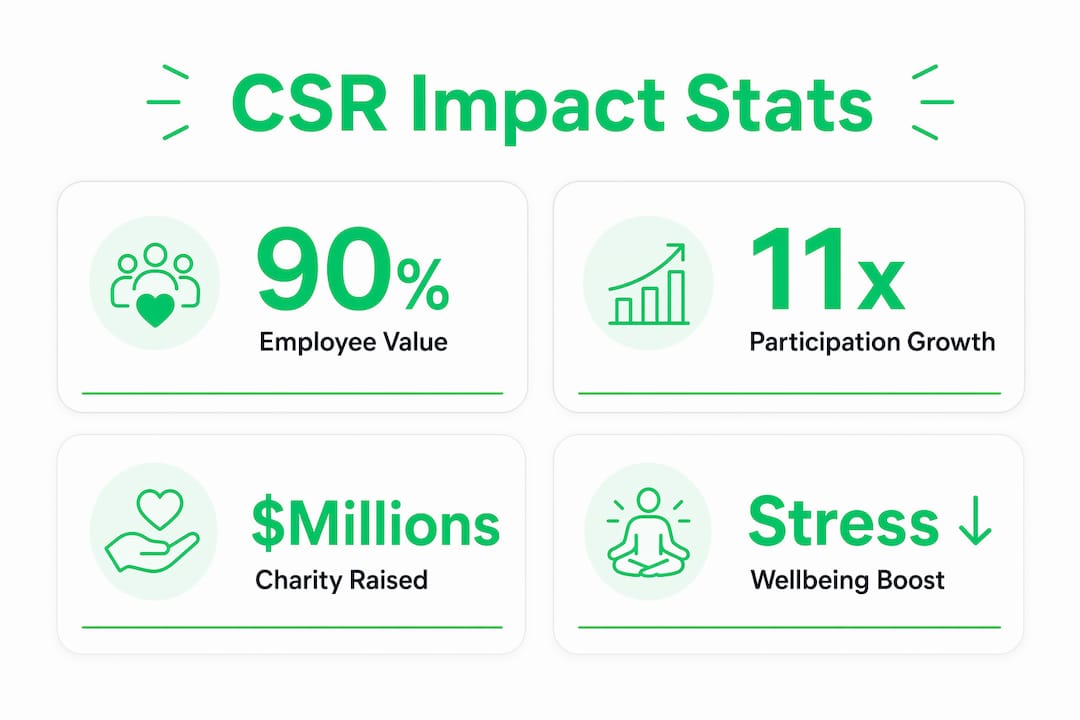
Ninety percent of employees consider their company’s CSR engagement important, yet most organizations still treat CSR as a communications function rather than an HR one. That gap is where engagement is lost. When employees never hear about CSR initiatives until the annual report drops, those initiatives cannot satisfy the psychological needs that drive engagement.

Self-determination theory explains why this matters. Employees are not passive recipients of organizational benefits. They are autonomous agents who seek meaningful connections between their work and their values. CSR that satisfies autonomy (choice of cause or activity), relatedness (shared purpose with colleagues), and competence needs converts social responsibility from an optional extra into a core part of how employees experience their jobs.
HEC Paris researchers are direct on this point: in the war for talent, genuine CSR is a competitive advantage, but only when employees are convinced the organization is serious. That conviction comes from internal communication, not external PR. Managers who model CSR involvement and HR systems that weave CSR into daily workflows produce that conviction far more reliably than a well-designed sustainability report.
Best practices for making CSR substantive and meaningful:
- Communicate CSR initiatives through channels employees actually use, such as team meetings, internal apps, and manager conversations.
- Give employees real choice in which causes or activities they support.
- Tie CSR participation to recognition, not just compliance.
- Avoid piling CSR on top of existing workloads. Embed it within the workday.
- Train managers to model and discuss CSR involvement openly.
Pro Tip: Integrate CSR messaging directly into your HRIS or intranet so employees encounter it alongside performance goals and benefits information. When CSR lives in the same system as their day-to-day work, it reads as in-role, not extra-role.
Why movement-based philanthropy works for wellbeing and engagement
Movement-based philanthropy sits at the intersection of three things employees already want: physical activity, a sense of purpose, and connection with colleagues. Programs that combine wellness, philanthropy, and team-building do not ask employees to add a new obligation to their day. They make the movement employees are already doing count for something larger.
The wellbeing case is straightforward. Regular physical activity reduces fatigue, lowers stress, and cuts burnout risk. When that activity is also generating donations for a cause the employee cares about, participation sustains itself in a way that a standard step challenge rarely does. The cause provides the intrinsic motivation that keeps people moving past the first few weeks.
Gamification and social recognition amplify this effect. Team challenges create friendly competition and camaraderie. Colleagues who walk together at lunch or compare weekly mileage build trust that carries back into their work. The result is an engagement program that strengthens culture without requiring a separate budget line for team-building events.
Key wellbeing and engagement benefits of movement-based philanthropy:
- Sustained physical activity reduces burnout and increases daily energy.
- Cause alignment gives movement personal meaning, driving long-term participation.
- Team challenges build camaraderie across departments and locations.
- Visible, measurable charitable impact reinforces organizational pride.
- Inclusive design (any movement counts) removes fitness barriers and reaches all employee groups.
Pro Tip: Launch your movement program with a company-wide challenge tied to a cause that reflects your organizational values. The shared goal accelerates camaraderie and gives leadership a natural moment to model participation publicly.
HARMAN launched its Charity Miles team in 2021 and saw 11x participation growth, with 1,200+ employees generating over $120,000 for charity. That is not a wellness metric. It is a culture metric.
How to implement a movement-based CSR program that lasts
The most common failure mode for CSR programs is the one-off event: a volunteer day, a charity walk, a giving campaign. Participation spikes and then collapses. Research confirms that CSR embedded in HRM systems, including training, incentives, and performance management, sustains participation far better than isolated activities. The goal is to make social responsibility a daily habit, not an annual highlight.
Start by aligning the program with organizational values that employees already recognize. If sustainability is a stated priority, direct sponsorship dollars toward environmental causes. If community health is central to your brand, let employees choose from a curated list of health-focused nonprofits. Value alignment is what makes CSR feel authentic rather than arbitrary.
Leadership modeling is non-negotiable. When executives and managers participate visibly, employees read CSR as a genuine organizational commitment. When only HR participates, employees read it as an HR initiative.
Design best practices for a durable movement-based CSR program:
- Offer varied activity types (walking, running, cycling) so the program is accessible regardless of fitness level.
- Set clear, transparent sponsorship terms so employees understand exactly how their miles translate to donations.
- Use configurable team challenges to maintain momentum after the launch period.
- Collect participation data and share it regularly so employees see collective impact in real time.
- Tie program milestones to recognition moments, such as a company-wide announcement when a donation threshold is reached.
Pro Tip: Use your program’s reporting dashboard to connect CSR participation data to broader HR metrics like retention and absenteeism. When you can show leadership that CSR engagement correlates with lower turnover, the program earns a permanent budget.
Employee engagement and CSR also connect directly to financial performance, but only when CSR is perceived as authentic and embedded in everyday organizational practice. That is the business case HR leaders need when presenting to the CFO.
Charitymiles in action: what the data shows
Charitymiles has been operating since 2012 and has generated tens of millions of dollars for charity through its corporate Employee Empowerment Program. The HARMAN case is the clearest available data point on what a well-run movement-based CSR program can produce.
| Metric | Result |
|---|---|
| Employee participation growth | 11x increase since 2021 launch |
| Employees active on platform | 1,200+ |
| Charitable funds raised | Over $120,000 |
| Program cost to employees | Free |
| Activity types supported | Walking, running, cycling |
Charitymiles meets every criterion for substantive CSR. Employees choose their own causes or participate in company-directed giving. Every mile is tracked and converted to a real donation. The impact is visible and measurable, not abstract. Companies control the sponsorship rate, the total cap, and the cause direction, which means the program can align precisely with existing CSR commitments. For HR leaders looking at CSR initiatives that actually move engagement metrics, that combination of employee autonomy and organizational control is rare.
The program also addresses the extra-role problem directly. Because movement happens during commutes, lunch breaks, and weekend runs, it does not compete with work time. CSR participation becomes woven into daily life rather than added on top of it.
Charitymiles: movement-based CSR built for your workforce
Charitymiles gives HR and CSR leaders a program that delivers on all three fronts: employee wellbeing, measurable charitable impact, and genuine engagement. Unlike one-off volunteer days or passive giving campaigns, the Employee Empowerment Program runs continuously, reaches every fitness level, and gives employees real ownership over the causes they support. Companies set their own sponsorship terms, run team challenges, and access participation reporting that connects directly to your CSR and HR goals.
The corporate wellness ROI case for movement-based philanthropy is clear: sustained physical activity, reduced burnout, stronger camaraderie, and a workforce that feels proud of where they work. HARMAN’s results are not an outlier. They are what happens when CSR is designed to be personal, inclusive, and daily.
Ready to see what Charitymiles can do for your team? Visit charitymiles.org/employee-empowerment-for-corporations to explore the Employee Empowerment Program and start building a CSR initiative your employees will actually participate in.
Key Takeaways
Authentic, embedded CSR consistently drives higher employee engagement, organizational identification, and retention than symbolic or extra-role CSR programs.
| Point | Details |
|---|---|
| Perceived CSR predicts engagement | Research confirms a significant direct effect (β=0.45, p<0.001) from perceived CSR to work engagement. |
| Authenticity is the key mechanism | CSR enables employees to bring their whole selves to work, which drives engagement more than organizational support alone. |
| Organizational identification rises with CSR | Identification increases 32% per additional point on a perceived CSR scale, correlating with retention and commitment. |
| Embed CSR in daily work, not events | CSR integrated into HRM systems sustains participation far better than isolated volunteer days or one-off campaigns. |
| Charitymiles delivers measurable results | HARMAN’s Charity Miles team achieved 11x participation growth and raised over $120,000 for charity since 2021. |