
The most reliable way to convert cycling to steps for a charity or corporate challenge is the calories-to-steps method: divide total calories burned during your ride by 0.05 kcal per step (the standard baseline for a 155-pound person). When calorie data isn’t available, use a MET-based formula. Both approaches capture effort, not just distance, which is what makes them fair across a mixed group of walkers, runners, and cyclists.
- Best method: Calories ÷ 0.05 = step equivalents (use when your device or app reports calories)
- Fallback: MET × duration (hours) × (weight in kg ÷ 0.05) = step equivalents
- Distance proxy: 1 mile of moderate cycling approximates a few thousand steps when neither calories nor duration data are available
- Low-friction option: Charitymiles tracks walking, running, and biking directly via GPS, so participants never need to run a manual conversion at all
Consistency matters more than precision. Pick one method, publish your assumptions, and apply it uniformly across every participant.
Table of Contents
- How to convert cycling to steps: three methods compared
- The MET formula: worked examples you can use right now
- Simple distance-based rules when you need a quick proxy
- Running the conversion fairly in your challenge
- Accuracy limits and fairness rules every organizer should know
- Key Takeaways
- Why inclusive counting changes everything for corporate challenges
- Charitymiles makes cycling count without the spreadsheets
- Useful sources for implementing your conversion
How to convert cycling to steps: three methods compared
Activity-equivalent methods exist because step counters and pedometers only register stepping motions. Cycling, swimming, and weightlifting don’t generate steps even when they burn significant energy. For a charity challenge where every mile counts toward donations, that gap has real consequences for fairness.

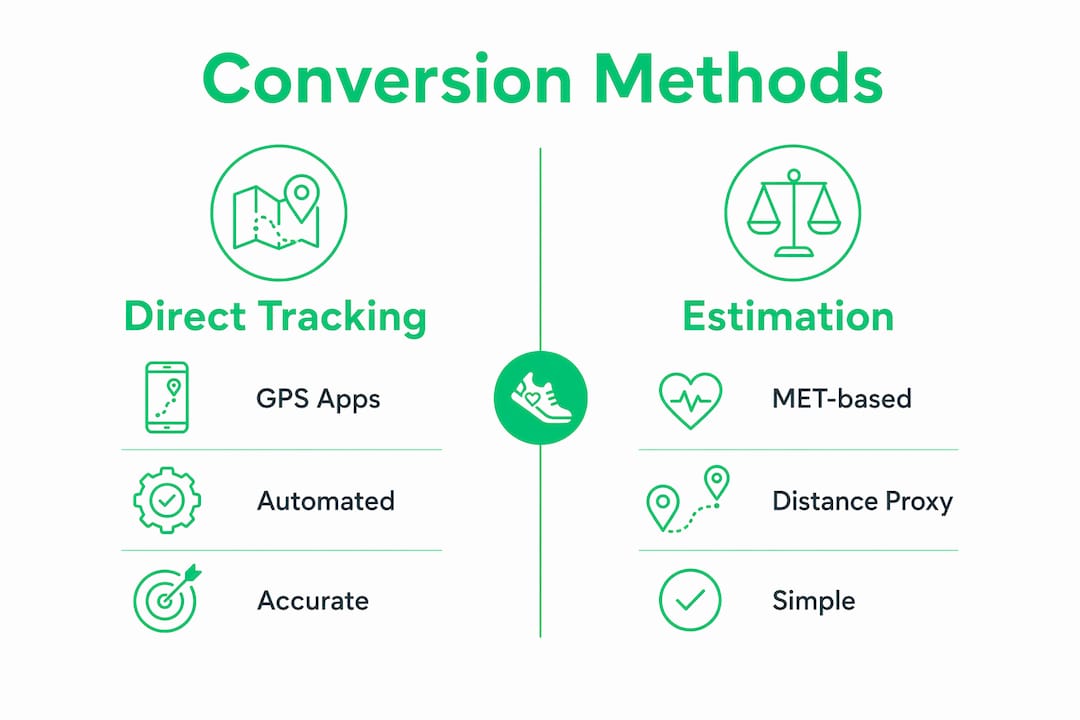
Method A: App or GPS direct tracking
Apps that log biking distance via GPS convert movement into donated miles without any manual math. This is the lowest-admin option and the most accurate for distance-based donation models. Best for enterprise programs where participants use a shared platform.
Method B: MET/calorie-based conversion
MET-equivalence compares metabolic cost across activities. Moderate cycling carries a MET of roughly 8.0, while brisk walking sits around 3.5. The ratio tells you how much harder cycling is per minute, which translates directly into a fair step equivalent. This is the gold standard when fairness across activity types is the goal.
Method C: Distance proxy
Simple steps-per-mile values by intensity. No device data required, just a ride log. Useful for volunteer-run events where collecting calorie or duration data from every participant isn’t realistic.
| Method | Accuracy | Admin effort | Participant fairness | Best for |
|---|---|---|---|---|
| GPS/app direct tracking | High | Very low | High | Enterprise, app-based programs |
| MET/calorie conversion | High | Medium | High | Mixed-activity challenges |
| Distance proxy | Moderate | Low | Moderate | Low-friction, volunteer events |
One-sentence guidance by organizer type: Enterprise teams with a shared app should use direct GPS tracking; HR teams running spreadsheet-based challenges should use the MET formula; small charities with paper logs should use the distance proxy with stated intensity bands.
The MET formula: worked examples you can use right now
The formula chain runs: MET → calories → step equivalents. Here’s the math, laid out so you can paste it directly into a spreadsheet.
| Variable | Value | Source |
|---|---|---|
| Moderate cycling MET | 8.0 | 2024 Compendium of Physical Activities |
| Calories per step baseline | 0.05 kcal | Standard for a 70 kg / 155 lb person |
| Walking reference MET | 3.5 | Compendium (moderate, 3 mph) |
Formula:
Steps = MET × Duration (hours) × (Weight in kg ÷ 0.05)
Worked Example 1: 30-minute moderate ride
- MET: 8.0, Duration: 0.5 hours, Weight: 70 kg
- Steps = 8.0 × 0.5 × (70 ÷ 0.05) = 8.0 × 0.5 × 1,400 = 5,600 steps
This aligns with calculator benchmarks showing a 30-minute moderate ride equals roughly 4,500–6,000 equivalent steps depending on the source and assumptions used.
Worked Example 2: Calories-first approach (when your device reports calories)
A rider logs 350 kcal on a 10-mile mixed-terrain ride. Using the calories-to-steps method: 350 ÷ 0.05 = 7,000 equivalent steps. This is the highest-confidence path when calorie data is available from a power meter or fitness tracker.
Spreadsheet template columns:
Participant | Ride date | Duration (min) | MET used | Weight (kg) | Calories (if known) | Step equivalents | Method used
Standardize weight at 70 kg for team aggregation if individual weights aren’t collected. Note this assumption in your reporting.
Simple distance-based rules when you need a quick proxy
When calorie or duration data simply aren’t available, distance proxies work well enough for most charity challenges. At moderate intensity, 1 mile of cycling approximates 2,100–2,400 walking steps; leisure riding drops to around 2,000 steps per mile, and vigorous effort pushes toward 2,400.
- Leisure cycling (<10 mph): about two thousand steps per mile
- Moderate cycling (12–14 mph): about 2,100–2,400 steps per mile
- Vigorous cycling (16–19 mph): about 2,400 steps per mile
Distance-only rules have real limits. Energy per mile shifts with terrain, wind, bike type, and rider weight, so a hilly 5-mile route burns meaningfully more than a flat one at the same speed. Distance-only approaches are best labeled as rough estimates, not precise equivalents.
Pilot test checklist before committing to a proxy:
- Run a two-week pilot with 10–20 participants who also have calorie data.
- Compare proxy-derived steps against calorie-derived steps for the same rides.
- Adjust your multiplier if the gap exceeds 15%.
- Cap individual daily conversions (e.g., 30,000 step equivalents per day) to prevent outlier rides from skewing team totals.
Pro Tip: Apply a 1.15× multiplier for hilly or off-road routes to account for the extra effort distance alone doesn’t capture. State this multiplier in your challenge rules before the event starts.
Running the conversion fairly in your challenge
Good rules prevent disputes. Before your challenge launches, publish a one-page document covering: the chosen conversion method, required inputs from participants (duration, distance, or calorie data), accepted devices and apps, and the logging window (e.g., activities must be logged within 48 hours of completion).
Verification options that work without burdening participants:
- GPS trace screenshots from a cycling app
- Exported activity summaries from a fitness device
- Third-party app exports (most major fitness platforms support CSV or PDF exports)
- Minimum quality threshold: rides under 5 minutes or under 0.5 miles are excluded
For reporting to charity partners and sponsors, include these fields: total participants, aggregated step equivalents, conversion method and assumptions used, total donated miles or dollars, and a breakdown by activity type if your platform supports it.
HARMAN’s experience with Charitymiles illustrates what’s possible when the program is set up well. Since launching its Charity Miles team in 2021, HARMAN saw an 11x increase in employee participation, with 1,200+ employees generating over $120,000 for charity. That kind of result comes from making every activity count, including cycling, not just walking.
For a full operational playbook, the step challenge implementation guide covers rules templates, verification workflows, and reporting structures in detail.
Accuracy limits and fairness rules every organizer should know
Cycling-to-step conversions are estimates, not clinical measurements. Participants should understand this upfront, and organizers should frame conversions as a fair common currency, not a precise physiological reading.
No universal standard exists for this conversion. Different platforms use different ratios, which is exactly why publishing your method matters. When participants know the rules were set in advance and applied consistently, they accept the estimates far more readily.
Fairness rules worth enforcing:
- Standardize on one method for the entire challenge duration. Mid-challenge changes erode trust.
- Treat e-bikes separately, or cap their contribution at the leisure cycling rate, since motor assist reduces metabolic effort.
- Set a retroactive edit policy: allow corrections within 48 hours of logging, then lock entries.
- For team aggregation, use the same weight assumption (70 kg standard) for every participant unless individual data is collected.
Clear communication is the single most effective fairness tool. A short FAQ for participants explaining why cycling counts, how the math works, and what the caps are will prevent most complaints before they start. Inclusive fitness challenge ideas that explain the “why” behind each rule consistently see higher completion rates.
This article provides general guidance for challenge design and is not a substitute for medical or clinical advice. Participants with health conditions should consult a qualified professional before setting activity targets.
Key Takeaways
Consistency of method across a challenge matters more than absolute precision in any single conversion.
| Point | Details |
|---|---|
| Use calories when available | Divide cycling calories by 0.05 kcal per step for the most accurate step equivalent. |
| MET formula as fallback | Apply MET × duration (hours) × (weight kg ÷ 0.05) when calorie data isn’t reported. |
| Distance proxy for low-friction events | Use 2,000–2,400 steps per mile by intensity band; label it an estimate and state the band. |
| Publish assumptions before launch | One method, stated upfront, applied uniformly prevents disputes and builds participant trust. |
| Charitymiles removes the math | Charitymiles tracks biking via GPS and converts movement to donated miles directly, eliminating manual conversions for corporate and charity programs. |
Why inclusive counting changes everything for corporate challenges
The debate over which conversion formula is most precise misses the bigger point. The real question is whether your challenge counts every employee’s effort, or just the ones who happen to walk.
Cycling commuters, people who prefer low-impact cardio, and employees returning from injury all move in ways that a pure step counter ignores. When a challenge excludes those contributions, participation drops, and so does the sense of shared purpose that makes these programs worth running. The MET-based approach exists precisely to solve this: it creates a common energy currency so a cyclist, a swimmer, and a walker can all contribute meaningfully to the same team total.
HARMAN’s results with Charitymiles are a useful reference point here. An 11x participation increase doesn’t happen because the formula was elegant. It happens because people felt their movement counted, regardless of how they moved. That’s the outcome inclusive measurement produces.
My recommendation: choose the method that your participants can understand in one sentence, apply it without exceptions, and communicate it clearly before day one. A challenge where everyone feels counted will always outperform one where the math is perfect but half the team opts out.
Charitymiles makes cycling count without the spreadsheets
If managing conversion formulas sounds like more work than your team has bandwidth for, Charitymiles offers a direct path. The app tracks walking, running, and biking via GPS and converts every mile into charitable donations automatically. No manual math, no spreadsheet columns, no disputes over which formula to use.
For corporate teams, the Employee Empowerment Program lets HR and CSR leaders create private team challenges, set configurable sponsorship rates, and generate reporting that goes straight to charity partners and leadership. Cycling miles count alongside walking and running miles from day one. The program is used by hundreds of companies, and the results speak for themselves: HARMAN generated over $120,000 for charity with 1,200+ participating employees.
If you’re evaluating corporate wellness programs that combine engagement, wellbeing, and CSR in one platform, Charitymiles is worth a close look. Contact the team at charitymiles.org to explore sponsorship structures and get your challenge set up.
Useful sources for implementing your conversion
These tools and references will help you build and verify your conversion approach without guesswork.
- Activity to Steps Converter (BetterLifeFitness): Enter activity type, duration, and weight to get MET-based step equivalents for 30+ activities including cycling. Use it to cross-check your spreadsheet formula.
- 2024 Compendium of Physical Activities: The authoritative MET reference for exercise science. Look up cycling intensity bands (light = 4.0 MET, moderate = 8.0 MET, vigorous = 12.0 MET) to set your challenge’s conversion table.
- Cycling to Steps Calculator (CyclingRegimen): Useful for spot-checking individual ride conversions using both calorie and distance inputs side by side.
- HTK Training intensity guidance: Practical reference for understanding MET bands and how training intensity affects calorie output, useful when setting multipliers for vigorous or hilly routes.
- Charitymiles challenge guide: The step challenge organizer guide covers how to structure inclusive challenges that count all movement types toward a shared donation goal.
When you report results to sponsors or charity partners, always cite the conversion method and assumptions used. Transparency about the inputs is what makes the numbers credible.