
A company walking club works when it is easy to join, social first and fitness second, and backed by people who show up every week. Pick a recurring lunchtime slot, name a few organizers, let any movement count, and give every mile a purpose beyond the step count. Do those four things and a walking club at work becomes a habit instead of a two-week fad.
Below we cover how to set one up, how to run a lunchtime walking challenge, how to keep people coming back, and how to connect the miles to charity so the program does more than fill a leaderboard.
TL;DR
- Pick one fixed lunchtime slot, one or two routes, and 3 to 5 organizers so the club does not depend on HR alone.
- Make the first goal social, not athletic. Any walk, any pace, any fitness level counts.
- Run a 3 to 5 week challenge to build the habit, then keep a light weekly rhythm going.
- Tie miles to a cause. Employees join for the walk and stay for the impact.
- Track it with an app so remote and hybrid staff can take part from wherever they are.
Table of Contents
- Why a walking club is the easiest wellness program to launch
- What a company walking club actually is
- How to start a walking club at work: 7 steps
- Running a lunchtime walking challenge
- Why most workplace walking clubs fade
- Put a purpose behind the miles
- Perspective: what we have learned from company teams
- Make it work for remote and hybrid teams
- Measuring whether it is working
- Where Charity Miles fits
- A first-month checklist
- FAQ
- Sources
Why a walking club is the easiest wellness program to launch
Walking needs no gym, no gear and no skill. That makes it the most inclusive option for a mixed workforce, and the health case is well established. The Physical Activity Guidelines for Americans say adults should get at least 150 minutes of moderate-intensity aerobic activity a week. A brisk 30-minute lunch walk, five days a week, covers that on its own.
Most people are not there yet. A review in the medical literature notes that only about 23% of Americans meet the aerobic guidelines, and it points to walking as a primary, accessible way to close the gap. The same paper makes a point that matters for workplaces: sedentary and isolated lifestyles tend to go together, and walking in a group addresses both.
That is the real opportunity. A walking club is not only exercise. It is a reason for colleagues from different floors, teams and time zones to talk to each other without a meeting invite.
What a company walking club actually is
It is a recurring, voluntary group walk, open to everyone at the company, usually during lunch or a mid-afternoon break. Some are strictly in person. Others are “walk where you are” clubs where each person logs their own walks and the group shares progress. Hybrid companies often need both.
There are three common formats:
| Format | How it works | Best for |
|---|---|---|
| In-person group walk | Fixed time, fixed meeting spot, led by a volunteer | Single-site offices, campuses |
| Distributed challenge | Everyone logs walks with an app, teams compete or pool miles | Remote and hybrid teams, multiple offices |
| Walking meetings | One-on-ones or small meetings held on foot | Managers who want to lead by example |
Most successful clubs mix the first two. The in-person walk builds the relationships, and the shared tracking keeps everyone else involved.
How to start a walking club at work: 7 steps
Public-sector wellness guides agree on the basics. New York City’s guide to starting a worksite walking club, for example, recommends naming group leaders, publishing a calendar, and choosing popular lunch hours of 12 to 1 pm or 1 to 2 pm for the best turnout. Here is how we would put that into practice.
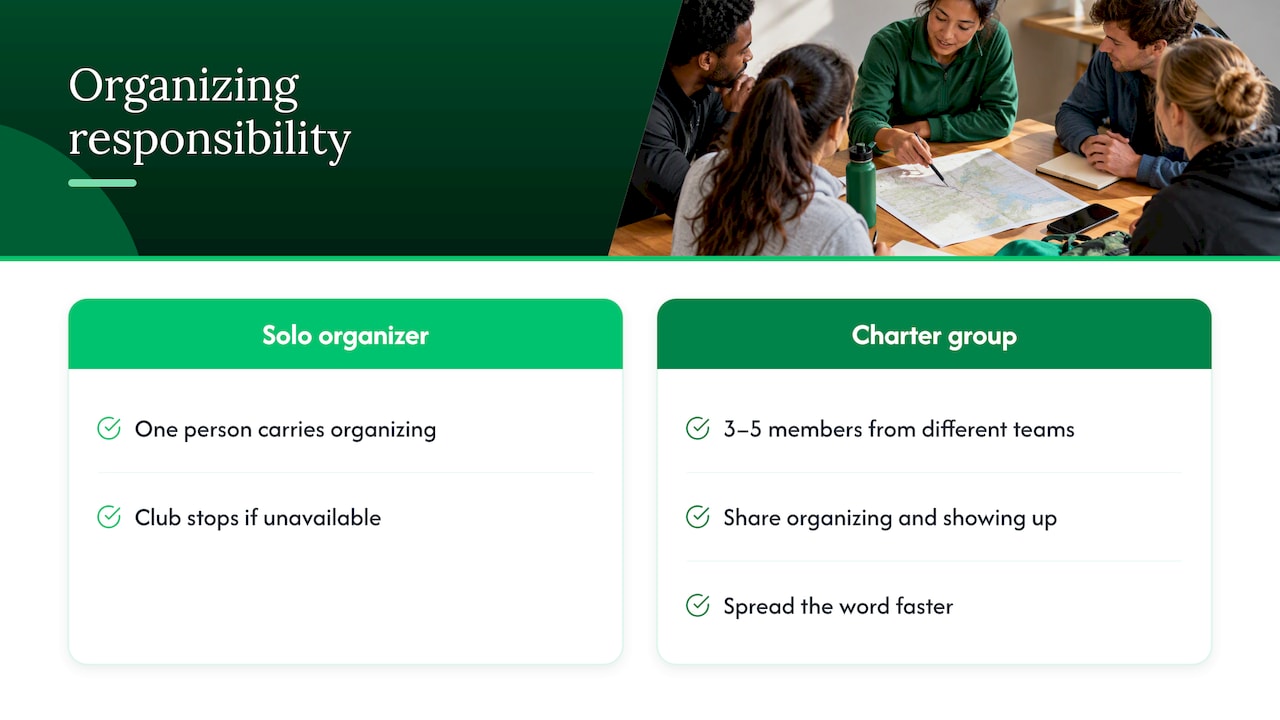
1. Get 3 to 5 charter members
One enthusiastic person is a single point of failure. When they change jobs, take vacation or get busy, the club stops. Recruit three to five “charter members” from different teams who commit to organizing and showing up. Having them in different departments also spreads the word faster than any all-hands email.
2. Get a visible leader on board
Participation rises when leadership walks too. An executive who schedules a walking meeting or joins the Thursday lap sends a clearer signal than any policy memo. The Walk with a Doc program describes this effect, noting that programs where leaders are physically present and active alongside participants change the dynamic and build social connection. You do not need a CEO every week. You need one senior person on the calendar now and then.
3. Pick a time and a route
Choose a fixed slot and keep it. Consistency beats perfect timing. Offer a short loop, around 15 to 20 minutes, and a longer one for people with more time. Scenic or interesting routes help, such as a park, a waterfront, a campus path or a historic block. Note which routes are accessible for wheelchair users and people who use walkers, and which have shade or indoor alternatives for bad weather.

If you have no safe outdoor route, a mall concourse, a parking structure’s top level or a long indoor corridor can work. Check with facilities and your insurer or safety team first.
4. Publish a simple calendar
Put the walks on shared calendars with who leads, when it starts and where it meets. A calendar lets people pick the days that suit them, and it tells anyone who missed a walk that another chance is coming. Worksite walking kits, like the one from Providence’s work-healthy program, also suggest deciding up front how often the club meets and how long each walk lasts.
5. Lower every barrier
Make the first walk so easy that nobody needs an excuse. Say clearly that comfortable shoes and normal work clothes are fine, that the pace is conversational, and that no one needs to keep up. Some people will be nervous about joining. A line such as “walk at your own pace, we will wait at the corners” does a lot of work.
6. Choose a way to track and celebrate
Step counters work, but they reward people who already move a lot. Tracking distance or minutes, and counting every kind of walking, is more inclusive. A shared leaderboard can be fun if it is team-based. Individual rankings alone tend to discourage the people you most want to reach.
7. Run a kickoff challenge
A starting event gives the club a reason to exist this month. We cover how below.
Running a lunchtime walking challenge
A lunchtime walking challenge is a time-boxed version of the club with a goal, a leaderboard and an end date. The research on habit-building points toward challenges of roughly 21 days to 5 weeks, long enough for a routine to form and short enough that people can see the finish line.
A simple five-week template:
- Week 1: Launch. Announce the challenge, open team sign-ups and hold a first group walk. Set a small, shared goal, for example a total team distance.
- Week 2: Build the habit. Encourage people to attach the walk to something they already do, like right after the lunch line or right after the noon stand-up. Pairing a new habit with an existing one makes it stick.
- Week 3: Add variety. Try a new route, a walking meeting day, or a themed walk such as a coffee walk or a pet-friendly walk for remote staff.
- Week 4: Add a stretch goal. Raise the team target or add a bonus, such as a day when leaders walk with their teams.
- Week 5: Finish and share. Celebrate totals, share stories and announce what the club does next so momentum carries over.
The key is what happens after week 5. Decide before the challenge begins that it will roll into a standing weekly walk. Otherwise, the end date becomes the end of the habit.
Keep it inclusive
A good lunchtime walking program has no entry fee, no fitness test and more than one way to win. Reward consistency, most improved, best team spirit and most miles. Let people count a walk to the mailbox, a walking meeting, a stroll with the dog or a walk with a stroller. Credibility matters here: if people think the contest belongs to the marathoners, the people who need it most will drop out in week one.
Why most workplace walking clubs fade
We see the same patterns again and again:
- They are treated as one-off events. A kickoff with free water bottles is not a program. The club has to be part of the weekly routine.
- They rely on HR alone. A mandate from the top does not create a community. Peer organizers do.
- The goal is steps and nothing else. Counting steps is a weak reason to get up from your desk on a rainy Tuesday.
- Nobody sees the point. People stay in programs when they can see what their effort achieves.
That last point is backed by research. A study on corporate philanthropy, “Familiarity matters,”, found that employees’ understanding of what a program actually accomplishes is a primary driver of their participation, while being told the company stands out in its industry can even work against volunteering. In plain terms: show the walk, not the talk. Say what the miles did.
Put a purpose behind the miles
One of the most effective ways to make that link visible is to attach donations to movement. A CDC-supported workplace demonstration tested a “Move-A-Thon” in which employees’ physical activity earned money for charity. Over two weeks, participants averaged about 9,300 steps a day, around triple the minimum needed to trigger a donation, and the authors concluded that charitable giving can work as an incentive for workplace activity. It was a small demonstration, not a guarantee, but it shows why the idea resonates.
The approach also solves a common problem. Many employees feel good about their company’s giving but never see their own role in it. When every lunchtime lap adds to a donation to a cause they chose, the walk stops being a wellness perk and becomes a small, regular act of giving.
Perspective: what we have learned from company teams
We built Charity Miles around a simple idea: movement should do some good. Members walk, run or bike, the app tracks the distance with GPS and pedometer, and money goes to a charity of their choice for every mile. The app is free for members and free for charities.
On the company side, we have watched the same thing happen in workplace after workplace. The first week is easy. The hard part is week nine. What carries a team through is not a prize. It is a sense that the club belongs to the people in it and that the miles matter.
That is why we design company programs around a few principles:
- Any movement counts. A lunchtime walk, a bike commute or a run all count, so the program fits every fitness level.
- Teams, not just individuals. Private company teams and friendly intra-company challenges give people someone to walk for and with.
- The company controls the terms. If a company chooses to sponsor employees’ miles, it sets the rate per mile, the total cap and whether donations go to each employee’s chosen charity or to a company-selected cause.
- Culture over event. A challenge should lead to a rhythm, not end in a trophy photo.
One example: since launching its Charity Miles team in 2021, HARMAN has seen an 11x increase in employee participation, with 1,200+ employees generating over $120,000 for charity. We would not promise any company that result, but it shows what happens when a movement program is woven into culture instead of run as a single event.
— Gene
Make it work for remote and hybrid teams
An office-only club leaves out many of your people. A few adjustments widen the circle:
- Use a shared tracker. When everyone logs walks in the same app, a person in Denver and a person in Atlanta can be on the same team.
- Schedule a “walk together” hour. Pick one hour when people across locations walk at once, and let them join a voice call or simply post a photo afterward.
- Share route photos. A thread of sidewalks, trails and neighborhood scenes does a lot for team connection.
- Let managers walk their one-on-ones. Phone or headset meetings are easy to take outdoors.
The American Heart Association also recommends small ways to move more during a workday, such as breaking up long stretches of sitting. Those fit neatly into a club’s weekly rhythm.
Measuring whether it is working
You do not need a complicated dashboard. Track a handful of numbers every month:
| Measure | Why it matters |
|---|---|
| Number of unique participants | Shows reach, not just the loyal few |
| Repeat participants | Shows the habit is forming |
| Participation by team and location | Reveals who is being missed |
| Total miles or minutes | A simple shared story to tell |
| Donations generated (if sponsored) | Makes the impact concrete |
| Short pulse survey | Captures energy, stress and connection in employees’ words |
Share results back with employees every month. Showing people what their miles accomplished is the strongest retention tool a walking club has.
Where Charity Miles fits
If you want a ready-made way to run this, our Employee Empowerment program lets you create a private company team, run friendly challenges, and, if you choose, sponsor your employees’ miles. You decide the rate per mile, the sponsorship cap and where the donations go. You can see how teams use it in our team spotlight, explore the details of employee empowerment for teams, or look at corporate sponsorship options. Individual employees can download the app and start logging miles right away.
Pricing for company programs is not published, so the best next step is to reach out through the program page.
A first-month checklist
- Recruit 3 to 5 charter members from different teams.
- Ask one senior leader to walk at least once in the first month.
- Pick the time, the routes and a rainy-day plan.
- Publish the calendar and a short “all paces welcome” message.
- Choose a tracking tool that works for remote staff.
- Pick a cause, or let people pick their own.
- Set a 3 to 5 week challenge and decide now what comes after it.
- Share the totals and stories at the end of each week.
FAQ
How long should a lunchtime walk be?
Fifteen to thirty minutes works for most people. Thirty minutes of brisk walking five days a week meets the 150-minute weekly aerobic target in the federal guidelines, but shorter walks still help. As the guidelines put it, some activity is better than none, so offer a short loop and a longer one.
How do we get people to join a walking club at work?
Make the first walk easy and social, and ask a respected colleague to invite people personally. Peer invitations beat mass emails. Say clearly that any pace and any fitness level is welcome, and give people a reason beyond exercise, such as a shared charity goal.
How long should a walking challenge last?
Three to five weeks is a good range. It is long enough to start forming a habit and short enough to stay exciting. Plan the next step before it ends, so the challenge turns into a regular weekly walk.
Can remote employees take part?
Yes. Use a shared tracking app so everyone logs walks wherever they are, and form teams across locations. Add a set hour when people walk at the same time and share photos or a call afterward.
Do we need a budget?
A basic club costs nothing: a calendar, a route and a few organizers. A budget helps if you want to sponsor miles for charity, provide small recognition items or use a platform to run challenges and reporting.
Sources
- Physical Activity Guidelines for Americans, 2nd edition (CDC)
- Walk with a Doc: a call to action for physician-led walking programs (PMC)
- A Move-a-thon Event: A Workplace Demonstration (CDC Stacks)
- Familiarity matters: corporate philanthropy and employee workplace giving and volunteering
- How to Start a Walking Club at Your Worksite (NYC)
- Worksite walking kit (Providence)
- Be More Active During Your Work Day (American Heart Association)