
The strongest results come from a small portfolio, not a single initiative: pair an inclusive activity challenge with matching gifts, a Volunteer Time Off (VTO) day, and a skills-based volunteering bank. That mix covers every employee’s preferred way to give, whether it’s money, time, expertise, or movement. If you’re starting from zero, pilot one campaign this quarter, a four-week team challenge with a 1:1 match and a built-in VTO day, then use the results to decide what to scale. The design checklist and measurement metrics below will get you there.
TL;DR:
- Starting with a four-week activity challenge, such as charity miles, rapidly tests employee engagement before expanding to other mechanisms.
- Matching gifts should begin at a 1:1 ratio with modest caps, increasing only during targeted campaigns like Giving Tuesday to maximize participation.
- Offering eight to sixteen paid volunteer hours annually, paired with small grants, encourages VTO usage among employees who might not otherwise volunteer.
- Movement-based giving formats outperform donation drives by including employees who have never contributed financially and scaling well in large companies.
- Legal compliance requires verifying nonprofit status, documenting processes, and involving finance or tax counsel before launching matching or grant programs.
Table of Contents
- 8 Company Giving Program Ideas You Can Launch This Quarter
- How to Design Your Program: A Step-by-Step Checklist
- What Metrics Actually Prove This Program Works
- The Legal and Tax Rules You Can’t Skip
- Why Activity Challenges Deserve a Spot in Every Portfolio
- Why Movement-Based Giving Gets Underrated in CSR Planning
- Run Your First Giving Challenge With Charity Miles
- Sources
- FAQ
8 Company Giving Program Ideas You Can Launch This Quarter
Most HR teams overthink program design and underthink program variety. CECP’s research on corporate giving shows that programs combining several participation paths, matching, payroll giving, VTO, dollars-for-doers, skills-based volunteering, and activity challenges, reach far more of the workforce than any single mechanism alone. Here are the formats worth testing first.
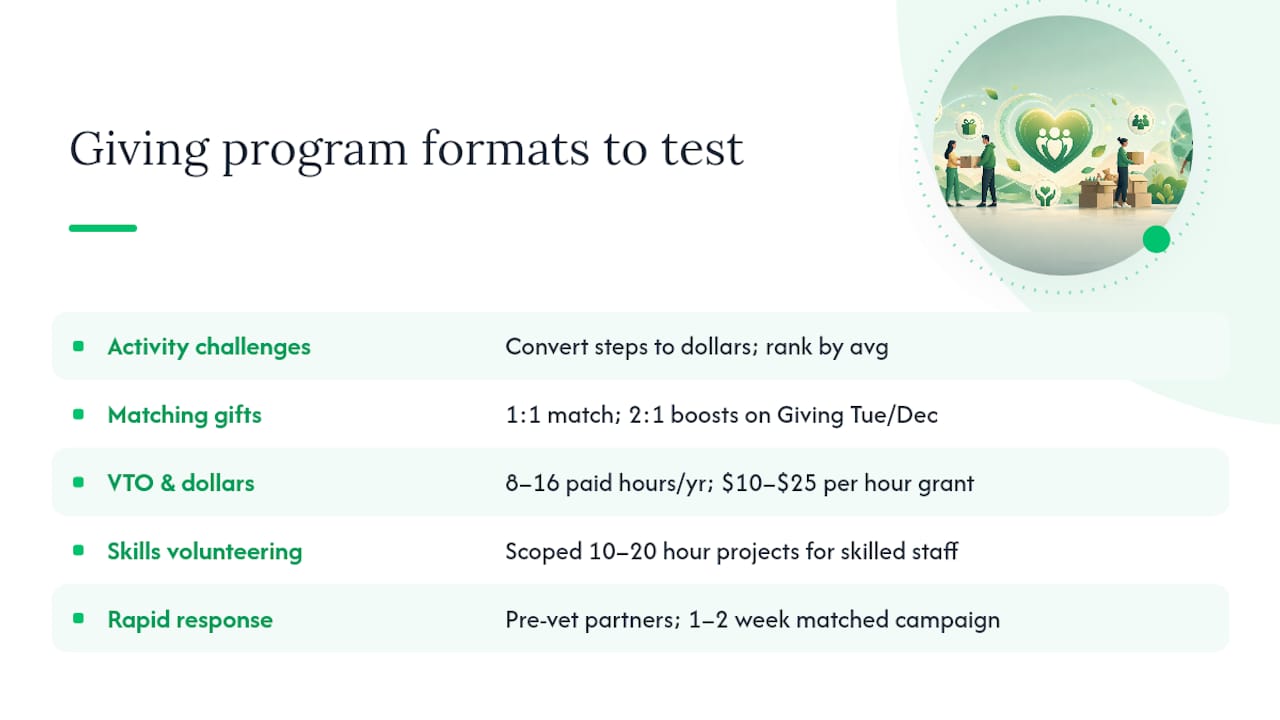
Activity-based team challenges. Walking, running, or biking challenges convert everyday movement into donations, and they’re the easiest entry point for employees who’ve never engaged with a giving program before. Design them inclusively: rank teams by average participation rate, not total miles, so a slower walker on a five-person team matters as much as a marathoner. Tools that convert steps or miles into dollars automatically remove the friction that kills participation in week two.
Matching gifts and payroll deduction. A straightforward 1:1 match up to a modest, sustainable cap per employee per year is a reasonable starting point for a first-year program; you can raise it once you see actual utilization. Boost the match to 2:1 during high-attention windows like Giving Tuesday or December, since campaign research shows time-bounded, boosted matches meaningfully lift participation compared to a flat, always-on match.
VTO and dollars-for-doers. Give employees eight to sixteen paid volunteer hours a year, with a simple manager-approval click rather than a multi-step form. Pair it with a dollars-for-doers policy that converts logged hours into a small grant, commonly $10 to $25 per hour, paid to the nonprofit once a quarter.
Skills-based volunteering. Not every employee wants to hand out water bottles at a 5K. Curate scoped projects, 10 to 20 hours, where a finance employee builds a nonprofit’s budget template or a marketer redesigns a donation page. This format tends to attract senior employees who skip generic volunteer days but will commit to a defined deliverable.
Cause-of-the-quarter voting. Let employees nominate and vote on one featured nonprofit each quarter, then build a short communications push around it: a launch email, a mid-quarter update, and a results recap. Rotating the spotlight keeps the program fresh and signals that leadership isn’t just picking causes from the top down.
Rapid-response disaster relief. Pre-vet two or three disaster-relief partners so you can activate a one-click matched-giving campaign within 24 hours of a major event, rather than scrambling to vet a nonprofit mid-crisis. Cap the match and set a clear expiration date, typically one to two weeks, to keep the response fast without becoming an open-ended budget line.
Innovation micro-grants. Open a short request-for-proposal window, two to three weeks, where employees pitch a nonprofit project for a small grant, often $1,000 to $5,000. Score submissions on community impact and feasibility, and fund three to five pilots a year rather than one large bet.
Onboarding credits and ERG-led campaigns. Give every new hire a small giving credit, say $50, to donate in their first month, which introduces the program before it competes with day-to-day work. Let employee resource groups (ERGs) run their own giving campaigns tied to their calendars, Black History Month, Pride, Disability Awareness, since those campaigns tend to generate some of the highest emotional engagement of the year.
Pro Tip: Launch your first pilot around a date employees already care about, a company anniversary, a local event, or Giving Tuesday, instead of an arbitrary Tuesday in March. Borrowed momentum beats a cold start every time.
How to Design Your Program: A Step-by-Step Checklist
Before picking mechanics, decide what you’re actually trying to achieve. A program built to boost retention looks different from one built to raise visible CSR impact for recruiting. Work through these steps in order.
- Define purpose and KPIs first. Write down whether success means participation rate, dollars raised, hours logged, or some blend, before you touch a vendor or a match ratio.
- Set eligibility rules. Decide who qualifies (full-time only, or contractors too) and require that eligible nonprofits are verified 501©(3) public charities, either through your own check or a vetted platform.
- Lock in match ratios and caps. A modest, sustainable cap you can honor every year beats a generous one you have to walk back after six months.
- Assign budget ownership. One person or team should own approval authority; ambiguity here is where programs quietly stall.
- Choose your tooling. A minimum viable pilot can run on a spreadsheet and a shared form for four to eight weeks; you don’t need enterprise software to test demand.
- Build the communications calendar. Plan a launch announcement, a midpoint reminder, a progress update, and a closing celebration, four touchpoints minimum.
- Set the pilot timeline. Spend months one and two on foundations and vendor selection, months three and four running the actual campaign, and month five reviewing results before deciding what scales.
Pro Tip: Resist the urge to launch every idea in this article at once. One well-run pilot with clean data beats three half-built programs competing for the same attention.
What Metrics Actually Prove This Program Works
Dollars raised is the easiest number to report and the least useful one on its own. A program that raises $50,000 from twelve people says something very different than one that raises $50,000 from 400.
Track these instead:
- Participation rate: unique participants divided by eligible employees. CECP’s 2025 data puts average volunteer participation at 25%, with smaller companies averaging 31% and the largest employers closer to 16%, so benchmark against companies your size, not the market leader.
- Repeat participation: what share of this quarter’s participants also showed up last quarter. This is your real loyalty signal.
- Match utilization: dollars claimed against dollars budgeted. Consistently low utilization means your cap or process is too restrictive, not that employees don’t care.
- Volunteer hours logged and converted: total hours times your dollars-for-doers rate gives you a clean grant total.
- Cost per participant: total program spend divided by unique participants, useful for comparing pilot formats against each other.
Report these fields monthly during a pilot and quarterly once the program stabilizes.
The Legal and Tax Rules You Can’t Skip
The IRS expects donation recipients to be qualified organizations, and Publication 526 is the baseline reference for what counts. Build these guardrails into your policy from day one rather than retrofitting them after an audit question:
- Require every matched nonprofit to be a verified 501©(3) public charity, either through your own documentation or a vetting platform.
- Document your approval and selection process, especially for employer-sponsored funds where a committee picks the recipient.
- Loop in finance or tax counsel before finalizing match structures, since certain employer-directed payments can raise compensation or private-benefit questions.
- Keep donor receipts, grant records, and selection-committee notes for as long as your standard financial retention policy requires.
Why Activity Challenges Deserve a Spot in Every Portfolio
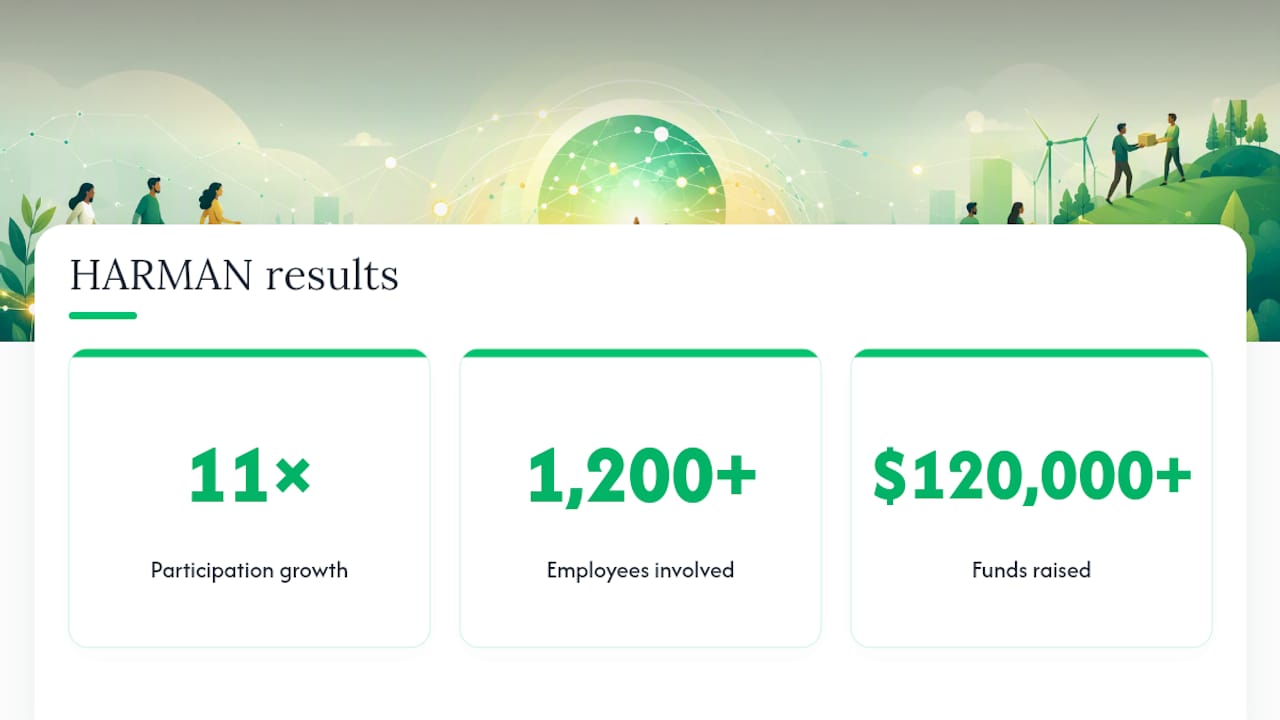
Movement-based giving works because it removes the two biggest barriers to participation: cost and time. Some employee engagement programs let companies sponsor employee miles at a customizable rate and cap, directing donations to a chosen cause or allowing employees to pick their own. When HARMAN launched its team in 2021, participation grew elevenfold, with over 1,200 employees generating more than $120,000 for charity, proof that low-friction, inclusive formats scale fast inside a broader employee engagement strategy.
Why Movement-Based Giving Gets Underrated in CSR Planning
Most CSR advice treats matching gifts as the default starting point and activity challenges as a nice extra. That ordering is backward. Matching gifts reward employees who already give, a self-selecting group that skews toward higher earners and existing donors. Activity challenges recruit people who’ve never written a check to a nonprofit in their life.
The data on company size and participation makes this concrete: smaller companies consistently out-participate large ones on volunteering, largely because smaller teams design more flexible, local options instead of one mandatory all-hands event. Large employers can replicate that flexibility by running challenges at the team level instead of the company level, which is exactly what makes an activity-based format like a walking or biking challenge scale inside a 5,000-person company as well as a 50-person one.
If you only have budget and attention for one pilot this year, don’t default to a matching-gift bump. Start with the format that gets the most people moving, literally and figuratively, then layer in matching, VTO, and skills-based options once you’ve proven engagement exists.
— Gene
Run Your First Giving Challenge With Charity Miles
Charity Miles turns everyday walking, running, and biking into charitable donations, free for every employee who joins, with your company setting the sponsorship rate and cap on your own terms. That control is the difference between a generic step contest and a giving program that actually reflects your CSR priorities.
For a first pilot, run a four-week team challenge with company-sponsored miles and a live progress tracker so employees see their collective impact grow in real time. It’s the fastest way to test participation before committing budget to a larger Employee Empowerment program. Visit the how-it-works page to see the setup process, or head to Charity Miles to start building your team today.
Sources
- Giving in Numbers: 2025 Edition (CECP)
- Giving in Numbers: 2025 press release (CECP)
- IRS Publication 526 (Charitable Contributions)
- Employee giving campaign ideas (MomoGood)
FAQ
What’s the fastest company giving program idea to launch?
A four-week activity challenge is typically the quickest to stand up because it needs no complex approval workflow, just eligibility rules and a sponsorship cap. Charity Miles’ Employee Empowerment Program lets companies configure a private team challenge in days, not months.
How much should a company match employee donations?
A straightforward 1:1 match up to a modest, sustainable cap per employee per year is a reasonable starting point for a first-year program. Many companies raise the ratio to 2:1 temporarily during high-visibility windows like Giving Tuesday to drive a short-term participation spike.
How many volunteer hours should VTO programs offer?
Eight to sixteen paid hours per year is a typical range for a Volunteer Time Off policy. Pairing VTO with a dollars-for-doers grant, often $10 to $25 per hour logged, gives employees a financial reason to actually use the time.
What’s a good participation rate benchmark for a giving program?
CECP’s 2025 data shows average volunteer participation around 25%, with smaller companies closer to 31% and the largest employers nearer 16%. Use company size as your benchmark reference point rather than a single industry-wide target.
Do employer-matched donations need to go to 501©(3) organizations?
Yes, IRS guidance expects matched recipients to be qualified public charities, and companies should verify status and keep records before releasing matching funds. Consult finance or tax counsel before finalizing your matching policy to avoid compensation or private-benefit issues.