
A fast way to run a movement-based charity team challenge that is inclusive, measurable, and CSR-friendly is an app-tracked program that converts employee miles into donations. Some platforms let any employee log a walk, run, or bike ride and turn it into a real contribution. You get built-in inclusivity, clean reporting for your CSR team, and a proven lever for employee engagement.
TL;DR:
- App-based challenges that convert employee miles into donations are most effective when set with clear sponsorship rules, fixed caps, and transparent charity options.
- Inclusive formats like adaptive movements, non-movement tracks, and flexible participation options help sustain engagement across diverse employee mobility levels.
- Running challenges over four weeks or a quarter with mid-point incentives and leadership visibility maintains momentum and broad participation.
- Tracking success with simple KPIs such as total miles, participation rate, and total funds raised makes CSR reporting transparent and impactful.
- Employers should treat movement challenges as ongoing culture builders rather than one-off events, emphasizing participation and inclusion for sustained results.
Table of Contents
- 10 ready-to-run movement-based charity challenge ideas
- How to design a challenge that is inclusive, measurable, and fair
- Engagement tactics and timelines that keep people moving
- Measurement and CSR reporting leaders actually need
- Client proof: enterprise capabilities behind the results
- Creative non-movement-based challenges for teams who want variety
- Theme-based challenges that keep motivation high
- Choosing the causes and charities your challenge supports
- Building collaboration and friendly competition into the format
- Using social media to extend the challenge’s reach
- What successful team challenges tend to have in common
- What most companies get wrong about these programs
- How Charity Miles helps you run these challenges
- Sources
- FAQ
10 ready-to-run movement-based charity challenge ideas
Once you have decided to run an app-based challenge, the next question is which format fits your workforce. Here are ten templates that HR and CSR leaders use, each with a quick setup note and an inclusivity check.
- Daily mile pledge: employees commit to a small daily distance, and the company matches every mile with a fixed donation; works well for a low-effort entry point for new participants.
- Team mileage relay: teams combine individual distances toward one shared goal, like “reach 1,000 miles together,” which spreads pressure across the group instead of resting on a few strong performers.
- Walk-the-country: teams plot a symbolic route (say, coast to coast) and watch their combined miles move a marker along it, giving the challenge a visual story employees can follow.
- Charity mile sprints: short, themed mini-weeks (a “Heart Health Week” or “Clean Air Week”) keep a longer challenge fresh by giving participants a new reason to log miles every few weeks.
- Family and friends extension: employees invite household members to join their team’s total, which widens participation without adding headcount pressure on the office roster.
- Active commute month: biking or walking to work earns bonus miles, rewarding a habit many employees already have and tying the challenge to everyday routines rather than extra workouts.
- Hybrid remote versus office challenge: teams are balanced across locations so remote and in-office employees compete on equal footing, which matters as hybrid work becomes the default setup for many companies.
- Inclusive movement challenge: steps, wheelchair pushes, and other adaptive movement types all count toward the same goal, so mobility differences never become a barrier to entry.
- Fundraising leaderboard: miles convert into dollars raised, and the top teams get public recognition, adding a competitive layer on top of the philanthropic one.
- Mileage-for-good: the company sets an organization-wide milestone (say, 10,000 combined miles) and releases a fixed donation once the group hits it, which rewards collective effort rather than individual ranking.
Each format can run through the same private-team structure, so you are not rebuilding infrastructure every time you want to try a new theme. The choice mostly comes down to how much competition your culture rewards and how spread out your workforce is. A corporate step challenge built around steps alone is a fine starting point, but adding mileage-based formats gives you more ways to keep the program feeling new across a full year.
How to design a challenge that is inclusive, measurable, and fair
Before you launch, a few decisions determine whether the challenge runs smoothly or creates confusion halfway through.
- Set goals and a timeline first: pick a business goal (participation rate, dollars raised, engagement score) and match it to a timeframe, whether that is a 4-week sprint or a full quarter.
- Choose your sponsorship structure: decide on a per-mile rate, a company match, or a fixed donation tied to a milestone, then set a spending cap and decide whether funds go to each employee’s chosen charity or a company-selected cause.
- Build in fairness and inclusion rules: allow multiple movement types (walking, wheelchair use, cycling), set a reasonable verification window for logging activity, and offer accommodations for employees with limited mobility so no one is excluded by design.
- Explain the tracking mechanics up front: most apps use GPS and pedometer data to log distance, so tell employees plainly what is tracked and what is not before they opt in.
The CDC’s employer guide on workplace physical activity recommends setting reasonable individual and organizational goals and monitoring progress throughout the program, which is exactly the discipline a well-run challenge needs. The same guide also notes that apps and wearables tend to boost initial engagement, but their effect on long-term behavior change is mixed, so plan to refresh your themes and formats rather than running the identical challenge indefinitely.
Pro Tip: Publish your sponsorship rules (rate, cap, charity options) before launch day so no one is guessing how their miles turn into dollars.
Engagement tactics and timelines that keep people moving
Participation tends to follow a predictable arc: a strong launch, a mid-challenge dip, and a wrap-up that either builds momentum for next time or lets it fade.
- Launch phase: get a senior leader to log the first miles publicly, hold a short kickoff event, name team captains, and push the challenge through both email and internal social channels.
- Mid-challenge phase: introduce a themed week, drop in a surprise mileage boost or small prize, and consider a joint event with a community partner to keep energy up when interest naturally softens.
- Wrap-up phase: share a simple impact report, hold a short recognition moment for top teams and top individual contributors, and invite everyone to pledge continued participation before the next challenge.
A 4-week sprint works with light staffing, usually one coordinator and a handful of team captains. A full-quarter challenge needs more planning around mid-point content and probably a small budget for prizes. The CDC’s Active People, Healthy Nation employer tools point to walking clubs, active-commute incentives, and multi-channel communication as reliable ways to build that culture of movement, which maps directly onto the launch and mid-challenge phases above.
Measurement and CSR reporting leaders actually need
A challenge only helps your CSR story if you can report on it cleanly. Keep the KPI list short enough that anyone on your team can explain it in one sentence.
- Total miles logged across all participating teams.
- Participating employees and the participation rate against total headcount.
- Dollars raised overall and dollars raised per participant, which helps compare challenges of different sizes.
HARMAN’s Charity Miles team saw an 11x increase in employee participation, with more than 1,200 employees generating over $120,000 for charity since the program launched in 2021. That single case shows how far participation and dollars raised can move once a program is woven into daily routines rather than run as a one-off event. Shareable outputs like a simple dashboard, a short team highlight, and a charity receipt give your leadership team something concrete to point to when they talk about culture and recruiting.
Client proof: enterprise capabilities behind the results
Some programs give companies private teams, sponsorship-rate controls, donation caps, and options for directing funds to a company cause or employee-chosen charities, all supported by GPS and pedometer tracking. Those controls matter because an enterprise program needs predictable costs and clean reporting, not open-ended pledges. HARMAN’s experience after standing up its Charity Miles team in 2021, an 11x jump in participation and more than $120,000 raised from over 1,200 employees, shows what those controls look like in practice at scale. For HR and CSR teams, the combination of sponsorship control, charity choice, and built-in tracking is what turns a wellness idea into something finance and leadership can both sign off on.
Creative non-movement-based challenges for teams who want variety
Not every team wants to log miles, and a movement-based program can sit alongside a creative one without competing for attention. A reading challenge where employees log books or pages toward a team total works well for a knowledge-driven culture, with a small donation tied to each milestone. A cooking challenge, where teams share recipes tied to a cause (say, dishes from a region the charity serves), adds a personal, sensory angle that a mileage log cannot. An art or photography challenge, where employees submit work around a theme and colleagues vote, gives creative employees a way to contribute without ever lacing up a shoe.

These formats work best as a companion track rather than a replacement, since the core CSR story mid-year probably still centers on the measurable, trackable mileage data. But offering a non-movement option signals that the program is not only for the already-athletic crowd, which matters if your workforce includes people managing injuries, caregiving responsibilities, or simply a preference for indoor activities. Running both tracks in the same quarter, with a shared leaderboard for overall team points, keeps the whole company inside one story instead of splitting attention across separate initiatives.
Theme-based challenges that keep motivation high
A theme gives a challenge a reason to exist beyond “walk more.” Health-awareness months (heart health, mental health, cancer research) are an easy starting point because they already carry public recognition and often line up with a charity partner’s own calendar. Seasonal themes, like a “Fall Fitness Push” or “New Year Reset,” tap into motivation people already feel at that time of year rather than fighting against it.
Company-milestone themes work differently: tying a challenge to an anniversary or a product launch turns the event into part of company history rather than a generic wellness push. Whatever theme you choose, keep the connection between the theme and the cause explicit. A challenge branded around mental health should send its donations to a mental health charity, not an unrelated cause, or the alignment falls apart and the messaging feels tacked on.
Choosing the causes and charities your challenge supports
The simplest approach is to let each employee direct their own miles to a charity of their choice, which tends to boost personal investment because people are raising money for something they already care about. The alternative is a company-selected cause, which concentrates the impact into one visible number and works well when the company wants a single, tellable story for its CSR report.
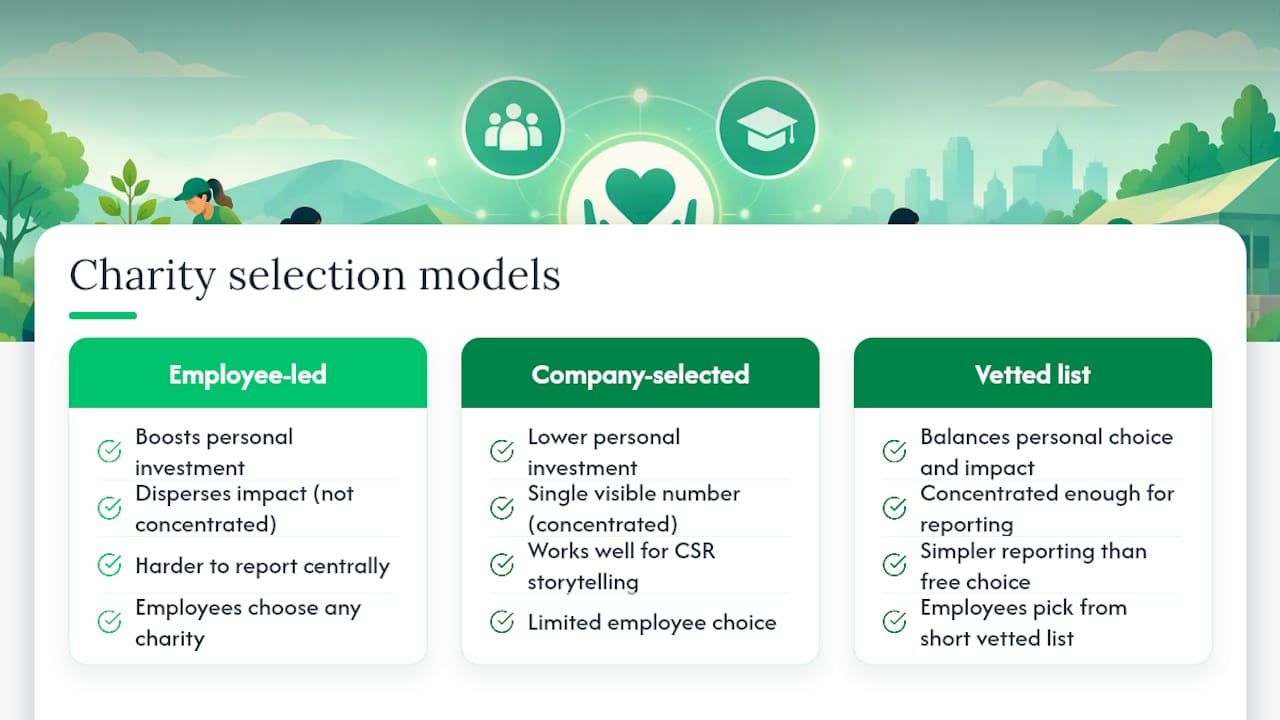
A middle path many companies use is a short list of vetted charities tied to a broader mission (education, health, environment) that employees choose from, which balances personal choice against reporting simplicity. Whichever model you pick, confirm the charity can actually receive and report on the donation type your platform generates, and be transparent with employees about where their miles are going before they log a single one.
Building collaboration and friendly competition into the format
Teams move more when they move together, and the structure of the challenge should encourage that rather than leave it to chance. Assigning team captains gives each group a natural cheerleader and a point of accountability for keeping momentum going through the middle weeks. A visible leaderboard, updated at least weekly, turns individual effort into shared stakes since no one wants to be the reason their team slips a rank.
Balancing teams by department, location, or tenure (rather than letting people self-select) tends to produce closer competition and pulls in people who might otherwise sit out. Small, low-stakes prizes for milestones, not just the final winner, keep teams that are behind early still engaged through the last stretch. The goal is friendly pressure, not a leaderboard so competitive it discourages employees who are new to regular movement.
Using social media to extend the challenge’s reach
Internal social channels do most of the heavy lifting during a workplace challenge, since a quick post from a team captain or a leader logging their morning run does more to normalize participation than any formal announcement. Short weekly recaps, posted where employees already spend time, keep the challenge visible without requiring a dedicated communications push.
For companies that want external visibility, a public post sharing overall team totals or a milestone (crossing a combined mileage mark, for instance) turns an internal wellness effort into a recruiting and employer-brand story. Tagging the charity partner in that post, when appropriate, also gives the cause its own visibility boost, which nonprofits often appreciate given how much they depend on grassroots attention.
What successful team challenges tend to have in common
The clearest example of scale is HARMAN’s Charity Miles program, which saw an 11x increase in employee participation and generated more than $120,000 for charity after the company set up its team in 2021. What stands out in that result is not the total dollar figure alone, but the participation jump, since a program that pulls in more employees tends to keep generating results well past its first quarter.
Smaller programs follow the same pattern at a different scale: a clear goal, a sponsorship structure employees understand from day one, and a format flexible enough to include people who would never call themselves athletes. The common thread across successful challenges is that movement becomes a habit tied to the company’s culture, not a one-time event that fades once the prizes are handed out.
What most companies get wrong about these programs
The biggest mistake we see is treating a charity team challenge like a single event instead of an ongoing part of company culture. A four-week sprint that never returns teaches employees that the program was a one-off perk, and participation the second time around is almost always lower than the first.
The second mistake is over-indexing on competition. Leaderboards are useful, but a program built entirely around ranking teams against each other quietly excludes the employees who are new to movement or managing a health limitation, exactly the people workplace wellness programs are supposed to reach. Inclusive rules, adaptive movement options, and a non-movement track for people who want to participate differently are not nice-to-haves, they are what makes the participation numbers hold up over multiple rounds.
If you take one thing from this, prioritize the sponsorship structure and inclusion rules before you pick a theme. Themes are easy to swap out. A sponsorship model employees do not trust, or rules that quietly leave people out, are much harder to fix once the program has already launched.
— Gene
How Charity Miles helps you run these challenges
Charity Miles’ Employee Empowerment Program gives you private teams, sponsorship controls, and donation caps in one setup, so you are not building tracking or reporting from scratch. Companies choose the per-mile rate, set a spending cap, and decide whether funds go to each employee’s chosen charity or a cause the company selects.
- See the mechanics for yourself on the Charity Miles app page.
- Request program details through the Employee Empowerment program page.
FAQ
What is the easiest charity team challenge to start with?
A daily mile pledge with a simple company match is the easiest format to launch since it requires no special equipment and lets any employee participate from day one. Apps like Charity Miles handle the mileage tracking automatically through GPS and pedometer data, so setup is mostly deciding the match rate and cap.
How long should a workplace charity challenge run?
Most programs run either a 4-week sprint or a full-quarter challenge, depending on how much staffing and content you can commit to sustaining momentum. The CDC’s employer guide recommends setting a clear goal and monitoring progress throughout, whichever timeline you choose.
How do you make a movement challenge inclusive for employees with limited mobility?
Allow multiple movement types, such as wheelchair pushes and adaptive activity, to count toward the same team goal instead of restricting the challenge to running or walking. Offering a non-movement track, like a reading or creative challenge, gives employees another way to contribute if physical activity is not an option for them.
What results have companies seen from app-based charity challenges?
HARMAN’s Charity Miles team saw an 11x increase in employee participation, with more than 1,200 employees generating over $120,000 for charity, after launching its program in 2021. Results vary by company size and how the sponsorship structure is set up, but sustained participation tends to follow programs that run as an ongoing part of company culture rather than a single event.
Who controls how much money is donated in an app-based challenge?
The company sets the sponsorship structure, including the per-mile rate or fixed donation amount and the total spending cap, before the challenge launches. Charity Miles lets companies choose whether funds go to each employee’s chosen charity or to a single cause the company selects.