
The most effective approach for corporate teams combines a hands-on build or donation drive with a recurring fitness-for-good challenge and at least one virtual format for distributed employees. That blend delivers an immediate emotional payoff, sustained daily participation, and measurable CSR outcomes your leadership team can actually report. For the scalable, ongoing layer, Charitymiles is the recommended platform: it converts employee movement into real charitable donations, runs as a private team challenge, and requires zero logistics overhead from HR.
- Pick your format and timeframe now. Choose one hands-on event (bike build, meal pack, donation drive) for a high-energy kickoff, then layer a multi-week Charitymiles fitness challenge to sustain momentum beyond the event.
- Run a pilot before you scale. Launch a private Charitymiles team challenge or a 90-minute in-person build with one department first. HARMAN did exactly that and saw an 11x increase in employee participation, with 1,200+ employees generating over $120,000 for charity.
Table of Contents
- What are the best charity team-building activities for corporate groups?
- Why does charity team building outperform standard volunteering?
- How do you choose and plan the right charitable team-building activity?
- What does the logistics plan actually look like?
- How do you measure impact and report it to stakeholders?
- How does the Charitymiles Employee Empowerment Program work at scale?
- Key Takeaways
- The case for making this a system, not an event
- Charitymiles makes recurring philanthropic programs easy for HR
- Useful sources and further reading
What are the best charity team-building activities for corporate groups?
The strongest programs draw from five categories. Each serves a different logistical reality and team goal, so knowing which format fits your situation is half the planning work.
Hands-on builds and donation drives
These are the highest-emotion formats. Teams assemble bikes, pack meals, or build care kits for a named recipient group, and the physical act of creating something for someone else creates a shared memory that generic social events rarely match. Build-A-Bike has distributed tens of thousands of bikes globally, giving you a concrete scale reference when pitching the concept internally.
- Bike builds: Groups of 10–200; 2–3 hours; low physical demand, fully accessible with seating options.
- Meal packing: Groups of 20–500; 2–4 hours; standing work, but adaptable for mixed mobility.
- Donation drives (books, hygiene kits, school supplies): Any size; 1–2 hours of collection plus a packing session; fully inclusive.
Cost shape: vendor-facilitated builds run $75–$150 per person; self-organized donation drives can cost under $20 per person in supplies.
Service projects and community fixes
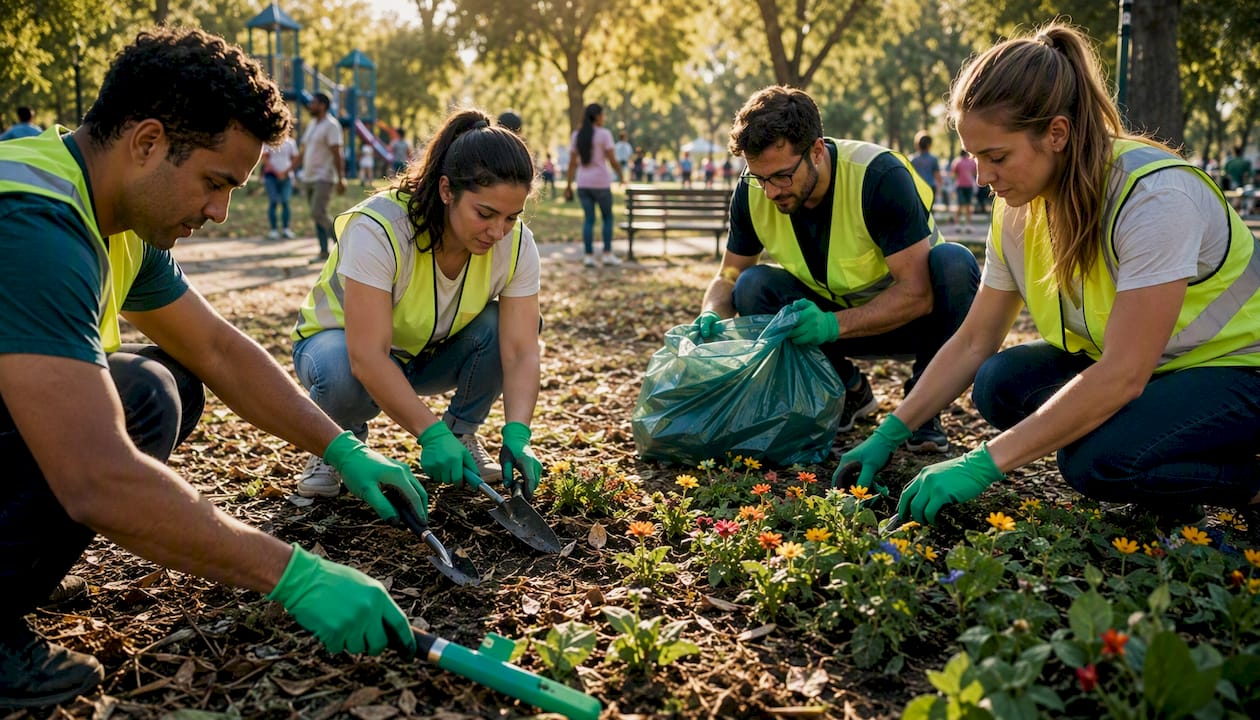
Habitat for Humanity builds, park cleanups, school garden installations, and food bank sorting shifts put teams in the community doing physical work. These require nonprofit coordination and, for construction-adjacent tasks, liability waivers. Ideal for groups of 15–60 who want a half-day outdoor experience.
Skills-based volunteering and mentoring
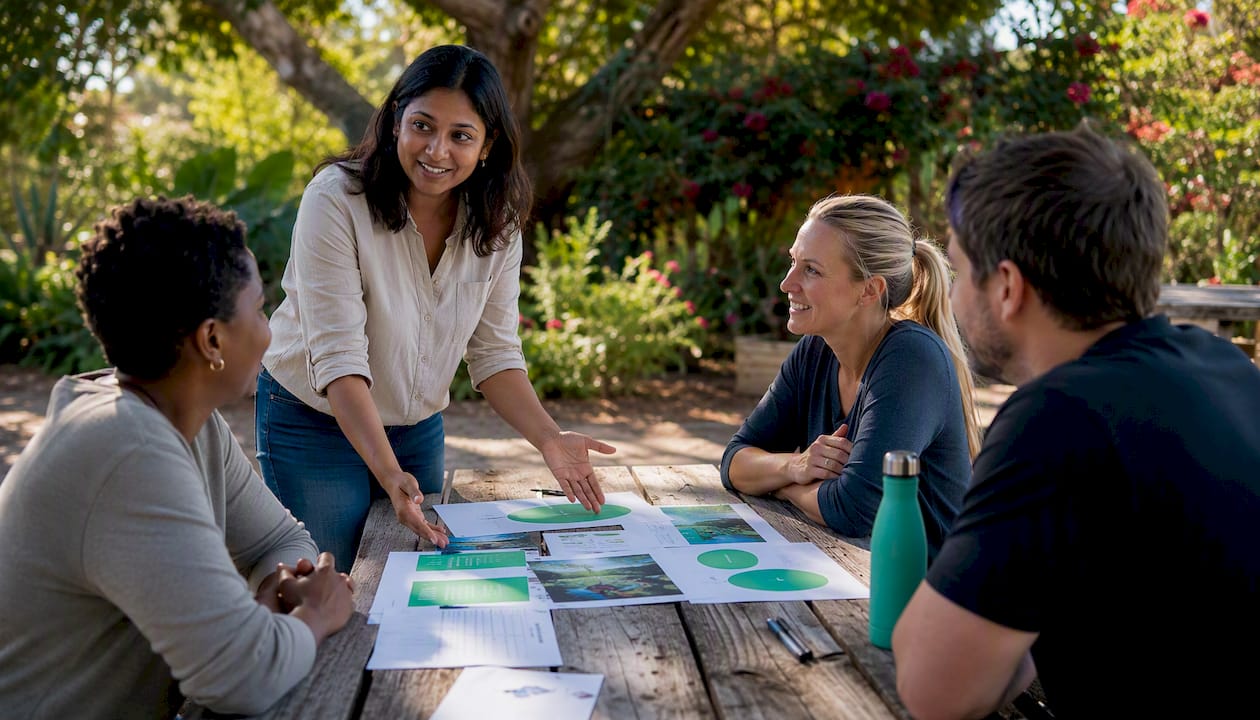
Teams contribute professional expertise: marketing workshops for nonprofits, financial literacy sessions for community organizations, or mock-interview coaching for job seekers. This format works especially well for knowledge-worker teams who want their skills to create impact, not just their labor. Groups of 6–20; 2–4 hours; fully remote-compatible.
Creative giving
Story campaigns, mural projects, and card-writing drives for veterans or hospital patients. Lower logistical complexity, high personal meaning. Works for any group size and is one of the most accessible formats for employees with physical limitations.
Virtual volunteering and remote-friendly formats
Online fundraising campaigns, virtual tutoring, digital content creation for nonprofits, and remote donation drives all work for distributed teams. The key is building in synchronous touchpoints (a kickoff call, a midpoint check-in) so the experience feels shared rather than solo. Pair with a virtual fundraising format to keep remote employees as engaged as in-person participants.
Fitness-for-good and step or mile challenges
This is where Charitymiles fits most naturally. Employees walk, run, or bike on their own schedule; the app tracks miles and converts movement into donations. A corporate step challenge structured this way runs for 4–8 weeks, scales to any team size, and requires no venue or vendor logistics. It is the most inclusive format available: a lunchtime walk counts the same as a 10-mile run.
Pro Tip: Pair a one-day hands-on build with a four-week Charitymiles fitness challenge that starts the same week. The build creates the emotional anchor; the challenge sustains participation and keeps the cause visible long after the event.
Why does charity team building outperform standard volunteering?
Philanthropic team building produces stronger, more durable outcomes than either generic social events or standalone volunteer days because it combines shared purpose with skill transfer and measurable impact. Participants leave with a concrete memory of what they built together, not just a pleasant afternoon.
The behavioral evidence supports this. Practitioners report that participants in philanthropic team building experience roughly 40% higher stickiness in behavioral change post-session compared to traditional training. The mechanism is straightforward: a shared mission creates an emotional anchor, and reflection exercises at the end of the session cement the lessons back in the workplace context.
40% higher behavioral stickiness post-session is the practitioner-reported difference between philanthropic team building and conventional training formats, attributed to the emotional anchoring effect of shared mission work.
Organizations that integrate philanthropy into corporate culture on a recurring basis see a 5x better culture shift compared to companies that run one-off events, according to research summarized by Magnovo. The word “recurring” is doing the heavy lifting there. A single bike build is memorable; a bike build followed by a four-week fitness challenge followed by a quarterly volunteer day starts to reshape how employees think about their company’s values.
Additional benefits HR can report to leadership:
- Empathy and perspective shift: Working alongside community members or building something for a named recipient group expands employees’ frame of reference in ways that classroom training cannot replicate.
- Retention signal: Employees who feel their company acts on its stated values are more likely to stay. Leadership participation signals organizational commitment and measurably increases program credibility.
- CSR metric generation: Every activity produces reportable outputs (items built, hours volunteered, dollars raised, miles logged) that feed directly into ESG and CSR reporting.
How do you choose and plan the right charitable team-building activity?
Start with the outcome you actually need, not the activity that sounds most impressive. A team that needs a morale reset after a difficult quarter benefits most from a high-emotion hands-on build. A distributed team trying to build connection across time zones needs a virtual or fitness-for-good format with built-in social touchpoints. Matching format to outcome is the single most important planning decision.
Selection checklist
Before committing to any activity or vendor, confirm:
- Values alignment: Does the cause connect to your company’s stated mission or existing charity partnerships?
- Accessibility: Can every employee participate, including those with physical limitations or remote locations?
- Optional participation policy: Practitioners consistently advise making participation voluntary and offering multiple involvement formats to maximize authentic engagement.
- Measurement and reporting: Can the vendor or platform provide impact outputs (items built, recipients served, dollars raised, miles logged) for your CSR report?
- Nonprofit partner reliability: Is the organization vetted, financially transparent, and experienced with corporate groups?
- Budget and time fit: Does the format work within your per-head budget and available calendar window?
Questions to ask any nonprofit or vendor
- What impact metrics do you provide, and in what format?
- Who handles insurance, liability waivers, and safety planning?
- What staff support do you provide on the day?
- What is the minimum lead time for booking?
- Can you accommodate hybrid groups (some in-person, some remote)?
Red flags that should stop the deal
- No impact metrics or post-event reporting offered.
- Mandatory participation with no opt-out path.
- Vague logistics or no named point of contact for day-of issues.
- No liability coverage or waiver process for physical activities.
Pro Tip: Survey employees on cause preferences before selecting a charity partner. A two-question poll takes five minutes and dramatically increases buy-in because employees feel heard before the program launches.
What does the logistics plan actually look like?
Good logistics planning is what separates a memorable event from a chaotic one. Build your checklist around these categories:
- Venue and supplies: Confirmed space, tables, tools, or materials; accessibility accommodations confirmed in writing.
- Transportation: Carpooling plan or transit guidance for off-site events.
- Insurance and waivers: Required for construction-adjacent builds and outdoor service projects; confirm with your legal team at least three weeks out.
- Food and safety: Dietary accommodations, first aid kit, emergency contacts on site.
- Volunteer background checks: Required when working with minors or vulnerable populations; build four to six weeks of lead time into your timeline.
- Communications plan: Pre-event email series, day-of instructions, and a post-event story or photo share.
Roles to assign before the day:
- Organizer: Owns the full checklist and vendor relationships.
- Nonprofit liaison: Single point of contact with the partner organization.
- Volunteer leads: One per group of 15–20 participants to keep energy up and answer questions.
- Photographer or communications lead: Captures content for internal storytelling and CSR reporting.
- Executive sponsor: Attends and participates visibly; this single factor has an outsized effect on overall participation rates.
Three sample agendas
60–90 minute virtual volunteering session
- 0:00 Kickoff call: context on the cause, team introductions (15 min)
- 0:15 Parallel work: digital content creation, virtual tutoring, or online fundraising sprint (45–60 min)
- 1:15 Debrief and impact share: what we accomplished, what it means (15 min)
- Cost: low (staff time only for most formats)
Half-day in-person build + reflection
- 9:00 AM Welcome and cause briefing from nonprofit partner (30 min)
- 9:30 AM Build activity (bike assembly, meal packing, care kits) (2.5 hours)
- 12:00 PM Reflection circle and photo share (30 min)
- 12:30 PM Lunch and informal debrief
- Cost: medium ($75–$150 per person for vendor-facilitated builds)
Multi-week fitness-for-good challenge (Charitymiles platform)
- Week 1: Kickoff email, team setup on Charitymiles app, goal announcement
- Weeks 2–3: Midpoint leaderboard share, peer encouragement post, optional team walk event
- Week 4: Final push communication, impact summary (miles logged, dollars generated)
- Week 5: Celebration post with total impact figures and employee spotlights
- Cost: low to medium depending on company sponsorship rate per mile; see fitness challenge ideas for format variations
How do you measure impact and report it to stakeholders?
The metrics that matter most depend on your primary goal, but every program should track at least participation rate and one impact output. Here is the full set to consider:
- Participation rate: Percentage of eligible employees who took part.
- Hours volunteered: Total across all participants.
- Items built or donated: Bikes assembled, meals packed, kits filled.
- Dollars raised or generated: Fundraising totals or sponsorship-converted donations.
- Miles or steps logged: For fitness-for-good programs.
- Pre/post engagement score: If you run a pulse survey before and after, even a single-question score is useful.
Reporting cadence
Publish a one-page impact summary within 48 hours of the event while the energy is fresh. Follow up with a quarterly digest that ties the activity to org-level KPIs (engagement score movement, retention data, CSR report inputs). Effective providers supply measurable impact reporting as a standard deliverable; if your vendor cannot provide it, that is a planning gap to close before the next event.
Reference figures for your internal business case
| Metric | Figure | Source |
|---|---|---|
| Culture shift improvement | 5x better for recurring vs. one-off programs | Magnovo / McKinsey-style research |
| Post-session behavioral stickiness | ~40% higher than traditional training | Odyssey Teams practitioners |
| HARMAN participation increase | 11x since launching Charitymiles team | Charitymiles Employee Empowerment Program |
| HARMAN total donations generated | $120,000+ for charity | Charitymiles Employee Empowerment Program |
| Build-A-Bike global distribution | 75,000+ bikes delivered | Build-A-Bike |
How does the Charitymiles Employee Empowerment Program work at scale?
Charitymiles has been converting movement into charitable donations since 2012, generating tens of millions of dollars for charity across its platform. The corporate Employee Empowerment Program layers a private team challenge on top of that foundation, giving HR a configurable, measurable program rather than a one-off event.
Here is how it works in practice:
- Private team setup: HR creates a company team; employees download the free app and join.
- Configurable sponsorship: The company sets its own rate per mile, total sponsorship cap, and whether donations flow to each employee’s chosen charity or a company-selected cause.
- Gamification: Leaderboards, team challenges, and friendly competition drive sustained participation without requiring HR to manage day-to-day engagement.
- Reporting: The platform tracks miles logged, dollars generated, and participation rates, giving HR the data they need for CSR reporting and internal storytelling.
- Inclusivity: Any movement counts. A lunchtime walk, a bike commute, a weekend run. No fitness threshold, no equipment required.
The HARMAN result is the clearest proof point available. Since launching their Charitymiles team in 2021, HARMAN saw an 11x increase in employee participation, with 1,200+ employees generating over $120,000 for charity. That outcome came from consistent program design: a clear company sponsorship structure, regular internal communications, and leadership participation that modeled the behavior they wanted to see.
For hybrid teams, the platform is particularly well suited: remote employees participate on equal footing with office-based colleagues because the app works anywhere. There is no venue to book, no travel to coordinate, and no participation cliff when the event day ends. To see how improving employee engagement through movement-based giving works in practice, the FE Fundinfo case study offers a useful parallel to HARMAN’s experience.
Key Takeaways
The most durable charity team-building programs combine a high-emotion in-person event with a recurring fitness-for-good platform, measured outcomes, and consistent internal storytelling to sustain momentum beyond any single activity.
| Point | Details |
|---|---|
| Match format to outcome | Hands-on builds deliver emotional payoff; fitness-for-good challenges scale inclusively across hybrid teams. |
| Require impact reporting | Prioritize vendors and platforms that provide participation rates, items built, and dollars generated for CSR reporting. |
| Make participation optional | Voluntary programs with multiple involvement formats consistently produce higher authentic engagement than mandatory ones. |
| Embed storytelling and follow-up | Share a one-page impact summary within 48 hours; tie results to org KPIs in a quarterly digest to sustain momentum. |
| Use Charitymiles for scale | The Employee Empowerment Program helped HARMAN achieve 11x participation growth and $120,000+ in donations with no venue logistics required. |
The case for making this a system, not an event
Most companies treat philanthropic team building as an annual checkbox. Run the bike build in November, share the photos, move on. That approach produces a warm memory and very little lasting change.
What actually shifts culture is repetition with reflection. A quarterly volunteer day anchored to a monthly fitness challenge, with leadership visibly participating and internal communications that name the impact, creates a feedback loop employees can feel. The 5x culture shift figure cited from recurring programs versus one-off events is not magic; it is the compounding effect of employees seeing their company act on its values more than once a year. The storytelling layer matters just as much as the activity itself. When an employee sees their name on a leaderboard, reads that their team logged 2,000 miles last month, and learns that those miles generated $800 for a cause they care about, the connection between their daily behavior and the company’s stated mission becomes concrete. That is the mechanism behind sustained engagement, and it is available to any HR team willing to build the system rather than just book the event.
Charitymiles makes recurring philanthropic programs easy for HR
Charitymiles’s Employee Engagement Solution gives HR teams a turnkey way to run a recurring fitness-for-good program without the venue logistics, vendor coordination, or one-off event fatigue that comes with traditional charitable activities.
The Employee Empowerment Program includes a private team challenge, configurable company sponsorship (you set the rate per mile and the total cap), and built-in reporting so you can show participation rates and dollars generated in your next CSR update. Three reasons HR teams choose it:
- Measurable CSR ROI: Every mile logged produces a trackable donation, giving you concrete impact figures for leadership and ESG reporting.
- Higher participation and wellness: Because any movement counts and the app is free for employees, participation rates stay high across all fitness levels and locations.
- Turnkey for hybrid teams: No venue, no travel, no logistics overhead. Remote and in-office employees participate on equal footing from day one.
Ready to see what a pilot looks like for your team? Explore the best employee engagement apps and program options, or reach out to Charitymiles directly to configure a private team challenge that fits your timeline and CSR goals.
Useful sources and further reading
- Charitymiles Employee Empowerment Program — Program mechanics, HARMAN case study figures, and corporate sponsorship options.
- Charitymiles: How It Works — Overview of the app, movement-to-donation model, and corporate team setup.
- Philanthropic Team Building: What It Is (And Why Fortune 500 Companies Choose It) — Research-backed case for recurring programs over one-off events, including the 5x culture shift finding.
- Philanthropic Team Building: The Ultimate Guide to Impactful Corporate Culture — Practitioner guidance on behavioral stickiness, emotional anchoring, and agenda design.
- Philanthropic Team Building: Strengthening Bonds While Building a Better World — Practical advice on leadership participation and empathy-building outcomes.
- Charity Team Building Activities — Vendor perspective on measurable impact reporting and activity formats.
- Build-A-Bike Team Building Events — Scale reference for hands-on build programs; 75,000+ bikes distributed globally.
- Why Every Company Should Invest in Philanthropic Team Building — Nonprofit perspective on the community and culture benefits of purpose-driven team events.